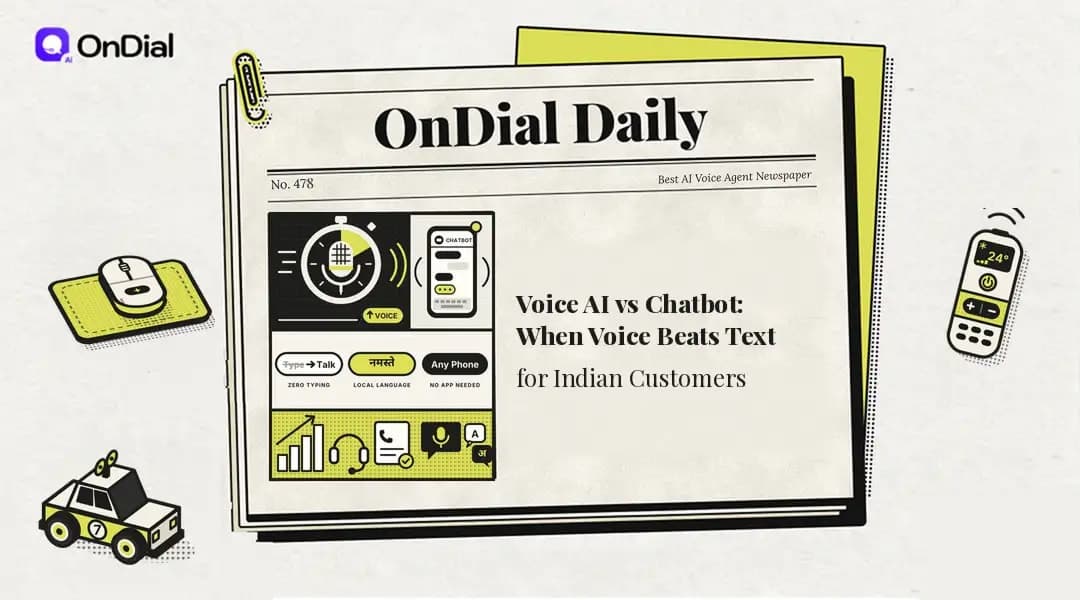
It is 7:40 p.m. near Dewas, and a farmer has missed his scooter EMI by two days. He won't open an app to fix it, but he will answer a call in Hindi. That gap drives every voice AI vs chatbot decision, and our explainer What is voice AI covers the mechanics.
Two made-up businesses, one in Indore and one in Bengaluru, keep things concrete. Kesar Auto Finance is an Indore two-wheeler lender whose borrowers mostly call. Neem & Nila is a Bengaluru skincare brand whose shoppers mostly scroll.
By the end, you will have a five-question test that sorts each journey into voice, WhatsApp chat or both. You will also know the Indian calling rules that shape the plan.
Voice AI and Chatbots, Seen Through One Lender's Monday
Kesar's voice agent speaks with borrowers on an ordinary phone call. Its chatbot replies in a typed window on WhatsApp or the website.
Underneath, both can run on similar language models. So the voice AI vs chatbot gap is really the effort each channel asks of customers.
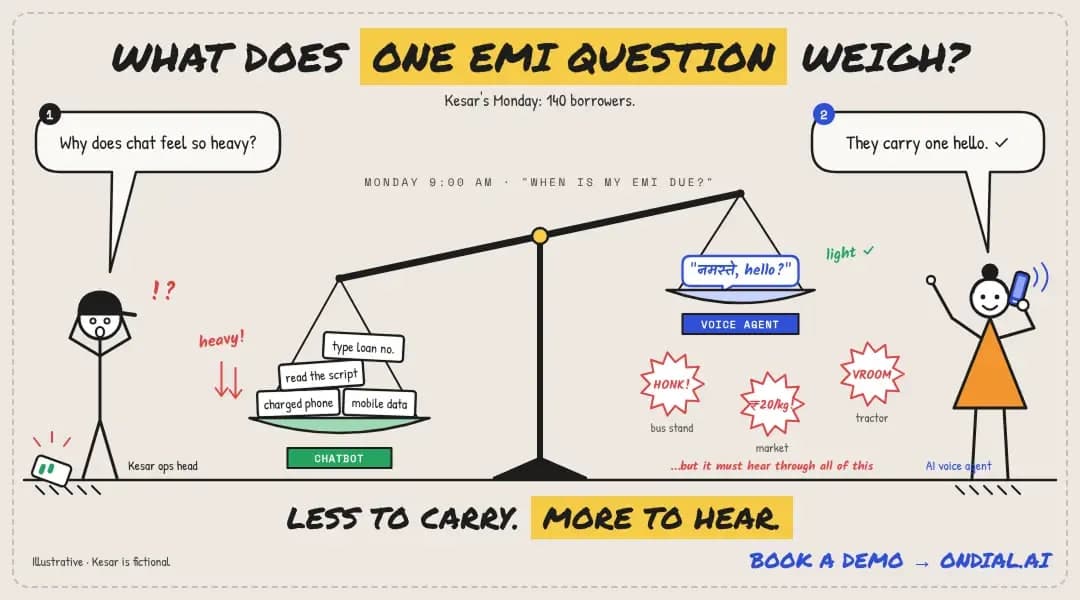
Picture Monday morning, when say 140 borrowers want their due dates. The chatbot needs each one to wake a phone, find the chat and type a loan number. The voice agent only needs them to say hello.
That difference shapes the voice agent vs chatbot choice more than any feature list does. Here is what each channel quietly demands from the person on the other end:
A chatbot expects the borrower to read Hindi or English script on a small screen.
It also needs mobile data, a charged phone and spare minutes to type a loan number.
A voice agent needs only a phone signal and the borrower speaking in Hindi.
In return, the voice agent must cope with noise from a market, a bus stand or a tractor.
How a Voice Agent Turns a Spoken Hindi Sentence Into an Action
Kesar's voice agent runs a five-leg relay, and each leg must finish before the pause feels odd. Suppose a Kesar borrower asks, in Hindi, how much of this month's EMI is still pending. Here is what happens between his question and the answer:
The call reaches the agent over a normal phone line or a SIP trunk, and the audio streams live.
Speech recognition converts his Hindi, plus any English words he mixes in, into text.
A language model reads that text, spots that he wants his EMI balance and plans a reply.
A tool call pulls the live balance from Kesar's loan system instead of guessing a figure.
Text-to-speech reads the answer aloud in natural Hindi while the agent keeps listening.
A chatbot skips the first, second and fifth legs. That is why chat wins the running-cost row of any voice AI vs chatbot budget. It also explains why voice quality depends so much on the speech layers, not only the model.
One more detail separates good agents from frustrating ones. If the borrower cuts in to say he already paid on Saturday, the agent should stop talking and listen. Engineers call this barge-in, and most older IVR menus lacked it.
Voice AI vs Chatbot: A Side-by-Side Table for Buyers
Choose by the row Kesar's borrowers care about most, not by an overall score.
What you are comparing | Voice agent at Kesar | Chatbot at Kesar |
What the borrower has to do first | He answers or dials, and speaking Hindi is enough | He opens WhatsApp, reads the reply and types back |
The Kesar job each channel suits | Talking through a missed EMI and agreeing on a new date | Sending a payment link or a loan statement PDF |
Handling a quick two-question EMI query | Quick, though he must hear the full EMI amount read out | Quicker, because he can skim the due date on screen |
Sending links, photos and loan forms | Weak, so it texts a WhatsApp or SMS follow-up | Strong, with payment buttons and PDFs sitting in WhatsApp |
Reading comfort the borrower needs to have | None, so it suits borrowers who cannot read the script | Assumes the borrower reads Hindi or English script comfortably |
Who can open the EMI conversation first | Can ring a showroom lead within minutes of a form fill | Business-started WhatsApp chats face template rules first |
Running cost across a month of EMI calls | Higher per minute, since each EMI call needs speech processing | Lower per conversation, since a typed EMI query costs little |
Records kept for audits and EMI disputes | Recording plus transcript, once the borrower hears a consent notice | A typed log the borrower can scroll back through |
Notice that neither column wins the voice AI vs chatbot contest outright. Kesar would pick voice for five rows and chat for three, and Neem & Nila would flip that.
Five Moments Where Voice AI Beats a Chatbot Window
Deciding when to use voice AI gets easier once you spot five moments in Kesar's week. Each one is shown through Kesar's borrowers, but it applies to any phone-first customer base.
Kesar's borrowers already treat the phone as the front door
Kesar's borrowers bought their scooters at a showroom and heard from a sales executive by phone. For them, a call is simply what a lender sounds like. A chat link from an unknown number, by contrast, can look like a scam.
Reach backs this up. MoSPI's 2025 telecom survey found that 95.3% of Indian households have a mobile phone or landline. Calling meets almost everyone where they already are.
A borrower's problem has more moving parts than a text box holds
One borrower lost his job, wants to shift two EMIs and has a co-applicant brother in Pune. A chatbot would ask him one narrow question at a time. On a call, he explains the whole tangle in about a minute.
Messy problems keep pulling people toward the phone, even in app-heavy markets. ContactBabel surveys 1,000 US consumers every year. Their preference for calling about complex queries rose from 28% in 2018 to 47% in 2024.
A stolen scooter at 9 p.m. can't wait for a typed ticket
At 9 p.m., a borrower calls because his scooter was stolen outside a temple. He needs the next steps tonight, not a ticket number by morning. A voice agent can collect the FIR details, flag the case as urgent and transfer him to on-call staff.
Chat can do parts of this too. However, a frightened person talking is faster and clearer than the same person typing with shaking thumbs.
Reading English, or any script, is the real barrier
Owning a phone is not the same as typing a loan query on it comfortably. In MoSPI's 2025 telecom survey, only 43.5% of Indians aged 15 and above could send or receive an email.
The gap shows up online too. IAMAI and Kantar count 958 million active internet users for 2025. Yet the same report finds about 579 million Indians, or 38%, still not active online.
A voice agent that speaks Marathi or Bhojpuri, where the provider supports it, reaches people a text window misses. Nobody has to learn a new screen first.
Showroom leads go cold while they wait for a reply
Speed to first contact shapes how many showroom enquiries turn into a loan. A showroom visitor who fills a form at 6 p.m. still remembers why at 6:05. By tomorrow morning, a rival lender may have rung first.
Outbound calling is where the voice AI vs chatbot gap feels sharpest. For the conversion side of this argument, read Voice agents vs chatbots for lead conversion.
Where a Chatbot Is the Smarter Buy
Chat wins whenever the answer is something to look at, keep or tap, like a courier link. It also wins when the customer cannot talk out loud, which describes most of Neem & Nila's buyers.
Its chatbot handles these jobs better than any call could:
Showing a shade chart while a shopper compares two serums side by side.
Sharing a courier tracking link the customer can tap again tomorrow.
Answering silently while the shopper sits in a crowded metro coach or a meeting.
Serving dozens of short serum questions at once, since each chat window costs little.
Leaving a written return policy the shopper can screenshot before opening a serum.
For Neem & Nila, the phone bot vs chatbot question is close to settled. Its buyers are urban, read English easily and shop with a thumb rather than a voice.
Still, voice earns one narrow job there. Calling cash-on-delivery buyers to confirm an order before it ships can save a wasted courier trip. For every other job, Neem & Nila settles the voice AI vs chatbot question in favour of chat.
Running Voice AI and a Chatbot as One Team
Run both when customers drift between channels, and connect them so nobody repeats a loan number twice. The connection matters more than either tool on its own.
A healthy hand-off at Kesar looks like this:
The voice agent rings a borrower in Hindi three days before his EMI date.
He says he will pay online but cannot find the old payment link.
Still on the call, the agent sends a fresh link to his WhatsApp.
If he replies on WhatsApp with a doubt, the chatbot already sees the call summary.
If the payment still fails, a human collector gets both transcripts before dialling.
The voice vs text AI debate fades once both channels share one memory. With AI Chatbot Development Services, businesses can create connected AI experiences where voice and text interactions access the same knowledge base. The failure to avoid is two bots with separate knowledge bases quoting two different due dates.
This mix suits India because WhatsApp is already where follow-ups land. Meta has said WhatsApp has more than 500 million users in India. So a call that ends with a WhatsApp link rarely asks the customer to install anything new.
A Channel-Choice Framework Built for Indian Customers
Score each customer journey, like an EMI reminder, on five questions. Three or more yes answers mean the journey should start with a call, with chat as the follow-up.
The five-question channel test
Run every journey, from loan enquiries to order tracking, through these questions:
Would most customers on this journey rather speak Hindi, Marathi or another regional language than type it?
Does solving it usually take more than three rounds, as rescheduling two EMIs would?
Is the customer stressed or on a clock, as with a stolen scooter or a hospital admission?
Do you need to start the conversation yourself, for EMI reminders or fresh showroom leads?
Can the agent say the full answer aloud, with no payment link, photo or form?
Two or fewer yes answers point to chat first, with a callback button for hard cases. Kesar's EMI reminder scores five out of five. Neem & Nila's order tracking scores one, and only on the outbound question.
Language weighs heavily in this test. India's Constitution lists 22 languages in its Eighth Schedule, and callers mix English into most of them. In IAMAI and Kantar's 2024 study, 57% of urban internet users preferred content in Indian languages.
Switching languages mid-conversation is a skill worth testing before you buy. Our guide to a Multilingual customer support agent walks through how that works on a live call.
TRAI and DPDP rules that shape an Indian voice plan
Calls carry regulatory weight that WhatsApp chats mostly avoid. Plan around these points before the first outbound call goes live:
RBI-regulated lenders like Kesar must use 1600-series numbers for service and transaction calls.
Promotional calls belong on 140-series numbers, which customers can block through the DND registry.
Businesses using 140-series numbers must first register with a telecom operator under TRAI's TCCCPR framework.
MeitY notified the DPDP Rules on 14 November 2025, with core consent duties arriving after 18 months.
A WhatsApp chatbot sidesteps the caller ID rules, but it still collects personal data. As a result, DPDP consent duties apply on both sides of the voice AI vs chatbot line. This is a planning aid, not legal advice, so confirm current TRAI directions with your telecom provider.
Where Voice AI Still Stumbles, Even on a Good Day
Voice AI struggles most with noise at a bus stand, long loan numbers, visuals and wary callers. Each limit below would hit Kesar's EMI calls, so design for it before launch:
A borrower calling from a bus stand may be misheard, so the agent must read key details back.
Twelve-digit loan account numbers are hard to catch by ear, and keypad entry often works better.
A loan top-up may need a signed form or photo, which a voice line cannot carry.
Borrowers burned by spam calls may hang up on an unfamiliar number before hearing a word.
Rare dialects and heavy Hinglish code-mixing still trip up many speech engines, depending on the provider.
Long EMI negotiations get expensive, because per-minute pricing keeps running while a borrower hesitates.
There is also an empathy ceiling. A borrower who has just lost a family member should reach a human fast, not a polite script. Build that exit into version one, not version three.
Voice is not for every business, either. If your customers are urban professionals who live inside apps, a voice agent may add cost without reach. For them, the voice AI vs chatbot answer is often just chat.
Pricing a Voice AI Pilot Against Your Current Chatbot
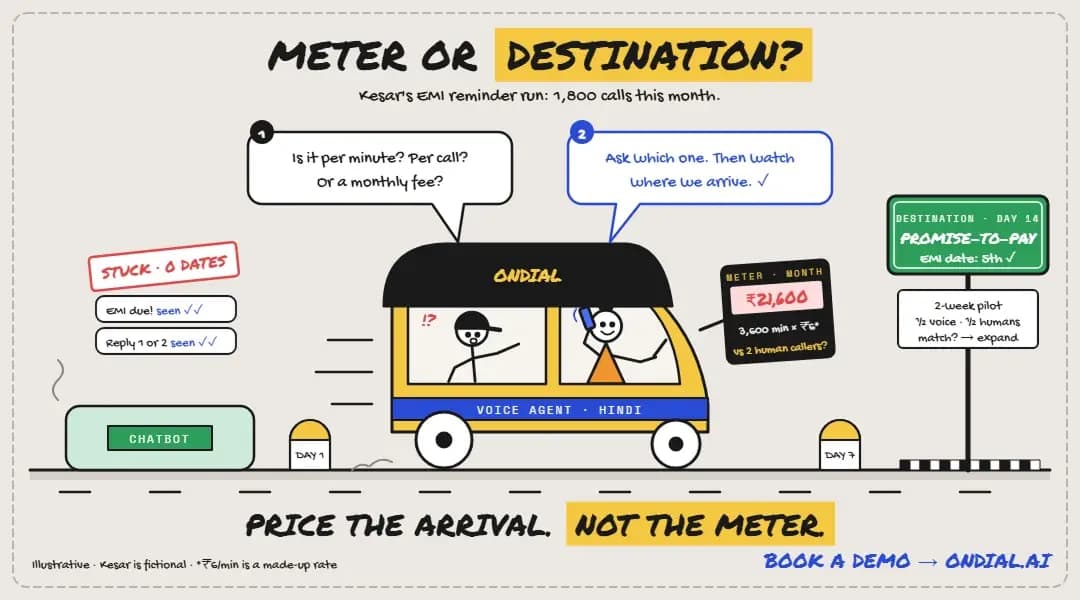
Compare cost per resolved query, such as a confirmed EMI date, not cost per minute. A cheap chat that nobody answers costs more than a pricier call that ends with a payment date.
Most vendors price voice in one of these ways, so ask which applies before comparing quotes:
Per-minute pricing that bundles speech recognition, the model and voice output for each Hindi call.
A flat fee per conversation or call, however long each borrower stays on the line.
Monthly platform fees plus usage, which suits steady volumes like Kesar's reminder list.
Here is an illustrative sum. Say Kesar sends 1,800 reminder calls a month, averaging two minutes each, which is 3,600 minutes. At a made-up rate of ₹6 a minute, that is ₹21,600.
Weigh that against two human callers working the same list. Then test the voice AI vs chatbot split with a short pilot before signing long term:
Pick one journey that scored high on the five-question test, such as EMI reminders.
Write the 20 questions borrowers ask most, each with an approved answer.
Put voice on half of Kesar's borrower list for two weeks, with human callers on the rest.
Compare promise-to-pay rates, transfer rates and complaint counts across both halves.
Expand only if the voice half matches the human half on promise-to-pay dates.
Before shortlisting vendors, line up their language coverage, CRM links and call recording options side by side. OnDial's Features page is one place to start that checklist.
Pick the First Journey, Then the Tool
Neither Kesar nor Neem & Nila has to settle the voice AI vs chatbot question forever. Each picks one journey, proves it works and adds the second channel where customers ask.
Got callers who switch between several Indian languages? Start by testing a Multilingual AI voice agent on that one journey, the way Kesar began with EMI reminders.