Roughly 40% of calls to hotel front desks go unanswered, according to research from Canary Technologies. Hotels across the wider hospitality industry automate guest calls by deploying AI voice agents for hotels that pick up every inbound line instantly, read live availability from the property management system, take reservations, log service requests, and transfer anything complex to staff with the full conversation attached. The agent absorbs the repetitive volume: rates, parking, check-in times, Wi-Fi passwords, late checkout. Your team keeps the conversations that actually require a person.
If you are sceptical, you should be. Most hoteliers I speak with are not worried about whether the technology works. They are worried about the one call where it fails in front of a guest who is already annoyed, and about what that does to a brand built on service. That fear is reasonable, and it is also solvable with sequencing rather than software.
At OnDial, we build voice AI for businesses where a bad call costs a customer, so the design question we start with is never "what can the agent do." It is "which calls should it never touch?" This guide covers what these systems actually do on a hotel line, a three-step framework for rolling one out safely, the integration details that separate a good deployment from an embarrassing one, and the disclosure rules you now have to meet.
Why the Phone Line Breaks Before Anything Else Does
Here is the counter-intuitive part: your phone problem is not a phone problem. It is a capacity problem that only becomes visible on the phone, because the phone is the one channel that cannot be queued politely. A guest standing at the desk will always beat a guest ringing from a competitor's parking lot.
The Missed Call Problem Nobody Puts on a Dashboard
Missed calls are invisible in a way that missed emails are not. There is no unread counter, no inbox, no morning review where someone notices forty conversations that never happened. Hotels have historically missed between 20% and 40% of incoming calls, a gap that persistent staffing shortages have made considerably worse. That range is the single most reliable number in this category, and it holds across property sizes.
The revenue consequence is not evenly distributed either. Reservation calls cluster in the evening and on weekends, exactly the windows when most independent properties run their thinnest desk coverage. An abandoned call at 9 pm on a Saturday is not a delayed booking; it is a booking that went to an OTA or to the hotel across the road, exactly the kind of leakage properties close when they boost hotel bookings with AI voice agents.
What Your Front Desk Loses When the Phone Wins
Every call your desk answers is time taken from someone physically present. Service staff in hospitality spend an average of 47 minutes per shift on the phone, according to DEHOGA, the German Hotel and Restaurant Association, across a three-person shift pattern that is more than two hours of hospitality labour redirected into repeating your check-in time.
The quality cost compounds the time cost. Staff who are interrupted mid-conversation give shorter answers, skip the upsell, and forget to note the special request. The phone does not just consume your team's hours; it degrades the hours it does not consume.
What an AI Voice Agent for Hotels Actually Does
An AI voice agent for hotels is a conversational system that answers inbound calls in natural speech, retrieves live property data, completes routine requests, and hands off to staff when a call exceeds its scope. That is the whole definition. Everything else is implementation detail.
The Five Stages of an Automated Guest Call
Modern platforms process each call through a predictable pipeline, and understanding it helps you ask vendors better questions:
Speech recognition: the system converts the caller's speech to text in real time, accounting for accent and background noise. This is where cheap platforms fail first, especially on non-native English.
Intent recognition: natural language understanding identifies what the guest wants, separating a rate query from a cancellation. Accuracy here determines how often the agent asks the guest to repeat themselves.
System integration: the agent queries your PMS, CRS, or loyalty platform for live availability, rates, and booking records. Without this step, you have an expensive answering machine.
Natural language response: the agent speaks the answer or confirms the completed action. Voice quality matters less than response timing, which I will come back to.
Escalation logic: when the request exceeds scope, the call transfers to a human with full context attached. This handoff stage is where enterprise deployments succeed or fail.
Calls That Automate Cleanly, and Calls That Do Not
The reliable automation candidates are the calls where the correct answer already exists somewhere in writing. Check-in and checkout times, parking, pet policy, pool and spa hours, directions, Wi-Fi access, luggage storage, restaurant hours, availability checks, and straightforward new reservations. Industry reporting puts the share of calls handled without human assistance at 70 to 90% in well-configured deployments.
The calls that should never automate are the ones where the correct answer depends on judgment. Complaints, billing disputes, group and event enquiries, accessibility requirements, and any guest who has already had a bad day. A system that tries to resolve a complaint is not saving you labour; it is manufacturing a review.
A Three-Step Framework for Hotel Call Automation
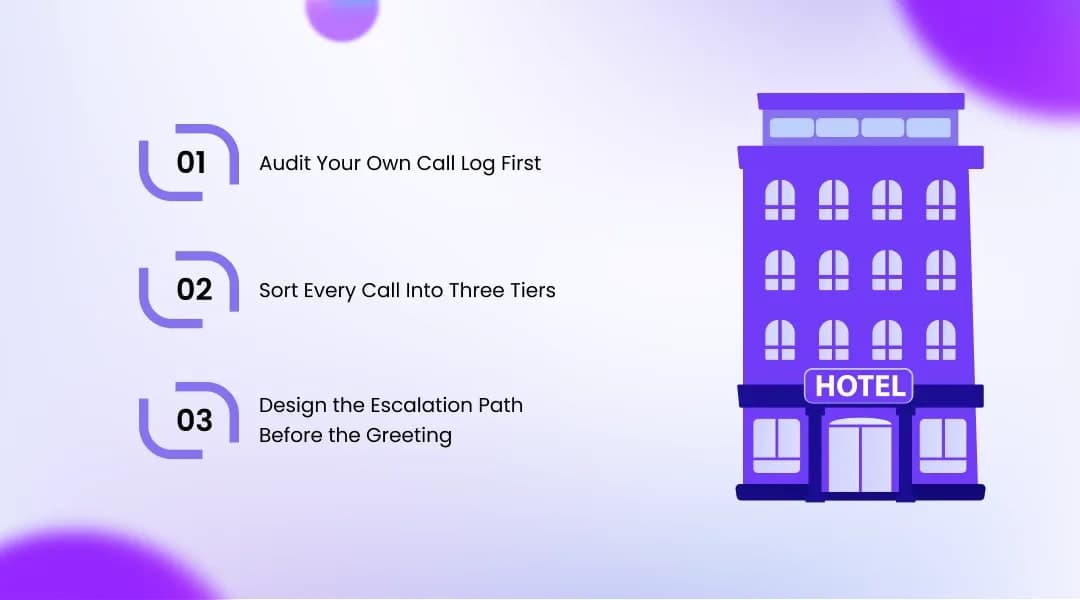
Most hotel call automation projects go wrong in the same place: the property picks a platform before it understands its own call pattern. Reverse that order and the vendor decision mostly makes itself.
Step One: Audit Your Own Call Log First
Pull ninety days of inbound call data from your phone system. You want four columns: time of day, duration, whether it was answered, and what it was about. If your system does not tag call reasons, have the desk hand-tally for two weeks, which is imprecise but sufficient.
What you are looking for is the shape of the miss, not the size of it. A property missing 35% of calls spread evenly across the day has a staffing problem. A property missing 35% concentrated between 6 pm and 8 am has a coverage problem, and coverage problems are exactly what automation solves cheaply.
Step Two: Sort Every Call Into Three Tiers
Take your tagged call reasons and sort them into three buckets before you speak to a single vendor:
Tier one, full automation: informational and transactional calls with a documented correct answer. These are your volume. Target every one of them.
Tier two, automate with handoff: reservations, modifications, and cancellations, the same day-and-night AI booking calls for hotels and restaurants where the agent gathers details but a human confirms, at least during the pilot. This tier is where PMS write access becomes the deciding technical question.
Tier three, human only: complaints, VIP guests, group bookings, and anything involving a payment dispute. Route these on first detection, not after three failed turns.
This tiering document becomes your vendor brief. When a platform cannot describe how it detects a tier three call, you have learned something useful for free.
Step Three: Design the Escalation Path Before the Greeting
Here is the question I would ask every vendor before discussing price: what happens when your agent does not know? The answer should be specific. During staffed hours, a warm transfer with the conversation summary already delivered to the receiving phone. After hours, a logged callback request that appears in the morning queue with a transcript attached.
The expensive failure mode in hospitality is not the agent giving a wrong answer. It is the agent dropping a call that was worth something, and nobody finding out. (I have reviewed deployment logs where a group enquiry disappeared entirely because the escalation was configured to voicemail on a line nobody checked.) Escalation is not a fallback feature; it is the product.
PMS Integration and Language Quality Decide Everything
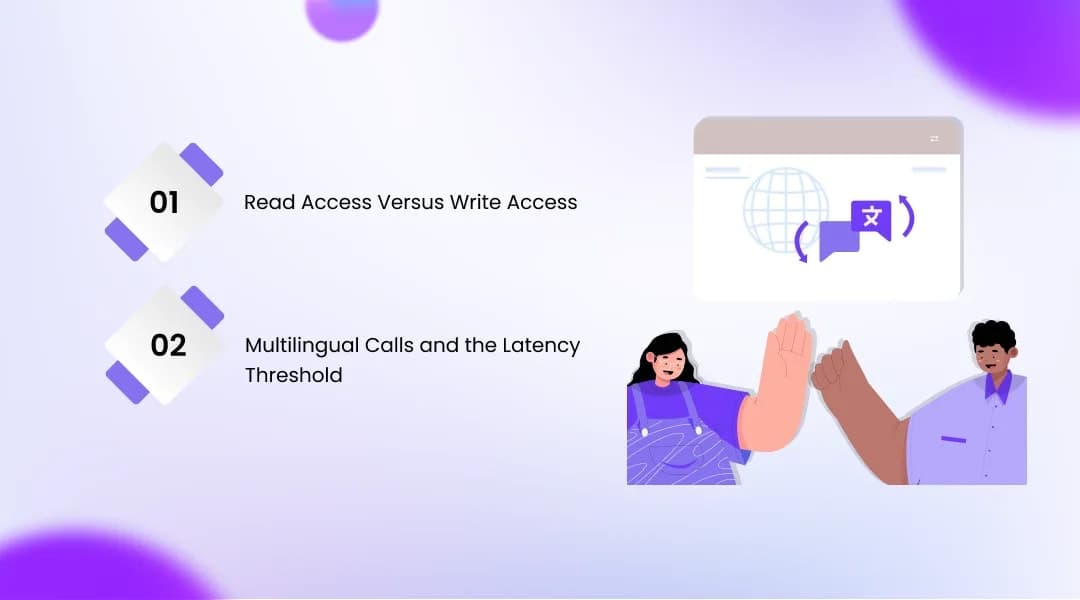
Two technical decisions separate a hotel PMS integration voice AI deployment that guests compliment from one they complain about. Neither of them is the voice.
Read Access Versus Write Access
Ask every vendor whether their PMS integration is read-only or read and write, and get the answer in writing. A read-only integration can quote live availability and rates accurately, which already covers most enquiry calls. It cannot confirm a booking, which means every reservation still lands in a human queue.
Integration depth varies considerably across platforms, and verifying whether a connector is read-only or read-and-write is a core evaluation step. Many properties find a staged approach works best: the agent handles the conversation, and routes confirmed bookings to a human write queue, then full write access activates once the integration is tested against real inventory. That preserves the call handling benefit while the backend catches up.
Multilingual Calls and the Latency Threshold
Language coverage is where voice AI outperforms almost any realistic staffing plan. An agent that detects a caller's language and responds in it the kind of multilingual AI voice agent capability guests now expect removes the barrier that quietly costs international direct bookings. Parloa's deployment with BER Airport handled passenger calls around the clock in four languages and reached 85% customer satisfaction, which is a useful benchmark for guest acceptance of automation in service-sensitive settings.
Response timing matters more than accent quality. Above roughly 700 milliseconds of latency, callers begin describing conversations as uncomfortable or robotic, per Stanford HCI voice research, while leading enterprise agents now operate below 200 milliseconds. When you demo a platform, time the pauses rather than admiring the voice.
Disclosure, Compliance, and the Honest Limits
This section is the one most vendor pages skip, which is precisely why it belongs in your evaluation. Automation on a guest line is a regulated activity in a growing number of markets.
Telling Guests They Are Speaking to an AI
Under Article 50 of the EU AI Act, guests must be told at the start of a call that they are speaking with an AI agent. For any property serving European guests, non-disclosure is a compliance exposure, not a branding choice. Configure the disclosure into the greeting and stop treating it as a drawback.
The operational layers underneath disclosure matter just as much. Payment interactions fall under PCI DSS, call recording runs into consent law that varies by jurisdiction, and Indian properties handling guest data need to account for the Digital Personal Data Protection Act. Industry bodies including AHLA and HTNG are actively working on standards here, and their guidance is worth tracking.
Where This Technology Still Falls Short
I want to be direct about the limits, because overselling this category helps nobody. Voice agents still struggle with heavy background noise, callers who change intent mid-sentence, and properties whose policies are genuinely ambiguous, since an agent cannot answer a question your own staff answer three different ways. Deployment quality depends almost entirely on how well your property knowledge is documented before go-live.
There is also an acceptance question that data has not fully settled. Research on front office automation has found that guests, particularly leisure travellers, still place real value on a human welcome, which suggests automation belongs on the volume calls rather than the relationship ones. That is a limit worth designing around rather than arguing with.
Conclusion
AI voice agents for hotels work best when you treat them as a capacity decision rather than a technology purchase. Three things carry the outcome: audit your own call log before you evaluate a single vendor, sort every call type into automate, assist, or human-only tiers, and design the escalation path before you write the greeting. Get that sequence right, and the platform choice becomes straightforward, because you will know exactly what you are asking it to do.
You already have the data you need to make this call. It is sitting in ninety days of phone logs that nobody has read yet, and reading it will tell you more than any vendor demo.
If you want a second pair of eyes on that call log, OnDial builds voice agents around exactly this kind of tiering work, and we will tell you honestly which of your call types should stay with your team.