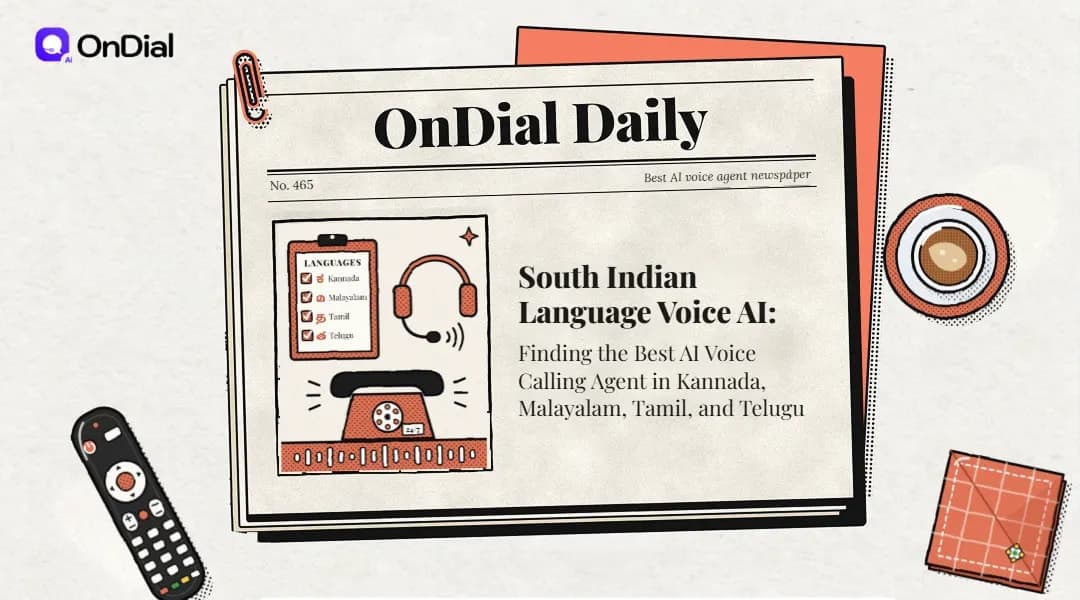
A shopper in Mysuru who picks up a delivery call and hears Hindi will often mumble a quick no and cut the line, even when the parcel is hers. That reflex is why CX leads across the South now look for the best AI voice calling agent in Kannada, plus Tamil, Telugu, and Malayalam versions that sound just as local. A Multilingual AI voice agent is designed to hold these conversations in several languages, so one support team can cover four states without staffing four separate calling floors.
Choosing one is harder than scanning a vendor’s language list. Kannada from Hubballi, Malayalam from Kozhikode, and Telugu from Hyderabad each trip up speech systems in their own ways, and those failures surface in your confirmation rates rather than in a polished sales demo. The questions that matter are narrow ones: which districts the model was tested on, how it copes with English words dropped mid-sentence, and what it does when it gets lost.
What a South Indian Language Voice Agent Does for Your Team
For a South Indian CX team, an AI voice calling agent takes over the repetitive phone conversations staff have all day, such as confirming a cash-on-delivery order in Kannada or moving a return pickup in Tamil, and writes the outcome straight into your order system. Unlike an old IVR menu, it listens to free speech instead of waiting for a keypress. It can also ask a follow-up question when an answer is vague.
Picture a buyer in Warangal who says, in Telugu, that she won’t be home until after six on Saturday. A conversational agent understands the time, offers the evening slot, reads it back to her, and updates the courier record before the call ends. A recorded menu would have pushed her through three keypad layers and probably lost her at the second.
The teams getting the most from this tend to share a profile. They run thousands of near-identical calls a week (order checks, payment nudges, appointment reminders) across D2C brands, marketplace sellers, logistics firms, clinics, and lenders. Their agents in Chennai or Kochi spend hours repeating the same four questions, and that time is better spent on complaints and escalations a bot shouldn’t own.
Why Customer Data, Not the State Map, Should Pick the Language
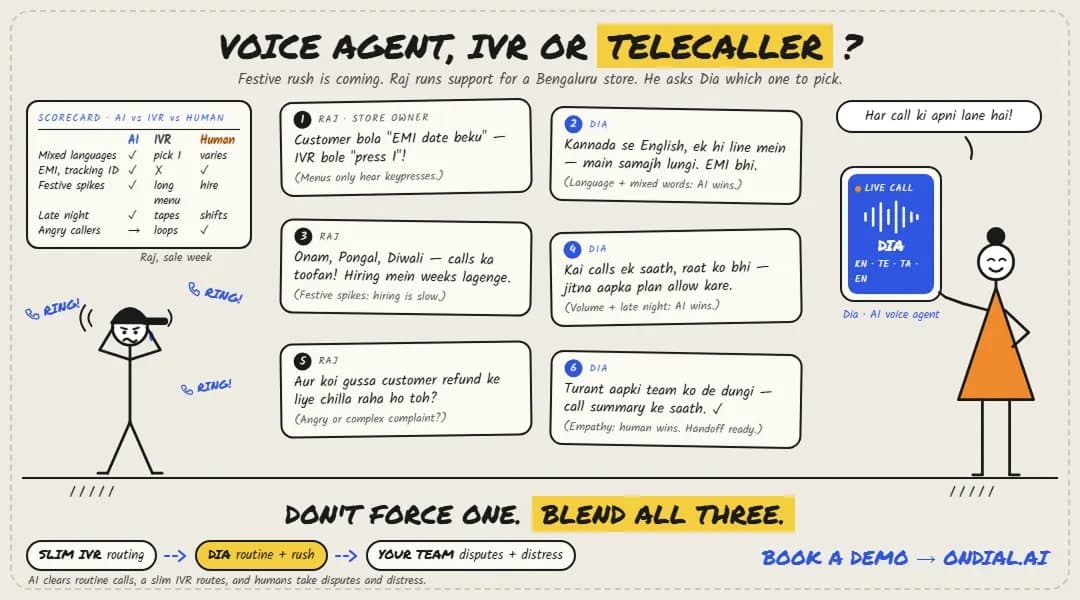
The language an agent opens with should come from what you know about each customer, because South India’s four major languages spill across state borders far more than a map suggests. The 2011 Census remains the most recent published count of mother tongues, and it shows how large these speaker bases are. Census figures from 2011 put Telugu first among the four at over 8.11 crore speakers, with Tamil near 6.9 crore, Kannada past 4.37 crore, and Malayalam above 3.48 crore.
Language | Mother-tongue speakers (2011 Census) | Main home region | Speakers counted outside that region |
Telugu | About 8.11 crore | Undivided Andhra Pradesh, now AP and Telangana | About 1.05 crore |
Tamil | About 6.9 crore | Tamil Nadu | About 52.7 lakh |
Kannada | About 4.37 crore | Karnataka | About 30.6 lakh |
Malayalam | About 3.48 crore | Kerala | About 24.3 lakh |
The overlap is the part most routing rules miss. The Census office’s Language Atlas of Tamil Nadu 2011 recorded roughly 42.3 lakh residents of the state whose mother tongue is Telugu. A customer in Hosur or Chennai flagged as Tamil purely by PIN code may answer in Telugu, and Bengaluru’s mixed population means a Karnataka address guarantees very little.
Demand for local-language digital experiences backs this up. The IAMAI and Kantar Internet in India 2024 study found that 98% of Indian internet users consumed at least some content in Indic languages, led by Tamil, Telugu, and Malayalam. The same research noted that about one user in five already speaks commands to get online, which suggests talking to software in a native language is routine for a large audience.
The practical rule is simple. Use PIN code or a stated preference as the opening guess, let the agent switch on the customer’s first reply, and save the chosen language to your CRM so the next call starts right. It sounds minor, but it removes one of the quickest reasons a regional caller hangs up.
Inside the Pipeline: From Ringtone to Logged Outcome
Most South Indian voice agents push every call through the same chain of choosing a language, listening, understanding, replying, speaking, and recording the result, and each link can fail in a way that depends on the language. Knowing the chain helps you ask vendors sharper questions. Here is how a typical outbound order-confirmation call moves through it.
Choosing the opening language before dialing: The system reads CRM fields such as PIN code, past call language, and any stated preference, then picks a Kannada, Tamil, Telugu, or Malayalam voice to greet the customer.
Turning muddy phone audio into text: A speech recognition (ASR) model transcribes the caller’s words from narrowband 8 kHz telephone audio, which sounds far rougher than a studio clip, and has to keep words like refund or OTP intact inside a Tamil sentence.
Working out what the caller wants: A language model reads the transcript, decides whether the customer confirmed, refused, or raised something new, and pulls order details from your store or CRM through an API when it needs them.
Writing a reply that sounds local: The response is generated in the caller’s language, with amounts, dates, and addresses phrased the way people in that region say them rather than as a literal translation of an English script.
Speaking it back with a regional voice: Text-to-speech (TTS) turns the reply into audio, ideally with a familiar accent, and the system stops talking the instant the caller interrupts, a behavior engineers call barge-in.
Logging the outcome and handing off when stuck: The agent tags the result, saves a transcript, triggers any follow-up such as a WhatsApp message, and passes the caller to a human with full context if it cannot resolve the request.
Some newer platforms replace steps two through five with a single speech-to-speech model that hears audio and answers in audio. That design can trim response delay, though in many implementations it also makes it harder to trace exactly where a Malayalam misunderstanding began. Whichever approach a vendor uses, ask how long the typical silence lasts between the caller finishing and the agent replying, because long gaps push people to talk over the bot or hang up.
Language by Language: What Each Market Asks of the Agent
Each of the four languages stresses a voice agent differently, so a platform that sounds fluent in one can stumble in the next. Treat them as four separate products to evaluate, even when one vendor sells all of them. Budget pilot time for every language you plan to launch rather than assuming quality carries over.
Kannada Voice Bots and Bengaluru’s English-Heavy Speech
Agents built for Karnataka face one of the widest speech ranges you will find on a single customer list. A software engineer in Whitefield may talk in Kanglish, swapping in English for every number, brand, and banking term, while a farmer near Kalaburagi uses north Karnataka vocabulary and rhythm that a Bengaluru-trained model has rarely heard. Coastal callers from Mangaluru and Udupi add another layer, since many grew up speaking Tulu or Konkani at home and use Kannada as a second language.
The language also travels well beyond the state. Census data counted roughly 30.55 lakh Kannada speakers living beyond Karnataka’s borders. For testing, gather recordings from at least three zones (Bengaluru urban, north Karnataka, and the coast), because an agent that only shines on the first will impress in a demo and frustrate everyone else on your list.
Tamil: Formal Script Versus Everyday Speech
Tamil has a sharp gap between its written form and the way people talk, and an agent reciting textbook Tamil on a delivery call sounds like a government announcement. Callers in Chennai often lean on Tanglish, Madurai speech carries its own vowels and expressions, and the Kongu belt around Coimbatore and Tiruppur has an accent that recognition models frequently misread. Numbers add a trap of their own, since many urban speakers quote prices in English but dates in Tamil, sometimes in one breath.
Generic multilingual bots often treat Tamil as one uniform language. If Tamil makes up a big share of your orders, a dedicated Tamil voice AI agent (Tamil Nadu) is worth evaluating on its own merits. Ask to hear it handle a Coimbatore textile trader and a Chennai college student on the same script, and if both calls sound natural, the model probably saw real colloquial Tamil during training.
Malayalam Voice Bots and Kerala’s Long, Layered Words
A Malayalam agent has to cope with some of the longest word forms among Indian languages, because Malayalam attaches suffix after suffix to a root until a single spoken word can carry a whole clause. That structure makes it hard for a recognition model to tell where one word ends and the next begins, especially on a crackly line. Malayalam also has the smallest speaker base of the four, which generally means less public speech data for vendors to train on.
Regional variation matters here as well. Malabar speech from Kozhikode and Malappuram differs in vocabulary and intonation from the Thiruvananthapuram variety, and families with members working in the Gulf often mix in Arabic or English loanwords. Before rolling out statewide, compare how a purpose-built Malayalam voice AI agent (Kerala) handles Malabar and southern Kerala test calls against a generic option, and track early hang-ups for each region separately.
Picking the Best AI Voice Calling Agent in Telugu for Two States
A Telugu agent has to serve two states with noticeably different speech. Hyderabad Telugu borrows freely from Deccani Urdu and Hindi, coastal Andhra speech around Vijayawada and Visakhapatnam sits closer to the variety heard on TV news, and Rayalaseema has its own accent and word choices. A model tuned on only one of these zones will misread the other two more often than most buyers expect.
Telugu’s size helps and hurts. With more than eight crore speakers, it tends to draw more vendor investment than Kannada or Malayalam, so baseline quality is often higher. That scale also means your customer list probably spans all three zones, so a Telugu voice AI agent (Telangana) should be tested on recordings from Andhra Pradesh as well as Hyderabad before you call it ready.
Voice Agent, IVR Menu, or Human Telecaller?
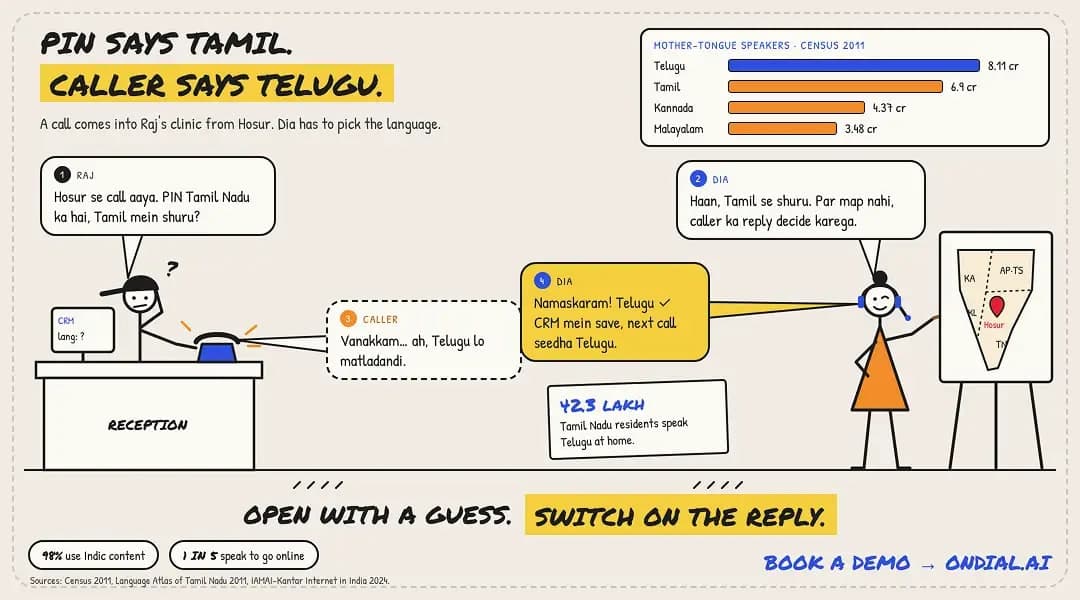
A conversational voice agent sits between a keypad IVR and a human telecaller: it handles free speech and volume far better than a menu, but it still trails a skilled person on emotionally loaded or unusual calls. Each option has a place in a South Indian support stack. The table compares them on the factors that matter most for regional language work.
Factor | AI voice agent | Keypad IVR menu | Human telecaller |
Language handling | Detects the caller’s language and can follow a jump from Kannada to English inside one sentence | Makes callers press a digit for their language, then stays locked to that choice | Limited to whichever languages that particular staff member grew up with |
Mixed English words | Catches terms like EMI or tracking ID inside a Telugu reply when trained on mixed speech | Ignores spoken words entirely and reacts only to keypresses | Picks up Tanglish or Kanglish effortlessly if raised in that environment |
Festive-sale spikes | Can run many simultaneous calls if your plan’s concurrency cap allows it | Absorbs volume but frustrates shoppers with long menu trees | Needs hiring and training weeks before Onam, Pongal, or Diwali |
Late-night coverage | Answers inbound calls at any hour and dials out within permitted calling windows | Always on, but limited to fixed recordings | Requires shift allowances and rosters |
Angry or complex complaints | Should step aside quickly and pass a call summary to a person | Tends to trap upset callers in repeating loops | Strongest option for empathy and judgment |
Cost pattern | Usage-based, so spend rises and falls with call volume | Cheap to run, though abandoned calls carry a hidden cost | Fixed salaries whether phones ring or not |
In practice, most South Indian support operations blend all three. The agent clears routine confirmations, a slim IVR stays for simple routing, and human staff take disputes, high-value refunds, and anyone in distress. That split is easier to defend to customers than forcing a bot to handle everything.
Where Ecommerce and Support Teams in the South Start
The strongest first deployments are short, high-volume calls with a clear outcome, which in South Indian ecommerce usually means cash-on-delivery checks, failed-delivery follow-ups, and return pickups. These calls follow predictable scripts, so accuracy problems surface quickly. Fixes are also easy to measure against a before-and-after baseline.
Call type | A South Indian example | What the agent writes back |
Cash-on-delivery confirmation | Calling a Salem buyer in Tamil to confirm a ₹1,499 silk saree order before dispatch | Confirmed, cancelled, or delivery address corrected |
Failed delivery follow-up | Reaching a Guntur customer in Telugu after the courier found the house locked | Fresh delivery slot or a nearby pickup point |
Return pickup booking | Scheduling a Mangaluru shopper’s shoe return in Kannada for a weekday morning | Pickup date, time window, and stated return reason |
Inbound order status | Answering a Thrissur caller in Malayalam who wants to know when her mixer grinder arrives | Live tracking status read aloud, with escalation if the parcel is overdue |
Renewal or payment reminder | Nudging a Hyderabad subscriber about a lapsed plan in mixed Telugu and English | Promised payment date or a callback request |
Post-delivery feedback | Asking a Hubballi customer in Kannada to rate the courier from one to five | Score plus any complaint routed to a human |
Inbound support deserves more attention than it gets. Most vendor content focuses on outbound sales and collections, yet a large slice of South Indian CX volume is people asking where an order is or how to send it back. An agent answering those calls in the caller’s own language at 10 pm can noticeably shrink the next morning’s queue.
How to Pick the Best AI Voice Calling Agent in Kannada
The right agent is the one that scores well on your own recorded calls, district by district, rather than the one with the longest language list on its pricing page. The same method works for Tamil, Telugu, and Malayalam. Run it once per language and keep the results separate.
Run a Scored Pilot on Your Own Calls
Pull real recordings from your own contact center: Gather at least 100 past calls per language and split them by region, such as Bengaluru, north Karnataka, and the coast for Kannada.
Build a reference transcript set: Have native speakers transcribe a sample by hand, agreeing on how to write names, rupee amounts, and PIN codes before anyone scores anything.
Grade each shortlisted vendor on the identical reference set: Compare word error rate per language and per region, and keep a separate tally of mistakes on numbers, names, and addresses, since those errors send parcels to the wrong door.
Run live calls with a small customer segment: Put a few hundred real customers through each finalist for two weeks, tracking answer rate, hang-ups in the first ten seconds, completion rate, and handoff rate.
Ask native speakers to listen blind: Have staff from each state rate naturalness without knowing which vendor produced which call.
Questions Every Vendor Should Answer in Writing
Which districts and accents did you test each language on, and can you share accuracy per language rather than one blended figure?
How does the agent behave when a customer moves from Kannada to English mid-sentence, and can we hear an unedited recording of that?
What happens on the call when recognition confidence drops, and how many seconds pass before a human takes over?
Which store platforms, CRMs, and helpdesk tools connect without custom work, and do call outcomes write back automatically?
Where is call audio stored and processed, and how long is it retained?
Can we bring our own phone numbers or telephony provider, and who handles DLT registration?
Are added languages, custom regional voices, or dialect tuning billed as separate line items?
What Shapes the Price of a Regional Language Voice Agent
Most providers charge per minute or per connected call, but your real cost depends on accuracy, telephony charges, and whether extra languages or voices carry surcharges. Comparing headline rates alone tends to mislead. Watch these cost drivers when quotes arrive.
Billing unit: Per-minute, per-connected-call, and outcome-based plans reward different call lengths, so model each against your average Kannada or Tamil call duration.
Telephony bundled or extra: Some quotes include carrier charges while others add them later, which can flip a comparison entirely.
Language and voice add-ons: A few vendors price additional languages, custom regional voices, or dialect tuning as separate fees.
Concurrency caps: Plans that limit simultaneous calls can force an upgrade during Onam or Diwali sale weeks.
Setup and script localization: Native-speaker script writing and integration work may show up as a one-time charge.
A low per-minute rate stops looking cheap if the agent misreads many of your Malayalam callers, because every failed call becomes a manual callback or a returned parcel. Judge price per successful outcome, such as cost per confirmed COD order, instead of cost per minute. That one number makes quotes built on very different pricing models comparable.
Calling Rules You Must Follow in India
Automated customer calls in India fall under TRAI’s commercial communication rules and the Digital Personal Data Protection framework, and both apply the same way whether your agent speaks Kannada or Hindi. Language doesn’t change your obligations. It does, however, affect how you organize numbers, scripts, and consent records.
RBI guidance that carries TRAI’s rules directs banks and other senders to place promotional voice calls only from the 140 number series, while the 160 series is set aside for transactional and service calls to existing customers, with no sales pitches mixed in. Promotional calls also need to respect DND preferences or recorded consent, and voice headers are registered on telecom operators’ DLT platforms. If one agent handles both order updates and upsell offers, plan separate numbers and scripts for each.
The Digital Personal Data Protection Rules, 2025 were notified in November 2025 with an 18-month phased rollout, giving businesses until 13 May 2027 to meet the core consent and data-handling duties. For voice programs, that means clear consent notices, a simple way for customers to withdraw consent, and a defined retention period for recordings. Treat this as a general overview rather than legal advice, and confirm the specifics with counsel.
Limitations: Where South Indian Voice AI Still Falls Short
Even well-built South Indian voice agents still misread some speech, miss emotional cues, and depend heavily on the quality of the scripts and data behind them. None of these gaps rule the technology out. Knowing them up front simply lets you design around them.
Underrepresented accents: Tulu-influenced coastal Kannada, Malabar Malayalam, and rural Rayalaseema Telugu remain harder for many models than big-city speech.
Noisy surroundings: Calls taken on a moving bus, inside a vegetable market, or on a two-wheeler with wind noise push error rates up sharply.
Addresses and landmarks: Directions like the lane behind a particular temple are hard to capture correctly, so confirm addresses by SMS or WhatsApp afterward.
Emotion and judgment: Customers who are upset, grieving, or disputing a charge need a person, and the agent should be set up to step aside fast.
Script quality: A machine-translated English script read in a flawless regional voice still sounds stiff, so native speakers need to write or review every flow.
Caller trust: Some older customers distrust automated calls and may refuse to confirm even a simple order with a bot.
A voice agent also isn’t the right move for every team. If you handle a few dozen calls a day, a trained person for each language is likely cheaper and warmer than any setup project. Automation starts to pay off when volumes are high, scripts repeat, and seasonal peaks overwhelm your current staff.
Start With One Language and One Call Type
A narrow start gives you the cleanest read on quality: one language, one call type, and real recordings to judge results against. Teams with a large Karnataka customer base often begin with Kannada order confirmations because volumes run high and scripts stay short. If that matches your situation, see how a Kannada voice AI agent (Karnataka) performs on your own calls, then expand to Tamil, Telugu, or Malayalam once it clears your accuracy bar.