If your customers live in Gorakhpur, Ballia, Rohtak, or Hisar, a polished Delhi-Hindi voice can still sound like an outsider on the phone. Bhojpuri text to speech, Haryanvi voices, and Hindi voice agents close that gap by speaking the way people talk at home. This guide explains how dialect speech synthesis works, when a simple voice file is enough, and when you need a full AI agent that listens and replies. It also covers collections, billing, and support calls, accent and tone control, the Indian calling rules that apply, and a step-by-step way to deploy.
What Is Bhojpuri Text to Speech?
Bhojpuri text to speech is software that turns written Bhojpuri, usually typed in Devanagari script, into spoken audio with Bhojpuri pronunciation, rhythm, and intonation. Because Bhojpuri shares its script with Hindi, a standard Hindi engine will read Bhojpuri text without errors. The catch is that it will sound like Hindi with a few unusual words, which defeats the purpose.
A dedicated dialect voice is trained on recordings of native speakers, so it learns the melody of the language, not just the letters. Open research is helping here. A public text-to-speech project on Hugging Face, built on data from IISc’s SPIRE Lab (the SYSPIN project), lists Bhojpuri male and female voices alongside Hindi, Maithili, and Magahi.
The bigger lever, though, is the script itself. Here is the same payment reminder in three varieties:
Variety | Sample line (EMI reminder) | What gives it away |
Hindi | आपकी किस्त की तारीख कल है। | आपकी, है |
Bhojpuri | रउआ के किस्त के तारीख काल्ह बा। | रउआ, बा, काल्ह |
Haryanvi | थारी किस्त की तारीख काल सै। | थारी, सै |
These lines are illustrative. Before anything goes live, have a native speaker from your target district review every script, because word choice shifts from one area to the next.
Hindi, Bhojpuri, and Haryanvi: Who Are You Actually Calling?
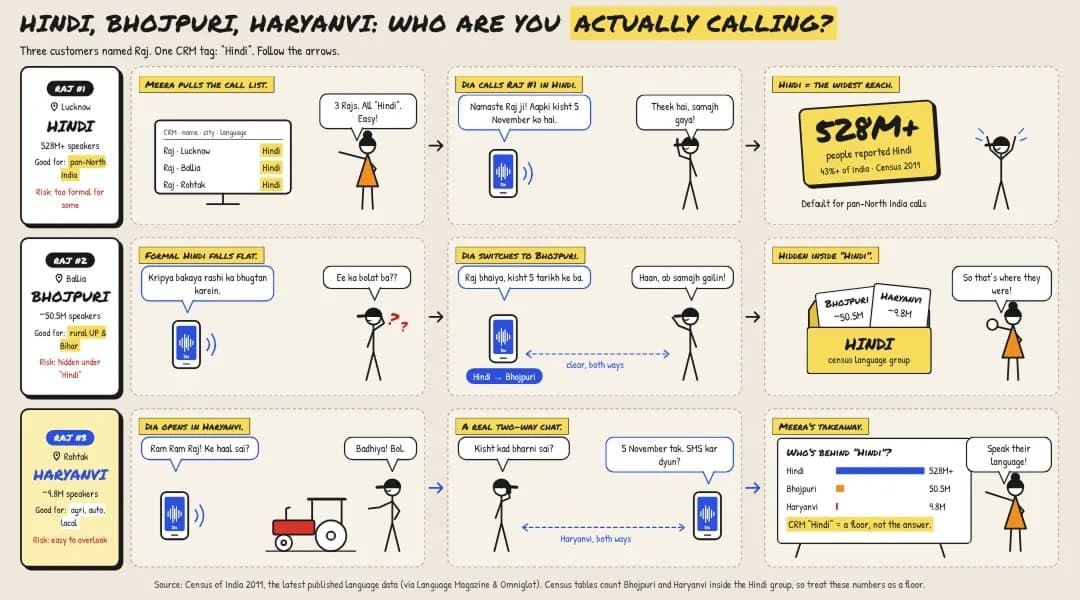
Hindi gives you the widest reach in North India, while Bhojpuri and Haryanvi are large regional audiences that official data often folds into Hindi, which makes them easy to underestimate. According to the 2011 Census, more than 528 million people (over 43% of India’s population) reported Hindi, as reported by Language Magazine.
The same census counted about 50.5 million Bhojpuri speakers, concentrated in western Bihar, eastern Uttar Pradesh, and parts of Jharkhand. Haryanvi had roughly 9.8 million speakers in 2011, according to Omniglot’s summary of census data, mainly in Haryana, Delhi, and western UP.
Variety | Core region | 2011 Census speakers | Where it fits best |
Hindi | Entire Hindi belt | 528 million+ | Default for pan-North India calls, formal notices |
Bhojpuri | Purvanchal, western Bihar, Jharkhand | About 50.5 million | Rural and semi-urban customers in UP and Bihar |
Haryanvi | Haryana, Delhi NCR outskirts, western UP | About 9.8 million | Agri, auto, and local service customers in Haryana |
There’s a practical wrinkle. The Census of India’s mother-tongue tables list both Bhojpuri and Haryanvi inside the Hindi language group. So a customer tagged “Hindi” in your CRM may well prefer Bhojpuri or Haryanvi on the phone. Treat these figures as a floor, since the 2011 Census is still the most recent published language data.
Text-to-Speech vs. a Full Voice Agent
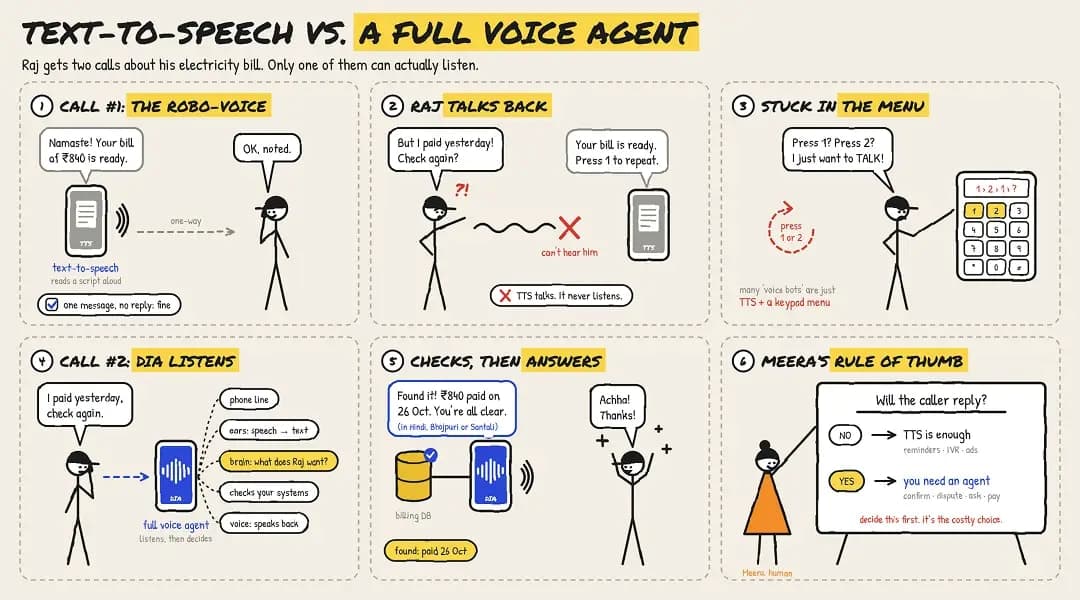
Text-to-speech only reads a prepared script aloud, while a voice agent listens to the caller, understands what they said, decides what to do, and replies in real time. Choosing between them is the first and most expensive decision you’ll make, so it’s worth getting right.
Text-to-speech (TTS) | Full voice agent | |
What it does | Converts text to audio | Holds a two-way phone conversation |
Components | Voice model only | Telephony, speech recognition, language model, TTS, integrations |
Typical uses | IVR prompts, broadcast reminders, announcements, ads | Collections, billing queries, support, bookings |
Can it answer questions? | No | Yes, within its instructions |
Setup effort | Low | Medium to high |
Some Hindi voice bots sold in India are really TTS plus a keypad menu, where callers press 1 or 2 instead of speaking. That works for one-way updates like “your bill is ready.” It breaks down the moment a caller says “I paid yesterday, check again.”
A simple rule: if the call has one message and no expected reply, Bhojpuri text to speech or Hindi TTS is enough. If the caller needs to confirm, dispute, ask, or pay, you need an agent.
How a Hindi-Belt Voice Agent Works, Step by Step
A voice agent chains several systems together in a loop that repeats every time the caller speaks. In most implementations, the pipeline looks like this:
Telephony connects the call. A cloud phone number or SIP trunk (the internet link between your system and the phone network) places or receives the call.
Speech recognition transcribes the caller. Automatic speech recognition (ASR) turns audio into text. Dialects, Hinglish, and noisy village lines make this the hardest step.
Language detection picks the reply language. The system decides whether to answer in Hindi, Hinglish, or a dialect, based on what it heard or on a stored preference.
A language model works out intent. Natural language understanding identifies what the caller wants, such as “pay later” or “wrong bill amount.”
Integrations fetch real data. The agent pulls the due amount, plan, or order status from your CRM, billing, or loan system through an API.
Guardrails check the response. Business rules block anything the agent isn’t allowed to say, like unapproved discounts or threatening language.
TTS speaks the reply. The chosen voice reads the answer in the right variety and tone.
Logging and handoff close the loop. The transcript, summary, and outcome go to your CRM, and complex calls transfer to a human with full context.
Every step adds a little delay. Ask vendors for end-to-end response time measured on a real mobile call, not a browser demo. If you’re new to this category and want a slower walkthrough of these building blocks, would a beginner-level explainer help? Our Hindi AI voice agent guide covers the basics before you talk to vendors.
Use Cases: Collections, Billing, and Support
Collections, billing reminders, and customer support tend to be the best starting points for Hindi and dialect voice automation because they are high-volume, repetitive, and easy to script.
Collections and EMI Reminders
Picture a two-wheeler lender in Gorakhpur with thousands of accounts one or two EMIs behind. A Hindi AI calling agent can open in Bhojpuri to build rapport, verify identity, state the overdue amount clearly, and send a payment link by SMS or WhatsApp. It records a promise-to-pay date and schedules a follow-up only within permitted hours.
Tone matters more here than anywhere else. Firm and respectful works. Pressure tactics create complaints, and as covered below, Indian rules restrict them.
Billing and Payment Reminders
Utility bills, broadband renewals, insurance premiums, and school fees all follow the same pattern: amount, due date, payment option. A Haryana broadband provider, for example, could remind subscribers in Haryanvi and handle the common replies, such as “already paid” (check the system) or “send the link again” (resend it).
Customer Support
Inbound support covers order status, plan changes, complaint registration, and appointment booking. North Indian callers often mix English words into Hindi (“mera recharge fail ho gaya”), so code-mixing support matters as much as pure Hindi. When the issue goes beyond the script, the agent should hand off to a person rather than guess.
Accent and Tone Control: Making It Sound Local
Sounding local depends on three levers, in this order: the words in the script, the voice and its pacing, and the tone you set for each call type. Most teams start with the voice and skip the script, which is backwards.
Write in the dialect, not translated Hindi
A dialect voice cannot invent dialect vocabulary. If your script says "आपका भुगतान लंबित है," it will sound like a Hindi notice no matter which voice reads it. Write short, spoken sentences using local verb forms and forms of address, and test them aloud with people from the region.
Tune pace, pauses, and numbers
Most providers support SSML (Speech Synthesis Markup Language), a set of tags that control speed, pauses, and emphasis. Use it to slow down for amounts and dates. Write “₹4,850” as words in the script if the engine stumbles, and pause before the due date so it lands.
Match tone to the call
Call type | Tone | Example opening (in English for clarity) |
Early collections | Warm, matter-of-fact | “Just a reminder that your installment is due tomorrow.” |
Late collections | Calm, firm | “Your payment is now overdue. Can we fix a date today?” |
Billing | Neutral, quick | “Your bill of 650 rupees is due on the 10th.” |
Support | Patient, helpful | “Tell me what went wrong and I’ll check right away.” |
Mix Hindi and dialect on purpose
Bhojpuri voice AI works best when you decide where the dialect adds value. Many teams use the dialect for greetings and small talk, then switch to clear Hindi for amounts, legal terms, or policy details that customers might later quote. Better still, ask customers on the first call which language they prefer and store it.
For marketing audio, a Haryanvi voice generator can produce recorded prompts and short ads. For live calls, the same voice needs to sit inside the agent so the opening and the conversation sound consistent.
Indian Calling Rules to Check Before You Automate
Automated calls in India fall under telecom, banking, and data-protection rules, and a voice agent generally has to follow the same rules a human caller would. This section is a starting checklist, not legal advice.
TRAI number series. TRAI’s July 2026 press note says the 1600 series is mandated for service and transactional calls by regulated BFSI entities, while 140-series numbers are required for promotional calls from any sector. Customers who block a sector on the DND registry won’t receive 140-series promotional calls from it.
RBI recovery hours. The RBI has told banks, NBFCs, and other regulated entities that they and their agents must not call borrowers before 8 am or after 7 pm for overdue loans, as reported by Deccan Herald. Newer draft RBI directions, reported by Moneylife in 2026, propose recording recovery calls and keeping records for at least six months.
DPDP Act and Rules. The government notified the Digital Personal Data Protection Rules in November 2025 with an 18-month phased rollout, according to PIB. Most data fiduciary obligations, including notice and consent requirements, apply from May 13, 2027, per a TaxGuru breakdown.
Disclosure. Telling callers they’re speaking with an automated assistant, and that the call is recorded, is good practice that heads off complaints.
Your voice platform should let you set calling windows, enforce DND checks, store recordings, and export call logs for audits. Ask your compliance team to sign off on scripts before launch.
Limitations: What Dialect Voice AI Can’t Do Well Yet
Dialect voice AI is strong at reading good scripts and handling predictable calls, but it still struggles with recognizing heavy local speech, emotional conversations, and anything outside its instructions. Knowing this upfront saves you from a bad pilot.
Listening lags speaking. In many systems, dialect TTS is ahead of dialect speech recognition. Agents often understand Bhojpuri or Haryanvi callers through Hindi-trained models, and accuracy drops with thick accents, background noise, or poor network audio.
Local variation is real. Bhojpuri in Ballia differs from Bhojpuri in Bhojpur district, and diaspora varieties differ again. One voice won’t suit every area.
Smaller voice libraries. Depending on the provider, you may get only a handful of Bhojpuri or Haryanvi voices compared with dozens in Hindi.
Sensitive calls need people. Bereavement, medical hardship, fraud claims, and angry disputes are poor fits for automation.
Model mistakes happen. Without strict guardrails and live data lookups, a language model can state a wrong amount or invent a policy.
There’s also a fit question. If most of your customers are salaried professionals in Noida or Gurugram, a dialect voice may feel odd or even patronizing. Plain Hindi or Hinglish is the safer default for that audience, and Bhojpuri text to speech belongs with the customers who actually speak it at home.
How to Evaluate a Voice AI Vendor
The most reliable test of a Hindi or dialect voice vendor is a blind listening and calling test with native speakers from your own customer base, run on real phone lines. Lab accuracy numbers rarely reflect a noisy call from a tractor shed.
What to test | How to test it | Red flag |
Dialect authenticity | Native listeners rate samples blind | “Sounds like Hindi with some dialect words” |
Speech recognition | Play recordings of your real customers | Only quotes lab accuracy figures |
Response time | Call from a mobile on 4G | Long silences after each reply |
Code-mixing | Speak Hinglish mid-sentence | Agent asks you to repeat in “pure” Hindi |
Numbers and dates | Test amounts like ₹12,450 | Reads digits one by one |
Integrations | Ask for CRM, payment link, WhatsApp support | Everything needs custom work |
Compliance | Ask about calling windows, recording, DND | Vague answers |
Human handoff | Ask for a live transfer during the demo | Transfer drops context |
What Drives the Cost
Many voice AI vendors in India price per connected minute, and your total depends on call volume, average call length, telephony charges, and how much integration work you need. Custom voice creation, dedicated numbers, and data residency requirements can add to the bill.
The more useful metric is cost per outcome. Divide your monthly spend by promises-to-pay secured, bills paid, or tickets closed, then compare that with the same metric for your human team. Short, well-scripted calls usually cost less per outcome than long, open-ended ones.
Deploying Your Voice Agent: From Pilot to Rollout
A safe rollout starts with one call type, one region, and a small slice of customers, then expands only after native speakers and your compliance team approve. Here’s a sequence that works for most North Indian businesses:
Pick one call type. Early-stage EMI reminders or bill reminders are good first choices.
Map your audience. Use district, pin code, or past call notes to estimate who prefers Hindi, Bhojpuri, or Haryanvi.
Write and review scripts. Draft in each variety, then get native-speaker and compliance review.
Connect systems. Link the agent to your CRM, billing, or loan management system and your payment link provider.
Set guardrails. Define calling windows, retry limits, banned phrases, and escalation triggers.
Run a pilot. Call a small batch, listen to recordings daily, and compare outcomes against a human control group.
Expand gradually. Add regions, varieties, or call types only after the pilot numbers hold.
Customer bases rarely stay in one language. A Patna-based lender may also serve Bihari migrants in Pune, and a Haryana distributor may get Punjabi-speaking callers. For that kind of mix, OnDial’s Multilingual AI voice agent page explains how automatic language detection and switching work across the languages it supports.
Start With the Call Your Team Dreads Most
The quickest way to see value from Hindi and dialect voice automation is to automate the repetitive call your team likes least, usually early-stage reminders, and measure the results against your current process. Native-sounding audio, clean scripts, and solid compliance settings matter more than any feature list.
The fairest test of any platform is hearing it handle your own script with your own customers’ accents. OnDial builds Hindi and Hinglish voice agents for inbound and outbound calls, with CRM sync and live-agent handoff. See the Hindi voice AI agent (India) page, book a demo with your collections or billing script, and ask whether a Bhojpuri or Haryanvi voice can be set up for your region.