A Santali AI voice generator turns written Santali into natural-sounding speech. Pair it with speech recognition and a phone line and it becomes a voice agent that can hold a real conversation in the caller’s own language. That matters for banks, government offices, and support teams working across Jharkhand, West Bengal, Assam, Mizoram, and Meghalaya. Most voice AI platforms stop at Hindi, English, and the largest regional languages, so millions of callers end up talking to systems that don’t speak their mother tongue. This guide covers what works today in Santali, Mizo, Garo, and Assamese, where the technology still falls short, and how to deploy an agent without wasting a pilot.
One clarification before we start. Santali is mainly spoken in Jharkhand and West Bengal rather than the Northeast, but Assam recorded 2,13,139 Santali speakers in the 2011 Census. Any organisation serving Assam has to plan for it alongside Assamese, Bengali, and Bodo. That is why this guide treats the four languages together: they share the same problem of thin training data and short vendor lists, even though Assamese is well ahead of the other three.
What Is a Santali AI Voice Generator?
A Santali AI voice generator is a text-to-speech (TTS) system that reads Santali text aloud in a synthetic voice, usually built from recordings of native speakers. TTS is the “mouth” of any voice product: you give it a sentence and it gives you back audio. On its own it cannot hear or understand anything a caller says in reply. That limits it to one-way jobs like IVR menu prompts, scheme awareness announcements, and recorded payment reminders.
If you only need a Santali voice maker for pre-recorded messages, TTS alone may be enough. You write the script, generate the audio, have a native speaker review it, and load it into your existing phone system. The bigger opportunity is a full voice agent. It adds automatic speech recognition (ASR), a language understanding layer, and business logic, so the system can answer questions and complete tasks. Most of this guide covers that second category, because that is where most organisations get a return.
Script is the first practical decision you will face. Ol Chiki is Santali’s official script, though the language is also written in Bengali-Assamese, Odia, Devanagari, and Latin letters. A TTS model trained on Ol Chiki text may mispronounce Devanagari input or reject it outright. Confirm which script a vendor’s model expects before your team writes a single prompt.
Why Santali, Mizo, Garo, and Assamese Are Underserved Online
These four languages are underserved because modern speech AI learns from large amounts of transcribed audio and digital text, and all four have far less of both than Hindi, Bengali, or Tamil. Speaker numbers are not the issue. The 2011 Census counted 1,53,11,351 people who returned Assamese, ranking it 12th among the 22 scheduled languages, and India recorded 7,368,192 Santali speakers in the same census. What these languages lack is machine-readable data, commercial attention, and in two cases, national-level recognition.
Garo and Mizo are smaller but far from tiny. The Central Institute of Indian Languages’ Sanchika collection puts the Garo figure at 1,145,323 as per the 2011 Census, and Mizoram officials say the state had more than 8.3 lakh Mizo speakers in 2011. Neither language is in the Eighth Schedule, and that affects how much public AI investment reaches them.
Language | Speakers in India (2011 Census) | Main regions | Common script | Official status |
Assamese | 15,311,351 | Assam | Assamese (Bengali-Assamese) | Scheduled language |
Santali | 7,368,192 | Jharkhand, West Bengal, Odisha, Bihar, Assam | Ol Chiki, plus Devanagari, Bengali-Assamese, Odia, Latin | Scheduled; additional official language in Jharkhand and West Bengal |
Garo | 1,145,323 | Meghalaya, Assam, Tripura | Latin | Non-scheduled; associate official language in the Garo Hills districts |
Mizo | 8.3 lakh+ (Mizoram alone) | Mizoram, Manipur, Tripura | Latin | Non-scheduled; official language of Mizoram |
Thin, Uneven Training Data
Speech recognition models get better as they see more hours of transcribed audio, and low-resource languages (languages with little digitised, labelled data) get only a sliver. The model card for ARTPARK-IISc’s open SraVaani model notes that fine-tuning data varies widely across its 63 supported languages, and that low-resource languages may see weaker accuracy as a result. You will see that pattern in the benchmark table later in this guide. Synthetic voices can sound polished even when recognition is weak, so a demo that only plays TTS samples tells you very little.
Scripts, Tones, and Dialects
Each of these languages has its own technical wrinkle. Santali spans several scripts, and it divides into northern and southern dialect spheres with slightly different sets of sounds. Mizo is tonal, so a syllable’s meaning shifts with its tone, and Garo includes dialects such as A·we, Am·beng, Matchi, Dual, and Chisak. A model trained on one variety can struggle with callers from the next district.
Official Status Shapes Investment
Government language programs usually start with the 22 scheduled languages. Bhashini supports the 22 scheduled languages plus several tribal languages, which puts Assamese and Santali inside the baseline. Mizo and Garo sit outside it, although Mizoram is again exploring inclusion of Mizo in the Eighth Schedule, and UNESCO classifies the language as vulnerable. For businesses, this means coverage of the two non-scheduled languages depends more on individual research projects and vendors than on a national pipeline.
How does this gap compare with better-resourced languages such as Tamil, Bengali, or Marathi? Those languages have years of public datasets behind them, so vendors can spend their effort tuning accents and code-switching instead of fighting for basic accuracy. If you want that wider picture before settling on a language strategy, the Vernacular voice AI pillar is a good next read on Indian-language voice agents in general.
How a Regional Language Voice Agent Works
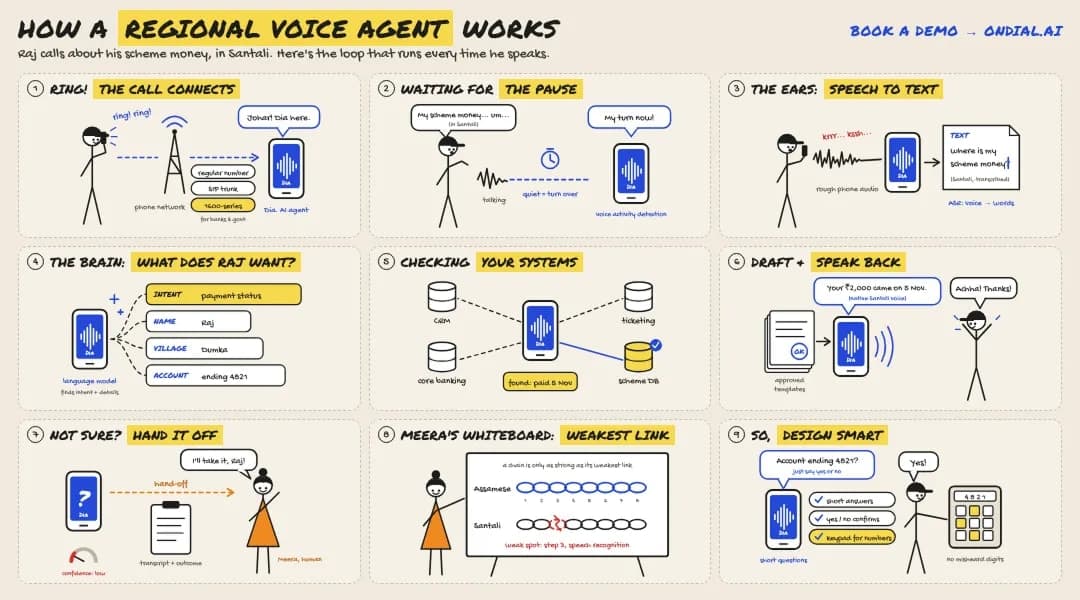
A regional language voice agent runs a fast loop every time the caller speaks: it listens, transcribes, works out what the caller wants, takes an action, and speaks a reply. Each stage can come from a different model or vendor, which is why quality varies so much between platforms. Here is the full pipeline:
The phone network connects the call through a regular number, a SIP trunk, or, for regulated financial entities and government bodies, a 1600-series number.
Voice activity detection listens for silence to decide when the caller has finished speaking.
ASR converts the caller’s speech into text in their language, often from narrowband phone audio that sounds much rougher than a studio recording.
A language understanding layer, often a large language model, identifies the intent and pulls out details such as a name, a date, a village, or an account reference.
Business logic checks the request against your systems, such as a CRM, core banking, a ticketing tool, or a scheme database.
The agent drafts a reply in the target language, ideally from approved templates for anything regulated.
TTS speaks the reply in a native-sounding voice.
The system logs the transcript and outcome, and hands the call to a human when confidence drops or the caller asks for a person.
A chain like this is only as strong as its weakest link. For Assamese, most steps work reasonably well today. For Santali, step 3 is the bottleneck, so the smart move is to design conversations that need less open-ended recognition: short answers, confirmations, and keypad input for numbers.
Voice Quality by Language: What to Expect Today
Based on the limited public benchmarks available in 2026, expect near-production recognition in Assamese, promising but thinly tested results in Mizo and Garo, and pilot-stage recognition in Santali. Word error rate (WER) is the share of words a speech recognizer gets wrong, so lower is better. A WER of 10 percent means roughly one word in ten is misheard. The table below uses figures from the open SraVaani model card, one of the few public sources that reports all four languages side by side.
SraVaani reports an average WER of 19.4 for Assamese, 57.3 for Santali, 25.3 for Mizo, and 9.5 for Garo, against 12.4 for Hindi.
Language | Average WER (SraVaani) | Test data behind the figure |
Hindi (reference) | 12.4% | Eight public test sets |
Garo | 9.5% | Vaani only |
Assamese | 19.4% | CommonVoice, FLEURS, Vaani |
Mizo | 25.3% | Vaani only |
Santali | 57.3% | Vaani only |
Read these numbers as direction, not as a promise. They come from one open model, and three of the four languages were scored on a single test set. Commercial systems trained on more data may do better, and real phone calls from rural areas may do worse. The useful signal is the relative order, plus the warning that Santali recognition needs careful conversation design.
Santali
Santali recognition is the weakest of the four today, so plan around it rather than waiting for it to improve. A Santali AI voice generator can already produce clear, intelligible speech, which is why many teams start with outbound reminders and announcements where the caller only presses a key or says yes or no. Geography helps you focus: 44.38 percent of India’s Santali speakers live in Jharkhand, so a Jharkhand-first pilot reaches the largest single group.
Numbers need special handling. Some Santali numbers follow a base-20 system, which can trip up models built around base-10 patterns in Hindi or English. Read amounts and dates back to the caller, and collect account numbers and PINs through the keypad rather than by voice.
Mizo AI Voice: Tones Decide Meaning
Mizo is a strong candidate for a voice agent because one language covers most callers in Mizoram. Mizo shares official status with English in Mizoram, so a bilingual Mizo and English agent fits how many callers already switch between the two. The 25.3 percent benchmark WER is workable for structured calls, though it comes from a single test set.
Tone is the quality test that matters most. A synthetic voice that gets the words right but flattens the tones can sound wrong to a native listener, or say something different from what you intended. Before you sign with any vendor, have three or four native speakers from different parts of the state rate sample sentences that include easily confused tonal pairs.
Garo AI: Promising Numbers, Narrow Evidence
Garo has a clear institutional home, which makes a public-service voice agent in western Meghalaya easier to justify. Under the Meghalaya State Language Act, 2005, Garo is an associate official language in the five Garo Hills districts. The 9.5 percent benchmark WER looks excellent, but it rests on one test set, so validate it on your own call recordings before you rely on it.
Plan for multilingual callers too. South West Garo Hills district recorded 88,216 Garo speakers, 45,586 Bengali speakers, and 10,292 Hajong speakers in 2011. An agent serving that district should recognise when a caller is speaking Bengali and route them correctly, instead of forcing a Garo-only flow.
Assamese AI Voice: The Most Mature of the Four
Assamese is the easiest of the four to deploy today, because it is a scheduled language with a large speaker base and the most public training data. Assamese speakers made up 48.38 percent of Assam’s population in 2011, which means a statewide agent will meet plenty of Bengali, Bodo, and Hindi speakers as well. Recognition near 19 percent WER on public sets is a reasonable starting point for structured calls.
The main risks are pronunciation and code-mixing. Assamese and Bengali share a script, so in some systems Assamese TTS borrows pronunciation habits that native listeners spot right away. Test the voice on local place names, honorifics, and the English terms your callers actually use, such as “EMI,” “KYC,” and “OTP.”
Government, Banking, and Support Use Cases
The strongest early use cases are high-volume, repetitive calls where the caller needs one piece of information or one action, such as scheme status, a payment reminder, or a delivery confirmation. These calls have predictable vocabulary, which offsets weak recognition. They also free human staff for the complex or sensitive calls that still need judgment.
Government and Public Services
Public departments are natural early adopters because they field the same questions over and over, often from callers who are least comfortable in Hindi or English. Picture a block office in Jharkhand’s Santal Pargana region that gets repeat calls every week about pension payment status. A Santali agent can check status against a database, read the result back, and log a grievance when something is wrong. Government interest is growing as well: the Ministry of Tribal Affairs has launched Adi-Vaani, an AI platform for translating and preserving tribal languages including Santali, Bhili, and Gondi.
Other good government fits include application status checks, camp and enrolment date announcements, document checklists for scheme applications, and outbound awareness calls in the district’s dominant language. Keep the agent informational at first. Decisions that affect a citizen’s entitlement should stay with officials.
Banking and Financial Services
Banks, NBFCs, cooperative banks, and regional rural banks can use regional language agents for EMI reminders, KYC document follow-ups, branch timing queries, and loan application status. Caller trust is the main barrier, and the regulator has been tightening the rules here. TRAI set phase-wise deadlines for moving service and transactional calls to the 1600 series: January 1, 2026 for commercial banks, February 1, 2026 for large NBFCs, payments banks, and small finance banks, and March 1, 2026 for remaining NBFCs, cooperative banks, and regional rural banks. Any outbound voice agent at a regulated entity should run on that numbering.
Design the banking agent so it never asks for an OTP, PIN, or full card number. Callers in these regions are targeted by impersonation fraud like everyone else, and a bot that requests secrets teaches them a dangerous habit. Route disputes, fraud reports, and hardship conversations straight to a trained human.
Customer Support and Commerce
Retail, logistics, healthcare, and telecom teams handle large volumes of simple calls that work well in the local language. A northeast India voice bot for a courier company might call a customer in Tura, confirm the delivery address in Garo, and reschedule if nobody will be home. A clinic network in Guwahati could confirm appointments in Assamese and send reminders the day before. These calls are short, the outcomes are easy to measure, and a misunderstanding costs little because a human can follow up.
Voice Generator vs. Voice Agent vs. Traditional IVR
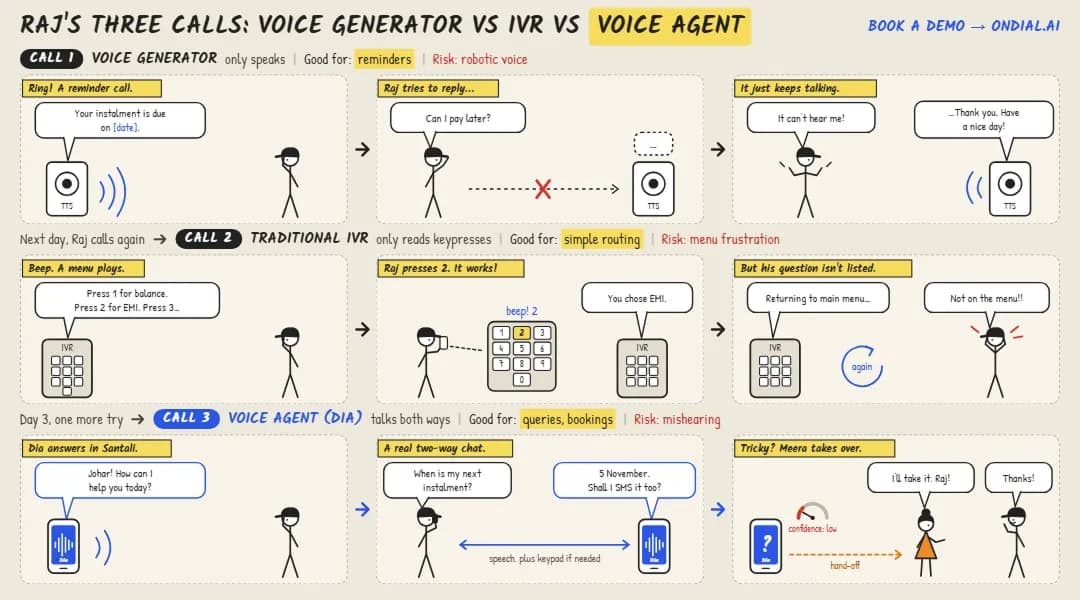
A voice generator only speaks, a traditional IVR only listens for keypresses, and a voice agent holds a two-way spoken conversation, so the right choice depends on whether callers need to say something back. Many deployments in low-resource languages mix all three. For example, an agent can speak Santali, accept keypad input for numbers, and hand off to a human for anything unusual.
Factor | Voice generator (TTS only) | Traditional IVR | Voice agent |
What it does | Speaks prepared text | Plays menus, reads keypresses | Understands speech and responds |
Caller input | None | Keypad only | Natural speech, plus keypad fallback |
Best for | Announcements, reminders | Simple routing | Queries, status checks, bookings |
Setup effort | Low | Low to medium | Medium to high |
Readiness in Santali | Usable now | Usable now | Pilot with tight scripts |
Main risk | Unnatural voice | Caller frustration with menus | Misrecognition in low-resource languages |
Cost and Fit: Is a Tribal Language Voice Agent Right for You?
Pricing for regional language voice agents usually depends on call minutes, the number of languages, custom voice work, and integration depth, and low-resource languages often add data collection and testing costs on top. Ask vendors to quote these items separately so you can compare like with like. Treat a quote that bundles everything into one per-minute rate with caution until you know what testing it includes.
The main cost drivers to ask about:
Per-minute or per-call usage charges for inbound and outbound traffic
Whether each additional language costs extra, and whether Santali, Mizo, or Garo carry a premium
Custom voice creation, if you want a voice that matches your brand or region
Integration with your CRM, core banking, or ticketing system
Native-speaker testing and transcript review during the pilot
Telephony costs, including 1600-series numbers for regulated entities
Not every organisation should automate tribal-language calls right now. If your Santali or Garo call volume is small, one trained bilingual staff member may be cheaper and kinder to callers than a bot that mishears every third word. The same goes for teams whose calls are mostly complaints, disputes, or emotional conversations. Voice agents earn their keep on volume and repetition, not on delicate one-off cases.
How to Deploy a Santali or Northeast Language Voice Agent
You can deploy a regional language voice agent in eight steps, from choosing one narrow call type to scaling after a supervised pilot. The order matters, because each step reduces the risk of the next. Skipping the testing steps is the most common reason pilots in low-resource languages fail.
Pick one call type with a clear, measurable outcome, such as payment reminders or application status checks, in one language and one district.
Collect a few dozen real call recordings in that language and dialect, with consent, so you can test vendors on your own audio instead of their demos.
Run live phone tests with native speakers from the target area, and score vendors on task completion rather than on how polished the voice sounds.
Write scripts with native speakers, and feed the Santali AI voice generator text in the script it was trained on, whether that is Ol Chiki or Devanagari.
Build fallbacks: keypad input for numbers, read-back confirmation for amounts and dates, and a human handoff after two failed attempts.
Handle compliance up front. The DPDP Rules bring notice, verifiable consent, security safeguards, and breach-reporting obligations into force 18 months after publication, which falls on 14 May 2027 under MeitY’s staggered schedule, so build consent notices in the caller’s language now.
Pilot with supervision for several weeks, review transcripts every week, and fix the phrases the agent mishears most often.
Scale to more call types or districts, and add a second language only after the first one hits your target completion rate.
Limitations: What Tribal and Northeast Language Voice AI Can’t Do Yet
Today’s voice AI for Santali, Mizo, Garo, and Assamese cannot reliably handle open-ended conversations, heavy dialect variation, or noisy rural calls without human backup. Knowing these limits up front helps you design around them instead of finding them in production. Most of the gaps below are data problems that will narrow over time, but they are real in 2026.
Recognition accuracy in Santali is far below Hindi or Assamese in public benchmarks, so free-form questions often fail.
Benchmarks for Mizo and Garo rest on narrow test sets, and real performance on your callers may differ.
Dialect coverage is patchy, and a model tuned on one variety may misunderstand callers from another district.
Tonal errors in Mizo synthesis can change meaning, which matters most for instructions and amounts.
Code-switching between these languages and Hindi, Bengali, or English is handled inconsistently across providers.
Proper nouns such as village names, clan names, and local landmarks are frequent recognition failures.
Sensitive calls about health, money trouble, or grievances need human empathy that current agents do not provide.
Voice cloning of a real local speaker raises consent and misuse questions that need written agreements before you use it.
Start With One Language and One Call Type
The fastest way to get value from Northeast and tribal language voice AI is to automate one call type in one language, prove it with real callers, and then expand. Pick the language where your call volume is highest and the conversation is most predictable. Measure task completion, not how impressive the voice sounds in a demo.
Vendors that publish language-specific agent pages make that first test easier, because you can judge them against your own scripts and recordings. OnDial, for example, offers a Santali voice AI agent (Jharkhand) and a Mizo voice AI agent (Mizoram) built for those two markets. Book a demo, bring ten real call recordings from your callers, and ask to see the agent handle them live before you sign anything.