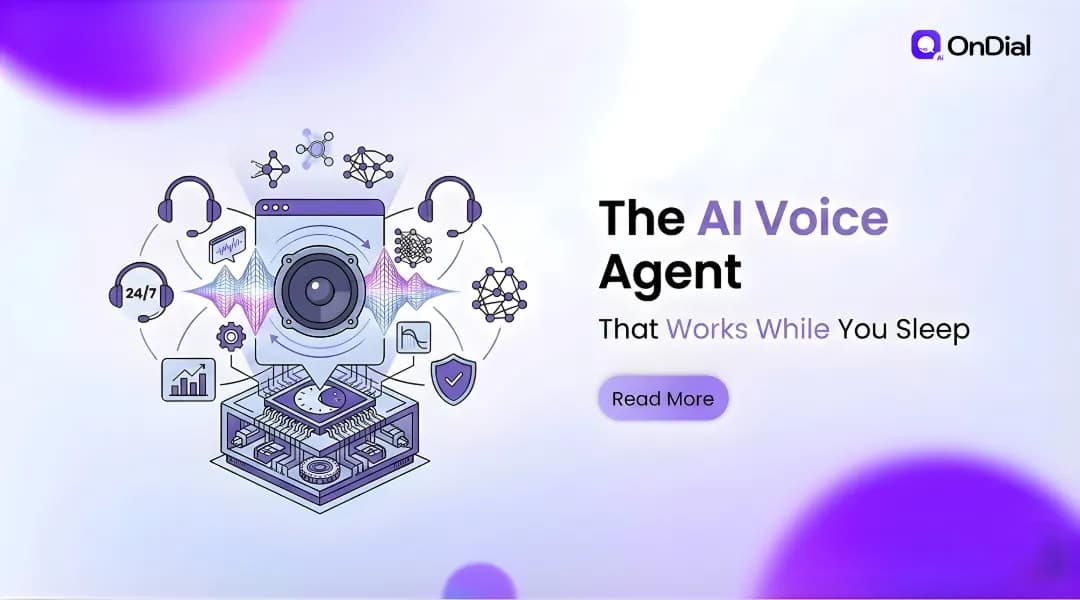
A business does not stop receiving calls just because the team has gone home.
Customers may need help late at night. A prospect may respond to an advertisement after dinner. Someone may want to reschedule an appointment before starting work in the morning. During weekends, holidays, product launches, and seasonal peaks, call demand can continue when human availability is limited.
That creates a simple business problem: the customer is ready to talk, but nobody is available to answer.
AI voice agents change that equation by giving businesses a way to handle phone conversations around the clock. They can answer calls, understand what the caller needs, provide information, capture details, schedule appointments, qualify leads, and transfer conversations to people when human judgment is required.
The important point is not that AI can talk all night. The real value is that a business can remain responsive when its employees are unavailable.
What Does an AI Voice Agent Do After Hours?
An AI voice agent is software that can conduct spoken conversations with customers over the phone.
Unlike a traditional IVR that sends callers through fixed menu options, a conversational voice agent can interpret natural language, ask follow up questions, use business information, and take actions based on the conversation.
For example, a customer might call an online retailer at 11:30 PM and ask where an order is.
Instead of hearing a message asking the customer to call again during business hours, the AI can identify the customer, retrieve relevant order information, explain the current status, and provide the next step.
The same approach can work for appointment requests, product questions, lead qualification, delivery updates, basic support, surveys, reminders, and many other repetitive conversations.
Businesses looking to understand the broader technology can explore OnDial AI Voice Agents and see how voice conversations connect with business workflows.
Why Businesses Lose Valuable Calls at Night
The problem with missed calls is not limited to the call itself.
A missed call can represent a potential sale, an existing customer who needs assistance, an appointment that could have been booked, or a problem that could have been resolved before it became a complaint.
Customers Have Their Own Schedules
People do not necessarily contact a business when the business wants them to.
A customer may have time to compare products after work. A patient may remember an appointment issue early in the morning. A property buyer may want information after browsing listings at night.
The customer's intent exists independently of office hours.
If the business cannot respond at that moment, the customer may postpone the decision, abandon the interaction, or contact another provider.
Human Teams Have Capacity Limits
Even businesses with strong support teams face practical limitations.
Employees need breaks, weekends, holidays, and predictable working hours. Adding another shift also introduces recruitment, training, management, and scheduling requirements.
AI voice agents can absorb predictable call volume outside normal operating hours while human employees remain responsible for conversations that genuinely require judgment.
Peak Demand Makes the Problem Worse
After hours is only one part of the challenge.
A campaign can suddenly generate hundreds of inquiries. A sale can increase support calls. A service disruption can cause a large number of customers to call simultaneously.
The issue is often not a lack of people. It is the mismatch between call demand and available capacity.
How an AI Voice Agent Handles a Call While Your Team Is Offline
The process is more practical than it sounds.
Step 1: The Call Is Answered
The customer calls the business number and the AI agent answers.
There is no requirement for an employee to manually pick up the call. The agent can operate according to the business rules defined for that particular workflow.
Step 2: The Agent Understands Intent
The caller explains what they need using natural speech.
The AI identifies the intent rather than relying only on a menu selection. It can distinguish between questions about an order, a booking request, a sales inquiry, a support issue, or a request that requires escalation.
Step 3: The Agent Collects the Required Information
The conversation can include relevant questions.
For a sales inquiry, the agent may collect product preferences and buying requirements. For an appointment, it may collect the preferred date and time. For support, it may gather account or issue details before determining the next step.
The goal is to collect only the information needed for the workflow.
Step 4: The Agent Takes Action
This is where voice automation becomes more useful than a basic answering system.
The AI can connect with business systems and trigger actions such as appointment scheduling, lead capture, notifications, customer record updates, or follow up workflows.
The customer does not simply receive an answer. The conversation can move the underlying business process forward.
Step 5: Complex Calls Go to Humans
AI should not be expected to handle every situation independently.
Sensitive complaints, complex negotiations, unusual requests, or conversations requiring human judgment may need escalation.
A well designed voice workflow should make that handoff easy. The human agent can receive relevant context instead of asking the customer to repeat the entire conversation.
Where 24/7 AI Voice Agents Create the Most Value
The strongest use cases are generally situations where customers ask predictable questions or need straightforward actions.
Customer Support
AI voice agents can handle common support questions outside normal working hours.
Examples include order status, service information, account questions, basic troubleshooting, delivery updates, and frequently requested policies.
The human team can then focus on cases that require deeper investigation.
Sales and Lead Qualification
Sales opportunities can lose momentum when an interested prospect has to wait until the next business day.
An AI agent can respond immediately, ask qualifying questions, capture lead information, and route high intent opportunities to the appropriate sales team.
This is especially useful when advertising, social media, search, or other campaigns generate inquiries at unpredictable times.
Appointment Scheduling
An appointment request is often time sensitive.
Instead of collecting a request and asking someone to call back later, an AI voice agent can handle the scheduling conversation directly when connected to the appropriate calendar or scheduling workflow.
This can be useful for healthcare providers, service businesses, education providers, real estate teams, hospitality businesses, and professional services.
Retail and E Commerce
Retail businesses can receive questions about products, orders, deliveries, returns, and availability at any time.
For these companies, AI voice agents for retail and e commerce can extend customer communication beyond the hours of a traditional support desk.
The value becomes even clearer during promotions and seasonal demand, when call volume can rise quickly.
Reminders and Follow Up
Not every valuable call is inbound.
Businesses can also use AI voice agents for outbound reminders, confirmations, surveys, customer follow ups, and lead re engagement.
The system can follow a defined workflow while recording the outcome for the next step.
AI Voice Agents and Indian Businesses
India presents a particularly interesting environment for voice automation because phone communication remains central to customer interactions across many industries.
Customers may also switch between English, Hindi, Hinglish, and regional languages during the same conversation.
For businesses serving multilingual audiences, voice automation needs to account for how people actually speak rather than assuming that every caller communicates in formal English.
The experience should also be designed around local business requirements, customer consent, data protection, telephony practices, and appropriate escalation processes.
A useful AI voice agent is not simply one that speaks multiple languages. It needs to understand the business context behind the conversation and respond appropriately.
What AI Voice Agents Should Not Do
The strongest implementation is not the one that tries to automate everything.
AI voice agents should have clear boundaries.
A customer asking a simple order question may not need a human. A customer making a sensitive complaint may.
A prospect asking about basic product information can be qualified automatically. A complex commercial negotiation may require an experienced salesperson.
A routine appointment can be scheduled by AI. A medically sensitive conversation may require appropriate human involvement.
These boundaries should be defined before deployment.
The objective is not maximum automation. It is useful automation.
How to Measure Whether 24/7 Voice Automation Is Working
Businesses should evaluate an AI voice agent using operational and customer outcomes rather than call volume alone.
Useful metrics include:
Answer Rate
How many incoming calls receive an immediate response?
Resolution Rate
How many conversations are successfully completed without human intervention?
Escalation Rate
How frequently does the AI need to transfer conversations to employees?
Lead Capture
How many previously missed inquiries become identifiable leads?
Appointment Completion
How many calls result in confirmed appointments or useful scheduling outcomes?
Customer Experience
Are customers finding the conversations clear, efficient, and easy to complete?
Operational Impact
How much repetitive work is removed from the human team?
These measurements provide a more realistic view of whether the system is improving the business.
AI Voice Agents vs Traditional After Hours Support
Traditional after hours support usually depends on one of three approaches.
The first is voicemail, which records the request and waits for a human callback.
The second is an outsourced or internal night team, which provides human coverage but increases operational complexity.
The third is a basic automated phone menu, which provides limited information but may not understand natural conversations.
AI voice agents introduce another option.
They can provide conversational coverage while connecting the phone interaction to business systems. That means the customer can potentially complete a task during the conversation instead of simply leaving a message.
The right choice depends on call complexity, customer expectations, compliance requirements, business hours, and the level of human involvement required.
The Best Model Is Usually AI Plus Humans
The idea that businesses must choose between AI and people misses the practical opportunity.
AI is well suited to repetitive, structured, high volume conversations.
Humans are better suited to complex decisions, sensitive conversations, relationship building, negotiation, and exceptions.
A blended model lets each handle the work it is best equipped to perform.
AI can answer the initial call, understand intent, collect information, complete routine actions, and provide context. A human can then step in when the situation needs judgment.
That creates a more resilient customer communication system without requiring every interaction to be automated from beginning to end.
How to Start Using an AI Voice Agent
Businesses do not need to automate their entire phone operation on day one.
Start with one clear problem.
For example, identify the calls that arrive after business hours and determine which ones are repetitive. Review the questions customers ask, the information employees need to collect, the actions that should happen after each conversation, and the situations that require escalation.
Then build one focused workflow around that use case.
Measure the results.
If the system successfully handles those conversations, expand into additional workflows such as lead qualification, appointment scheduling, customer support, reminders, surveys, or outbound follow ups.
This approach makes automation easier to test, improve, and govern.
The Business Case for a Phone That Never Sleeps
The biggest advantage of an AI voice agent is not that it stays awake while employees sleep.
It is that customers can continue moving through a business process even when the human team is unavailable.
A late night sales inquiry can become a qualified lead. An appointment request can become a confirmed booking. A support question can receive an immediate answer. A routine request can be resolved without entering a morning queue.
For businesses with meaningful phone volume, that responsiveness can change how customer communication operates.
The technology works best when it is connected to real workflows, given clear boundaries, and measured against business outcomes.
For businesses exploring that model, OnDial provides AI voice agents for inbound and outbound conversations, customer support, lead qualification, appointment scheduling, and other phone based workflows.
The goal is simple: when a customer decides to call, the business should be ready to respond.