Roughly 40% of all appointment bookings happen outside normal business hours, according to Gartner consumer research cited widely across the industry. That means almost half of your potential customers are trying to reach you when no one is sitting at the desk to pick up. If you have ever wondered whether AI appointment scheduling can actually catch those calls, or whether it is just clever marketing, you are asking exactly the right question.
Here is the honest version. AI appointment scheduling works by answering a live phone call, understanding what the caller wants, checking your real calendar in real time, offering open slots, and writing the confirmed booking straight into your system, usually in under a minute. No hold music. No callback queue. (And no receptionist staying late to clear voicemails.)
I have spent years at OnDial building voice AI that does precisely this for Indian businesses, and the mechanics are far less mysterious than most vendors make them sound. In this guide I will walk you through every step from the moment the phone rings to the moment the slot is locked, where the technology is genuinely strong, and where it still needs a human in the loop.
What AI Appointment Scheduling Actually Does
From a missed call to a booked slot
AI appointment scheduling lets a voice agent book, confirm, or reschedule an appointment during a live conversation, without a human at the desk. The agent answers the phone, speaks naturally, and finishes the booking before the caller ever hangs up. Most of the friction that used to lose you customers simply disappears.
Compare that to the old way. A call comes in, the line is busy, the caller leaves a voicemail, and someone phones back two hours later only to play calendar tag over three more messages. By then a competitor has often booked the job. The whole point of an AI agent is to collapse that back-and-forth into a single conversation that ends with a confirmed slot.
Why this matters more in 2026
Here is something counter-intuitive: the biggest cost of bad scheduling is not the appointments you handle badly, it is the calls you never answer at all. Phone leads convert far more often than web-form leads, yet they are the first thing a stretched front desk drops during a busy stretch. Every unanswered ring is a customer who was ready to commit.
That is why AI receptionist scheduling has moved from novelty to default infrastructure. SchedulingKit's 2026 analysis found that AI phone answering systems cut missed calls by around 75%, with a meaningful share of businesses eliminating them entirely. When the phone is always answered, the math changes for almost any appointment-driven business.
How AI Appointment Scheduling Works on a Phone Call
The five steps from call to calendar
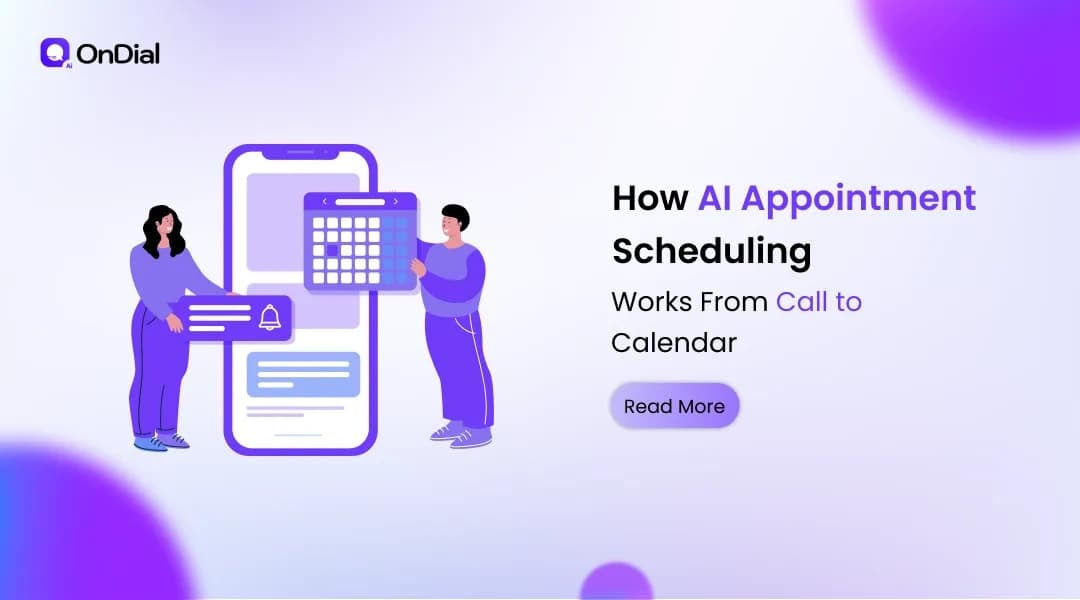
On a phone call, AI appointment scheduling works in five steps: the agent answers, asks what the caller needs, checks your live calendar for open slots, offers specific times, and writes the confirmed booking into your calendar with a text confirmation, usually within sixty seconds. That snippet is the whole loop in one breath.
Walk through it slowly and each step has a job. First, the agent greets the caller in your business name. Second, it qualifies the request, asking whether this is a repair or a new install, a first visit or a follow-up. Third, it reads your real availability. Fourth, it offers two or three concrete times rather than a vague "when works for you." Fifth, it confirms and locks the slot.
What the caller hears versus what happens underneath
What the caller hears is a smooth conversation. What happens underneath is a short technical pipeline. The agent's speech-to-text layer turns the caller's words into text, an NLP model extracts intent and details like date, service type, and name, a calendar API query checks open slots, and a text-to-speech layer voices the response back. All of it runs in the gap between sentences.
The detail that separates a real system from a demo is real-time availability. A genuine agent queries your calendar at the exact moment of the call, so if a slot was taken thirty seconds ago by another caller, it is no longer offered. In projects I have run at OnDial, this single behaviour is what earns a business's trust, because nothing erodes confidence faster than a double booking.
Real-Time Calendar Integration and CRM Sync
Which calendars and tools connect
Real-time calendar integration is what turns a talkative bot into a working scheduler, and most agents connect through standard tools you already use. Common integrations include Google Calendar and Outlook via OAuth, plus scheduling layers like Calendly and Cal.com. You usually do not need to abandon your existing stack to get started.
After the call, the data does not just sit in the calendar. A webhook typically fires on call completion and pushes the booking, with caller name, phone number, and service notes, into your CRM or notification system. That is how the appointment reaches the technician's job sheet without anyone retyping anything.
How double-booking is prevented
The integration is two-way, which is the part that matters. The agent reads your availability and writes new appointments back to the same calendar, so if you block lunch or mark yourself busy, those slots are never offered. One source described it plainly: the booking appears in your calendar the instant the caller confirms.
Should you trust that to never collide? Mostly, yes, with one caveat. Calendly-style integrations are often tied to a single user rather than an organisation, so a five-person team that each runs a personal calendar may need native scheduling or a multi-calendar setup instead. This is a question worth asking any vendor directly before you sign.
Can an AI Voice Agent Reschedule or Cancel Appointments?
Handling changes mid-lifecycle
Booking is the easy part. The fuller test of an AI voice agent booking system is whether it can manage the whole appointment lifecycle, including reschedules and cancellations. A strong agent reads the existing booking, finds a new slot, updates the calendar, and resends confirmation, all in the same call.
This matters because the appointment that gets changed is often the one that would otherwise become a no-show. When a patient or customer can move a slot in thirty seconds instead of giving up, that revenue stays on your books rather than walking out the door.
The limits worth knowing
Now the honest part. Real users on platform forums have flagged that rescheduling and cancellation are not universal yet, and some agents still collect only an email address rather than a name, phone number, or date of birth. For a clinic serving older patients who rarely use email, that is a real gap, not a footnote.
So treat the feature list as a checklist, not a given. Confirm that rescheduling, cancellation, recurring bookings, and the contact fields you actually need are supported before you commit. The platforms that win here are the ones honest about where a human still needs to step in, such as emergencies, billing disputes, or anything outside the scoped conversation.
What AI Booking Looks Like for Indian Businesses
Regional language and Hinglish booking
Here is the angle most global guides skip entirely. For an Indian business, the question is not only whether the agent books well, but whether it books in the language your customer actually speaks. A natural voice agent in 2026 handles Hindi, Hinglish, and the major regional languages, and a good one cannot be identified as a bot inside the first ten seconds.
I have seen this make or break adoption. At OnDial, the deployments that succeed are the ones where a caller's parent can finish a booking comfortably in their mother tongue without ever feeling routed to a machine. Voice quality and language coverage are not cosmetic features here, they are the conversion lever.
DPDP and TRAI DLT consent at the point of booking
There is also a compliance layer that no calendar-link tool ever had to think about. Every AI call generates personal data: voice recordings, transcripts, and CRM entries, all of which fall under the DPDP Act, now fully in effect with penalties reaching as high as ₹250 crore for significant breaches. Consent has to be built into the call, not bolted on afterward.
A compliant deployment captures clear, informed consent before processing personal data and aligns its outbound calling with TRAI DLT registration so numbers are not flagged or disconnected. Hospital and clinic booking specifically sits under both DPDP and TRAI DLT, with sectoral healthcare overlays on top. This is exactly the kind of detail OnDial treats as a launch requirement rather than a later patch.
Reducing No-Shows and Capturing After-Hours Demand
The after-hours problem
Remember that opening number. With around 40% of bookings happening after hours, a system that only works nine to five is leaving close to half its demand uncaptured. Research cited by industry analysts suggests most prospects who hit a closed booking system after hours never come back to finish.
An always-on agent closes that gap directly. The caller who rings at 10 PM to book next Tuesday gets a confirmed slot instead of a voicemail, and you wake up to a fuller calendar. This is usually where businesses see their first measurable gain, often within the first thirty days.
The reminder and confirmation cadence
The second lever is reducing no-shows with AI, and the data here is strong. A Peerlogic study across 26 dental and veterinary practices found roughly 38% fewer no-shows and about $47,000 in recovered revenue per location, largely from automated follow-up. In Indian healthcare, Caller Digital reports deployments cutting hospital no-shows from 32% to 12%.
The mechanism is a disciplined confirmation cadence: a reminder around 48 hours out, a confirm-or-reschedule call at 24 hours, and a final nudge near the appointment. Pair that with multi-channel confirmation across voice, WhatsApp, and SMS, and the patient leaves the conversation with something they can find again later. That is the difference between a booked slot and a kept one.
Conclusion
AI appointment scheduling stops being a black box the moment you can trace the path from call to calendar. Three things matter most: the agent must check your calendar in real time so double bookings never happen, it must confirm across voice and text so the slot actually sticks, and it must hand off cleanly when a conversation goes beyond booking.
You do not need to take anyone's word for how it works anymore. You know what good looks like, and you know which questions to ask a vendor. That clarity is worth more than any feature list.
If you run an appointment-driven business in India and want a voice agent that books in your customers' language with DPDP-aligned consent built in, the team at OnDial can walk you through a live call flow on your own calendar before you commit to anything.