Gartner projects that conversational AI will cut contact center labor costs by roughly $80 billion in 2026, and the share of agent interactions handled by automation is climbing from about 1.6% to 10%, a trend that is rapidly reshaping how AI voice agents for call centers and BPO operations are deployed at scale. That is not a rounding error. It is a signal that something structural is shifting on the contact center floor. If you have spent years refining call scripts and you feel skeptical about handing conversations to a machine, you are asking exactly the right questions.
Here is the short answer. Modern contact centers are replacing call scripts with AI conversations because scripts were always a compromise: they traded genuine problem-solving for consistency and control. Conversational AI, built on natural language understanding, now delivers that consistency without forcing agents or customers into a rigid box. Callers get answers that fit their actual problem, not the nearest scripted branch.
In this guide, I will walk through why scripts quietly started costing you customers, what conversational AI actually changes, the real business case behind the shift, and what all of it means for your human agents.
Why Call Scripts Quietly Started Costing You Customers
For decades, the rigid call script was the backbone of quality control. It promised uniformity, compliance, and a safety net for new hires. The trouble is that the same rigidity that made scripts feel safe is what makes them fail the moment a real conversation drifts off the expected path.
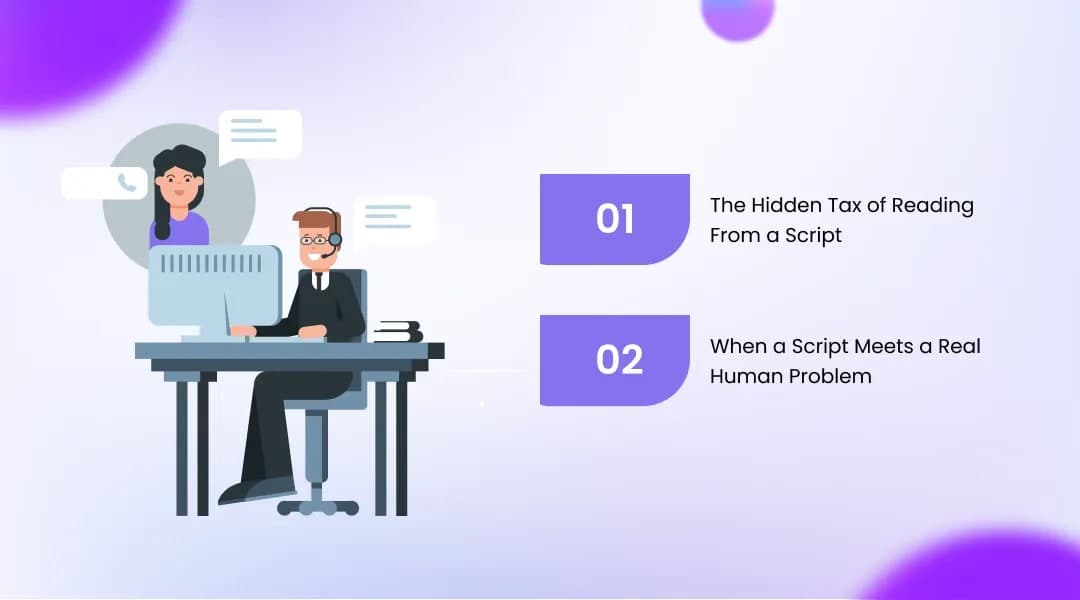
The Hidden Tax of Reading From a Script
A script is designed to standardize what an agent says, but it cannot standardize how a customer feels. According to analysis cited by voice AI, roughly two-thirds of customers can tell when an agent is reading word for word, picking up on the flat tone, the unnatural pauses, and the inability to adapt. That detection carries a cost, because trust drops even when the agent is technically following the rules.
The damage compounds over time and across your whole base. PwC has reported that 59% of customers feel companies have lost touch with the human element of customer experience, while Accenture found that 75% are more likely to buy from a brand that recognizes and personalizes. A script actively works against both of those instincts. It flattens a unique person into the nearest matching branch.
When a Script Meets a Real Human Problem
Here is the uncomfortable truth: the script was rarely protecting your customer. It was protecting the business from variability in the agent.
That works fine until a caller presents something the script did not anticipate. A patent-level description of contact center design puts it plainly: scripts break down the moment a customer asks questions or refuses to follow the prepared path. In the voice AI projects we have worked on at OnDial, this is the single most common complaint we hear from operations leaders. Their agents were not underperforming; they were boxed in.
When was the last time a scripted call actually solved your problem on the first try?
That gap between the script and the situation is where customers churn, agents burn out, and average handle time quietly balloons. Rigid dialogue trees force people through pre-approved messaging even when it clearly does not fit, and the human on the phone is penalized for using common sense. The script becomes the product, and the customer becomes an interruption.
From Rigid Scripts to Conversational AI: What Actually Changed
The shift is not simply "add a bot." It is a change in the underlying philosophy of how a call is handled, from control-first to outcome-first.
Why are contact centers replacing call scripts with AI conversations? Because scripts force one-size-fits-all responses that frustrate callers and agents alike. Conversational AI understands intent, adapts in real time, and resolves issues through natural dialogue, delivering the consistency scripts promised without the robotic delivery customers can instantly detect. The technology finally matched the ambition.
To be precise about terms: conversational AI is software that understands natural human speech and responds in real, adaptive dialogue rather than pre-written lines.
Conversational AI Is Not a Smarter Chatbot
This is the distinction that trips up most buyers, so it is worth being direct about it.
A traditional chatbot follows a fixed decision tree and breaks when a caller goes off-script. Conversational AI uses natural language understanding (NLU) and large language models (LLMs) to interpret intent, handle multi-step requests, and hold context across a full conversation. One matches keywords. The other actually understands what the customer means.
That difference shows up in the results. Early IVR systems and rule-based bots were cutting edge in their day, but today they are more a source of frustration than help, routing people through menu trees that cannot reason. Modern systems reason from the request itself, which is why they can gracefully handle inputs no one thought to script.
How AI Voice Agents Hold a Real Conversation
An AI voice agent is an autonomous system that listens, understands intent, and speaks back in natural conversation over a phone line. The magic is not one model but a tight stack working in near real time.
The pipeline usually runs like this:
Speech-to-text (STT): the caller's words are transcribed instantly, so the system has an accurate text version of what was actually said rather than a keypad choice.
Language understanding (LLM plus NLU): the model interprets intent, pulls the relevant details, and decides the next best action, including when to call an external system.
Text-to-speech (TTS): the response is spoken back with natural cadence and timing, which is what removes the awkward pauses that give older systems away.
Knit those layers together with low latency and integrate them with your CRM, and the caller experiences a conversation, not a menu. In the deployments we build at OnDial, the goal is never to trick anyone into thinking the AI is human. It is to make the interaction genuinely useful, transparent, and fast enough that the caller stops thinking about the technology at all.
The Business Case: Resolution, Cost, and Consistency
None of this matters if it does not move the metrics leadership cares about. The strongest of those is first call resolution, the share of customer issues fully solved in a single interaction with no callback needed.
What the Numbers Say About AI Conversations
The economics are hard to ignore. Industry reporting cited by CX Today puts voice AI at roughly $0.40 per call against $7 to $12 for a fully human-handled call, which is exactly why teams looking to reduce call center costs with AI tools are seeing ROI within the first quarter of deployment. Even accounting for the calls that should never be automated, that spread reshapes the unit economics of an entire support operation.
Resolution quality is the more important story. SQM Group data shows that when first call resolution is achieved, 86% of customers report being satisfied, compared with just 42% when a repeat contact is required. Metrigy's research on hybrid routing, where AI handles what it can and escalates cleanly, reports 78% to 83% first call resolution, close to top-quartile human-only performance while absorbing a large share of volume. The point is not that AI is flawless. It is that a well-designed conversation resolves more on the first try than a script does.
Consistency Without the Cage
Scripts existed largely to guarantee that certain words got said every single time, especially in regulated industries. Conversational AI delivers that guarantee more reliably than a tired human on their fortieth call.
An AI system can deliver required disclosures on every relevant call, adapt phrasing to the customer's actual question, and stay on brand without sounding stiff capabilities that are core to the AI voice agent features and capabilities we build into every deployment. It can also feed sentiment analysis and automated quality assurance across 100% of interactions rather than the small sample a manual QA team can review. You get the compliance benefit of a script and the flexibility of a real conversation, which is the combination scripts could never offer at once.
What This Means for Your Human Agents
This is the part that makes people nervous, and it deserves an honest answer rather than a slogan.
Agents Move From Scripts to Judgment
The most capable contact centers are not planning mass layoffs. Gartner has noted that more than 80% of organizations intend to expand human agent responsibilities as they adopt AI, not shrink them a shift that aligns closely with what we explore in our deep dive on the future of automated customer support with AI call center agents.
What changes is the nature of the work. When AI absorbs the repetitive tier-one volume, order status checks, password resets, and basic FAQs, agents spend their time on the complex, high-emotion calls where human judgment wins. Consider the alternative today: annual agent turnover runs between 30% and 45% across the industry, driven largely by the monotony of reading the same lines into a headset for eight hours. Removing the script removes a real source of that burnout.
Agents stop being voice-activated machines and start being problem solvers again. That is better for retention, and it is better for the customer who finally reaches a person empowered to actually help.
Where Humans Still Win
I want to be candid about the limits, because pretending they do not exist is how deployments fail.
Emotional and sensitive calls belong to people. A caller navigating insurance after a serious diagnosis needs empathy no model can authentically provide. Gartner projects that around 90% of customer interactions in 2026 still involve human agents for exactly these reasons.
AI needs guardrails. Without prompt-level controls and clean escalation paths, a generative system can drift or overreach, so responsible deployment pairs automation with confidence thresholds and human handoff.
Bad data breaks good AI. If your knowledge base is incomplete, the conversation will be too, which means the groundwork matters as much as the model.
The honest framing is not AI versus agents. It is AI and agents as two halves of one operation, where speed and volume go to the machine and complexity and care go to the human.
Conclusion
AI conversations are not a threat to your contact center. They are the upgrade your call scripts were always straining to become. Three shifts matter most: scripts trade real problem-solving for control, conversational AI delivers consistency without the cage, and your best human agents become more valuable, not less, once they are freed from reading lines.
You do not have to rip everything out overnight. Start where the volume and repetition are highest, keep people on the calls that need a heartbeat, and measure resolution rather than script adherence.
At OnDial, we help contact centers make exactly this shift: replacing rigid scripts with human-centric AI voice agents that sound natural, resolve more calls, and hand off to a person when it counts. If your scripts are working harder than your customers are, it is time to let the conversation lead.