Here is a number that should worry anyone running a delivery operation: 79% of consumers will switch to a competitor that responds faster, and 75% have already hung up after being kept on hold too long, according to the Invoca B2C Buyer Experience Report published in 2026. If you run logistics, you already feel this in your gut. The single most common call your team fields is some version of "where is my order," and every one of those calls that goes to voicemail is a customer quietly deciding you don't care.
AI voice agents for transportation and logistics exist to close exactly that gap. They are automated phone systems that hold natural conversations, pull live shipment data from your systems, answer "where's my package" instantly, and proactively call customers before a delay turns into a complaint. Not a phone tree. Not a chatbot bolted onto your website. An actual voice that talks, understands, and acts.
I have spent the last few years at OnDial building these agents for real operations, and I want to be honest with you about what they do well and where they still trip. Here is what you'll learn: how the update loop actually works, what real companies are seeing, and how to tell whether this fits your operation or not.
Why Customer Updates Became Logistics' Biggest Communication Problem
Logistics customer communication used to be simple because expectations were low. You shipped it, you gave a rough window, and customers waited. That world is gone, and it is not coming back.
The "Where Is My Shipment" Call That Never Stops
Every logistics leader knows the pattern. A shipment moves through warehouses, trucks, and last-mile handoffs, and at each stage the customer gets nervous and picks up the phone. That single question, "Where is my shipment," is the highest-volume call type in the entire industry, and it ties up trained staff on the most repetitive task imaginable — one reason logistics shows up in how logistics ranks among the industries seeing the strongest AI call automation ROI.
The math gets ugly fast. A mid-sized operation handling a few hundred shipments a month can generate 200 to 300 routine status calls in that same window, according to case figures cited by Vocalis in 2026 with AI voice agents for transportation. Your dispatchers did not sign up to read tracking numbers aloud all day. Yet that is where their hours go.
What Silence Costs You
Here is the counter-intuitive part: the delay itself rarely destroys the relationship. The silence around the delay does.
When a customer does not hear from you, they fill the gap with the worst-case story. They assume you lost the package, forgot them, or prioritized someone else. Missed or late updates cost the supply chain industry over $2 billion annually, a figure Statista put on record, and most of that damage is relationship erosion rather than the physical delay. Think about your own experience as a buyer. A delivery that arrives a day late with three clear updates along the way feels fine, while one that arrives on time after total silence still leaves you uneasy.
How AI Voice Agents Keep Logistics Customers Updated
Let me answer the core question directly, because this is what you actually came here for.
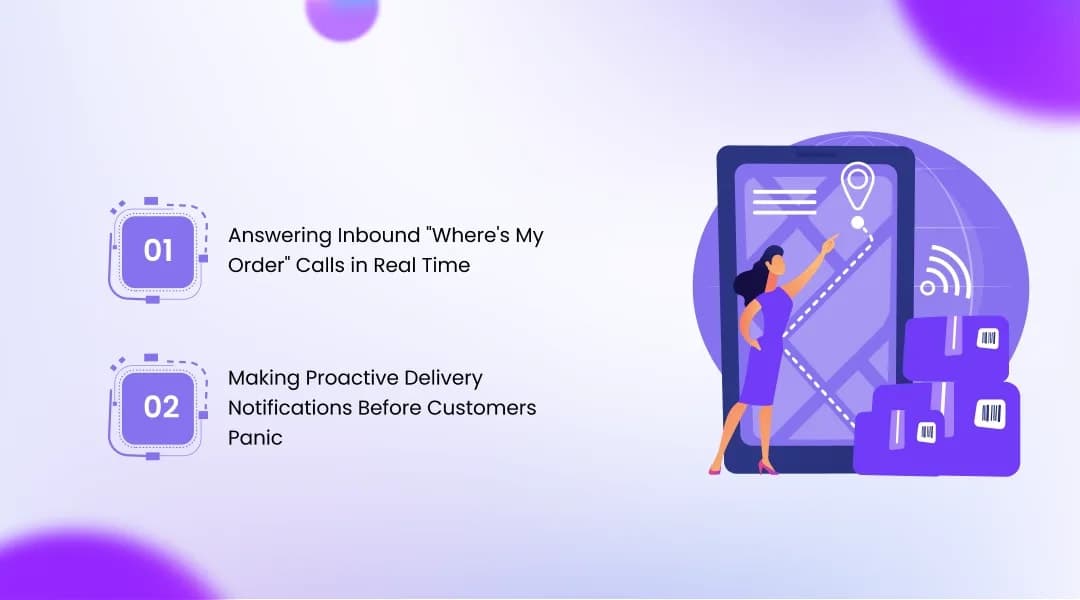
How do AI voice agents keep logistics customers updated? They handle two jobs at once. Inbound, they answer "where's my order" calls instantly by pulling live tracking data and speaking a clear status. Outbound, they proactively call or notify customers about delays, delivery windows, and exceptions before those customers ever have to chase you.
That is the whole model in a nutshell. Now let me break down each half.
Answering Inbound "Where's My Order" Calls in Real Time
This is where real-time shipment tracking stops being a dashboard and starts being a conversation. Instead of forcing a customer through a menu of "press 1 for tracking," the voice agent understands the plain question, identifies the shipment, and pulls the current status from your order management system and carrier feed. It answers in natural language, and it does this around the clock without a queue.
The technology underneath is speech recognition plus natural language processing, or NLP, which is what lets the agent understand unscripted speech rather than rigid keywords with enterprise AI voice agent services. A good agent responds within roughly 800 milliseconds, because anything slower and the caller starts talking over it and abandons the call. When someone asks a question outside the agent's scope, it escalates to a human with full context attached, so the customer never repeats themselves. In projects I have worked on, this single capability deflects the majority of routine tracking calls on day one.
Making Proactive Delivery Notifications Before Customers Panic
The inbound half is defense. The outbound half is where you actually win.
Proactive delivery notifications flip the entire dynamic. Rather than waiting for the anxious call, the agent reaches out first: "Your shipment is delayed by 90 minutes. Would you like to reschedule?" That turns a service liability into a moment of trust, which is exactly the pattern Plivo's 2026 analysis identified as the retention advantage separating winners from losers. A proactive delay call, delivered quickly and paired with a fix, preserves the relationship far better than a passive tracking page ever could.
Here is what proactive voice updates typically cover:
Order and pickup confirmations: The agent confirms the delivery window before dispatch, which cuts failed first-attempt deliveries and the expensive re-attempts that follow.
Delay and exception alerts: When a route changes or a truck breaks down, the agent calls affected customers with the new ETA instead of leaving them guessing.
Failed delivery rescheduling: If a drop-off is missed, the agent calls back, offers new slots, and pushes the choice straight into your scheduling system without a human touching it.
Post-delivery follow-up: After the package lands, the agent can collect a quick satisfaction rating, which frees your live team from chasing feedback manually.
Would your customers rather get a heads-up call about a two-hour delay, or discover it themselves at the door? You already know the answer.
The Part Nobody Explains: How the Data Loop Actually Works
Most articles wave their hands here and say the agent "integrates with your systems." That is not good enough if you are the one signing off on it.
Connecting Voice AI to Your TMS, WMS, and CRM
TMS/WMS integration is the difference between a voice agent that helps and one that lies to your customers. The agent is only as accurate as the data it can reach, so it has to connect to your transportation management system, warehouse management system, and CRM in real time. Most platforms do this through APIs or middleware that sync the voice interaction with those systems live.
Skip that integration and the whole thing collapses. If shipment records are stale or the systems are not connected, the voice assistant will confidently give a wrong answer, which is worse than no answer at all with AI voice agent platform features. Global Trade Magazine made this point plainly in 2025, and it matches what I see in the field. Before you evaluate any vendor on voice quality, evaluate them on how deeply and quickly they read from your source of truth.
The Driver-to-Customer Update Loop
Here is the elegant part that ties it together. The same agent that answers customer calls can also capture spoken updates from your drivers, and those two flows feed the same record.
A driver calls in a status, a location, and an ETA. That data lands in the system. Moments later, when a customer asks "Where's my order?" the agent answers using that fresh driver input. Parloa described this in 2026 as one connected loop instead of three disconnected tools, and that framing is exactly right. The customer-facing answer stays accurate precisely because the driver-facing capture keeps it current. Voice AI in logistics is the use of AI-powered voice agents to automate this two-way communication across the supply chain. That single loop is the architecture everything else depends on.
Real Logistics Companies Already Doing This
Skepticism here is healthy. So let me point at named operations rather than vague promises.
Enterprise Proof Points
The largest players have already moved past pilots. C.H. Robinson announced it has performed over 3 million shipping tasks with its fleet of generative AI agents, automating steps across the shipment lifecycle, including the first moves toward supplying tracking updates with AI, per the company's 2025 statement. That is not a demo. That is production volume at one of the biggest 3PLs in North America.
Retail logistics shows the same signal. Decathlon runs more than 500,000 interactions through its AI agent per year, with 74% of customers identified by order number and 20% of repetitive tasks lifted off human agents, according to figures Parloa reported in 2026. The pattern across both is consistent: the routine, high-volume, low-judgment work moves to AI, and people get the exceptions.
What Mid-Sized Operations Are Seeing
You do not need C.H. Robinson's budget to get value, which is the encouraging part for most readers here. Smaller and mid-sized logistics firms typically see return on investment within 60 to 90 days, mostly from reduced manual call handling and fewer missed deliveries, according to guidance published by Smallest AI in 2026. The economics are stark at the unit level too. McKinsey's 2026 figures put voice AI at roughly $1.18 per resolution against $7.40 for a human-handled call.
Customer acceptance has caught up with the capability, which was not true a few years ago. Order status checks now carry 85% customer acceptance for AI voice, per the AInora State of AI Voice Agents Report in 2026, and Forrester research puts voice AI at 19% of inbound contact-center volume, up from 6% in 2024, with a forecast of 33 to 37% by 2027. The direction of travel is not subtle.
Where AI Voice Agents Fall Short (And Why That's Fine)
Now the honest part, because if I only sell you the upside, I have not earned your trust.
The Calls You Should Never Automate
Voice AI is not a replacement for your team. It is a filter.
The data is clear about where customers still want a human. Acceptance for AI drops sharply on emotional and high-stakes interactions: complaint resolution sits around 41% acceptance, and financial disputes near 38%, per the AInora 2026 report with automate order status calls with voice AI. A furious customer whose critical shipment vanished does not want a friendly bot, and forcing one on them will cost you the account. The right design routes those calls to people quickly, with full context, rather than trapping the caller. AI earns its place on the routine, repeatable questions, and it should hand off the moment empathy or judgment is needed.
What to Check Before You Buy
If you evaluate platforms, judge them on operational fit rather than the demo voice, and check that they cover the must-have features for any AI call agent you evaluate. Here is my short checklist from real deployments:
Latency under 800ms: Anything slower feels robotic and drives abandonment, so test this on live calls, not a scripted demo.
Deep integration: Confirm it reads your TMS, WMS, and CRM in real time, because accuracy is the entire value.
Clean escalation: The agent must transfer to a human with context intact, so customers never repeat themselves.
Compliance by default: For regulated flows, look for standards like SOC 2 and TCPA compliance, plus a clear audit trail for every interaction.
Multilingual coverage: If your customers span languages, the agent should switch without breaking the conversation.
One honest limitation worth naming: trust in fully autonomous agents actually dipped in some 2025 surveys, and analysts expect a chunk of poorly scoped AI projects to be scrapped. The winners are the operations that start with one narrow workflow and expand, not the ones that try to automate everything on day one.
Conclusion
AI voice agents for logistics solve the one problem that quietly costs operations the most: keeping customers updated without burning out your team. The three things to remember are simple. They answer "where's my order" instantly, they proactively warn customers before a delay becomes a complaint, and they only stay accurate when they are wired directly into your TMS, WMS, and CRM.
You do not have to automate everything, and you should not. Start with the routine update loop, keep your people on the hard calls, and let the numbers prove themselves in the first quarter. At OnDial, we build exactly this kind of tailored, human-first voice AI, and we would rather map one real workflow with you, like inbound tracking or proactive delay calls, than sell you a demo. Bring us your highest-volume call type, and let's see if it belongs on autopilot.