Gartner forecasts that conversational AI will cut contact center agent labor costs by $80 billion in 2026. That is not a projection about some distant future. It is happening in production right now, across support lines, booking desks, and outbound teams. If you run a call center and that number makes you uneasy, you are reading the right article.
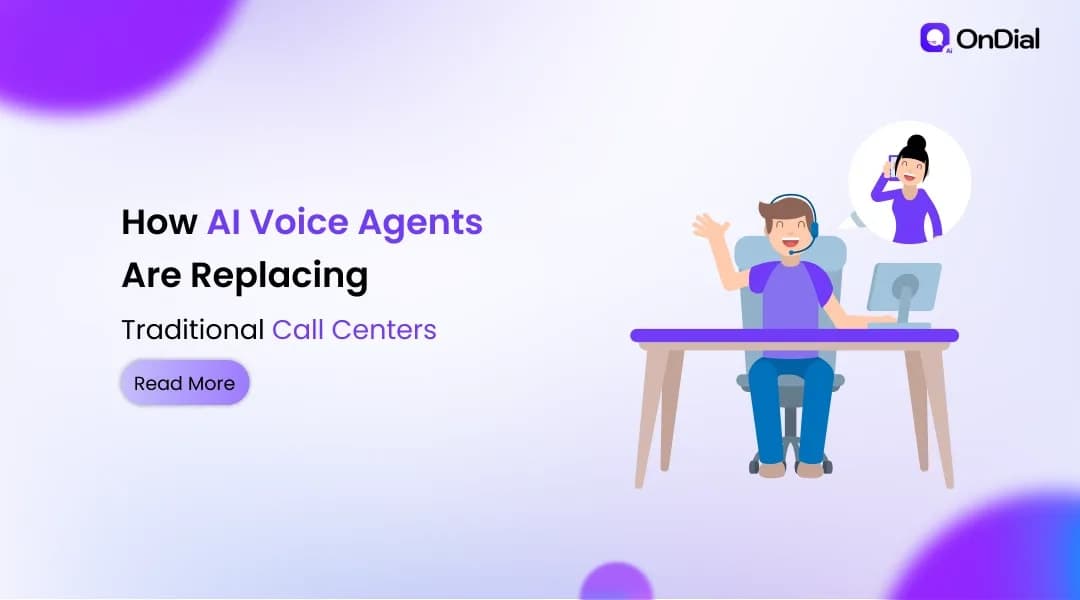
AI voice agents for call centers & BPO are replacing traditional call centers by automating the routine, high-volume calls that make up most of the daily workload, while shifting human agents toward complex and sensitive conversations. These systems understand natural speech, pull live data from your CRM, resolve common issues in a single call, and operate around the clock at a fraction of the per-call cost. The traditional model of stacking hundreds of agents in one building to answer repetitive questions is quietly being unbundled. What replaces it is not a robot pretending to be human. It is a layer of automation sitting on top of a smaller, sharper human team.
Here is what you will learn: why the old model is breaking, what these agents actually do differently, the real economics of replacement, where humans still win, and the trust threshold most businesses cross far too late.
The Real Reason Traditional Call Centers Are Breaking

The traditional call center did not fail because of one bad quarter. It failed because its core math stopped working. Cost pressure, staffing churn, and rising customer expectations have all pushed the model past its breaking point at the same time.
The Cost Structure That No Longer Adds Up
A traditional call center is expensive in ways that compound. A fully loaded 10-agent operation starts at roughly $67,000 per month once payroll and overhead are counted, and the average inbound call costs around $7.16 to handle with a human agent. Those numbers climb further the moment you need overnight or weekend coverage, because shift premiums can double labor costs during nights and weekends.
Scale makes it worse, not better. When call volume spikes during a product launch or an outage, human centers fail gracefully at best, and callers sit in queues for hours. A well-trained representative can handle only 30 to 50 calls a day before burnout sets in, which caps how much any building full of people can absorb. The old model scales by adding bodies, and bodies are the most expensive thing you can add.
The Turnover and Wait-Time Death Spiral
Now layer in the human cost. The contact center industry runs at a 30 to 45 percent annual turnover rate, and replacing a single agent costs roughly $8,000 in recruiting and training before you count lost productivity during onboarding. Every departure resets your quality and drains your budget.
Customers feel the result directly. Research from L10 AI Labs found the average hold time in 2026 is still around 13 minutes, and satisfaction with phone support sits near 44 percent. When a caller waits, repeats their account number three times, and still does not get resolution, they do not just leave the call. They start shopping for a competitor who respects their time.
What AI Voice Agents Actually Do Differently
An AI voice agent is a software system that answers phone calls, understands natural speech, and resolves customer requests in real time without a menu tree. If you want a deeper breakdown of what an AI phone agent actually does, it works the same way under the hood. The difference between this and the automated systems you already hate is not cosmetic. It is architectural.
From Rigid IVR Menus to Real Conversations
Old interactive voice response (IVR) systems forced callers down a fixed path: press one for sales, press two for support, then repeat everything to a human anyway. Modern AI voice agents skip the menu entirely. They authenticate the caller, understand intent from plain speech, access backend systems, and often solve the problem in a single interaction.
The real gain is context handling. When a customer calls about a missing delivery but then mentions they also need to update their address, the agent pivots and handles both in one conversation. It does this using natural language processing to interpret intent and speech-to-text to transcribe with high accuracy across accents and languages. That flexibility is exactly what a scripted IVR could never do.
The Architecture Behind a Modern AI Voice Agent
Under the hood, these systems run a layered pipeline that fires in real time on every call. Understanding the layers helps you see why they work where older automation failed.
Speech recognition converts the caller's voice to text, often at 90 percent or higher accuracy for well-configured deployments.
Natural language understanding determines what the caller actually wants, whether that is a billing question, a booking, or a complaint.
CRM integration loads account history and previous interactions so the caller never starts from scratch.
Response and action lets the agent answer directly, trigger a workflow such as processing a return, or hand off to a human with full context attached.
In OnDial deployments I have worked on, the layer that matters most in practice is the last one. A voice agent that resolves 80 percent of a call but drops the customer cold on the remaining 20 percent is worse than useless. The graceful handoff, where the full transcript travels to a human so nobody repeats themselves, is what separates a real replacement from a demo.
The Economics: What Replacing a Call Center Really Costs
Let me be direct about the number that drives every one of these decisions. Voice AI cost reduction is not marginal. It is the kind of gap that rewrites a budget.
AI voice agents handle a customer call for roughly $0.40, compared with $7 to $12 for a human agent, according to Teneo.ai and McKinsey figures — a cost gap broken down further in our complete guide to AI customer service. That is a 90 to 95 percent reduction in cost per interaction, and it is the single largest reason businesses are replacing traditional call center volume with automation. This is not a forecast. It is what enterprises pay in production today.
Cost Per Call: The 90 Percent Gap
The math is almost uncomfortable once you run it at volume. A contact center handling 10,000 calls a month that deflects half of them to AI typically saves somewhere between $270,000 and $570,000 a year, based on the cost differential alone. The savings come from the interactions that were never worth a human's time in the first place.
That is why adoption is moving so fast. Roughly 80 percent of businesses plan to integrate AI voice technology into customer service by 2026, and Gartner data shows about 1 in 10 agent interactions are already fully automated, up from just 1.6 percent in 2022. The direction of travel is not subtle.
ROI, Payback, and the Numbers That Matter
Cost per call is only half the story. The return timeline is what makes finance teams sign off. A Forrester Total Economic Impact study found enterprise voice AI deployments achieve 331 to 391 percent ROI over three years, with a median payback period of under four months.
There is a revenue side too, and it often gets ignored. Service businesses report an average 18 percent revenue increase in the first year, driven mostly by eliminated missed calls and faster lead response. A call that goes unanswered at 9 p.m. is a lost customer, and AI takes the 9 p.m. call every time. Have you ever added up what your missed calls actually cost you last quarter?
Will AI Voice Agents Replace Call Center Agents Completely?
This is the question everyone asks, and it deserves an honest answer rather than a sales pitch. The short version is no, and anyone telling you otherwise is selling something.
No, AI voice agents will not fully replace call center agents. They automate the routine 50 to 60 percent of call volume, such as order status, password resets, and appointment booking, while human agents handle complex, emotional, and high-stakes conversations. The dominant 2026 model is hybrid: AI for scale and speed, humans for judgment and empathy.
What Transfers to AI, and What Stays Human
The line between the two is clearer than the hype suggests. McKinsey analysis found that tier-1 support, the repetitive scripted work, makes up 50 to 60 percent of contact center volume. That is exactly the band AI handles well.
Transfers to AI: password resets, order and shipping status, appointment booking, account lookups, basic troubleshooting, after-hours coverage, and outbound lead qualification.
Stays human: emotional or distressed callers, complex multi-step disputes, high-value retention conversations, and any edge case that does not fit a known pattern.
The role does not vanish so much as it moves up. The "call center agent" is becoming a "customer experience specialist," a higher-skilled position that manages escalations and supervises the AI. Total headcount drops, but the remaining work is more interesting and better paid.
The Hybrid Model and the Human Handoff
The evidence for hybrid over full automation is strong. Natterbox's 2026 Contact Center Benchmarks report, based on 58.2 million calls and a survey of 178 contact center leaders, found that 76 percent have implemented a Human-in-the-Loop model. The market has already voted, and it voted for AI plus humans, not AI instead of humans.
The design principle behind a good handoff is simple honesty, and it's exactly the kind of graceful escalation built into OnDial's features. When the agent hits the edge of what it can resolve, it transfers the caller and the complete conversation context to a person, so the customer never repeats themselves. A graceful handoff is the transfer of a call, plus its full transcript, from an AI agent to a human the moment automation reaches its limit. Get that right and customers barely notice the seam.
The Trust Threshold Most Businesses Cross Too Late
Here is the counter-intuitive part nobody in the vendor pitch wants to say out loud. The biggest risk in replacing your call center is not that the AI fails. It is that the AI works so well you automate past the point customers will tolerate.
When Over-Automation Starts Costing You, Customers
The data on this is blunt. Research from Kinsta shows that 49.6 percent of customers would leave a company's service entirely because of AI-driven customer service, and 41.5 percent would pay more money for the ability to speak to a human representative. When the same research asked which agents resolve problems faster, 78.3 percent of customers said humans, and 84 percent said humans are more accurate.
Read those numbers carefully. They do not mean AI does not work. They mean customer trust has a ceiling, and if you hide the exit to a human being, you will cross it. Over-automation does not show up as a bad metric on your dashboard. It shows up months later as churn you cannot explain.
How to Replace a Call Center Without Losing Trust
The businesses that get this right treat replacement as a sequence, not a switch. In projects I have seen at OnDial, the deployments that hold up follow a consistent pattern.
Start with one high-volume call type, such as order status, and prove resolution accuracy before expanding.
Keep the human handoff obvious and fast, never buried, so callers feel in control rather than trapped.
Disclose the AI clearly, which is not just good practice but is increasingly required by regulation such as the EU AI Act and, for India-based operations, the DPDP Act.
Measure resolution and satisfaction together, because a call resolved cheaply but unhappily is not a win.
I will be honest about the limits here. AI voice agents still struggle with heavy regional accents, and generative models can occasionally state something wrong with total confidence. That is precisely why a clean human backup path is not optional. The goal is not the fewest humans possible. It is the right humans, freed to do work that actually needs them.
Conclusion
AI voice agents are replacing traditional call centers not by pretending to be human, but by absorbing the repetitive volume that never needed a human in the first place. Three things matter most as you weigh this. The economics are real, with a 90 percent drop in cost per call and payback measured in months. The model that wins is hybrid, where AI handles scale, and people handle judgment. And the trap to avoid is over-automating past the trust threshold your customers will accept.
You do not have to choose between saving money and keeping customers. You can do both if you sequence the change carefully and keep humans reachable. That is exactly the kind of tailored, human-first voice automation OnDial builds. If you want to see which of your call types are ready to automate first, and where to keep a person in the loop, talk to the OnDial team about mapping your call volume before you change a thing.