Here is a number that should keep every clinic owner up at night: the average medical practice no-show rate sits at 23%, and across the U.S. healthcare system, missed appointments cost an estimated $150 billion every year, according to research compiled by MGMA and the National Institutes of Health. That is not a rounding error. That is revenue walking out the door, schedules sitting half-empty, and patients falling through the cracks of a system that was never designed to chase them down.
If you run a clinic or manage a practice, you already feel this. The phone rings constantly, the front desk is buried, and patients who do not get through simply call someone else. AI phone agents for clinics offer a direct answer to this problem: they pick up every call, understand what the patient needs, schedule or reschedule appointments in real time, and follow up after missed visits, all without adding headcount or burning out your staff.
In this article, I will walk you through how this technology actually works, what the evidence says about its impact, and what I have learned from building voice AI solutions at OnDial that most vendors will not tell you.
The Hidden Cost of Missed Calls and No-Shows
Why Clinics Lose More Than They Realize
Most practice managers can estimate their no-show rate. Fewer can tell you how much it actually costs. Each missed appointment represents roughly $200 or more in lost revenue when you factor in staff preparation, facility overhead, and the opportunity cost of the patient who could have taken that slot, according to MGMA data. For independent practices, that adds up to an estimated $150,000 in annual losses. One documented clinic recorded 14,000 no-shows in a single year with losses exceeding $1 million, as reported by Healthcare Finance News.
And that is only the appointments that were booked. What about the patients who never got through in the first place?
The Voicemail Problem No One Talks About
Here is the part that stings: 80% of patients who reach voicemail do not leave a message. They hang up. They call another clinic. They delay care. Your front desk may never even know that call happened. For a busy practice fielding hundreds of calls daily, that represents dozens of lost patient visits every single week, a slow bleed that compounds into serious revenue and care gaps over time.
I have seen this pattern repeatedly in the clinics we work with at OnDial. The phone line is simultaneously the most important patient touchpoint and the most neglected one. (It is also, ironically, the one piece of infrastructure most clinics have not updated since the early 2000s.)
What AI Phone Agents Actually Do for Clinics
An AI phone agent is a voice-based conversational AI system that answers patient calls, interprets spoken requests using natural language processing, and takes action, like booking or modifying an appointment, without requiring a human to intervene. It is not a phone tree. It is not a voicemail box with a friendlier greeting.
Understanding Patient Intent in Real Time
When a patient says, "I need to move my Thursday appointment," the AI does not ask them to press 1 for scheduling. It understands the intent, checks provider availability by connecting to the clinic's EHR or practice management system (platforms like Epic, Athenahealth, or AdvancedMD), and confirms a new time in the same conversation. This happens whether the patient calls at 2 PM or 2 AM.
The difference between this and a traditional answering service is not incremental. It is structural. The AI resolves the request on the spot instead of generating a message that someone has to return later, by which point the patient may have already booked elsewhere.
Automated Scheduling, Rescheduling, and Follow-Up
Beyond inbound call handling, modern AI voice assistants handle automated appointment reminders through outbound calls, texts, or both. Research published in multiple studies shows that SMS reminders alone can reduce no-show rates by 34% to 50%. When you add a voice call that lets patients confirm, cancel, or reschedule with a single spoken response, the recovery rate climbs further.
At OnDial, we have found that the outbound follow-up call is where the real appointment recovery happens. It is not enough to remind patients. You need to give them a frictionless way to act on that reminder in the moment, and voice is the fastest path to that action.
How AI Voice Assistants Recover Lost Appointments
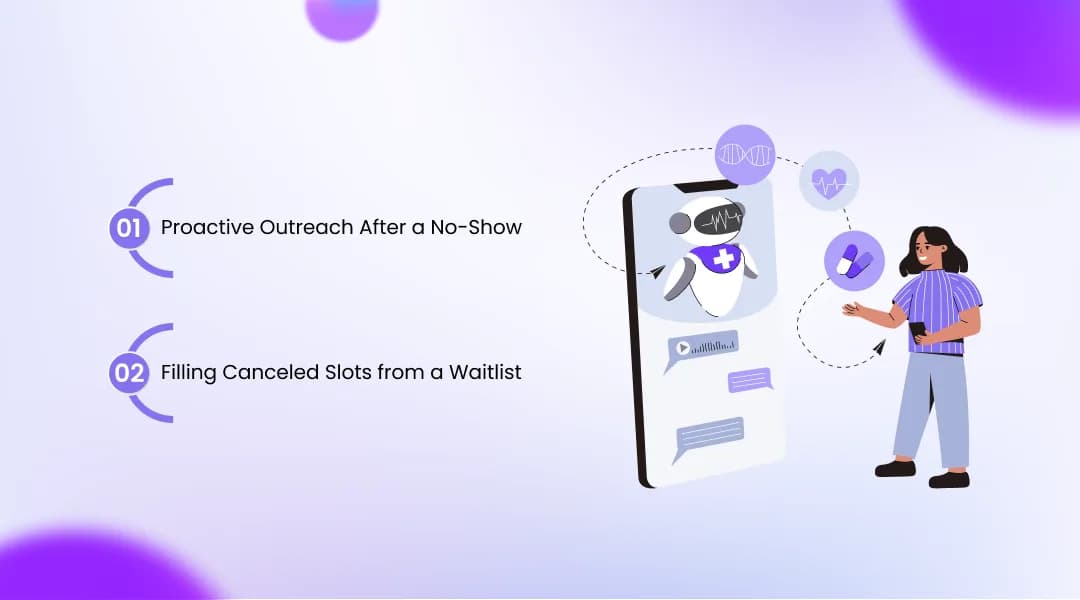
Proactive Outreach After a No-Show
What happens after a patient misses an appointment matters more than most clinics realize. Without a follow-up system, that patient may disengage entirely. They forget, they feel embarrassed, or they simply move on. An AI phone agent changes that dynamic by reaching out within hours of a missed visit, not days, with a warm, blame-free message and an immediate rebooking option.
This is the recovery mechanism that separates AI-equipped clinics from the rest. The technology does not just prevent future no-shows. It actively reclaims the ones that already happened.
Filling Canceled Slots from a Waitlist
Some of the more advanced systems now include no-show prediction, analyzing historical data, patient demographics, and appointment patterns to flag which slots are most likely to go unfilled. When a cancellation or no-show does occur, the AI automatically contacts patients on the waitlist to fill the gap. Seeing even one or two additional patients per day through this process can recover thousands of dollars in annual revenue.
Have you ever calculated how many empty slots your clinic has in a typical week? (Most practice managers I have spoken to guess low by a factor of two.)
Reducing Clinic No-Shows with AI: What the Data Shows
The 23% Problem and How AI Addresses It
A comprehensive review of 105 studies published through PMC/NIH found an average no-show rate of 23% across specialties, with some clinics seeing rates as high as 50%. Pediatrics and dermatology hover around 30%. Sleep clinics hit 39%. The financial math at these rates is brutal.
How do AI phone agents reduce no-shows at clinics? They address the top causes simultaneously: forgotten appointments get caught by automated reminders sent at optimal intervals (typically three days and one day before the visit). Scheduling friction disappears when patients can reschedule by voice at any hour. And disengaged patients get pulled back in through proactive, personalized follow-up calls that feel human, not robotic. Clinics deploying these systems report no-show reductions of 34% to 50%, with some achieving rates below 5% when combining dual reminders with easy self-rescheduling.
Predictive No-Show Identification
The newest frontier in this space is machine learning models trained on appointment history, patient behavior, and even factors like distance from the clinic or weather patterns. A 2025 study published in the Annals of Family Medicine demonstrated that gradient boosting models could predict no-show risk at the individual patient level, enabling clinics to focus human outreach on the highest-risk appointments. This is the direction AI phone agents are heading: not just reactive recovery, but preemptive intervention.
I want to be honest about something here. Predictive models are not perfect. They work well in aggregate, but individual patient behavior is messy and unpredictable. The clinics I have seen get the best results combine AI prediction with human judgment for complex cases rather than fully automating every decision.
What to Look for Before Choosing an AI Phone Agent
EHR Integration and HIPAA Compliance
An AI phone agent without EHR integration is essentially an expensive answering machine. The system must read and write directly to your scheduling platform so that appointment changes are reflected instantly without staff re-entering data. Look for vendors offering integration with your specific EHR, whether that is Epic, Athenahealth, eClinicalWorks, or another system.
On compliance: any AI handling patient calls must be HIPAA compliant with a signed Business Associate Agreement (BAA). SOC 2 Type II certification adds another layer of verified security. Two well-known platforms in this space are explicitly not HIPAA compliant, which should be an immediate disqualifier for any healthcare practice. Always ask. Never assume.
Conversational Quality and Patient Trust
The technology has to sound right. Patients will not engage with a voice that sounds like a robot reading a script. Modern text-to-speech engines produce remarkably natural voices, but the conversational design, how the AI handles interruptions, accented speech, confused callers, and emotional patients, is where quality separates good platforms from mediocre ones.
At OnDial, we believe in building voice AI that respects the patient's intelligence and emotional state. A patient calling to reschedule a chemotherapy appointment is in a very different headspace than someone booking a dental cleaning. The AI needs to recognize that difference, and the best systems do.
Conclusion
AI phone agents for clinics solve a problem that most practices have accepted as unavoidable: the steady loss of patients and revenue through missed calls, forgotten appointments, and disengaged no-shows. The data is clear. Automated reminders cut no-show rates by up to 50%. Proactive follow-up calls recover appointments that would otherwise vanish. And 24/7 availability captures the patients who call outside business hours, which is roughly 40% of all appointment requests.
The clinics that act on this are not just saving money. They are building a patient experience that earns loyalty and referrals.
If you are ready to stop losing appointments to voicemail and start recovering them with voice AI built specifically for your practice, OnDial can help.
AI phone agents give clinics a reliable way to answer every call, recover missed appointments, and keep schedules full without adding staff, turning a persistent operational problem into measurable revenue recovery.