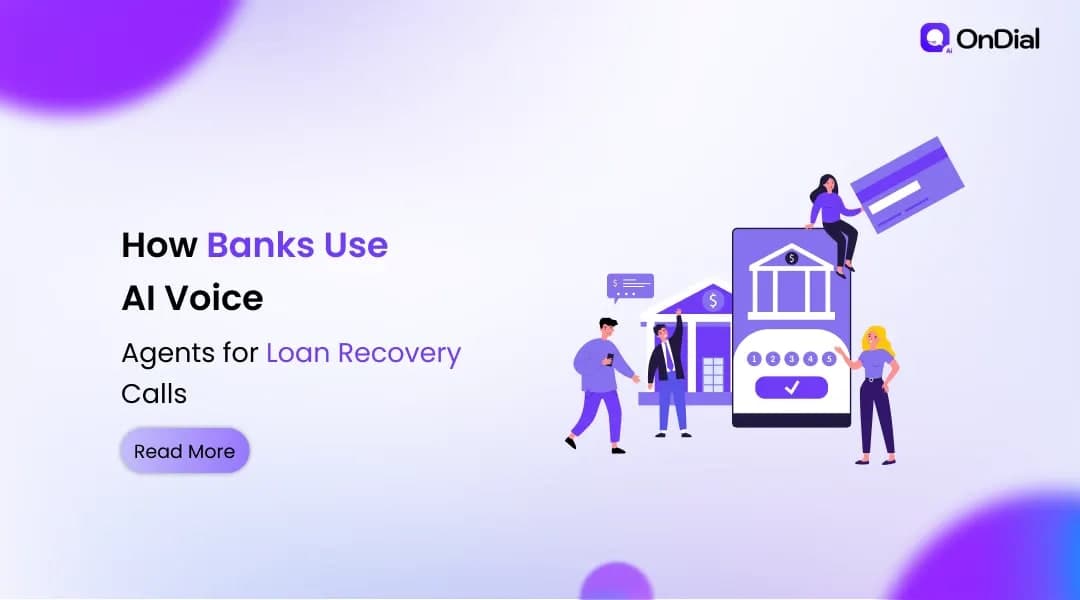
A human recovery agent in India costs a bank around Rs 30,000 a month and manages roughly 250 cases. An AI voice agent can make up to 20 times more calls, runs 40 to 60 percent cheaper, and posts resolution rates of 80 to 85 percent in the zero-to-30-day delinquency window, according to a Business Standard report citing The Economic Times. That single gap explains why AI voice agents for loan recovery have moved from pilot to production across Indian lending in barely a year.
If you run collections, you have probably watched this shift with a mix of interest and worry. Will the calls actually recover money? Will they trip an RBI rule and turn into a harassment complaint? Those are the right questions to ask.
I have spent years building voice AI for Indian businesses at OnDial, and the short version is this: a well-built AI recovery agent is not a cheaper version of a human caller. It is a more auditable one. This guide walks through how banks deploy these systems, how they stay inside the rules, where they beat human teams, and where they still need a person in the loop.
Why Loan Recovery in India Is Outgrowing the Old Model
The old recovery playbook was simple: hire more agents, make more calls, escalate the difficult accounts. That model is quietly breaking. Loan books are growing faster than any call center can staff for, and the regulator is tightening the rules on how those calls can be made.
The volume problem no call center can solve
Retail lending in India has exploded in ticket count, not just ticket size. More borrowers, more first-time credit users, more small-value loans slipping into early DPD buckets (days past due). The recovery work scales with the borrower count, and human hiring simply cannot keep pace.
The stress shows up in the numbers. India's microfinance sector recently saw loans overdue beyond 31 days surge 163 percent to Rs 43,075 crore, per analysis published by Cuberoot. When delinquency rises across millions of small accounts, the bottleneck is never strategy. It is raw calling capacity.
Why early-stage delinquency is where banks lose money
Here is the counter-intuitive part: the most valuable recovery work is also the most boring. Accounts that are one to 30 days past due are highly recoverable, but only if someone reaches the borrower quickly and often. Miss that window and a soft reminder hardens into a write-off.
Human teams ration their time toward older, higher-value accounts, so early-bucket reminders get skipped. AI voice agents for loan recovery flip that logic by making the high-frequency, low-drama calls that humans cannot sustain. A few points worth knowing about this window:
Recovery is cheapest before legal action. The 30-to-90-day stage is where banks recover without notices or court time, and it demands a call cadence no human floor can hold.
Consistency beats intensity. A polite, timely nudge before the due date passes prevents more defaults than an aggressive call after it.
Volume is the constraint, not skill. When auto-debit fails on a million accounts in one night, only an automated layer can reach them all by morning.
How AI Voice Agents Actually Run Loan Recovery Calls
Do these calls actually work, or is it just a robot reading a script? The honest answer is that the script is the least interesting part. The intelligence sits in who gets called, when, in what language, and what happens when the borrower says something unexpected.
From risk score to dialed call
An AI recovery agent does not start with a phone number. It starts with data. The system ingests loan amount, repayment history, delinquency days, and past behavior, then uses predictive scoring to segment borrowers by how likely they are to repay.
That scoring decides everything downstream. High-probability accounts get a gentle reminder; higher-risk accounts get prioritized outreach at the time and channel most likely to connect. The agent then dials, identifies the lender, states the loan reference, and runs a natural conversation rather than a rigid menu tree.
Handling the conversation, not just the call
Promise-to-Pay, usually shortened to PTP, is the real goal of an early recovery call. A capable voice agent captures a PTP date, offers a UPI payment link by SMS or WhatsApp while still on the line, and logs the commitment against the account in the Loan Management System (LMS).
The agent also adapts to how the borrower speaks. A borrower in Coimbatore may prefer Tamil, one in Indore may want Hindi with English loan terms, and the agent detects this from CRM records or the first seconds of the call. In projects we have worked on at OnDial, the language match alone often decides whether a borrower stays on the line or hangs up.
The 40 to 60 word answer for a featured snippet
How do AI voice agents handle loan recovery calls? AI voice agents score borrowers by repayment risk, dial them at the best time in their preferred language, deliver compliant reminders, capture a Promise-to-Pay date, send a UPI payment link, and log every outcome to the bank's loan management system. Complex or distressed cases are escalated to a human collector.
Staying Compliant: AI Recovery Calls and RBI's Fair Practices Code
This is where most banks hesitate, and rightly so. Recovery is the most heavily watched activity in Indian lending, and the rules just got stricter. So the real question is not whether AI can be compliant, but how its compliance is proven during an inspection.
What the rules actually require
The RBI Fair Practices Code is the bedrock. It governs how, when, and how often a borrower can be contacted, and it makes the lender, not the agent, responsible for every interaction. Any recovery system, human or AI, has to live inside it.
From July 2026, the RBI tightened these norms further. According to ZeeBiz, banks must not call borrowers after 7 PM, repeated pressure calls are classified as a harsh practice, recovery agents need mandatory IIBF certification, and lenders must publish their authorized agent lists on their website and app. Layer on the DPDP Act 2023 for data handling and TRAI DLT rules for messaging, and the compliance surface is wide.
The 40 to 60 word answer for a featured snippet
How do AI voice agents stay compliant with RBI guidelines? AI voice agents enforce RBI's Fair Practices Code in code: they call only within 8 AM to 7 PM, identify the lender and loan reference at the start, respect daily contact limits, honor opt-outs instantly, never threaten, and record every call with a timestamped audit trail for inspection. Human agents handle disputes and hardship cases.
The IIBF gap nobody talks about
Here is the nuance most vendors skip. The RBI's Recovery Agents Code requires human collection agents to hold IIBF-DRA certification, and an AI agent cannot sit that exam. So how can a machine make a recovery call at all?
The answer is that the platform's compliance architecture becomes the auditable substitute that examiners probe, a point made well by Caller Digital's regulatory map. Where a human passes a certification, the AI platform must prove the same discipline through enforced scripts, contact-frequency caps, opt-out handling, and complete call logs. I will be honest about the limit here: an AI agent does not replace certified human judgment for disputes or hardship, and any bank that claims otherwise is overselling.
AI Voice Agents vs Human Recovery Agents: The Honest Comparison
The comparison between AI vs human recovery agents is not a clean win for either side. Each is strong exactly where the other is weak, which is why the banks getting results run them together, not in competition.
Where AI clearly wins
On raw economics and consistency, the gap is not close. The numbers from Indian deployments are blunt:
Cost and scale. One AI voice agent replaces the workload of several human callers, with reported collections-cost reductions of 60 to 70 percent, per CarmaOne. A human handles 80 to 100 connected calls a day; AI scales to millions on demand.
Recovery lift. Banks using AI-driven collections outreach see 20 to 30 percent higher recovery rates than traditional methods, according to McKinsey figures cited byGoodCall.
Compliance by design. An AI agent never loses patience, never calls after hours, and never goes off-script, which removes the single biggest source of harassment complaints.
There is also a quieter advantage. Borrowers often feel less shame discussing financial trouble with an AI, so they are more honest about what they can actually pay.
Where humans are still essential
AI is not a full replacement, and pretending it is creates risk. Complex negotiations, genuine hardship, disputed amounts, and emotional distress all need a trained person.
The working model that holds up is a tiered one. AI handles the high-volume early buckets and routine reminders, then escalates anything sensitive to a human collector with the full conversation history attached. That handoff, done cleanly, is what separates a compliant operation from a complaint waiting to happen.
Deploying AI Voice Agents in Your Collections Stack
A pilot that recovers money in a demo can still fail in production if it cannot plug into your systems. Deployment is mostly an integration and governance question, not a magic-AI question.
The integrations that decide success
An AI recovery agent is only as good as its connection to your data. Without real-time account context, it is just an autodialer with a nicer voice. The non-negotiable connections are:
LMS and CRM. The agent needs live read-write access to account status so it can speak accurately and update PTP outcomes instantly.
Dialer or SIP trunk. Calls run on cloud telephony, which is what lets volume scale without new hardware.
Payments and messaging. UPI links, payment gateways, and DLT-registered SMS or WhatsApp let the agent close the loop on the same call.
Governance, audit, and rollout
Treat the rollout as a compliance project first. Every call needs a stored recording, transcript, language used, outcome, and escalation event, retained per DPDP Act rules so you can answer an RBI query or a consumer-court notice without scrambling.
Start narrow and expand on evidence. Most Indian teams begin with accounts under 30 DPD, measure recovery and complaint rates against their human baseline, and widen scope only once the audit trail proves clean. (The teams that skip this step are usually the ones who end up rebuilding after their first inspection.) Done right, the SARFAESI and legal escalation paths stay reserved for the genuinely hard accounts, while AI keeps the routine pipeline moving.
Conclusion
AI voice agents for loan recovery are not about replacing your collections team. They are about giving it a tireless, deterministically compliant first line that handles the volume humans cannot, so your people focus on the cases that need real judgment. Three things matter most: AI wins on cost and consistency, RBI compliance must be enforced in the platform's architecture rather than assumed, and a human-in-the-loop handoff is what keeps the whole operation safe.
You do not have to choose between scaling recovery and staying compliant. With the right design, the same system does both. At OnDial, we build India-first voice AI that calls inside RBI windows, speaks your borrowers' language, and logs every interaction for audit, so if you are weighing an early-bucket recovery pilot, that is exactly the conversation worth starting.