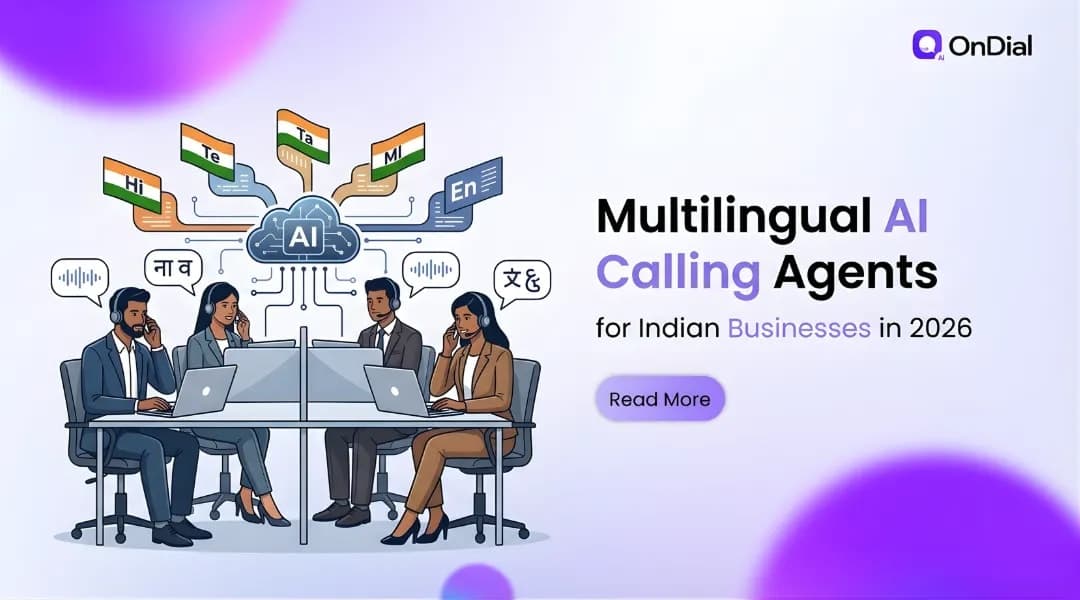
India is not a single language market. A customer may speak Hindi with one business, Gujarati with another, and English when dealing with a national brand. In many everyday conversations, the language can change within the same sentence.
For businesses that depend on phone calls, this creates a practical challenge. Hiring separate teams for every language is expensive, while relying on English only or a rigid IVR can make customers repeat themselves, abandon calls, or move to another provider.
Multilingual AI calling agents offer another approach. They can answer inbound calls, make outbound calls, understand different languages, identify customer intent, complete routine tasks, and transfer complex conversations to human teams.
The value is not simply that an AI system can speak multiple languages. The real advantage comes from understanding how customers actually communicate and connecting those conversations to business workflows.
What Are Multilingual AI Calling Agents?
A multilingual AI calling agent is an AI powered voice system that can conduct phone conversations in multiple languages.
Unlike a traditional IVR that asks callers to press a number to select a language, a conversational AI agent can identify the language being used and continue the conversation naturally.
A typical interaction involves several stages:
The customer calls the business or receives an outbound call.
The system processes the customer's speech.
The AI identifies language, intent, and relevant context.
The agent generates an appropriate response.
The system performs an action such as booking, qualifying, updating, reminding, or routing.
The conversation and outcome can be recorded in connected business systems.
This means the AI is not limited to answering questions. It can become part of an operational workflow.
For example, a customer might call an online retailer to ask about an order. The AI can understand the request, retrieve the relevant information, explain the delivery status, and escalate the conversation if the issue requires human assistance.
Why Multilingual Calling Matters in India
India's language diversity affects customer service, sales, healthcare, financial services, education, retail, real estate, logistics, and many other sectors.
A company expanding from one city to several states may suddenly need to communicate with customers who have very different language preferences. Building separate human teams for every region can make expansion operationally difficult.
Multilingual AI calling changes the economics of that expansion.
Instead of creating an independent phone operation for every region, businesses can build common workflows and adapt the conversational layer to the languages their customers use.
This is particularly useful for businesses serving tier 2 and tier 3 markets, where regional language communication can be an important part of customer experience. Businesses in these markets can use AI calling to extend phone support without creating large local teams.
For a broader look at how AI calling is helping businesses outside major metros, see how Tier 2 and Tier 3 Indian businesses are using AI agents.
Language Support Is More Than Translation
One of the biggest mistakes businesses make when evaluating multilingual AI is treating language support as a simple checklist.
A platform might technically support Hindi, Gujarati, Tamil, Marathi, or another language. That does not automatically mean it can conduct a useful business conversation in that language.
Real conversations contain interruptions, accents, regional expressions, incomplete sentences, background noise, and mixed vocabulary.
Understanding Code Switching
Code switching happens when a speaker moves between languages during a conversation.
In India, a caller might use Hindi for most of a sentence and insert English terms for a product, technical concept, payment method, or business process.
This creates a different requirement from simple translation.
An effective multilingual AI voice agent needs to understand the meaning of the entire conversation rather than treating every language change as a new interaction.
It should maintain the caller's context while adapting its responses to the language being used.
Handling Regional Speech Patterns
Language accuracy also depends on how people speak.
Pronunciation can vary between regions. The same word may sound different depending on the speaker's accent. Customers may also use local expressions that do not appear in formal written language.
For this reason, businesses should test AI voice systems using real examples from their customer base instead of relying only on a product demonstration.
How Multilingual AI Calling Works
A multilingual AI calling system combines several components into one conversational workflow.
1. Speech Recognition
The system processes what the caller says and converts speech into information that the AI can interpret.
Accuracy matters because an incorrect transcription can affect every step that follows.
2. Language Detection
The system identifies the language or language pattern being used.
A strong multilingual workflow should also account for situations where the caller changes languages during the conversation.
3. Intent Understanding
The AI determines why the customer is calling.
The intent might be to book an appointment, check an order, ask about a service, qualify as a sales lead, request support, make a payment inquiry, or speak with a human.
4. Business Logic
The AI then follows the workflow configured by the business.
For example, a healthcare workflow may collect appointment details, while a real estate workflow may ask about location, budget, and property preferences.
5. System Integration
The conversation becomes more useful when the AI can interact with connected systems.
Depending on the workflow, it may retrieve customer information, update a CRM, check scheduling availability, create records, or trigger a follow up.
6. Human Handoff
Automation should not mean that every conversation stays with AI.
When a customer needs human judgment, has a complex problem, or meets a predefined escalation condition, the call should move to an appropriate employee with relevant context.
Key Business Use Cases
Multilingual AI calling can support both inbound and outbound communication.
Customer Support
Businesses can use AI voice agents to answer frequently asked questions, provide order information, collect basic issue details, and route complex cases.
This can extend customer support beyond normal working hours without requiring every employee to work night shifts.
Lead Qualification
Sales teams often spend significant time calling leads, asking the same qualification questions, and updating CRM records.
A multilingual AI agent can handle the first conversation, collect information, identify buying intent, and route qualified prospects to the sales team.
This is particularly useful when a business receives leads from multiple regions.
Appointment Scheduling
Healthcare providers, education companies, professional services, and other appointment based businesses can automate scheduling conversations.
The AI can ask what the customer needs, identify suitable availability, confirm the appointment, and communicate in the customer's preferred language.
Payment and Reminder Calls
Businesses can use outbound AI calls for reminders, renewals, follow ups, and other repetitive communication.
For customers who are more comfortable speaking in a regional language, multilingual calling can make these interactions easier to understand.
E-commerce Communication
Online retailers can use AI voice agents for order confirmation, delivery updates, return related questions, customer feedback, and other post purchase conversations.
For businesses serving multilingual customer bases, AI voice agents for retail and e-commerce can connect voice automation with these customer journeys.
Healthcare
Healthcare organizations can use multilingual calling for appointment reminders, scheduling, follow ups, basic administrative questions, and patient communication.
Because healthcare conversations can involve sensitive information, businesses should define clear escalation rules and data handling processes before deploying automation.
BFSI
Banks, insurers, lending companies, and financial service providers can use AI calling for reminders, customer support, lead qualification, renewals, and routine communication.
Financial workflows should be designed with appropriate authentication, security, compliance, and human escalation requirements.
Education
Schools, universities, coaching providers, and EdTech businesses can automate admission inquiries, student onboarding, counseling follow ups, reminders, and information requests.
Multilingual communication can also help organizations serve parents and students across different regions without requiring every team member to speak every language.
Multilingual AI Calling vs Traditional IVR
Traditional IVR systems are useful for structured routing, but they can create friction when customers need to explain something in their own words.
A conventional flow might ask:
"Press 1 for English."
"Press 2 for Hindi."
"Press 3 for customer support."
A conversational AI agent can instead allow the caller to explain the reason for the call naturally.
The difference is not only language.
It is the ability to understand intent, retain conversational context, perform business actions, and adapt the interaction based on what the customer says.
OnDial's multilingual platform supports automatic language detection, code mixed conversations, CRM connectivity, appointment scheduling, lead qualification, analytics, and human handoff. The platform currently states support for more than 100 languages and 50 plus regional accents.
How Businesses Should Evaluate a Multilingual AI Calling Platform
Choosing a platform based only on the number of supported languages can lead to disappointing results.
A better evaluation framework looks at the entire customer conversation.
Test Real Customer Conversations
Use actual examples from your business.
Include regional accents, incomplete sentences, background noise, common product names, local terminology, and mixed language conversations.
Test Mid Call Language Changes
Ask whether the system can maintain context when a caller changes language during the conversation.
A customer should not have to restart the interaction simply because the language changed.
Evaluate Business Actions
Ask what the AI can actually do.
Can it update the CRM?
Can it schedule appointments?
Can it qualify leads?
Can it retrieve information?
Can it trigger a workflow?
Can it transfer the call with context?
These capabilities determine whether the system is useful beyond conversation.
Check Human Handoff
Every serious deployment needs an escalation strategy.
Define which situations require human intervention and what information should be passed to the employee receiving the call.
Measure Outcomes
Do not evaluate the system only by how natural the voice sounds.
Track operational metrics such as:
Calls answered
Call completion rate
Lead qualification rate
Appointment booking rate
Escalation rate
Resolution rate
Customer satisfaction
Average handling time
Follow up completion
CRM data accuracy
The right metrics depend on the business workflow.
A Practical Deployment Approach
Businesses do not need to automate every phone conversation on day one.
A focused pilot is usually easier to evaluate.
Start with one high volume workflow, such as appointment scheduling, lead qualification, order updates, or reminders.
Then identify the languages most frequently used by customers in that workflow.
Next, document the conversation flow, business rules, escalation conditions, and required integrations.
Run the AI alongside existing processes during the pilot and compare results.
Once the workflow performs consistently, expand into additional languages, departments, and use cases.
This approach reduces implementation risk while creating a clear path from one successful workflow to broader automation.
What Multilingual AI Calling Means for Business Growth
The biggest opportunity is not simply reducing the workload of a call center.
It is making phone based customer communication easier to scale.
A business can expand into a new region without immediately building a new multilingual support operation. A sales team can respond to more inquiries without manually calling every prospect. A healthcare organization can manage more appointment communication without increasing administrative workload at the same rate.
The technology becomes especially valuable when language, call volume, and response time intersect.
That is where traditional staffing models can become difficult to scale.
Multilingual AI calling provides another layer between customers and business teams, handling routine conversations while allowing employees to focus on decisions, relationships, and cases that require human judgment.
The Future of Multilingual AI Calling in India
The next stage of voice AI will move beyond simply supporting more languages.
The important developments will be better context understanding, stronger code switching, more natural interruptions, improved regional speech recognition, deeper business integrations, and more reliable workflow execution.
Customers will increasingly expect to communicate with businesses in the way they already communicate with people.
That means language choice should become part of the conversation rather than a barrier at the beginning of it.
For businesses, the goal should not be to replace every human conversation.
The goal should be to make sure routine communication is handled quickly, accurately, and consistently while human teams remain available when their judgment matters.
Businesses exploring the broader role of regional language automation can also read how regional language AI agents are transforming customer service in Tier 2 India.
Conclusion
Multilingual AI calling is becoming a practical business capability for organizations serving India's diverse customer base.
The strongest implementations go beyond translation. They understand language preferences, handle code switching, recognize customer intent, connect conversations to business systems, complete routine tasks, and escalate complex situations to humans.
For Indian businesses, this can make customer communication easier to scale across regions without creating a separate operational structure for every language.
The key is to evaluate the technology based on real conversations and measurable business outcomes.
When multilingual voice automation is connected to the right workflows, it becomes more than a way to answer calls. It becomes an operational layer that helps businesses respond faster, serve more customers, and expand communication without allowing language to become a bottleneck.
To explore how OnDial approaches multilingual voice automation for regional and global customer conversations, visit OnDial.