Let me say something most blogs won’t.
Building a real-time AI voice assistant is not hard.
Building one that doesn’t sound like a confused robot having a bad day? That’s the real challenge.
I’ve worked on voice systems that looked perfect in demos and completely collapsed when real users started talking over them, pausing mid-sentence, or switching languages halfway through a call.
And that’s the gap.
Between “it works” and “it works in reality.”
If you're here, you're probably asking:
How do I actually build a real-time AI voice assistant?
What tech stack should I use?
Why do most voice bots feel… broken?
Good. You're asking the right questions.
Let’s build this properly.
How Real-Time AI Voice Assistants Work
At a high level, every real-time AI voice assistant follows a loop:
Listen → Understand → Think → Respond
Simple. On paper.
Messy. In production.
Speech-to-Text (STT)
This is where raw voice becomes text.
If your STT fails, everything fails. Period.
Modern systems use deep learning-based speech recognition AI that can handle accents, noise, and interruptions.
But here’s the catch…
Latency.
Even a 500ms delay feels unnatural in a conversation.
Natural Language Processing (NLP)
Once the system has text, it needs to understand intent.
Not keywords. Intent.
There’s a difference between:
“I want to cancel my subscription”
“I think I’m done with this service”
Same meaning. Different words.
This is where NLP voice assistants shine or crash.
Text-to-Speech (TTS)
Now your AI needs to speak back.
And this is where most systems lose trust.
Because users instantly detect robotic voices.
Human-like AI conversations depend heavily on:
Tone
Pauses
Emotional cadence
Miss those… and your assistant sounds fake.
Response Generation (LLMs)
This is the brain.
Large Language Models generate responses dynamically instead of relying on rigid scripts.
But here's a blunt truth:
If you don’t control the responses properly, your AI will hallucinate.
Yes. Even in voice.
Real-Time Streaming Architecture
This is the invisible hero.
Instead of waiting for full sentences, modern systems stream:
Audio in chunks
Partial transcriptions
Incremental responses
This reduces delay and creates natural flow.
Without streaming… your assistant feels slow. And users hang up.
Core Technologies Required
Let’s get practical.
AI Models (LLMs, ASR, TTS)
ASR (speech recognition AI)
NLP/LLMs for understanding
TTS for voice output
You need all three working together in sync.
APIs & Frameworks
You’re not building everything from scratch (unless you hate sleep).
APIs handle:
Speech processing
Language understanding
Voice synthesis
WebRTC / VoIP Systems
This is how real-time audio travels.
Without low-latency communication protocols like WebRTC… your “real-time” system isn’t real-time.
Cloud Infrastructure
Voice AI is resource-heavy.
You’ll need:
Scalable compute
Low-latency servers
Global availability
Otherwise, your AI call agent in India won’t work smoothly for global users.
Step-by-Step Guide to Build AI Voice Assistant
Let’s build this step by step.
No fluff.
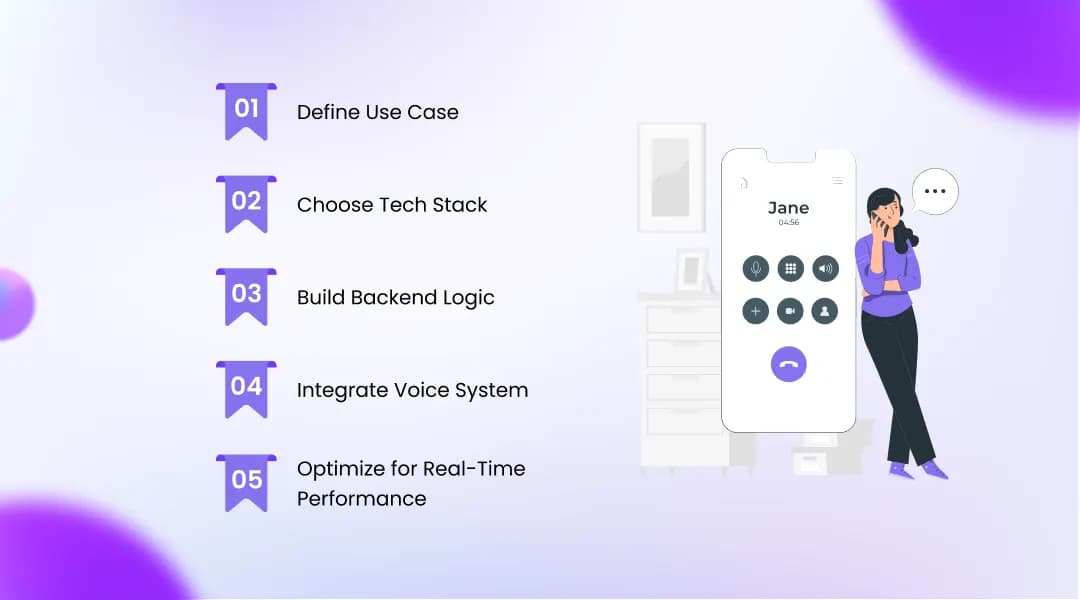
Step 1: Define Use Case
This is where most people mess up.
They start with tech instead of purpose.
Ask yourself:
Customer support?
Sales calls?
IVR replacement?
Because building AI Call Assistants for support is very different from building one for sales.
Step 2: Choose Tech Stack
Pick wisely.
Your stack defines your system’s limits.
STT tools → Whisper, Google STT
NLP engine → LLM APIs
TTS providers → realistic voice engines
Want Low-Cost AI Voice Assistants?
Then optimize here. Not later.
Step 3: Build Backend Logic
This is the brain wiring.
You’ll need:
Intent recognition
Conversation flow management
Context memory
Here’s a question most people ignore:
What happens when the user says something unexpected?
If you don’t handle that… your system breaks.
Step 4: Integrate Voice System
Now connect your AI to actual calls.
Using:
Twilio
WebRTC
This is where your assistant becomes a real AI phone answering system in India.
Step 5: Optimize for Real-Time Performance
This is where pros separate from beginners.
You need:
Fast inference
Streaming responses
Minimal API latency
Even 1-second delay = bad experience.
Users don’t wait.
They hang up.
Best Tools & Platforms in 2026
Here’s what’s actually working right now:
OpenAI / Whisper → speech recognition
Google Speech-to-Text → scalable STT
ElevenLabs → realistic TTS
Twilio Voice API → call handling
I’ve tested most of these.
They work. But only if integrated properly.
Real-Time Architecture Explained
Let’s simplify this.
A real-time voice AI system looks like this:
User speaks → Audio stream → STT → NLP/LLM → Response → TTS → Audio output
All happening in milliseconds.
The key is a low-latency pipeline.
(And yes… this is where most systems fail.)
Because APIs + network delays + processing time = lag.
Fixing that requires:
Edge computing
Smart caching
Streaming architecture
Use Cases of AI Voice Assistants
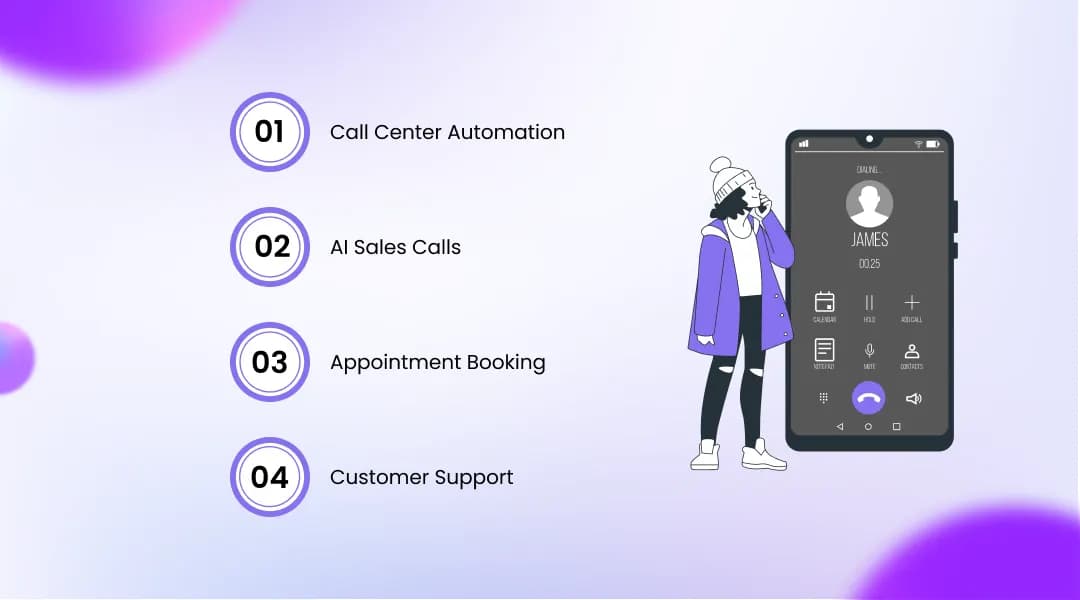
This isn’t theory. This is already happening.
Call Center Automation
Replacing repetitive support calls with AI customer support automation.
AI Sales Calls
Outbound calls that qualify leads and book meetings.
Appointment Booking
Healthcare, salons, services fully automated.
Customer Support
Handling FAQs, complaints, and requests 24/7.
And the biggest shift?
Businesses are moving from static IVR systems to conversational AI voice agents.
Challenges & Solutions
Let’s not pretend this is easy.
Latency Issues
Problem: Delays kill conversations Solution: Streaming + optimized APIs
Voice Accuracy
Problem: Misunderstanding users Solution: Better training + fallback logic
Multilingual Support
Especially critical for India.
Your AI call agent India solution must handle:
Hindi
English
Regional languages
Cost Optimization
Here’s the painful truth:
Voice AI can get expensive fast.
Solution?
Efficient API usage
Hybrid models
Smart scaling
Future of Voice AI in 2026 & Beyond
Let me be blunt.
Call centers as we know them are slowly disappearing.
AI-driven communication is taking over.
We’re moving toward:
Emotion-aware voice assistants
Human-like AI conversations
Fully autonomous voice agents
But here’s the twist…
The winners won’t be the ones with the best tech.
They’ll be the ones who understand human conversation best.
Conclusion
If you take one thing from this guide, let it be this:
Real-time AI voice assistants are not a tech problem.
They’re a human experience problem disguised as technology.
Build for speed. Design for humans. Test in real chaos—not perfect demos.
That’s how you win.