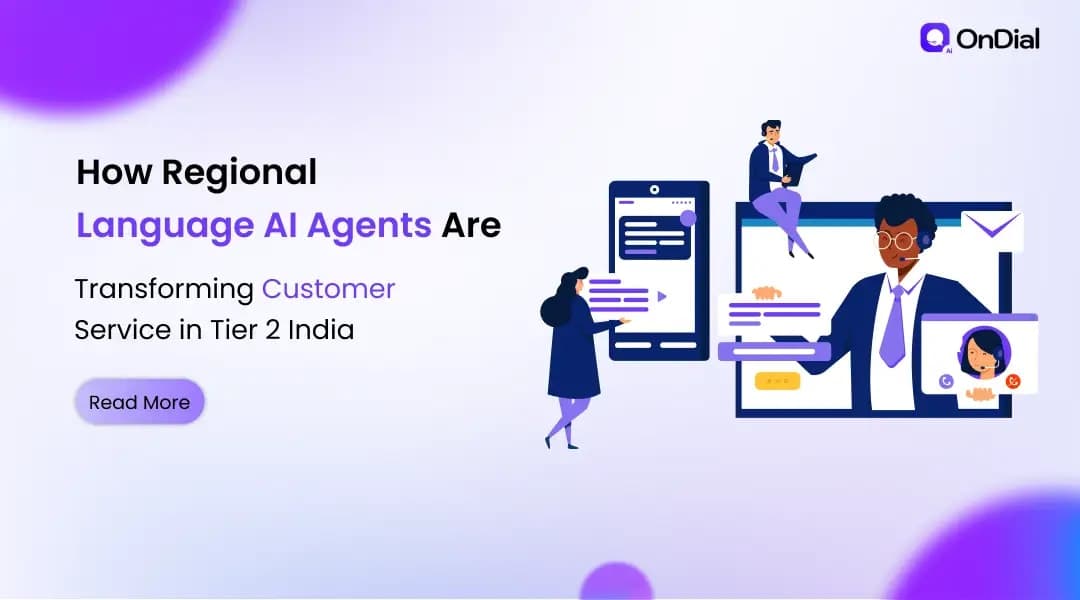
Vernacular content delivers a 40% increase in customer engagement in Tier 2 and Tier 3 cities, according to YourStory's research on regional digital adoption. That number should stop every CX leader in their tracks. Yet most businesses in India still run their customer service infrastructure entirely in English, serving a country where only about 10% of the population is fluent in it.
I've spent years at OnDial building voice AI solutions for Indian businesses, and the pattern I see repeating is this: companies chase growth in smaller cities, pour money into marketing, and then lose customers at the very first support interaction because the customer called in Marathi and got a response in English. Regional language AI agents are changing that equation. They are AI-powered systems that understand, process, and respond to customer conversations in languages like Hindi, Tamil, Telugu, Bengali, Gujarati, and Kannada, with the ability to handle dialects and mixed-language speech in real time.
Here is what you will learn: why Tier 2 India specifically needs language-first customer service, how code-switching technology actually works, which industries are seeing measurable returns, and what to look for when choosing a platform that fits your business.
What Are Regional Language AI Agents and How Do They Work?
The Technology Behind Multilingual AI
A regional language AI agent is an AI-powered virtual assistant that can understand and respond in Indian regional languages using three core technologies working together. Automatic Speech Recognition (ASR) converts spoken language into text, trained specifically on Indian language datasets. Natural Language Processing (NLP) interprets intent and context from that text. And Text-to-Speech (TTS) generates spoken responses that sound natural in the target language.
What makes modern systems different from the clunky translation bots of a few years ago is intent comprehension. When a customer in Lucknow says "bhaiya, order kab aayega?" the AI does not translate word by word into English and then processes the query. It understands the intent directly in Hindi, connects to the backend system, and responds with the delivery status, all in under two seconds.
Why This Is Not Just Translation
Here is a distinction most vendors gloss over: translation and understanding are fundamentally different capabilities. A translation layer converts words. A regional language AI agent processes meaning. It picks up on colloquialisms, honorifics, and regional phrasing that a simple translate-and-respond pipeline would butcher. At OnDial, we have learned this the hard way across dozens of deployments. The moment you treat regional language support as a translation problem, you lose the customer's trust.
India's conversational AI market was valued at INR 38.10 billion in 2024 and is projected to reach INR 152.31 billion by 2030, growing at a CAGR of approximately 26%, according to ResearchAndMarkets. That growth is not coming from English-first products. It is being driven by vernacular capabilities.
Why Tier 2 India Demands a Language-First Approach
The Digital Adoption Surge Beyond Metros
The next 100 million internet users in India are not coming from Mumbai or Bangalore. They are coming from cities like Indore, Coimbatore, Patna, Nagpur, and Surat, where regional languages dominate every aspect of daily life. According to the Indian National Readership Survey, 56% of Indians prefer using regional languages when accessing digital content. In Tier 2 and Tier 3 markets specifically, that number climbs even higher.
Over 500 million smartphone users in India now drive a digital economy that is increasingly voice-first. Many of these users are more comfortable speaking than typing. And when they need support, they expect to be understood in their mother tongue, not redirected to an English menu tree that makes them feel like an afterthought.
The Cost Problem with Human-Only Support
Can you hire native speakers for every regional language across every time zone? Technically, yes. Practically, the economics collapsed. A fintech company expanding lending into Tier 3 cities cannot staff separate Tamil, Telugu, Hindi, and Bengali support teams around the clock without destroying margins. This is exactly where AI agents fill the gap: they handle the high-volume, low-complexity interactions that consume most of a contact center's capacity, while human agents focus on cases where empathy and judgment matter.
(And let us be honest: the humans were never thrilled about answering "where is my order?" for the four hundredth time that day.)
The Code-Switching Challenge: When Customers Mix Languages Mid-Sentence
Understanding Hinglish, Tanglish, and Everything in Between
Here is something that surprises teams building for global markets: Indian customers do not speak in one language at a time. A customer in Pune might say "mujhe ek return request raise karna hai for yesterday's order." That is Hindi and English in the same sentence. In Chennai, someone might say "payment pending-aa irukku, please check pannu." That is Tamil mixed with English. This phenomenon, called code-switching, is not an edge case. It is the norm.
Leading voice AI agents in 2026 achieve 90-95% accuracy in Hindi and 85-92% in other major Indian languages, according to CarmaOne's analysis. But accuracy in pure-language input is only half the battle. The real test is whether the AI can handle a sentence that switches languages mid-thought without pausing, re-processing, or misinterpreting the intent.
Why Generic Global AI Fails Here
I have seen global AI platforms marketed as "multilingual" that fall apart the moment a customer in Jaipur mixes Hindi with English slang. These systems were trained on clean, monolingual datasets. Indian conversations do not follow textbook rules. People interrupt, repeat themselves, change topics, and ask indirect questions. A system trained on Western English patterns does not know what to do with "arey bhai, woh jo last week wala issue tha, uska kya hua?" That requires India-specific NLP training, not a translation API bolted on as an afterthought.
Real Business Impact: Where Multilingual AI Agents Deliver ROI

E-commerce and Quick Commerce
E-commerce platforms deploying regional language support have seen 3x higher conversion rates in Tier 2 and Tier 3 cities, based on Vomyra's deployment data. Meesho's implementation of multilingual voice AI handling over 60,000 daily calls demonstrated increased user engagement and reduced repeat contact rates. Flipkart's multilingual voice bot in Hindi, Tamil, and Bengali reduced cart abandonment by 12%.
The pattern is consistent: when a customer can ask "ye wala product acne pe kaam karega kya?" in Hinglish and get a natural, helpful response, trust goes up immediately. That trust converts directly into purchases.
Banking, Financial Services, and Insurance
Banks like HDFC and SBI use AI agents in Marathi, Kannada, and Tamil to improve accessibility in semi-urban and rural markets. For NBFCs and insurance companies operating in Tier 2 cities, vernacular voice agents handle collections, payment reminders, and loan servicing with measurable improvements in first-call resolution.
Think about what financial inclusion actually means in practice. A farmer in rural Maharashtra should be able to check his loan balance in Marathi at 9 PM without waiting on hold. Regional language AI makes that possible today.
Healthcare and Government Services
Brands like Practo deploy multilingual chatbots to guide users through healthcare procedures in local languages, which is essential in smaller cities where English literacy is lower. The Government of India's Bhashini initiative, launched under Digital India, is building open-source AI systems to support public services across all 22 official languages.
How to Choose the Right Voice AI Platform for Indian Languages
Non-Negotiable Technical Requirements
Not every platform that claims "multilingual support" actually delivers it at production quality. Here is what to evaluate:
Language depth over language count. A platform supporting 30 languages at 70% accuracy is less useful than one supporting 8 languages at 95% accuracy with dialect-level understanding. Ask vendors for accuracy benchmarks on code-switched conversations, not just pure-language tests.
Latency matters more than you think. For voice AI, any response delay over 1.5 seconds kills the human-like experience and leads to hang-ups. Leading platforms in 2026 operate at sub-400 millisecond latency. If a vendor cannot share their latency numbers, that is a red flag.
Integration with your existing stack. The AI agent must have deep API access to your CRM, order management system, or core banking platform. Without real-time backend connectivity, the agent becomes a glorified FAQ reader.
Evaluating for Indian Market Fit
Should you prioritize a global platform with Indian language add-ons or an India-first platform built from the ground up for vernacular conversations? In my experience at OnDial, India-first usually wins for Tier 2 deployments. These platforms are trained on how people in Indore and Visakhapatnam actually speak, not on sanitized language models built for Western markets and adapted later.
Ask these questions during evaluation: Does the platform handle mid-sentence code-switching natively? Can it recognize regional place names and local idioms? Does it support Devanagari and other native scripts for CRM logging? Is the pricing in INR per minute, which keeps unit economics workable for Indian scale?
What the Next 18 Months Look Like for Vernacular AI in India
The Shift from Pilot to Infrastructure
Vernacular AI is no longer experimental. It has moved from innovation labs into production contact centers. NVIDIA's release of the Nemotron-4-Mini-Hindi model as a NIM microservice, and Tech Mahindra's Indus 2.0 model focused on Hindi and its dialects, signal that the foundational model layer for Indian languages is maturing rapidly.
Sarvam AI, an Indian startup building sovereign language models, represents a growing trend: India-specific AI infrastructure that does not depend on Western model providers for vernacular capability. This matters for data sovereignty, latency, and cultural accuracy.
What Business Leaders Should Prepare For
The businesses building deployment experience now are accumulating language-specific training data and developing escalation logic that will compound in value. Waiting another year means competitors capture the loyalty of the Tier 2 market while you are still running pilots.
Here is a question worth sitting with: if your customer in Nagpur has a choice between your English-only support line and a competitor who greets them in Marathi, who do they call back?
Conclusion
Regional language AI agents are not a future concept for Indian customer service; they are a present-day competitive advantage. The three takeaways that matter: first, Tier 2 and Tier 3 customers actively prefer and reward businesses that speak their language. Second, code-switching capability separates real Indian AI from rebranded global translation tools. Third, the cost of not adopting vernacular AI is measured in lost customers, not just operational savings.
If your business is expanding into India's growing Tier 2 markets and you are navigating the complexity of multilingual customer engagement, this is the right time to explore a voice AI approach tailored to how your customers actually speak. At OnDial, we build conversational AI solutions designed around India's linguistic reality, not around English-first assumptions. Reach out to our team at OnDial to discuss how voice AI can work for your specific customer base and regional footprint.
Regional language AI agents give Indian businesses the ability to serve millions of customers in their own languages at scale, turning India's linguistic diversity from a support challenge into a growth strategy.