I’ll say something most vendors won’t.
Most businesses don’t have a “call problem.” They have a response problem.
Calls come in. Teams get busy. Leads go cold. Customers wait. And somewhere in that mess, revenue quietly leaks out.
I’ve seen this from the inside. I’ve sat with ops teams staring at dashboards full of missed opportunities. Not because they didn’t care, but because humans don’t scale infinitely.
So the question isn’t: “Is AI taking over phone calls?”
It’s this:
Why were we relying on fragile, human-only systems in the first place?
That’s where voice AI automation steps in, not as a replacement story, but as a correction.
What is Voice AI Automation?
Voice AI automation is the use of intelligent systems to handle phone conversations without human intervention, at least for the parts that don’t require human judgment.
Think of it as a highly trained operator. Except it doesn’t sleep. Or forget scripts. Or panic under pressure.
How AI voice agents work
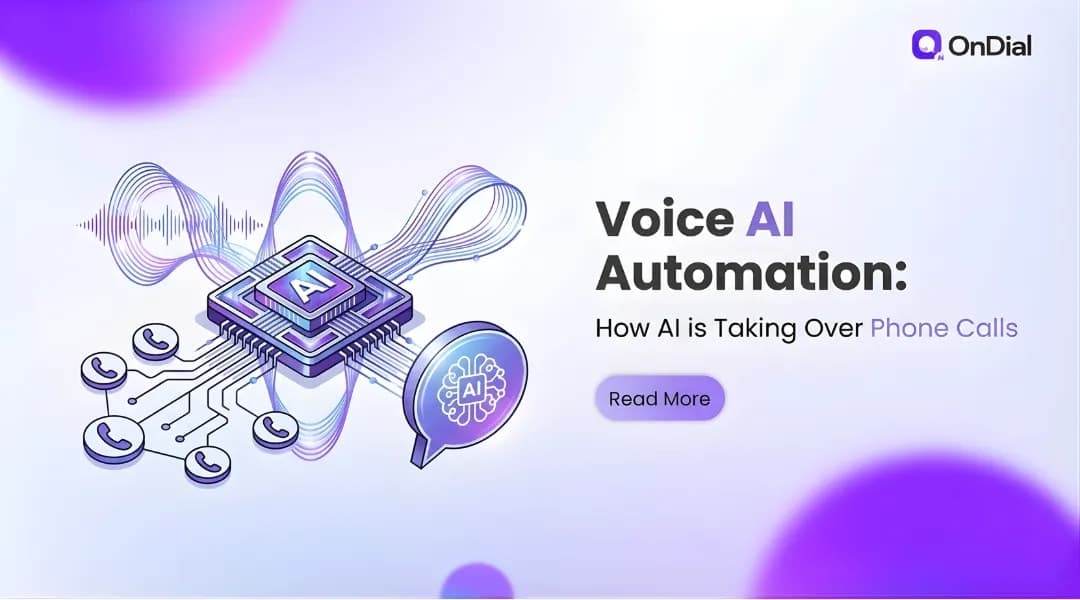
At a technical level (and yes, I’ve built pieces of this), an AI calling agent operates through a layered system:
Speech recognition converts voice to text
Natural language models interpret intent
Decision logic determines response
Text-to-speech generates human-like replies
All of this happens in milliseconds.
And when done right? It doesn’t feel like talking to a machine.
It feels… normal.
How AI is Taking Over Phone Calls
Let’s break the myth first.
AI isn’t “taking over” everything. It’s taking over the repeatable parts.
AI in inbound calls
Customer support is where this started.
FAQs
Order tracking
Appointment booking
These are predictable flows. Perfect for voice AI for call centers.
And honestly? Humans were never the best fit for these tasks anyway.
AI in outbound sales calls
Now it gets interesting.
Outbound is messy. Emotional. Rejection-heavy.
Yet, automated phone calls AI systems are now:
Qualifying leads
Scheduling demos
Running follow-ups
And doing it at scale.
Thousands of calls. Simultaneously.
Pause for a second.
How many calls can your best sales rep make in a day? 50? 80?
Now compare that to AI.
Real-time conversation handling
This is where modern AI voice agents have evolved.
They don’t just follow scripts anymore. They adapt.
Interruptions? Handled. Accents? Improved recognition. Context? Maintained across conversation.
Not perfect. But far better than most people expect.
Key Technologies Behind Voice AI

Let’s strip away the buzz.
This isn’t magic. It’s engineering.
Natural Language Processing (NLP)
This is the brain.
It helps the system understand what the user actually means, not just what they say.
Speech Recognition & Text-to-Speech
The ears and voice.
Speech-to-text captures input. Text-to-speech delivers output.
The difference between a bad system and a good one? Latency and realism.
Machine Learning models
These improve performance over time.
More calls → better understanding → fewer errors.
(Assuming someone actually trains the system properly. Many don’t.)
Conversational AI systems
This is the orchestrator.
It manages flow, context, and decisions.
Without this, you just have a talking parrot.
Benefits of Voice AI Automation

Let’s be honest.
No one adopts AI because it’s “cool.”
They adopt it because something is broken.
24/7 availability
Customers don’t care about your office hours.
AI doesn’t either.
Cost reduction
Fewer repetitive tasks for humans = lower operational cost.
Simple math.
Scalability
You don’t hire 50 agents overnight.
But you can scale AI phone call automation instantly.
Faster response times
Speed matters more than politeness.
Harsh. But true.
Improved customer experience
When done right, customers get:
Instant responses
Consistent answers
No waiting queues
And yes, sometimes they prefer it.
AI vs Human Call Agents
Let’s not pretend this is a fair fight.
It’s not.
Performance comparison
Factor | AI | Human |
Availability | 24/7 | Limited |
Scalability | Infinite | Linear |
Consistency | High | Variable |
Empathy | Limited | Strong |
Where AI wins
Repetitive queries
High-volume environments
Data-driven interactions
Where humans are still needed
Emotional conversations
Complex problem-solving
Relationship building
If someone tells you AI replaces everything… They’re selling something.
Use Cases Across Industries
This is where theory meets reality.
Call centers & BPO
Handling bulk interactions using voice AI for call centers.
Healthcare appointment booking
Reducing no-shows. Automating reminders.
E-commerce order support
“Where is my order?”- answered instantly.
Real estate lead qualification
Filtering serious buyers from casual browsers.
Banking & finance support
Balance checks. Fraud alerts. Basic queries.
Best AI Voice Automation Tools in 2026
Let me be blunt.
Tools don’t matter as much as implementation.
But still, here’s what to look for.
Overview of top platforms
Modern platforms (including solutions like those built by companies such as OnDial) focus on:
Custom conversation design
CRM integration
Real-time analytics
Features to look for
Low latency (<1 second response)
High speech accuracy
Multi-language support
Easy integration
And one more thing.
If it sounds robotic, it’s already obsolete.
Challenges & Limitations
Let’s not romanticize this.
Accuracy issues
Accents. Noise. Slang.
Still a challenge.
Complex queries handling
AI struggles with edge cases.
Humans don’t.
Customer trust factors
Some users still resist talking to machines.
And that’s okay.
Trust is earned, not forced.
Future of AI Voice Automation
This is where things get… interesting.
Hyper-personalization
AI will remember past interactions.
And adapt tone, style, and responses.
Emotion-aware AI
Detecting frustration. Adjusting responses.
Still early, but coming.
Fully autonomous call centers
Entire operations run by conversational AI voice systems.
Minimal human oversight.
Sounds extreme?
Give it a few years.
How to Implement Voice AI in Your Business
Let’s make this practical.
Step-by-step setup
Identify repetitive call flows
Define clear use cases
Map conversation journeys
Train AI with real data
Test. Break. Fix. Repeat.
Choosing the right platform
Don’t chase features.
Chase reliability.
Integration with CRM
This is non-negotiable.
Your voice assistant should:
Log interactions
Update customer data
Trigger workflows
Otherwise, it’s just noise.
Conclusion
AI isn’t taking over phone calls.
It’s fixing a system that was already broken.
And the businesses that understand this early?
They don’t just save costs.
They respond faster. Scale smarter. Serve better.
The rest?
They’ll still be hiring more agents… wondering why nothing changes.