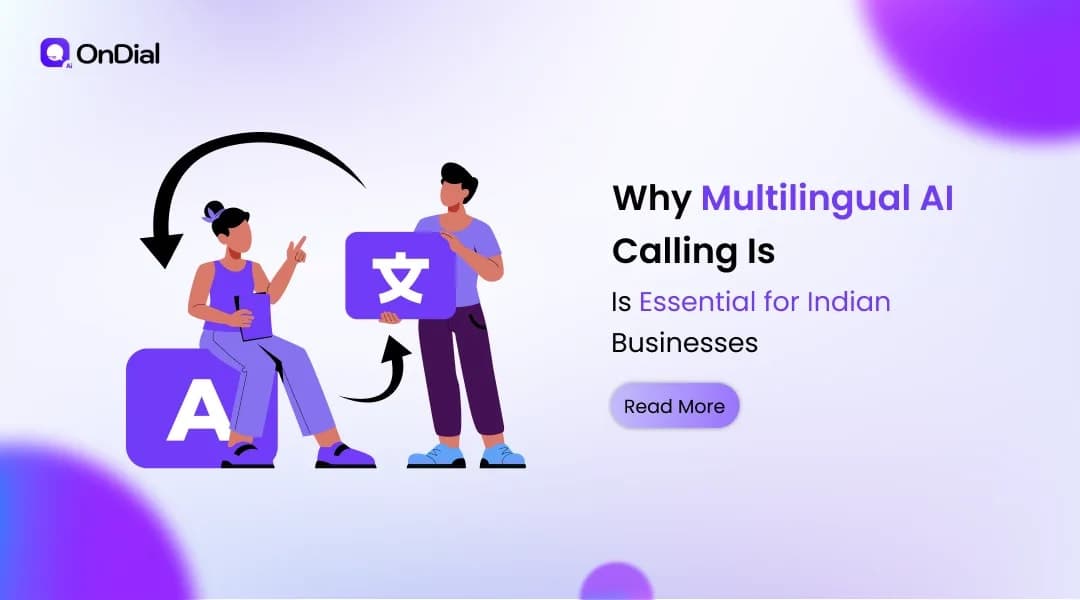
Here is a number that reframes the whole conversation. A landmark study by KPMG and Google found that roughly 66 percent of internet users in India prefer to engage in a language other than English, with the Indian-language user base projected to cross 536 million. Yet most business phone lines still greet every caller in stiff English or formal Hindi.
Multilingual AI calling is the practical answer to that mismatch. It lets an AI voice agent listen, understand, and reply in Hindi, Tamil, Telugu, Marathi, Bengali, Gujarati, and the natural Hinglish blend your customers actually speak, all on a normal phone call.
If you have wondered whether this is genuine capability or just another AI label, that doubt is fair. I have sat through early demos that sounded robotic and fumbled the moment a caller switched languages. The technology has moved well past that point.
In this guide I will walk through why language coverage is now a revenue decision, what the technology genuinely does, where it pays off, the compliance rules you must respect, and the honest limits worth knowing before you commit.
The Language Reality No Indian Business Can Ignore
India is not a single-language market wearing a regional costume. It is a genuinely multilingual country where the language of a conversation often decides whether a sale happens. This is the foundation of the case for regional language voice AI.
India Speaks in Hundreds of Languages, Not One
The scale here is easy to underestimate. The Census of India records 22 officially scheduled languages in the Eighth Schedule of the Constitution, while the 2011 Census identified 1,369 distinct mother tongues across the country.
Hindi leads at roughly 43.6 percent of the population, but that still leaves a majority who think, buy, and complain in something else. A customer in Coimbatore expects Tamil. A caller in Lucknow expects Hindi. A buyer in Ahmedabad is most comfortable in Gujarati.
For a business with multi-state ambitions, this creates a hard operational problem. Building human calling teams that cover every relevant language is expensive, slow to hire, and almost impossible to scale evenly. At OnDial, this is the problem we hear most often from founders trying to grow beyond their home state.
Your Customers Have Already Decided
Language preference is not a nice-to-have. It is a buying signal. Research cited by localization firm Rubric, drawing on CSA Research, found that 44 percent of Indians online struggle to understand product information presented only in English.
That snippet is the core of the argument. The choice is rarely between a good English call and a good regional call. It is between a regional-language conversation and a call the customer mentally checks out of within seconds.
So ask yourself a direct question. How many of your missed conversions were actually language problems wearing a different label?
What Multilingual AI Calling Actually Means
The term gets thrown around loosely, so it helps to be precise. Multilingual AI calling is automated phone conversation in which a single AI voice agent can detect, speak, and switch between multiple languages within the same call, without a menu and without a human.
From Rigid IVR to Real Conversation
Most people's reference point is the old IVR menu. Press 1 for Hindi. Press 2 for English. Wait through a script that never quite matches the problem.
Modern voice AI is a different category of system entirely. It combines automatic speech recognition (ASR) tuned for Indian accents, a large language model for reasoning, and text-to-speech (TTS) that produces natural regional voices. The result is a system that can take an inbound call, retrieve a customer's details, answer a real question, and log the outcome in your CRM inside one continuous conversation.
The difference is not incremental. An IVR routes a caller. A capable voice agent resolves the reason they called, which is why adoption across Indian businesses has accelerated through 2026.
How It Handles Hinglish and Code-Switching
This is the feature that separates serious India-built platforms from global tools adapted after the fact. Real Indian conversation rarely stays in one language. A caller says, "Sir, kal site visit book kar dein?" and expects a reply in the same register.
Handling this well depends on a few technical realities that practitioners watch closely:
Indian-accented speech recognition. Voice AI trained only on US or UK English loses meaningful accuracy on Indian English, with reported drops in the 15 to 25 percent range. The ASR layer must be trained or fine-tuned on Indian speech data.
Native code-switching. The agent must understand a sentence that mixes Hindi and English mid-flow, and respond in that same mix rather than stitching two separate voices together awkwardly.
Low latency. Natural conversation breaks down if the response lag is too long, so India-first deployments target end-to-end latency under roughly 350 to 400 milliseconds.
When we build agents at OnDial, Hinglish and regional code-switching is treated as the default mode of Indian conversation, not an edge case bolted on later. That single design decision is what makes a call feel local instead of imported.
The Business Case: Why This Became a Revenue Decision
Strip away the technology talk and the question becomes simple. Does this make or save enough money to justify the investment? For most Indian businesses serving diverse markets, the answer is now clearly yes.
Cost, Coverage, and the Tier-2 and Tier-3 Opportunity
Start with the math that decision-makers care about. An IBM case study with Assisto Technologies reports that automating customer service through multilingual voice bots can reduce operational costs by up to 50 percent, while lifting customer satisfaction scores by 20 to 30 percent.
The coverage advantage is just as important. A single AI voice agent can serve many languages at once, which lowers total cost of ownership compared with maintaining separate language teams or separate phone numbers per language.
The real prize sits in Tier-2 and Tier-3 markets. These are the regions where English-only support fails hardest and where human agents fluent in the local language are scarcest. Multilingual AI calling is often the only practical way to reach millions of price-sensitive prospects in their own language at unit economics that work.
The Trust Dividend of Speaking a Customer's Language
Cost savings get the budget approved. Trust is what actually drives the returns. When a customer is addressed in their mother tongue, the interaction stops feeling like a transaction and starts feeling like respect.
I have seen this shift play out repeatedly in projects where a business moved a campaign from English to the caller's regional language. Pickup rates rise. Conversations last longer. People volunteer information they would never share with a script that does not sound like them.
This is the quiet compounding benefit. A customer who feels understood comes back, refers others, and forgives the occasional mistake. Regional language voice AI is therefore a loyalty engine as much as a cost lever, and that is the part most cost-only analyses miss.
Compliance and Quality: What You Must Get Right
Adopting this technology in India is not a free-for-all. The calling environment is regulated, and getting compliance wrong can cost far more than the system saves. This is also the area where honest providers earn their keep.
Calling Rules: TRAI DLT, DND, and the DPDP Act
The short version is reassuring, with conditions attached.
A few obligations sit at the center of any serious deployment. Outbound calling must respect TRAI DLT registration and DND or NCPR scrubbing so you are not dialing numbers that opted out. Customer data must be handled under the Digital Personal Data Protection (DPDP) Act, which covers consent, data residency, and the right to erasure.
Regulated sectors carry extra weight. Businesses in banking and lending also answer to RBI guidance, and insurers to IRDAI rules, which is why audit trails, call recording, and encrypted storage are standard requirements rather than optional extras.
Where Multilingual AI Still Has Limits
Here is the counter-intuitive part. The honest case for this technology is stronger when you admit what it cannot yet do.
Accuracy is not uniform across the country. Industry benchmarks circulating in 2026 suggest recognition accuracy of around 82 to 88 percent in Tier-2 cities and 70 to 80 percent in Tier-3 towns, with Hinglish speech running a few points lower again. The gap between metro and small-town performance remains the biggest practical barrier.
Heavy dialects, noisy environments, and highly technical conversations can still trip an agent up. The right approach is to deploy on a high-volume, well-understood workflow first, measure against real customer audio, then expand language by language.
Honesty about these limits is not a weakness in the pitch. It is the difference between a vendor selling hype and a partner like OnDial that wants the deployment to actually work in your market.
Conclusion
Multilingual AI calling has crossed the line from interesting experiment to business necessity for any Indian company that serves more than one language community. Three things should stay with you. India's customers overwhelmingly prefer their own language, the economics now favour automation with cost savings reaching as high as 50 percent, and compliance with TRAI and DPDP rules is non-negotiable rather than optional.
You no longer have to guess whether this fits your business. You have a clear way to evaluate it: pick one high-volume workflow, deploy in your customers' actual languages, and measure the difference honestly. If you want a partner that builds this for Indian conversation from the ground up, talk to OnDial about a focused pilot on a single campaign and let the numbers from your own market make the decision for you.