The average customer spends 56 seconds navigating a traditional IVR menu before reaching any form of resolution, and 67% of callers who encounter a multi-level IVR system hang up before completing the tree. That statistic alone explains why enterprise contact centres handling more than 50,000 monthly calls are aggressively evaluating AI call agents as a replacement for their legacy telephony automation. The economics are equally compelling. A single human agent handling inbound calls costs between $3,200 and $5,500 per month when you factor in salary, benefits, training, attrition replacement, and infrastructure overhead. An AI call agent handling equivalent call volume operates at roughly $0.08 to $0.18 per minute of conversation, which translates to a 55% to 78% cost reduction depending on call complexity and resolution rates.
This blog is a complete guide to AI call agents written for the teams evaluating, building, or buying them. It covers the full production architecture from speech recognition through telephony integration, the critical design decisions that separate reliable agents from demo prototypes, the implementation journey from pilot to production, the realistic ROI framework, the failure modes you must design around, and what a mature AI call agent looks like after six months of production operation. Whether you are a contact centre director building a business case or a technical architect designing the system, this is the reference you need.
What an AI Call Agent Actually Does and Where It Fits
An AI call agent is a software system that conducts real telephone conversations with callers or call recipients using speech recognition, natural language understanding, dialogue management, response generation, and text to speech synthesis, all orchestrated in real time over a telephony connection. Unlike a chatbot that handles text on a website or a simple IVR that routes calls through touch tone menus, an AI call agent operates in the most demanding interaction modality: live, full duplex voice over a phone line, where latency tolerance is under 800 milliseconds and there is no visual interface to fall back on.
The scope of what a well designed AI call agent handles in production today spans a wide range of call types. Inbound scenarios include customer service enquiries, order status checks, appointment scheduling and rescheduling, billing questions, technical troubleshooting for common issues, insurance claims intake, and prescription refill requests. Outbound scenarios include appointment reminders and confirmations, payment collection calls, lead qualification, survey administration, and proactive service notifications. The distinguishing characteristic of a true AI call agent versus a simple voice bot is its ability to handle multi-turn conversations with context retention, manage interruptions and topic switches gracefully, access backend systems during the call to retrieve or update information, and escalate to human agents with full context when the conversation exceeds its capabilities.
Where AI Call Agents Sit in the Contact Centre Stack
An AI call agent does not replace the entire contact centre infrastructure. It sits as an intelligent front layer that handles the calls it can resolve autonomously and routes the remainder to human agents with enriched context. In a typical deployment, the AI call agent connects to the existing telephony infrastructure through SIP trunking or cloud telephony APIs, integrates with the contact centre platform such as Genesys, Five9, NICE, or Amazon Connect, and accesses the same CRM and backend systems that human agents use. The result is a hybrid operation where the AI handles 40% to 70% of total call volume autonomously and reduces the average handle time on escalated calls by providing human agents with a full conversation transcript and extracted intent summary.
Production Architecture of an AI Call Agent
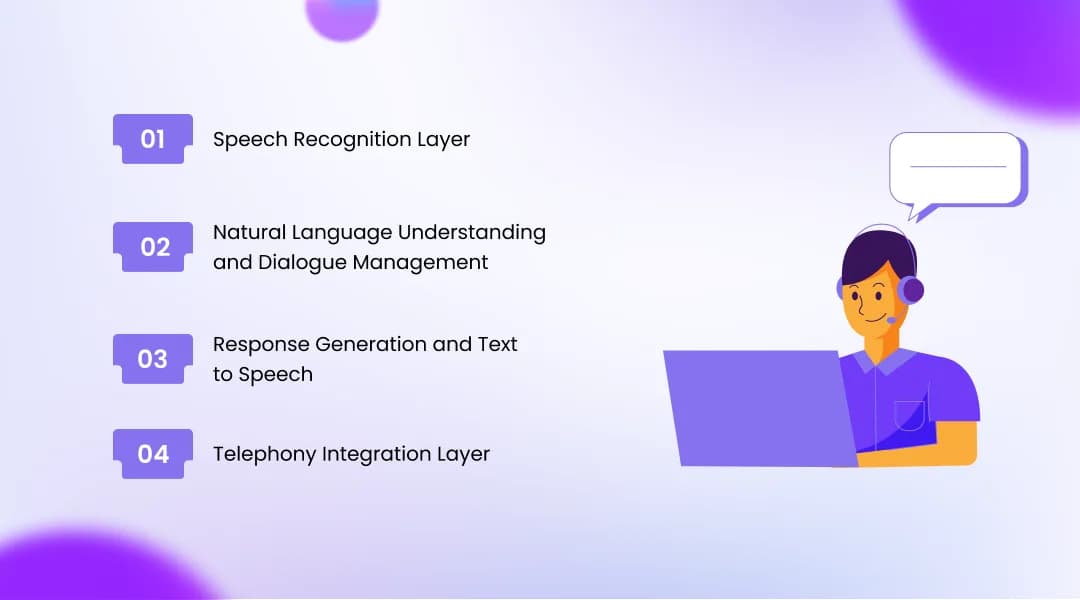
Building an AI call agent that performs reliably on live phone calls requires a carefully engineered pipeline where every component operates under strict latency and accuracy constraints. The following architecture reflects what KriraAI deploys in production environments handling thousands of concurrent calls.
Speech Recognition Layer
The ASR component must operate in streaming mode, producing partial transcriptions as the caller speaks rather than waiting for the full utterance to complete. Production systems typically use Conformer based ASR models or fine-tuned Whisper variants optimised for streaming inference. The choice between these architectures involves a direct tradeoff. Conformer models with RNN-T (Recurrent Neural Network Transducer) decoders deliver lower streaming latency, typically 150 to 250 milliseconds for partial results, and handle real time processing efficiently. Whisper based systems offer superior accuracy on diverse accents and noisy audio but require chunked processing that adds 300 to 500 milliseconds of latency unless specifically optimised with speculative decoding or distilled model variants.
For domain specific deployments such as healthcare call agents or financial services call agents, the ASR layer must be adapted to recognise specialised vocabulary. This is achieved through language model hot words, contextual biasing with domain specific phrase lists, or fine-tuning on domain audio data. A healthcare AI call agent that cannot accurately transcribe medication names or procedure codes will fail regardless of how good the rest of the pipeline is. Production ASR systems also require voice activity detection to segment caller speech from background noise and silence, endpointing logic to determine when the caller has finished speaking, and echo cancellation to prevent the agent's own TTS output from being captured as input.
Natural Language Understanding and Dialogue Management
Once the caller's speech is transcribed, the NLU layer must extract the caller's intent, relevant entities, and conversational context. Modern AI call agent systems use one of three architectural approaches for this layer, each with distinct tradeoffs.
The first approach uses a fine-tuned classifier model, typically a distilled BERT or RoBERTa variant, trained on labelled call transcripts to classify intents and extract entities. This approach delivers very low inference latency (under 50 milliseconds) and high accuracy on known intent categories, but it cannot handle novel intents or complex multi-intent utterances without retraining. The second approach uses a large language model such as GPT-4o, Claude, or an open source model like Llama 3 as the primary understanding and reasoning engine, with a carefully engineered system prompt that defines the agent's persona, capabilities, and guardrails. This approach handles novel situations and complex reasoning well but introduces 400 to 1,200 milliseconds of inference latency per turn and requires careful prompt engineering to maintain consistency. The third approach, which KriraAI typically recommends for production AI call agents, is a hybrid architecture. A lightweight classifier handles the 15 to 20 most common intents with sub-50-millisecond latency, while an LLM handles complex, ambiguous, or multi-intent utterances that the classifier routes to it. This hybrid approach achieves both the speed required for conversational fluency and the flexibility required for real caller behaviour.
Dialogue management in production call agents has evolved beyond finite state machines. While state machines work for simple, linear call flows such as appointment confirmations, they break down when callers interrupt, change topics, or ask questions the flow designer did not anticipate. Frame-based dialogue managers that track slots and goals across turns handle mid-conversation topic switches more gracefully. For the most capable AI call agents, a retrieval-augmented LLM manages the conversation state, using a structured context window that includes the current call's transcript, the caller's account information retrieved from the CRM, and the agent's policy and procedure knowledge base.
Response Generation and Text to Speech
The response generation layer must produce natural, contextually appropriate responses under tight latency constraints. Template-based responses with dynamic slot filling remain the fastest approach and are used for predictable responses like confirming an appointment date or reading back an account balance. For open-ended responses, LLM generation is used with streaming output so that the TTS layer can begin synthesising speech before the full response text is complete.
The TTS layer converts the agent's text responses into spoken audio. Neural TTS systems based on architectures such as VITS, or proprietary systems from providers like ElevenLabs, PlayHT, or Deepgram, produce natural sounding speech with latencies between 100 and 400 milliseconds for the first audio chunk when operating in streaming mode. Voice persona design is a critical but often overlooked component. The AI call agent's voice must match the brand identity, and production systems allow control over speaking rate, pitch variation, and emotional tone. A collections call agent should not sound identical to a customer service agent for a luxury brand.
Telephony Integration Layer
The telephony layer connects the AI call agent to the actual phone network. This integration uses SIP (Session Initiation Protocol) for connecting to PSTN carriers and PBX systems, RTP (Real-time Transport Protocol) for streaming audio bidirectionally, and WebRTC for browser-based or app-based voice interactions. Production deployments typically use cloud telephony platforms such as Twilio, Vonage, or Telnyx as the connectivity layer, with the AI call agent application receiving raw audio streams via WebSocket connections. The telephony layer must handle concurrent call capacity (production systems routinely manage 200 to 2,000 simultaneous calls), call recording for compliance and quality assurance, DTMF tone detection for callers who press keypad buttons, and call transfer protocols for escalation to human agents.
Critical Design Decisions That Determine Call Agent Quality
The difference between an AI call agent that impresses in a demo and one that survives 10,000 production calls per day comes down to a set of design decisions that are invisible in a prototype but critical in deployment.
Latency Budget Allocation
The total end-to-end latency from the moment a caller finishes speaking to the moment they hear the first word of the agent's response must stay below 800 milliseconds for the conversation to feel natural. This budget must be allocated across the pipeline: ASR endpointing and final transcription (150 to 300 ms), NLU and dialogue management processing (50 to 200 ms), response generation (100 to 400 ms), TTS first chunk synthesis (100 to 300 ms), and network transmission latency (30 to 80 ms). When these components are not carefully optimised and orchestrated, the total latency exceeds 1,200 milliseconds and callers perceive the agent as slow or broken. KriraAI's production pipeline engineering focuses heavily on this latency budget, using techniques like speculative response generation (beginning to generate a likely response while ASR is still finalising), streaming TTS that begins playback from partial text, and intelligent caching of common response fragments.
Interruption and Barge-in Handling
Real callers interrupt. They speak over the agent, correct themselves mid-sentence, and say "actually, wait" after the agent has already started responding. A production AI call agent must detect when the caller is speaking while the agent is speaking (barge-in detection), immediately stop TTS playback when a barge-in is detected, capture and process whatever the caller said during the overlap, and resume the conversation incorporating the new input. Systems that do not handle barge-in correctly either talk over the caller, creating a frustrating experience, or stop and restart awkwardly, breaking conversational flow. Barge-in detection uses a combination of voice activity detection on the caller's audio channel and energy level comparison between the agent's output and the caller's input.
Escalation and Handoff Design
No AI call agent handles 100% of calls autonomously. The escalation design determines whether the calls that the agent cannot handle result in a good customer experience or a disaster. Effective escalation requires the agent to recognise when it has reached the boundary of its capability, which may be indicated by repeated failed intent classification, a caller explicitly requesting a human, or a topic that falls outside the agent's configured scope. The handoff to a human agent must include the full conversation transcript, the extracted intent and entities, any account information already retrieved, and the reason for escalation. The human agent should be able to continue the conversation without the caller repeating anything. Production systems achieve warm transfer latencies of 8 to 15 seconds from escalation trigger to human agent connection.
Building and Deploying an AI Call Agent: The Implementation Journey
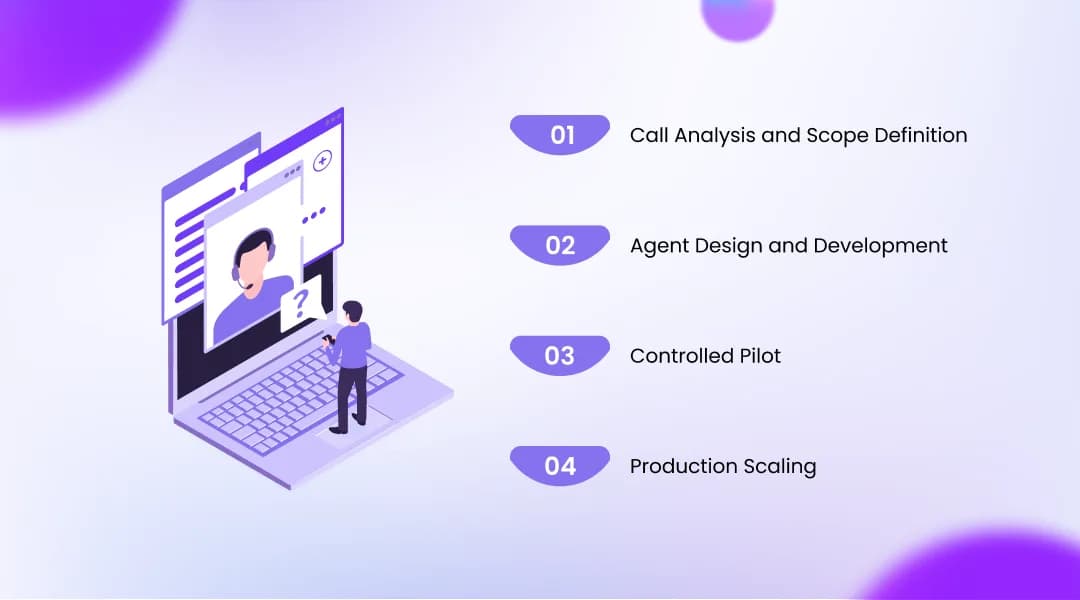
Deploying an AI call agent into a live contact centre is a phased process that typically spans 8 to 16 weeks from initial scoping to production traffic handling.
Phase 1: Call Analysis and Scope Definition (Weeks 1 to 2)
The first phase involves analysing a representative sample of existing call recordings, typically 500 to 2,000 calls, to identify the distribution of call types, the most common intents and their resolution patterns, the average call duration and complexity, and the percentage of calls that are candidates for AI handling. This analysis produces a prioritised list of call types for the AI agent to handle, ordered by volume and automation feasibility. Most deployments start with 3 to 5 call types that represent 40% to 60% of total volume and have relatively structured resolution paths.
Phase 2: Agent Design and Development (Weeks 3 to 8)
This phase involves designing the conversation flows, building and testing the NLU models, configuring backend integrations, selecting and customising the TTS voice, and building the monitoring and analytics dashboards. The conversation design process is iterative, using simulated calls to test the agent's handling of common paths, edge cases, and failure scenarios. Backend integration work often takes longer than expected because the AI agent needs real-time access to the same systems human agents use, and those systems were not always designed for programmatic access at conversational speed.
Phase 3: Controlled Pilot (Weeks 9 to 12)
The pilot phase routes a controlled percentage of live calls, typically 5% to 15%, to the AI agent while monitoring performance metrics in real time. Critical metrics during the pilot include call containment rate (percentage of calls the AI resolves without escalation), task completion rate, caller satisfaction scores, average handle time, and error rates on intent classification and entity extraction. The pilot phase is where most design assumptions are validated or corrected. Teams at KriraAI typically iterate through 3 to 5 agent updates during the pilot based on real caller interaction patterns that were not anticipated during design.
Phase 4: Production Scaling (Weeks 13 to 16)
Once the pilot demonstrates acceptable performance metrics, the system scales to handle full production call volume. This phase involves infrastructure scaling to handle peak concurrent call loads, failover and redundancy configuration, integration with production monitoring and alerting systems, and training for the operations team that will manage the AI agent alongside human agents.
Measuring ROI: The Realistic Business Case for AI Call Agents
The business case for an automated call handling system must be built on realistic assumptions, not vendor marketing numbers. Here is the framework for calculating the actual ROI of an AI call agent deployment.
Cost Structure Comparison
A mid-size contact centre handling 100,000 inbound calls per month with an average handle time of 4.5 minutes operates with approximately 45 to 55 full-time agents across shifts. The fully loaded cost of this operation, including salaries, benefits, training, attrition (which averages 30% to 45% annually in contact centres), management overhead, and infrastructure, ranges from $180,000 to $300,000 per month depending on geography and complexity.
An AI call agent handling 60% of this call volume (60,000 calls per month) at an average cost of $0.12 per minute of conversation and an average AI-handled call duration of 3.2 minutes costs approximately $23,000 per month in compute and telephony. Adding the platform licensing, ongoing optimisation, and the reduced human team needed for escalations and complex calls, the total monthly cost of the hybrid operation typically falls between $95,000 and $155,000 per month. This represents a voice AI call centre automation savings of 35% to 52% on total contact centre operating costs. The payback period on the initial implementation investment of $150,000 to $400,000 is typically 4 to 8 months.
Beyond Cost: Quality and Consistency Improvements
The ROI extends beyond direct cost savings. AI call agents deliver perfectly consistent service quality across every call, eliminate hold times for the call types they handle (average answer time drops from 45 seconds to under 2 seconds), operate 24/7 without staffing challenges for off-hours coverage, and generate structured data from every conversation that enables continuous operational improvement. Organisations deploying production AI call agents consistently report a 15% to 25% improvement in first-call resolution rates for AI-handled call types because the agent always follows the optimal resolution path and never forgets to check a system or ask a qualifying question.
Common Failure Modes and How to Avoid Them
Teams evaluating or building AI call agents must understand the failure modes that derail deployments, because most failures are predictable and preventable.
The first common failure is over-scoping the initial deployment. Teams try to automate 20 call types simultaneously instead of mastering 3 to 5 first. This spreads NLU training data thin, creates a conversation design surface area too large to test thoroughly, and results in a mediocre agent across many call types instead of an excellent agent for a few. The remedy is to start with high-volume, structured call types and expand scope incrementally based on production performance data.
The second failure is ignoring the latency budget. Teams assemble a pipeline of best-in-class components, each excellent independently, that collectively produce 1,500+ milliseconds of end-to-end latency. Callers perceive this as the agent being confused or broken. Every component selection must be made with the total latency budget in mind, and the pipeline must be benchmarked end-to-end, not component by component.
The third failure is inadequate escalation design. When the AI agent fails and cannot transfer the caller smoothly to a human agent with full context, the resulting experience is worse than if the caller had reached a human directly. Escalation is not an afterthought. It is a core product feature that must be designed, built, and tested with the same rigour as the happy path.
The fourth failure is neglecting post-deployment optimisation. An AI call agent is not a product you deploy and leave running. It requires continuous monitoring, weekly or biweekly analysis of failed interactions, regular NLU model updates based on new caller language patterns, and ongoing conversation design refinement. Teams that treat the agent as a static deployment see performance degrade within 60 to 90 days as caller behaviour and business processes evolve. KriraAI builds continuous improvement pipelines into every deployment, with automated flagging of low-confidence interactions and structured review workflows that feed improvements back into the agent.
What a Mature AI Call Agent Looks Like in Production
After six months of production operation and iterative improvement, a well-built AI call agent exhibits characteristics that distinguish it from both a newly launched system and a traditional IVR.
A mature AI call agent achieves a call containment rate above 65% for its scoped call types, meaning two-thirds of calls within its scope are resolved without human intervention. Its intent classification accuracy on production traffic exceeds 92%, measured on a continuously updated test set drawn from real calls. Its average end-to-end response latency sits below 700 milliseconds for the 90th percentile of turns. Its escalation rate has stabilised at a predictable percentage, and every escalation includes sufficient context that human agents rarely need to ask the caller to repeat information.
The conversational AI phone system at maturity also demonstrates sophisticated handling of edge cases that would trip up a newly deployed agent. It recognises when a caller is elderly and automatically slows its speaking rate and simplifies its language. It detects frustration in caller tone and proactively offers human escalation before the caller asks. It handles callers who call back about the same issue by referencing the previous interaction. It manages multi-party calls where a caregiver calls on behalf of a patient or a business partner calls on behalf of a client. These capabilities emerge not from initial design alone but from the systematic analysis of thousands of production calls and the disciplined incorporation of findings into the agent's behaviour.
Conclusion
Three takeaways define the current state of AI call agents for any team evaluating or building them. First, the production architecture must be engineered as a latency-optimised pipeline with a strict sub-800-millisecond response budget, not assembled from independent best-in-class components without regard for end-to-end performance. Second, the implementation must be scoped tightly at launch, targeting 3 to 5 high-volume call types, and expanded methodically based on production data rather than attempting broad coverage from day one. Third, the realistic automated call handling ROI of 35% to 52% in total contact centre cost reduction is compelling, but it is realised only through continuous post-deployment optimisation, not through a single deployment milestone.
KriraAI designs and delivers production-grade AI call agent systems with the engineering depth to handle the full pipeline from speech recognition through telephony integration, the domain expertise to adapt agents to specific industry requirements, and the operational methodology to move from pilot to production reliably. The systems KriraAI builds are not demos or prototypes. They are production voice automation systems handling thousands of live calls daily with measurable, auditable performance. If your organisation is evaluating a conversational AI phone system for your contact centre operations, reach out to KriraAI to discuss your specific call volumes, use cases, and integration requirements.