According to a Salesforce study, 62% of students say they would benefit from better assistance during the admissions process. That number should concern every enrollment leader reading this. Because behind it is a harder truth: most institutions already know their follow-up process is falling short, yet the fix feels either too expensive or too uncertain. Here is the short answer. AI voice agents for admissions automate outbound and inbound follow-up calls, respond to prospective students within seconds, qualify leads, schedule campus visits, and sync every interaction back to your CRM. They operate around the clock, speak multiple languages, and free your counselors to do the work that actually requires a human. In this guide, I will walk you through why admissions follow-up fails at most institutions, what AI voice agents do (and do not do), how they directly improve enrollment conversion, and what to look for when evaluating a solution for your campus.
Why Admissions Follow-Up Is Broken
Let me be direct. The admissions follow-up process at most educational institutions was designed for a world that no longer exists. It assumed smaller applicant pools, predictable timelines, and enough staff to make personal calls. None of that is true anymore.
The Volume Problem No Team Can Outrun
A mid-sized university receiving 15,000 annual inquiries during peak enrollment season cannot realistically expect a team of 8 to 10 counselors to respond to every one within 24 hours. The math does not work. And yet, speed of response is among the strongest predictors of whether a prospective student converts.
I've personally seen institutions where admissions staff spend 60% to 70% of their day answering the same five questions: "What is the application deadline?" "Do you offer scholarships?" "What documents do I need?" These are important questions. But they do not require a trained counselor. They require a system that can answer accurately, instantly, and at scale.
The demographic picture makes this more urgent. According to the Western Interstate Commission for Higher Education (WICHE), the number of high school graduates will decline steadily through 2041, with nearly half a million fewer traditional-age students entering the pipeline. Every lost inquiry now costs more than it did five years ago.
What Happens When Follow-Up Fails
Here is what staff burnout and slow responses actually look like in enrollment data. A higher education survey cited by VoAgents found that universities using AI for student calls reported a 40% drop in missed calls during admissions season. That stat implies the inverse: institutions without automation are missing nearly half their inbound contact attempts during the busiest windows.
(Think about that for a moment. A student calls your admissions office, gets no answer, and calls a competing institution instead. That is not a hypothetical. That is Tuesday.)
Students today expect the same responsiveness from a university that they get from an e-commerce platform. A Salesforce report confirmed that 77% of students would use AI agents to help with school processes, and 52% said they would be more likely to apply to a school where finding information was easier. Slow follow-up is not just an operational problem. It is a brand problem.
What AI Voice Agents for Admissions Actually Do
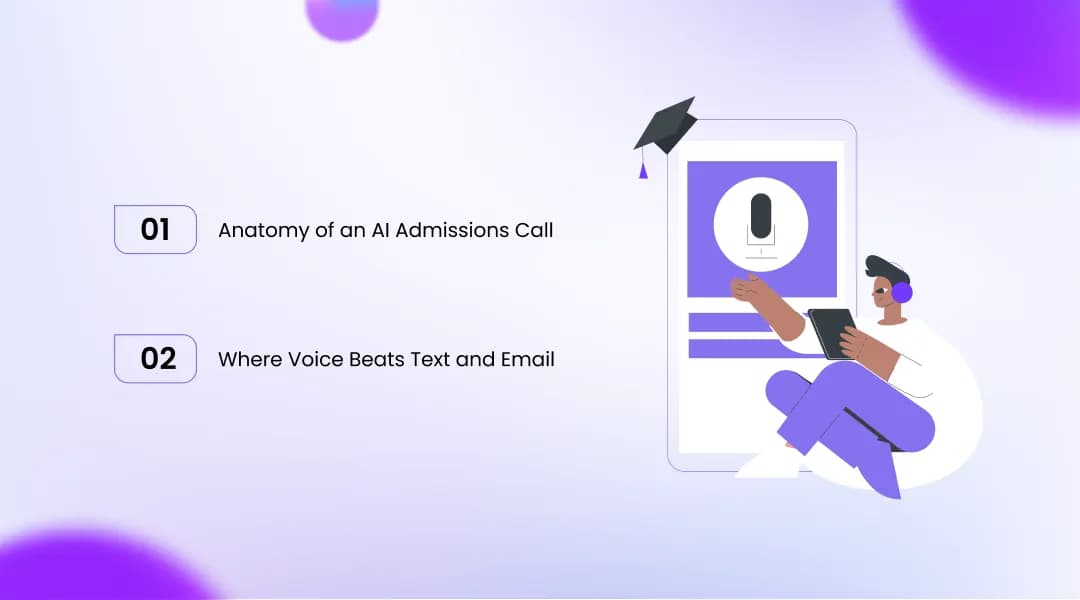
An AI voice agent is an automated calling system powered by natural language processing (NLP) that conducts real-time, two-way phone conversations with prospective students. It is not a robocall. It is not a recorded message. It listens, understands context, and responds in natural speech.
Anatomy of an AI Admissions Call
Here is a typical workflow, step by step:
Trigger activation: A student submits an inquiry form, abandons an application, or misses a deadline. The CRM flags this event automatically.
Outbound call initiation: The AI voice agent places a call within minutes of the trigger, not hours or days.
Live answer detection: The system identifies whether a real person answered or whether it reached voicemail. It adapts accordingly.
Contextual conversation: The agent introduces the purpose of the call, answers questions about programs, deadlines, or requirements using the institution's knowledge base, and qualifies the student's intent.
Action completion: Depending on the conversation, the agent books a campus tour, schedules a counselor callback, or confirms document submission.
CRM sync: Every detail from the call, including transcript, outcome, and next steps, is written back to the institution's CRM system.
This is not futuristic technology. Platforms like Conversica, Mainstay, and Element451 already operate this way across hundreds of institutions. At OnDial, we build tailored voice AI solutions following this same architecture, but with a particular focus on regional language support and India-specific enrollment workflows.
Where Voice Beats Text and Email
Why voice specifically? Data from Haptik's education AI research shows that outbound voice AI for admissions generates 2 to 3 times higher engagement than SMS or email alone. The reason is straightforward: voice is immediate, personal, and two-directional. A student can ask a follow-up question mid-call. An email cannot do that.
Should you abandon email and SMS? No. But voice should be the primary channel for high-intent follow-up moments: abandoned applications, post-visit check-ins, deadline reminders, and re-engagement of stalled applicants.
How AI Voice Assistants in Education Improve Enrollment Conversion
Here is a question worth sitting with: if your team could respond to every single inquiry within 60 seconds, how would your enrollment numbers change?
That is not rhetorical. Institutions deploying AI voice agents are seeing exactly this kind of shift.
Instant Response, Higher Yield
Enrollment conversion with voice AI improves because the biggest friction point in the admissions funnel is time. A student who inquires on a Friday evening and hears back on Monday morning has already researched three other schools. An AI voice agent calls back within minutes, regardless of the hour.
A case study published by QuickVoice AI documents a 15,000-student university that automated 38,000 calls per year across admissions, financial aid, and registration. The result was $503,000 in savings and a 3.2% improvement in enrollment yield. For context, at many institutions, a single percentage point of enrollment yield improvement is worth millions in tuition revenue.
I've worked on projects at OnDial where institutions in India saw similar patterns. One coaching institute we partnered with was losing 30% of its high-intent leads between inquiry and enrollment because counselors simply could not call everyone back the same day. After deploying a voice AI agent with regional language capability, their response time dropped from 18 hours to under 3 minutes. The conversion lift was immediate and measurable.
The Human-AI Handoff Framework
This is where many institutions get nervous, and reasonably so. "Will the AI say something wrong?" "Will students feel they are talking to a machine and hang up?"
These are valid concerns. But the answer is not to avoid AI; it is to design the handoff correctly. An effective student inquiry automation system should follow a clear escalation model:
Tier 1 (AI handles fully): Deadline inquiries, document checklists, application status, fee structure, campus tour scheduling. These represent roughly 60% to 70% of all admissions calls.
Tier 2 (AI assists, then transfers): Financial aid nuances, scholarship eligibility, transfer credit evaluation. The AI gathers context first, then routes to a counselor with a full summary.
Tier 3 (Human only): Emotional or sensitive conversations, special accommodations requests, disciplinary disclosures. The AI recognizes these moments and escalates immediately.
Can a voice bot actually handle admissions questions? Yes, for structured and repeatable queries. No, for conversations requiring empathy, judgment, or institutional discretion. And the best implementations are transparent about this boundary.
Ocelot, which serves over 470 schools, reports 97% question accuracy for its AI system on structured queries. That accuracy drops significantly for ambiguous or emotionally loaded conversations, which is exactly why the handoff model matters.
Admissions Follow-Up Automation: A Step-by-Step Workflow
Let me walk through how admissions follow-up automation works in practice, from initial setup to daily operation.
Setting Up Trigger-Based Outreach
The foundation of any voice AI deployment is the trigger map. This is the document that defines which student actions initiate an AI call and what the call should accomplish. Common triggers include:
Inquiry submitted but no application started within 48 hours. The AI calls to offer help, answer questions, and walk the student through the application link.
Application started but incomplete for more than 5 days. The AI calls to identify the sticking point, whether it is a missing document, confusion about requirements, or a change in interest.
Application submitted, awaiting decision. The AI calls with a status update and reminds the student about next steps such as financial aid deadlines or housing deposits.
Accepted but not enrolled. This is the critical "summer melt" window. The AI calls to congratulate, confirm intent, and schedule orientation.
Each trigger maps to a conversation script that the AI follows, but with enough NLP flexibility to handle variations in how students phrase their questions.
CRM Integration and Data Sync
No voice AI deployment works without tight CRM integration. The agent needs to pull student records in real time and write outcomes back after every call. Platforms like Salesforce Education Cloud, LeadSquared, and HubSpot all support this kind of integration.
At OnDial, we prioritize this data loop because it is where most implementations fail. An AI agent that cannot access the student's current application status will give generic answers, and generic answers destroy trust. The value is in personalization: "Hi Priya, I can see you have submitted your documents for the Computer Science program. Your application is currently under review, and you should hear back by June 15th." That is a fundamentally different experience from a recorded message.
Compliance matters here too. For institutions in the United States, FERPA governs how student data is stored and processed. The Department of Education's recent guidance has expanded FERPA enforcement to cover AI-processed student interactions. Any voice AI vendor you evaluate should demonstrate SOC 2 Type II certification or equivalent data security posture.
What to Look for When Choosing Voice AI for Higher Education
Not all voice AI for higher education platforms are equal. Some were built for sales call centers and adapted for education as an afterthought. Others were designed specifically for student-facing workflows.
Compliance, Languages, and Scalability
Here are the non-negotiable evaluation criteria:
Data compliance: FERPA alignment (for US institutions), GDPR (for European students), and local data protection laws. Ask for audit certificates, not just marketing claims.
Language support: If your institution serves multilingual populations, the AI must handle regional languages with native-level fluency, not just English with a translation layer. In India, this means Hindi, Tamil, Telugu, Marathi, and Bengali at minimum. This is where OnDial's expertise in multilingual voice AI becomes particularly relevant.
Latency: Response time under 800 milliseconds. Anything slower creates unnatural pauses that cause callers to hang up. Retell AI's testing benchmarks show that sub-600ms latency is the current gold standard.
CRM integration: Native connectors for your existing SIS (Student Information System) or CRM. If integration requires custom development, factor in 4 to 8 weeks of additional deployment time.
Scalability: Can the system handle 1,000 concurrent calls during peak enrollment? Many platforms throttle at much lower volumes.
Questions to Ask Every Vendor
Before you sign a contract, ask these five questions:
"Can you share a case study from an institution similar to ours in size and region?"
"What percentage of calls does your AI resolve without human intervention, and how do you measure that?"
"How do you handle calls where a student becomes frustrated or asks to speak with a person?"
"What is your data retention and deletion policy for call recordings?"
"Can we listen to sample calls from your education deployments?"
I want to be honest about something. AI voice technology has improved dramatically, but it is not perfect. Accents, background noise, and emotional nuance still challenge even the best systems. The institutions that succeed with this technology are the ones that set realistic expectations, start with high-volume repeatable calls, and expand gradually. The ones that fail are the ones that try to automate everything on day one.
Conclusion
AI voice agents for admissions solve three problems simultaneously: they eliminate response delays that cost you applicants, they free your counselors to focus on high-value conversations, and they create a data trail that makes your entire enrollment pipeline visible and improvable. The technology is not theoretical. It is operational at hundreds of institutions today, with documented cost savings and enrollment gains.
The institutions that will thrive through the coming enrollment decline are the ones building these systems now, not the ones waiting for perfection. If your admissions team is stretched thin and your follow-up process depends on someone being at their desk, that is the gap an AI voice agent fills.
At OnDial, we help educational institutions deploy tailored, multilingual voice AI solutions built around their specific enrollment workflows. If you want to explore what this looks like for your institution, start a conversation with our team at OnDial and we will map your admissions funnel together.
AI voice agents for admissions automate follow-up calls, reduce missed inquiries, and improve enrollment conversion by responding to every student instantly, in their language, at any hour.