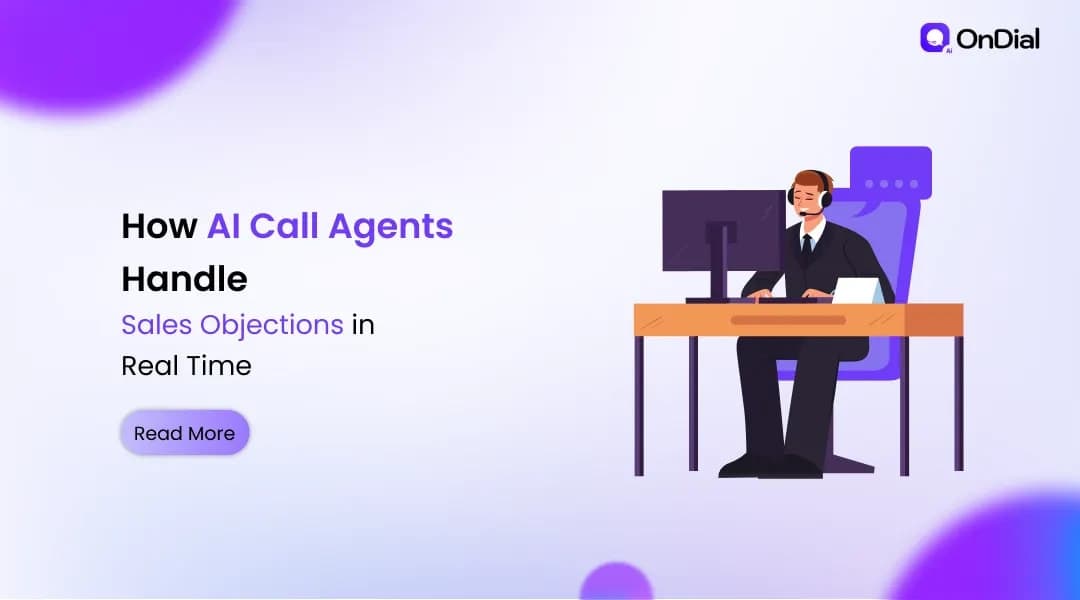
Here is the statistic that should reframe how you think about this: roughly 44% of prospects who hang up on an AI sales call do so because "it sounded like a bot", according to Auto Interview AI's 2026 benchmark data. If you have ever felt skeptical that a machine could survive a real objection, that number probably confirms your instinct. I understand the doubt. AI call agents that handle sales objections in real time work by detecting the objection the moment it surfaces, classifying what is really being said, and responding with an approved, context-aware answer before the conversation loses momentum. The good ones do this without sounding scripted. The bad ones freeze, and the prospect walks. At OnDial, building voice AI for Indian businesses, I have watched both outcomes happen on live calls. This guide breaks down how real-time objection handling actually functions, which objections AI handles well, where it still struggles, and how to deploy it without eroding trust.
What Real-Time Objection Handling Actually Means
Real-time objection handling is an AI call agent's ability to recognize customer resistance, identify the objection type, and respond appropriately without breaking the flow of conversation. That last part is where most systems fail.
The Four-Step Loop Behind Every Response
Every competent AI agent runs the same evidence-driven loop on a live call. It listens and transcribes the speech, diagnoses the true blocker behind the words, asks a clarifying question if needed, then delivers a structured response drawn from approved messaging.
What makes this different from an old phone menu is natural language understanding. Legacy IVR systems followed fixed branches, so an unexpected reply broke them instantly. Modern agents using NLP and large language models interpret intent even when a prospect phrases an objection indirectly, like "we have to tighten spend this quarter" instead of "you're too expensive." The agent reads that as a budget-timing signal, not a flat rejection.
Why Milliseconds Matter
Speed is not a vanity metric here. Speech-to-text converts spoken words in under 500 milliseconds on production systems, which is the window that lets the agent respond before an awkward pause forms.
That pause is the tell. Auto Interview AI's 2026 data found that agents handling interruptions gracefully through barge-in detection see 18% higher conversion than agents that hesitate. (The irony is that the technical feature buyers ignore most is the one that decides the call.) A natural rhythm signals competence, and competence builds the trust an objection is really testing.
The Most Common Sales Objections AI Agents Face
The common sales objections an AI agent must handle fall into predictable categories, which is exactly why software can be trained for them.
Price, Timing, and Authority Objections
Most live objections cluster into a handful of types that an agent learns to recognize by keyword and tone. Training the agent on these in advance is what separates a useful system from a frustrating one.
Price: "It's too expensive." The agent acknowledges the concern, then reframes around outcomes rather than arguing the number.
Timing: "Not right now." The agent treats this as a scheduling problem and offers a specific callback window.
Authority: "Let me talk to my partner first." A well-built agent reads this as an authority objection and offers to arrange a follow-up when the decision-maker is available, rather than losing the lead.
Competitor: "We already use someone else." The agent surfaces a relevant differentiator instead of going quiet.
The Objection Nobody Scripts For: "Are You a Robot?"
Here is the objection most teams forget to prepare for. The prospect interrupts and asks whether they are talking to a machine.
Evading that question is the fastest way to destroy a call. The honest move, which I push for in every OnDial deployment, is a simple, on-brand acknowledgment that yes, this is an AI assistant, and a quick pivot back to how it can help. Most people do not actually mind the technology. They mind being deceived. Handling this objection with transparency often does more for conversion than any clever price rebuttal.
How AI Call Agents Detect and Respond Without Breaking the Conversation
Detection is the engine. An AI call agent catches an objection through two signals at once: the words spoken and the sentiment analysis running underneath them.
Reading Tone, Not Just Words
The same phrase can be a real objection or a simple request for information. "Send me an email" might mean "I'm not interested," or it might mean "I'm interested but busy." Tone resolves the ambiguity.
Advanced agents track changes in pitch, pace, and hesitation to gauge whether a prospect is frustrated, curious, or genuinely closing the door. Objection detection accuracy reaches 87% to 94% on fine-tuned STT and LLM systems, compared with around 71% on untuned ones, per Auto Interview AI's 2026 figures. That gap is the difference between an agent that adapts and one that misreads the room.
Knowing When to Hand Off to a Human
The smartest thing an AI agent does is recognize what it should not handle alone. Human handoff is a feature, not a failure.
When an objection involves legal terms, complex procurement, or a high-value negotiation, a well-designed agent escalates and passes a complete summary of what was said and which objections were raised. A cold handoff, where the human starts from zero, wastes the goodwill the agent built. Should you let AI handle every call? No. You should let it handle the repeatable 80% and route the rest with full context intact.
What Separates Effective Objection Handling From Awkward Scripts
Counterintuitively, the platforms that handle objections worst are often the ones with the most scripted responses.
Dynamic Conversation Beats Rigid Decision Trees
A dynamic conversation architecture lets the agent backtrack, revise its approach mid-call, and handle two objections raised at once. Rigid flow-builders cannot, because every objection needs a pre-built branch, and a curveball sends the agent looping back to a useless default.
The performance difference is measurable. Voice AI with dynamic conversation handling converts 40% to 60% more calls than static IVR systems, according to Trillet's 2026 analysis, precisely because it addresses objections live instead of losing callers to fixed menus. Have you ever rage-quit a phone tree that would not let you reach a person? That is the experience dynamic systems are built to kill.
Compliance and Trust in the Indian Market
For Indian businesses, objection handling cannot be separated from compliance. India is now the fastest-growing AI-calling market globally at 94% year-over-year growth, per Auto Interview AI's 2026 data, which makes responsible deployment a competitive necessity, not a checkbox.
That means honoring TRAI DLT registration for messaging and the consent and data principles of the DPDP Act when an agent captures personal information mid-call. An agent that handles a billing objection while quietly mishandling CRM data is not a win. At OnDial, I treat transparent AI disclosure and lawful data handling as part of objection handling itself, because trust is the real currency on every call. I will be honest about the limits, though: AI still stumbles on genuinely novel edge cases, and any vendor claiming a flawless agent is overselling.
Conclusion
AI call agents handle sales objections in real time by detecting resistance instantly, reading tone alongside words, and responding before the conversation stalls. Three things decide whether they succeed: a dynamic conversation engine instead of rigid scripts, an honest answer to "are you a robot?", and a clean handoff to humans when stakes climb. You do not need to choose between scale and trust. You can build both into the same system. If you are weighing voice AI for your sales calls, OnDial builds tailored, transparent agents trained on your real objections and aligned with Indian compliance standards, so your prospects feel heard, not handled. Start with the objections your team hears most. That is where AI earns its place fastest.