Let me guess.
You’ve heard the pitch.
“AI call agents will replace your entire support team.” “100% automation.” “Zero human intervention.”
And something about it felt… off.
Good instinct.
Because here’s the truth: most businesses don’t fail with AI because the tech is bad. They fail because they misunderstand what it actually does.
I’ve spent years watching companies experiment with AI call automation, some brilliantly, others painfully. And the difference always comes down to one thing:
Clarity.
So let’s strip the hype. No buzzwords. No inflated promises.
Just what works.
What Are AI Call Agents?
At their core, AI call agents are software systems that can handle phone conversations with humans, without a human on the other end.
But that definition is too clean. Too simple.
In reality, they’re a stack of technologies working together to simulate something very human: conversation.
Not scripts. Not IVR menus. Actual back-and-forth dialogue.
Think of them as digital operators that can:
Answer inbound calls
Make outbound calls
Understand intent
Respond naturally
Take action (book, update, notify)
And yes, modern AI Voice Agents can handle far more than basic queries. But, and this matters, they’re not magic.
They’re only as good as how they’re designed.
How AI Call Agents Work
Let’s break this down without turning it into a PhD lecture.
Speech Recognition Technology
This is where everything begins.
The system listens. Converts voice into text. Fast. Real-time.
Accuracy here is non-negotiable. Accents, background noise, speed of speech—it all matters.
Bad recognition = broken experience.
Natural Language Processing (NLP)
Now comes understanding.
The AI doesn’t just hear words—it interprets intent.
“Where’s my order?” “I haven’t received my package.” “Any update on delivery?”
Different sentences. Same intent.
Good NLP connects those dots instantly.
AI Decision Engines
This is the brain.
Based on intent, context, and past interactions, the system decides what to do next.
Answer a question? Ask for clarification? Transfer to a human?
This is where most systems either feel smart… or painfully dumb.
Voice Response Generation
Finally, the AI responds.
And here’s where things get interesting.
Modern systems don’t sound robotic anymore. They pause. Adjust tone. Even handle interruptions.
Key Features of AI Call Agents
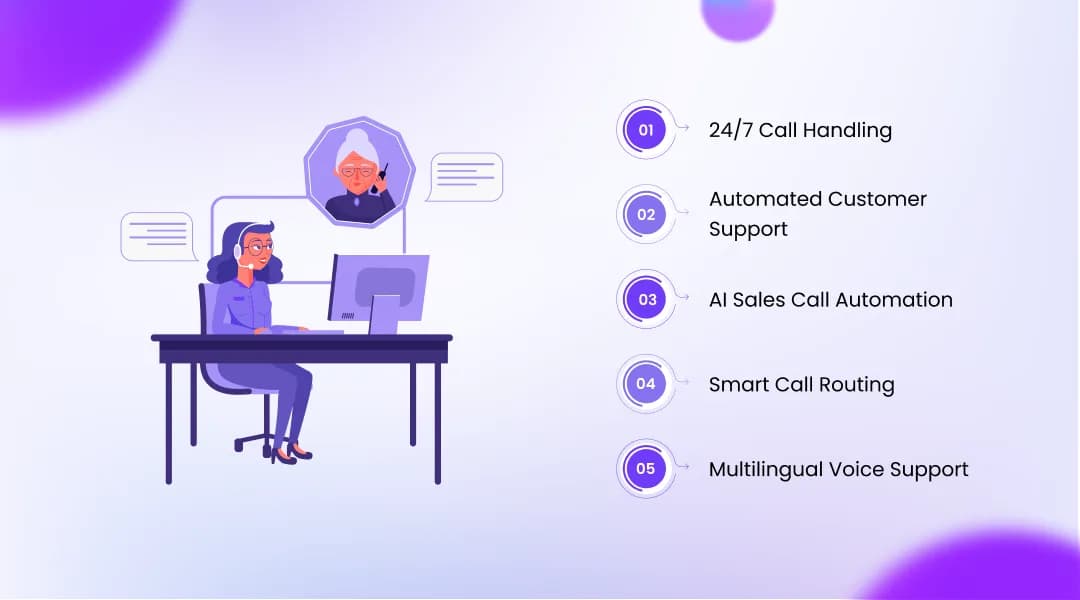
24/7 Call Handling
No shifts. No breaks. No queue frustration.
Customers call at 2 AM? They still get answers.
Automated Customer Support
Repetitive queries disappear:
Order status
FAQs
Account updates
Handled instantly.
AI Sales Call Automation
Outbound calls at scale.
Follow-ups. Lead nurturing. Qualification.
Without burning out a sales team.
Smart Call Routing
Not every call should be automated.
Good systems know when to step back and route to a human.
That balance? Critical.
Multilingual Voice Support
Especially relevant in markets like India.
One system. Multiple languages. Localized experience.
Benefits of Using AI Call Agents for Businesses
Reduce Operational Costs
Let’s address the elephant in the room.
Yes, AI reduces costs.
But not just salaries.
It cuts:
Missed opportunities
Long wait times
Inefficient workflows
Improve Customer Experience
Here’s the twist.
Automation, when done right, actually feels better than human interaction.
Why?
Because it’s:
Instant
Consistent
Error-free
No bad moods. No off days.
Scale Call Handling Instantly
Traffic spike?
No problem.
AI doesn’t “scale later.” It scales immediately.
Increase Sales Conversion
Speed matters.
The faster you respond, the higher the conversion.
AI call agents remove delay entirely.
AI Call Agents vs Traditional Call Centers
Let’s be honest. This isn’t a fair fight.
Cost Comparison
Human teams = salaries + training + attrition AI = upfront investment + optimization
Long term? AI wins. Clearly.
Efficiency & Speed
Humans are good. AI is consistent.
And consistency beats bursts of excellence.
Availability & Scalability
Humans have limits.
AI doesn’t.
Industries Using AI Call Agents in 2026
I’ve seen adoption patterns across industries. Some expected. Some surprising.
E-commerce – Order tracking, returns, COD confirmations
Healthcare – Appointment booking, reminders
Banking & Finance – KYC updates, alerts
Real Estate – Lead qualification, site visit scheduling
Travel & Hospitality – Booking confirmations, cancellations
BPO & Customer Support – Hybrid automation models
Quick question.
If your business gets more than 50 calls a day… why is a human still answering every single one?
Use Cases of AI Voice Agents
Customer Support Automation
First-line support handled instantly.
Humans step in only when needed.
Appointment Scheduling
No back-and-forth.
Just: “What time works for you?”
Done.
Lead Qualification
Filtering serious buyers from casual inquiries.
Automatically.
Order Tracking Calls
“Where is my order?” becomes a non-issue.
Payment Reminders
Consistent. Polite. Persistent.
(And surprisingly effective.)
How to Choose the Best AI Call Agent Platform
This is where most businesses mess up.
They choose based on demos.
Don’t.
Integration with CRM
If it doesn’t connect with your systems, it’s useless.Voice Quality & Accuracy
Test it.
Not in ideal conditions. In real ones.
Noise. Accents. Interruptions.
Customization Options
Your business isn’t generic.
Your AI shouldn’t be either.
Analytics & Reporting
If you can’t measure performance, you can’t improve it.
Simple.
Future of AI Call Agents
This is where things get… interesting.
Emotion Detection in Calls
AI detecting frustration. Urgency. Confusion.
And adjusting accordingly.
Hyper-Personalized Conversations
Not just using your name.
But understanding your history, preferences, behavior.
Fully Autonomous Customer Support
We’re not fully there yet.
But we’re closer than most people think.
Conclusion
Let me leave you with this.
AI call agents won’t replace humans.
They’ll replace bad systems.
The long wait times. The repetitive conversations. The inefficiencies everyone hates—but tolerates.
And the companies that understand this early?
They won’t just save costs.
They’ll build better experiences.
And that’s what actually wins.