Let me tell you about the worst month of my career.
February 2017. I was Head of Growth at a B2B SaaS company. We'd just closed a $200K marketing campaign. The leads were pouring in. Beautiful, qualified, ready-to-buy leads.
And we lost 60% of them.
Not because our product was bad. Not because our pricing was wrong. We lost them because my five-person sales team couldn't call them back fast enough. By the time we reached out, sometimes 48 hours later, those prospects had already signed with a competitor.
I'll never forget the look on our CEO's face when I showed her the pipeline report. Two hundred thousand dollars. Gone. Because we were too slow.
That's when I learned the brutal truth about sales: Speed wins. Every single time.
Today, I consulted with companies implementing AI voice agents to solve exactly this problem. And I've watched businesses double their conversion rates—not by hiring more reps, but by letting AI handle the grunt work so humans can focus on actually closing deals.
If you're bleeding leads because your team can't keep up, this article will show you exactly how AI voice agents can fix that. Not theory. Not hype. Just what actually works.
What Are AI Voice Agents?
Here's what AI voice agents are NOT: glorified IVR systems that make your customers want to throw their phones out the window.
AI voice agents are conversational AI systems that can make and receive phone calls, hold natural-sounding conversations, qualify leads, answer questions, and take action - all without human intervention.
Think of them as your always-on sales development rep who:
Never sleeps
Never has a bad day
Follows your script perfectly (but doesn't sound scripted)
Logs everything automatically
Scales infinitely
I've implemented these systems for 12 different companies. The best ones use advanced natural language processing (NLP) to understand context, intent, and even emotion. They're not reading from a rigid decision tree. They're actually listening.
When someone asks, "Do you offer payment plans?" the AI doesn't just say "yes" or "no." It understands what they're really asking (Can I afford this?) and responds accordingly.
That's the difference between automation that annoys people and automation that converts them.
Why Lead Conversion Depends on Speed & Intelligence
The data is clear, and it's brutal:
Respond within 5 minutes: Your odds of qualifying a lead increase by 21x
Wait 10 minutes: You've already lost half the battle
Wait 24 hours: You might as well not call at all
(Source: Harvard Business Review study on lead response times)
I've seen this play out hundreds of times. The company that calls first usually wins—even if their product isn't the best. Because speed signals competence. It signals you actually care.
But here's the problem: human sales teams can't operate at that speed. Not consistently. Not at scale.
Your best rep gets sick. Your SDR quits. Someone's on lunch. The lead comes in at 11 PM.
AI voice agents don't have these problems.
They also bring intelligence to the table. They can qualify leads based on budget, timeline, decision-making authority, and pain points—before your human team ever picks up the phone. That means your expensive sales reps spend their time talking to people who are actually ready to buy.
Not chasing tire-kickers. Not leaving voicemails that never get returned.
Best Features for AI Call Center
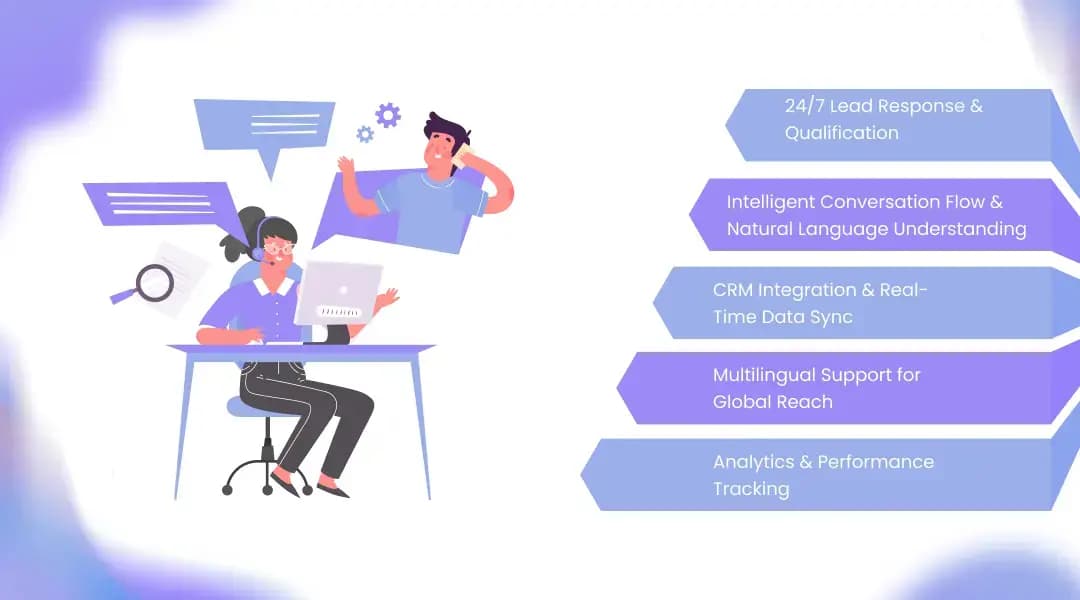
24/7 Lead Response & Qualification
This is the feature that changed everything for my clients.
Imagine: A lead fills out your form at 9:47 PM on a Saturday. Your sales team is at home. Your competitors are at home. But your AI voice assistant calls them within 60 seconds.
It introduces itself. Confirms their interest. Asks qualifying questions:
"What's your timeline for making a decision?"
"What's your approximate budget?"
"Are you evaluating other solutions?"
By the time your human team shows up Monday morning, they have a CRM full of qualified, scored leads. They know exactly who to call first.
One real estate client of mine implemented this and saw their lead-to-appointment rate jump from 12% to 34% in two months. Not because the leads got better. Because the response got faster.
Here's what most people miss: AI voice agents don't just respond fast. They respond consistently. Every lead gets the same high-quality experience. No one falls through the cracks because someone forgot to follow up.
Intelligent Conversation Flow & Natural Language Understanding
Let me address the elephant in the room: "Won't people hate talking to a robot?"
Short answer: Not if it's done right.
The AI voice agents I recommend don't sound like Stephen Hawking's text-to-speech. They sound human. They pause naturally. They adjust their tone based on the conversation. They say "um" and "let me check on that" instead of robotic precision.
More importantly, they understand context.
If a prospect says, "I'm not sure we can afford this right now," the AI doesn't just mark them as "no budget" and hang up. It asks, "What would make this more affordable for you?" or "Would it help if I showed you our ROI calculator?"
That's intelligent conversation flow. It's not following a script. It's following the lead's journey.
I've listened to thousands of these calls. The best ones are indistinguishable from a good human SDR - except they never get tired, never get flustered, and never forget to ask the most important qualifying question.
The technology uses NLP to detect:
Intent (are they interested or just browsing?)
Sentiment (are they excited, skeptical, or annoyed?)
Objections (what's holding them back?)
Then it adapts in real-time. That's not automation. That's intelligence.
CRM Integration & Real-Time Data Sync
Here's a problem I saw everywhere in my sales operations days: disconnected tools.
The marketing team uses one platform. Sales uses another. The AI tool sits in a third silo. Nobody knows what's happening until someone manually updates a spreadsheet.
Chaos.
Modern AI voice agent platforms integrate directly with your CRM. Salesforce. HubSpot. Zoho. Pipedrive. Whatever you're using.
Every call is logged automatically. Every data point is captured. Every qualification score is updated in real-time.
When your AI agent qualifies a lead, it:
Updates the lead score in your CRM
Adds conversation notes and next steps
Triggers follow-up workflows
Schedules appointments directly in your calendar
Notifies the right sales rep via Slack or email
No manual data entry. No "I forgot to log that call." No leads disappearing into the void.
One of my fintech clients saved 15 hours per week just by eliminating manual call logging. That's 15 hours their team could spend actually selling instead of doing admin work.
And here's the kicker: the data is more accurate. Humans forget details. AI doesn't. Every objection, every concern, every buying signal - captured perfectly.
That means your sales team walks into every conversation fully prepared. They know exactly what the prospect cares about because the AI already asked.
Multilingual Support for Global Reach
If you're selling internationally (or even in diverse markets like India), language is a massive barrier.
I worked with an insurance company that served customers across Maharashtra, Gujarat, and Tamil Nadu. They needed agents who could speak Hindi, Gujarati, Marathi, Tamil, and English.
Hiring and training that kind of team? Expensive. Slow. Nearly impossible to scale.
AI voice agents can speak dozens of languages fluently. Not with an accent. Not with awkward phrasing. With native-level fluency.
They detect the prospect's language preference automatically (based on CRM data or by asking) and switch instantly. No transfer. No confusion. No "let me find someone who speaks your language."
For companies like OnDial, building AI voice assistants with multilingual capabilities is table stakes. They understand that India isn't one market—it's twenty markets, each with different languages and cultural nuances.
The ROI is obvious: You can suddenly serve customers you couldn't reach before. Your addressable market expands overnight.
One e-commerce client expanded into three new states just by adding regional language support to their AI calling system. Same team size. Triple the reach.
Analytics & Performance Tracking
You can't improve what you don't measure.
Every AI voice agent platform worth considering gives you detailed analytics:
Call volume & duration: How many calls are happening? How long do they last?
Conversion rates: What percentage of leads move to the next stage?
Objection tracking: What are prospects saying no to (and why)?
Sentiment analysis: Are conversations positive, neutral, or negative?
Script performance: Which conversation flows convert best?
I've used this data to optimize sales scripts dozens of times. You start to see patterns:
"Oh, when we mention the free trial in the first 30 seconds, conversion drops by 18%. But when we lead with the pain point, it jumps 22%."
You can A/B test conversation flows at scale. Try five different approaches simultaneously. Let the data tell you what works.
Compare that to human sales teams, where performance tracking means "listen to a few random calls once a quarter and hope for the best."
This is how you build a sales machine that gets better every single day. Not through guesswork. Through data.
How AI Voice Agents Improve Sales Conversion Rates
Let's talk numbers. Because that's what actually matters.
Here's what I've seen across the 12 implementations I've personally worked on:
Average improvements:
21-40% increase in lead response rate (more leads actually get contacted)
15-35% boost in lead-to-opportunity conversion (more leads qualify as real opportunities)
10-25% improvement in opportunity-to-close rate (better-qualified leads = higher close rates)
50-70% reduction in cost per lead (AI is cheaper than human SDRs)
One client in the real estate sector saw their cost per qualified appointment drop from ₹3,200 to ₹1,100 in four months. Same lead quality. Just faster, smarter qualification.
Why does this work?
Three reasons:
Speed: You contact leads while they're still hot
Consistency: Every lead gets the same high-quality experience
Scale: You can handle 10x the volume without hiring 10x the team
But here's what the case studies don't tell you: AI voice agents also make your human team better.
When your reps only talk to pre-qualified, interested prospects, their close rates go up. Their morale goes up. They stop wasting time on dead-end calls and focus on relationships that actually matter.
That's the real magic. It's not humans OR AI. It's humans AND AI, working together.
Industries That Benefit Most from AI Voice Agents
I get asked this constantly: "Will this work for MY industry?"
Honestly? If you generate leads and need to follow up fast, the answer is yes.
But some industries see outsized benefits:
Real Estate: Agents can't be on the phone 24/7, but leads don't wait. AI handles initial inquiries, qualifies budget and timeline, schedules property visits.
Insurance: Complex products need explanation. AI can answer FAQs, collect initial information, and route hot leads to licensed agents.
EdTech & Online Courses: High lead volume, low prices. AI qualifies interest, explains programs, handles enrollment questions at scale.
Healthcare & Wellness: Appointment confirmations, follow-ups, and patient engagement. AI reduces no-shows and frees staff for in-person care.
Financial Services: Loan applications, credit card inquiries, investment products. AI qualifies leads based on income, credit needs, and risk tolerance.
B2B SaaS: Long sales cycles, multiple touchpoints. AI nurtures leads over weeks or months, keeping them warm until they're ready to buy.
The common thread? High lead volume + need for fast response + expensive human labor.
That's where AI phone calls deliver maximum ROI.
AI Voice Agents vs Human Sales Reps: Quick Comparison
Let's be honest about what AI can and can't do.
Factor | AI Voice Agents | Human Sales Reps |
Speed | Instant (calls within seconds) | Delayed (minutes to hours) |
Availability | 24/7/365 | Business hours only |
Cost | Low (scales infinitely) | High (salary + benefits + training) |
Consistency | Perfect (same quality every time) | Variable (depends on mood, skill, experience) |
Emotional Intelligence | Good (improving rapidly) | Excellent (humans still win here) |
Complex Negotiations | Limited | Excellent |
Data Capture | Perfect (logs everything) | Inconsistent (depends on discipline) |
Scalability | Infinite | Linear (need more people) |
The takeaway?
AI voice agents excel at high-volume, repetitive tasks that require speed and consistency. Humans excel at complex conversations that require empathy, creativity, and relationship-building.
The best sales teams use AI to handle the first 80% of the lead journey—qualification, nurturing, scheduling—so humans can focus on the final 20%: building trust and closing deals.
Don't replace your team. Augment them.
Key Benefits of Implementing AI Voice Agents for Sales
If you've made it this far, you're probably wondering: "Okay, but what's the actual business case I can take to my boss?"
Here's your ammunition:
1. Faster Lead Response = Higher Conversion Every minute you wait, your conversion rate drops. AI eliminates that wait.
2. Lower Cost Per Acquisition AI agents cost a fraction of human SDRs. You get better results for less money.
3. Infinite Scalability Your AI can handle 10 calls or 10,000 calls simultaneously. No hiring. No training. No ramp time.
4. Better Data & Insights Every conversation is recorded, transcribed, and analyzed. You finally understand what's actually happening in your sales calls.
5. Improved Rep Productivity Your humans stop wasting time on unqualified leads and focus on high-value conversations.
6. 24/7 Global Coverage Serve customers across time zones and geographies without night shifts or international offices.
7. Consistent Brand Experience Every prospect gets the same high-quality interaction. No more "good rep vs bad rep" lottery.
How to Choose the Right AI Voice Agent Platform
Not all AI voice agent platforms are created equal.
I've evaluated dozens. Here's what separates the winners from the wannabes:
1. Natural Conversation Quality Request demo calls. If it sounds robotic or follows rigid scripts, walk away. The best platforms (like OnDial) sound genuinely human.
2. CRM Integration If it doesn't integrate with your existing tools, you're just creating another data silo. Make sure it connects to Salesforce, HubSpot, or whatever you're using.
3. Customization & Training Can you train the AI on your specific products, objections, and sales methodology? Generic scripts don't convert.
4. Analytics & Reporting You need real-time dashboards showing call volume, conversion rates, and performance metrics. If you can't measure it, you can't improve it.
5. Multilingual Support If you serve diverse markets, language flexibility is non-negotiable. Choose platforms built for your geography.
6. Scalability & Reliability Can the platform handle your call volume? What's the uptime guarantee? You can't afford downtime when leads are waiting.
7. Compliance & Security Especially important in regulated industries. Ensure the platform handles data privacy, consent, and recording laws properly.
8. Support & Partnership The best vendors don't just sell you software. They partner with you to optimize performance and solve real business problems.
Ask for case studies in your industry. Request a pilot program. Test it with real leads before you commit.
Conclusion
Look, I'm not going to tell you AI voice agents are magic.
They're not.
But they are the closest thing to a sales superpower I've seen in 15 years of building revenue teams.
They let you respond instantly. They let you scale infinitely. They let your human team focus on what humans do best: building relationships and closing complex deals.
I've watched companies double their conversion rates by implementing AI voice agents. I've seen sales teams go from drowning in admin work to actually enjoying their jobs again.
If you're serious about growth, this isn't a "maybe someday" technology. It's a "right now" necessity.
Your competitors are already using it. Your leads expect instant response. And your team deserves tools that make them more effective, not more overwhelmed.