I've watched three call centers collapse under their own success.
Not because they failed. Because they grew. Revenue doubled, customer inquiries tripled, and suddenly the infrastructure that worked beautifully at 500 calls per day became a bottleneck at 2,000. Hiring more agents? Sure. But training takes weeks, quality becomes inconsistent, and costs spiral faster than revenue ever could.
Here's what nobody tells you about scaling business communication: The problem isn't volume. It's the assumption that human labor is the only solution to human conversation.
I spent seven years architecting enterprise communication systems, the unglamorous backend that routes your calls, manages your queues, and (hopefully) doesn't make customers wait 47 minutes to talk about their billing issue. I've seen companies throw millions at traditional call centers, only to discover they'd built a cost structure that punished growth instead of enabling it.
Then AI voice technology matured. Actually matured. Not the robotic IVR nightmares from 2015, but genuine conversational AI that can handle complex queries, understand context, and yes, sound remarkably human.
AI calling agents aren't replacing human connection. They're making it possible at scale. And if you're running a business where communication volume is choking your growth, this might be the infrastructure shift that changes everything.
Let me show you what I've learned.
What Is an AI Calling Agent?
An AI calling agent is a voice-first artificial intelligence system that handles inbound and outbound phone conversations autonomously. Think of it as a sophisticated Voice Assistant that doesn't just respond to commands—it engages in natural dialogue, understands intent, makes decisions, and executes actions within defined parameters.
But here's what makes modern AI calling agents different from the IVR systems you probably hate:
Speech recognition that actually works. Natural language processing (NLP) has crossed the threshold from "technically functional" to "reliably accurate." These systems understand accents, handle interruptions, and parse context—not just keywords.
Dynamic conversation flow. Traditional IVR: "Press 1 for sales, press 2 for support." AI calling agents: "How can I help you today?" followed by actual comprehension of your answer. The conversation adapts based on what you say, not what menu option you selected.
Action execution. This isn't just conversation for conversation's sake. AI calling agents integrate with your CRM, update records, schedule appointments, process payments, and trigger workflows, all while talking to your customer.
(And before you ask: No, they don't sound like robots anymore. Voice synthesis technology has become eerily good. Some customers don't realize they're not talking to a human until you tell them.)
Technical architecture? Speech-to-text converts audio to data, NLP engines process intent and extract entities, dialogue management systems determine appropriate responses, and text-to-speech synthesis delivers the output. All happening in milliseconds.
But you don't need to know the plumbing to use the sink.
How AI Calling Agents Transform Call Operations
Let me tell you about a fintech company I consulted for last year. They processed loan applications. Standard workflow: customer applies online, call center agent calls to verify details, another call to explain approval status, follow-up calls for documentation.
Seventeen human agents. Eight-hour shifts. Maximum 680 calls per day if everything went perfectly. (It never did.)
They deployed an AI Voice Assistant for their verification calls.
Result? 2,400 calls per day. Same quality scores. Lower error rates. And those seventeen agents? Reassigned to handle complex cases that actually required human judgment—loan exceptions, distressed customers, fraud investigations.
Here's how AI calling agents fundamentally transform operations:
Automating Inbound & Outbound Calls
Inbound calls get answered instantly. Every time. No hold music. No "your call is important to us" followed by twenty minutes of silence. The AI calling agent picks up, understands the query, and either resolves it immediately or routes intelligently to the right human agent with full context already captured.
Outbound calls? The AI doesn't take coffee breaks. It doesn't have bad days. It makes 200 appointment confirmation calls before your human team finishes their morning standup meeting. Payment reminders, follow-ups, surveys—executed with mechanical precision and conversational warmth.
Real-Time Speech Recognition & NLP
Modern AI Phone Calls aren't waiting for you to finish speaking before processing. They're analyzing in real-time, detecting emotional cues, identifying urgency markers, and preparing contextual responses while the conversation flows naturally.
I've watched these systems handle interruptions gracefully—something that would derail a traditional IVR completely. Customer cuts off the AI mid-sentence? It adjusts. Rephrases the question differently? It understands the intent behind the new wording.
Intelligent Call Routing & Responses
Here's where it gets interesting. AI calling agents don't just answer questions—they triage complexity. Simple query? Resolved immediately. Complex issue requiring human expertise? Routed to the appropriate specialist with a full transcript and context summary already prepared.
They also learn. Not in some sci-fi way, but through conversation data analysis. Which phrases confuse customers? Which responses lead to successful outcomes? The system adapts its dialogue strategies based on aggregate performance data.
The transformation isn't about replacing humans. It's about redesigning call operations so humans only touch conversations that actually require human capabilities—empathy for distressed situations, creative problem-solving, relationship building.
Everything else? Automated. Reliably. At scale.
Key Features of an AI Calling Agent for Business

Not all AI calling agents are created equal. I've evaluated dozens of platforms, and the feature gap between mediocre and exceptional is enormous. Here's what actually matters:
24/7 Call Handling
Obvious but critical. Your AI calling agent doesn't clock out. It doesn't call in sick. It handles the 2 AM customer emergency with the same attentiveness as the 2 PM routine inquiry. For businesses operating across time zones or serving global markets, this alone justifies the investment.
Multi-Language & Accent Support
I watched a healthcare AI calling system crash and burn because it couldn't handle South Asian accents. In India. Where the entire customer base was, unsurprisingly, speaking with South Asian accents.
Quality AI calling agents support multiple languages with genuine linguistic understanding—not just word-for-word translation. They adapt to regional dialects, code-switching, and even the weird hybrid English-Hindi conversations common in Indian business contexts.
OnDial built their platform specifically for this linguistic complexity. When your AI Voice Agent Platform can seamlessly handle conversations that switch between three languages mid-sentence, you're solving real-world problems, not demo scenarios.
CRM & ERP Integration
An AI calling agent that doesn't integrate with your existing systems is just an expensive toy. The value comes from bidirectional data flow—pulling customer history before the call starts, updating records in real-time during the conversation, triggering workflows after the call completes.
Look for API-first architectures. REST APIs, webhooks, pre-built connectors to major CRMs (Salesforce, HubSpot, Zoho), and the flexibility to build custom integrations when you need them.
Call Analytics & Reporting
If you can't measure it, you can't improve it. Premium AI calling agents provide granular analytics: call duration, resolution rates, sentiment analysis, conversion metrics, drop-off points in conversations, common failure patterns.
I've used this data to optimize call scripts that improved conversion rates by 23%. Not through guessing—through identifying exactly which conversation paths led to positive outcomes and which led to customer frustration.
Voice Cloning & Natural Conversations
Here's where it gets slightly unsettling (in a good way). Modern voice synthesis can clone specific voices. Want your AI calling agent to sound like your company founder? Or your top-performing sales agent? Provide 30 minutes of audio samples, and the system generates a voice model.
The natural conversation part? That's the NLP sophistication I mentioned earlier. These systems use contextual awareness, maintain conversation history, handle clarifying questions, and even inject appropriate pauses and verbal acknowledgments ("I see," "That makes sense," "Let me check that for you").
When customers can't tell they're talking to AI—not because you're deceiving them, but because the conversation feels genuinely natural—you've crossed the adoption threshold that matters.
Use Cases of AI Calling Agents Across Industries
Theory is boring. Let me show you where this actually works in practice.
Customer Support & Helpdesk
Account inquiries, password resets, order status checks, return initiations—the repetitive queries that consume 70% of your support team's time but require zero creative thinking. AI calling agents handle these autonomously while your human agents focus on the 30% that actually needs human judgment.
E-commerce companies use this to provide instant support during flash sales when call volumes spike 10x. The alternative? Hire temporary agents (expensive, inconsistent quality) or let customers wait (abandoned carts, negative reviews).
Sales Calls & Lead Qualification
Outbound sales at scale has always been a numbers game. More calls = more conversions. But more calls also = more sales agents = higher costs = compressed margins.
AI calling agents make 500 qualification calls in the time your human agent makes 50. They follow the same script perfectly every time, capture lead data consistently, and immediately route hot leads to human closers while nurturing cold leads through automated follow-up sequences.
I've seen B2B SaaS companies triple their qualified lead volume without adding a single sales hire. The Role of AI Call Agents in modern sales operations isn't replacement—it's force multiplication.
Appointment Booking & Reminders
Healthcare, salons, professional services, any industry where no-shows kill revenue. AI calling agents call customers 48 hours before appointments, confirm attendance, offer rescheduling options if needed, and update your calendar automatically.
One dental clinic reduced no-shows by 64% simply by ensuring every appointment got a confirmation call. Previously impossible with manual calling. Trivial with AI automation.
Payment Follow-ups & Collections
Nobody likes making collection calls. AI calling agents don't mind. They deliver payment reminders with consistent professionalism, offer payment plan options, process payments over the phone, and escalate to human agents only when the situation requires negotiation.
The psychological benefit? Customers often find it easier to discuss financial difficulties with an AI than a human. No judgment. No awkwardness. Just clear information and available solutions.
Surveys & Feedback Calls
Post-purchase surveys, NPS tracking, customer satisfaction calls—essential for business intelligence but resource-intensive to execute manually. AI calling agents conduct these at 100% completion rates, capture structured data automatically, and identify urgent issues for human follow-up.
The data quality is often better than human-conducted surveys because the AI maintains script consistency and doesn't accidentally bias responses through tone or phrasing variations.
Benefits of Using an AI Calling Agent
Let's talk ROI. Because ultimately, that's what matters.
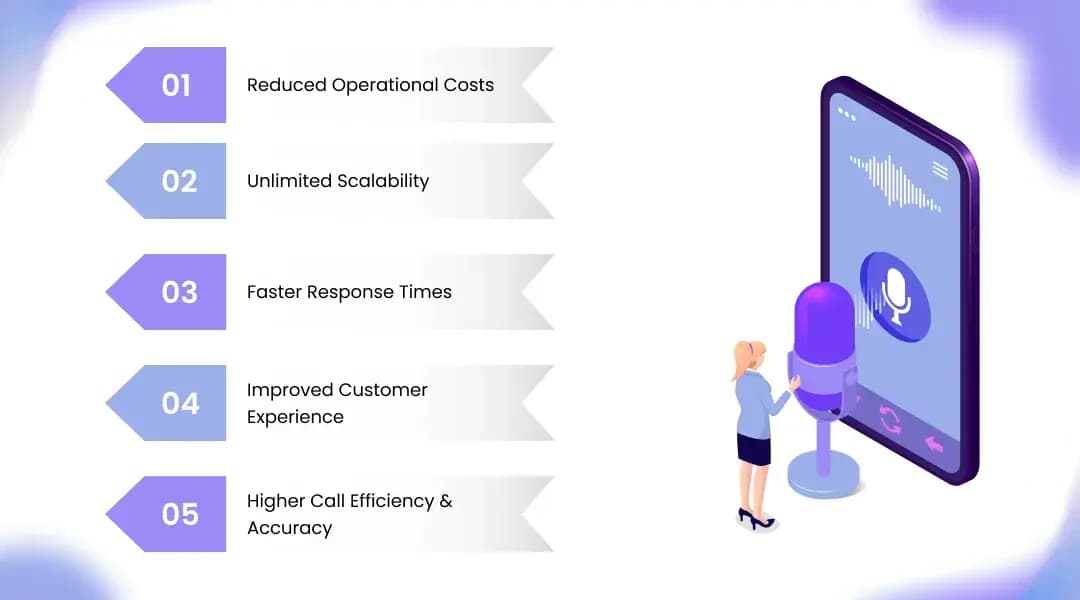
Reduced Operational Costs
A human call center agent costs $15-30/hour when you include salary, benefits, infrastructure, training, and management overhead. An AI calling agent? Fraction of that cost. Often 80-90% reduction per conversation handled.
But here's the nuance: The goal isn't replacing your entire team. It's restructuring your cost base so fixed costs (human agents) handle only high-value interactions while variable costs (AI agents) absorb volume fluctuations.
Unlimited Scalability
Black Friday. Product launches. Service outages. Your call volume just went from 1,000 to 15,000 per day.
Traditional call center: Panic. Hire temporary staff (if you can find them), suffer through training delays, accept degraded quality, watch your operational costs explode.
AI calling agent: Scale instantly. 1,000 concurrent calls? Sure. 10,000? Also sure. The marginal cost of handling call #10,001 is nearly zero.
This is why Customer Calls handled by AI are becoming standard infrastructure for growth-stage companies. You simply can't scale human labor at the same pace as customer acquisition.
Faster Response Times
Average wait time in traditional call centers: 5-12 minutes. For AI calling agents: Zero seconds. Instant pickup. Every. Single. Time.
Response speed is a competitive advantage. Customers who get immediate answers are more likely to convert, less likely to churn, and more forgiving of other service issues. You're literally buying customer satisfaction through elimination of wait times.
Improved Customer Experience
I know what you're thinking. "How does talking to a robot improve customer experience?"
Fair question. Here's the answer: Because AI calling agents don't have bad days. They don't show up tired. They don't get frustrated with repetitive questions. They don't transfer you incorrectly. They don't lose your information halfway through the call.
Consistency is quality at scale. And when 80% of customer queries fall into that repeatable, scriptable category, AI delivers superior experiences through sheer reliability.
Higher Call Efficiency & Accuracy
Human agents make mistakes. They mishear information. They forget steps. They enter data incorrectly. They miss follow-up tasks.
AI calling agents execute their scripts with 99.9% accuracy. They capture data correctly. They trigger workflows reliably. They never forget the follow-up call scheduled for next Tuesday.
The efficiency gain isn't just speed, it's the elimination of error-correction overhead that silently drains resources in human-operated call centers.
AI Calling Agent vs Traditional Call Center
Let me put this in stark terms:
Dimension | Traditional Call Center | AI Calling Agent |
Cost per Call | $5-15 | $0.50-2 |
Scalability | Linear (hire more agents) | Exponential (add server capacity) |
Availability | Business hours (or expensive 24/7 staffing) | True 24/7 at no additional cost |
Response Time | 5-12 minute average wait | Instant pickup |
Quality Consistency | Variable (depends on agent skill, mood, training) | Consistent (follows script perfectly) |
Ramp-up Time | 4-8 weeks for new agents | Hours for new call flows |
Error Rate | 2-5% (data entry, process adherence) | <0.1% |
Multilingual Support | Requires separate agents per language | Native support, instant switching |
Does this mean you should fire your entire call center team tomorrow?
No. Absolutely not.
But it does mean you should fundamentally rethink what humans do best (complex problem-solving, empathy, creativity, relationship building) and what AI does best (repetitive execution, instant availability, perfect consistency, infinite scalability).
The winning strategy? Hybrid operations where AI handles volume and routine, humans handle complexity and relationship-building. I've seen this model reduce costs by 60% while improving customer satisfaction scores by 20%.
Because customers get instant answers for simple questions AND quality human attention for complex issues. Best of both worlds.
How AI Calling Agents Enable Business Scalability
Scalability isn't about handling more calls. It's about growing revenue without proportionally growing costs.
Handling Peak Call Volumes
Seasonal businesses know this pain intimately. Tax season for accountants. Holiday shopping for retailers. Enrollment periods for insurance. Your call volume swings wildly throughout the year.
Traditional approach: Staff for peak capacity, watch overhead destroy margins during slow periods. Or staff for average capacity, suffer through peak periods with terrible customer experiences.
AI calling agents: Staff humans for baseline, let AI absorb the peaks. Your cost structure now scales with revenue instead of fighting against it.
Supporting Global Operations
You can't hire 50 agents in 20 countries to provide local-language support across time zones. You can absolutely deploy one Best AI Voice Agent Platform that handles 50 languages across all time zones.
Companies expanding internationally no longer face the impossible choice between global presence and operational efficiency. AI calling agents provide local communication infrastructure without local overhead.
Scaling Without Hiring More Agents
The math is simple and brutal: If handling customer conversations requires linear headcount growth, your margins eventually die. Every new customer acquisition dollar funds a proportional customer service cost increase.
AI calling agents break this equation. Your 50th customer and your 50,000th customer receive the same instant, high-quality support. The cost per customer decreases as you scale instead of increasing.
This is what software-enabled scalability actually looks like in communication-intensive businesses. It's not a theory. It's infrastructure.
How to Choose the Right AI Calling Agent Solution
Buying advice from someone who's implemented these systems dozens of times:
1. Start with integration requirements
If the AI calling agent can't talk to your CRM, calendar system, and business tools, it's useless. Evaluate API documentation first, demo features second.
2. Test with your actual use cases
Vendors love showing polished demos. Great. Now give them your messiest, most complex call scenarios and watch what happens. Can it handle your weird edge cases? Your industry-specific terminology? Your actual customer conversations?
3. Evaluate language and accent support
If you're in India or serving multilingual markets, this is non-negotiable. Hire AI Voice Agents that actually understand your customers' natural speech patterns.
4. Understand the pricing model
Per-minute charges? Per-call fees? Concurrent call limits? The wrong pricing structure can make an economical solution expensive at scale. Model your expected usage and calculate realistic costs.
5. Demand analytics and reporting transparency
You need visibility into call performance, failure patterns, resolution rates, and customer sentiment. If the platform doesn't provide detailed analytics, you can't optimize your call operations.
6. Verify security and compliance
If you're handling financial data, healthcare information, or personal details, understand exactly how the platform handles data security, encryption, storage, and compliance frameworks.
7. Evaluate the vendor's expertise
Are they the best AI development company with deep AI voice technology experience, or are they just reselling someone else's technology? The difference matters when you need custom solutions or face technical challenges.
OnDial checks these boxes specifically because they built their platform from the ground up for complex Indian business environments. That means linguistic complexity, integration flexibility, and the kind of hands-on partnership that matters when you're betting your customer communication infrastructure on AI.
Conclusion
AI calling agents aren't future technology. They're the current infrastructure.
The companies winning in competitive markets right now? They're not debating whether AI belongs in their call operations. They're optimizing which conversations AI handles autonomously and which require human expertise.
I've shown you the architecture, the use cases, the economics, and the evaluation criteria. You now know more about AI calling agents than 95% of business leaders currently making technology decisions.
Here's what happens next: You either lean into this infrastructure shift and gain competitive advantage, or you watch competitors provide faster, cheaper, more consistent customer communication while your costs spiral and your customer satisfaction suffers.
The technology matured. The economics make sense. The customer experience improves.