According to Salesforce's State of Sales 2026, 87% of sales organizations already use some form of AI, yet most of them still run their CRM like a filing cabinet that waits to be updated. That gap is the whole story. AI CRM integration is what turns a passive record-keeping system into an active one that scores leads, drafts replies, answers customers, and updates itself while your team focuses on the work that actually needs a human. If you have felt skeptical watching AI tools overpromise and underdeliver, that instinct is fair, and it is also exactly why the details below matter.
Here is the honest version. The technology is not magic, and it fails in predictable ways when the data underneath it is messy. But when it is wired into your everyday sales and service workflows correctly, the results are measurable, and they show up fast. In this guide, I will walk through what genuinely gets automated across sales, support, and customer service, share what I have seen work in real deployments, and flag the limits nobody puts in the brochure.
What AI CRM Integration Actually Means
AI CRM integration is the process of embedding artificial intelligence directly into your customer relationship management workflows so the system can act, not just store. Most confusion here comes from thinking of AI as a bolt-on chatbot. That is not integration. That is a widget sitting next to your data, unable to touch it.
From Static Database to Active System
For decades, a CRM did one job: log the customer, track the deal, wait for someone to pull a report. The rep had to remember to update it, and the data sat there until a manager went looking. AI-powered CRM flips that direction entirely. The system starts scoring leads before a rep opens the account and flagging churn risk before anyone notices the warning signs.
In projects I have worked on, this shift is what changes team behavior, not the AI label itself. When the CRM begins surfacing the next best action instead of demanding manual entry, adoption climbs because the tool finally gives back more than it asks. That single change, from waiting to working, is the real definition worth remembering.
Why Integration Matters More Than the AI Itself
Without CRM integration, an AI assistant can answer generic questions but has no idea who it is talking to. As the team at Builts AI put it, an unintegrated AI cannot say "I see your order shipped this morning" because it never sees the order. It is a smart voice in an empty room.
With integration, that same AI becomes an agent doing the work your team does. It pulls live order status, account balance, and ticket history in real time, then writes the outcome back to the record. The intelligence is only as useful as its access to your data, which is why natural language processing (NLP) and clean pipelines matter far more than which model you pick.
How AI CRM Integration Automates Sales
Sales automation is where most businesses see the first clear payoff, because so much of selling is repetitive admin that quietly drains selling time. AI does not close the deal for you. It clears the runway so your reps can.
Predictive Lead Scoring and Prioritization
Predictive lead scoring uses historical patterns to rank incoming leads by likelihood to convert, so reps spend their hours on the prospects most likely to say yes. Instead of a rep guessing which of forty new leads deserves attention, the CRM sorts them automatically and explains why. Zoho's Zia and Salesforce Einstein both do exactly this inside their platforms.
The impact compounds over time. Salesforce reports that top-performing sales teams are 1.7 times more likely than underperformers to use prospecting AI agents, and sellers with agent access expect research time to drop by around 34%. (Ask yourself how many hours your team currently loses to researching cold leads that were never going to buy.)
Automated Follow-ups and Outreach
The follow-up is where deals go to die, usually because a human simply forgot. AI CRM integration handles this quietly in the background:
Timed nudges: The system notices a proposal has sat unopened for six days and queues a polite follow-up for your approval, so nothing slips.
Draft generation: It writes a personalized email using the contact's history, which the rep edits and sends in seconds rather than minutes.
Meeting logging: Calls and meetings log themselves to the timeline, keeping every customer record current without manual entry.
I have seen this single capability recover a pipeline that teams assumed was simply lost with OnDial. The deals were not lost. They were forgotten, and forgetting is exactly what automation prevents.
How AI Transforms Support and Customer Service
AI customer service is arguably the most mature use case, because support runs on high volumes of repetitive, time-sensitive questions that machines handle well. This is also where the numbers get genuinely striking.
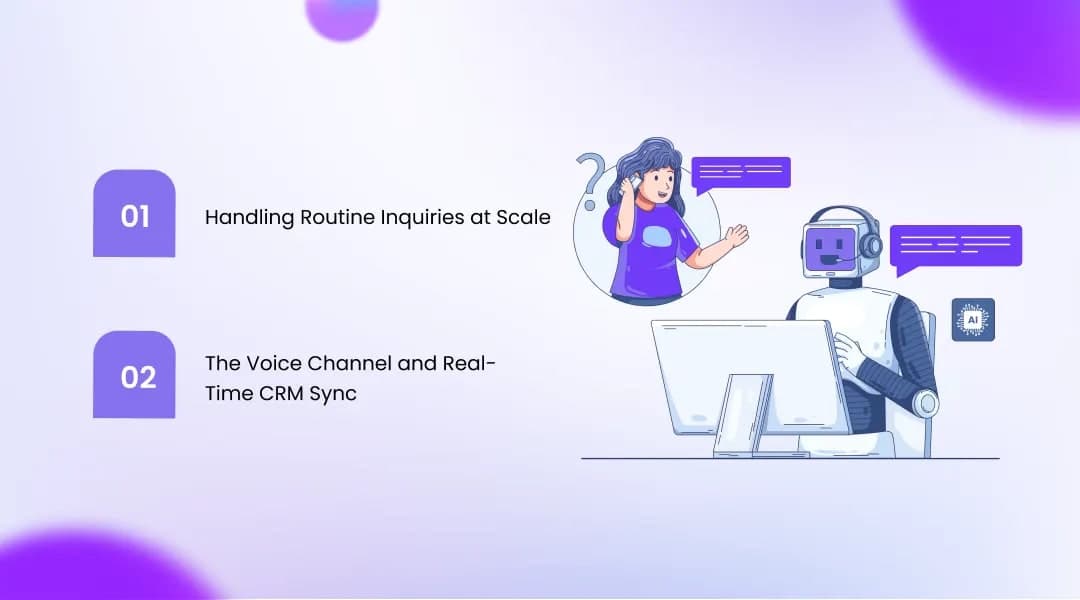
Handling Routine Inquiries at Scale
When a customer reaches out at 2 AM, an integrated AI can instantly pull their order history and preferences and give a real answer, not a canned one. That 24/7 coverage keeps customers happy while freeing your human team for the complex cases during business hours. Sentiment analysis layered on top flags frustrated customers automatically, so an at-risk account gets escalated before it churns.
The production results are real, not demos. Salesforce's published case studies show Pandora resolving 60% of customer cases without human handoff while posting a 10-point lift in net promoter score. During a peak tax week, 1-800Accountant's deployment autonomously closed 70% of inbound chat engagements that would normally have required a staffing surge.
The Voice Channel and Real-Time CRM Sync
Here is what almost every guide on this topic misses. The most valuable customer conversations still happen on the phone, and the phone is where CRM data most often goes missing with CRM integrated AI voice agents. Agents finish a call, then log it later from memory, if they log it at all. Leads wait, records stay incomplete, and managers cannot see an accurate pipeline in real time.
This is the gap I care about most at OnDial, because it is what we build for. A voice AI agent integrated with your CRM answers the call, holds a natural conversation, captures the outcome as structured data, and updates the record before the call ends. Industry data from Gladly names voice the number-one CX investment priority for 2026, precisely because a spoken conversation gives the AI no time to pause and look things up. It has to recognize the caller, pull their history, and respond in real time, which only works when the integration is tight. That is the difference between a voice agent that sounds polished and one that actually knows your customer.
Is AI CRM Integration Actually Worth It?
AI CRM integration is worth it when your data is reasonably clean, and you target repetitive, high-volume tasks first; it delivers weaker returns when bolted onto messy records or expected to replace human judgment. That honest answer matters more than any vendor promise, so let me break down both sides.
The Measurable Gains
The upside is well documented across current research. The evidence points in a consistent direction:
Cost and resolution: Gartner projects agentic AI will autonomously resolve 80% of common customer service issues by 2029, cutting operational costs by 30%.
Retention and speed: Salesforce's State of CRM data indicates businesses using AI in sales CRM see materially higher retention and faster sales cycles than those on legacy systems.
Seller sentiment: In Salesforce's 2026 survey, 87% of reps with AI agent access said the tooling makes their job less stressful, which is a strong signal for adoption.
These are not fringe numbers. They come from the largest CRM vendors and independent analysts, and they line up with what I see in the field.
The Honest Limitations
Now the part the case studies skip. Roughly 25% of CRM implementations still fail, and the cause is almost never the AI. It is poor data quality, weak adoption, and unclear goals.
AI trained on incomplete or contradictory records produces confident, wrong answers, which erodes trust faster than no AI at all. There is also a real ceiling on autonomy: the phone remains the top channel for emotionally sensitive issues, and those still need a human, or at minimum a clean handoff. Anyone promising full replacement of your team is selling you a problem, not a solution.
How to Approach AI CRM Integration the Right Way
You do not need to rip out your CRM to get value from AI. Workflow automation works best when you augment the system you already have, one process at a time, rather than attempting a big-bang overhaul.
Start With Clean Data and Clear Goals
Before touching any AI feature, fix your data. Deduplicate contacts, standardize fields, and close obvious gaps, because every downstream automation inherits the quality of the records beneath it. Then define one clear goal, whether that is deflecting routine tickets, qualifying inbound leads, or capturing call outcomes automatically with AI voice agents that qualify leads automatically.
A narrow, well-defined first goal beats a vague ambition to "add AI everywhere." Map your top 20 to 30 recurring customer questions, since those become the backbone of any automated support or voice workflow. This groundwork is unglamorous, and it is the single biggest predictor of whether the project succeeds.
Choose the Right Integration Depth
Not every business needs the same depth of connection, so match the integration to the workflow you are automating:
Native features: Platforms like HubSpot Breeze and Microsoft Dynamics 365 Copilot offer built-in AI that turns on with minimal setup, ideal for standard sales and marketing tasks.
Connected specialists: For channels the core CRM handles poorly, such as live voice, a dedicated integration writes structured data back in real time and fills the gap that generic tools leave open.
Phased rollout: Start with core systems, prove the value, then expand, which keeps the rollout manageable and your team's trust intact.
The goal is not the most AI. It is the right AI in the right place, connected to data it can actually use.
Conclusion
AI CRM integration is not about replacing your people; it is about removing the repetitive drag that keeps them from doing their best work. The three things worth holding onto: it automates the busywork across sales and service that quietly costs you deals; it delivers the strongest returns when your data is clean, and your first goal is narrow, and its biggest untapped edge is the voice channel, where conversations still go unrecorded. Approached this way, you are no longer guessing whether AI belongs in your CRM. You know where it helps, where it breaks, and how to start.
If phone calls are where your customer data currently disappears, that is exactly the gap OnDial was built to close. Our voice AI agents hold natural conversations and write every outcome back to your CRM in real time, so your records stay current, and your team stays focused. Let's talk about what that looks like for your workflow.