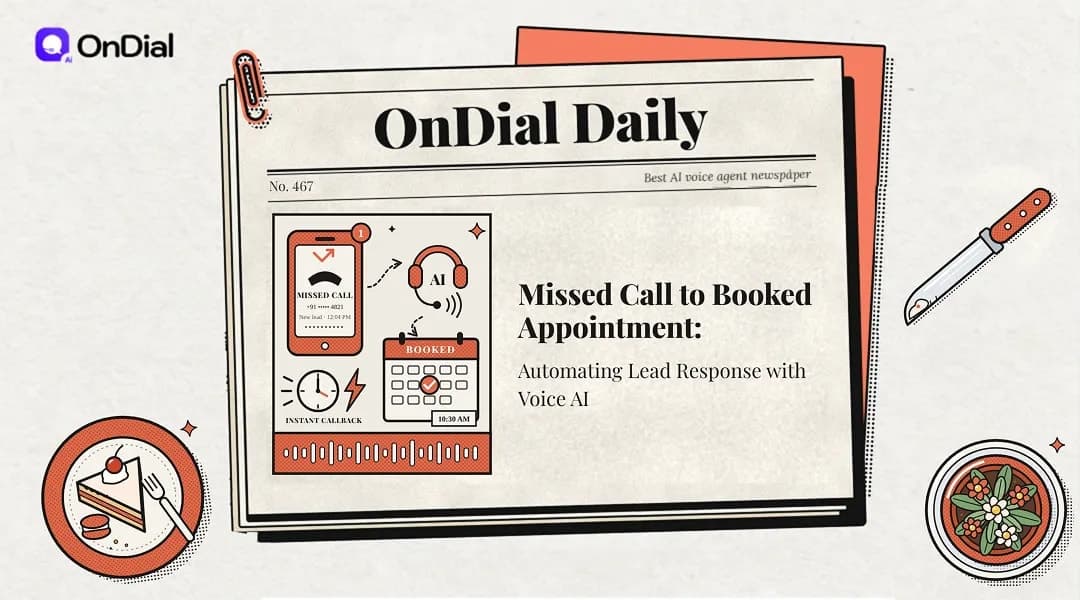
Picture a solar installer whose seven inside reps log off at 5:30 pm, right when homeowners finish dinner and start dialing the number from a search ad. By Monday morning the team faces a queue of about 40 voicemails, and most of the people who left them have already spoken to another installer. AI lead follow-up calls narrow that gap, and missed call automation closes it by ringing each caller back within a minute or two, asking the questions a rep would ask, and putting a site survey on the calendar before the homeowner moves on.
The installer in this example is invented, and so are its numbers, but the pattern will look familiar to anyone who reports on cost per lead. Say the team receives 520 inbound calls a month from paid search and social ads and misses about 130 of them, nearly all after hours or on Saturday mornings while consultants are out measuring roofs. Every one of those 130 calls was already paid for, which is why fixing them belongs on the sales leader's desk rather than the front desk.
What a Missed Call Costs When Your Ad Budget Already Bought It
A missed call from a paid ad costs you both the media spend behind it and the appointment it would have produced, and in the installer's case that means roughly $11,050 a month in ad spend landing in voicemail if each call lead costs about $85. Suppose a third of answered calls normally turn into a free in-home site survey. Those 130 unanswered calls then represent about 43 surveys that never reached a consultant's calendar, and at a close rate of one in four, roughly 10 installations a month quietly disappear.
Most marketing dashboards hide this leak because the call-tracking report counts a conversion the moment the phone rings. The ad platform gets credit, the cost per lead looks healthy, and nobody connects the 7:40 pm Thursday call to the empty survey slot the following week. Pulling one month of call logs and filtering for unanswered calls after 5:30 pm is usually enough to show the size of the hole.
What Missed Call Automation Does in the Minutes After a Hang-Up
When a homeowner calls the installer at 7:40 pm and nobody answers, missed call automation detects the unanswered call, triggers a voice AI agent to ring that number back within about a minute, and turns the conversation into a qualified, booked site survey. The agent holds a two-way spoken conversation rather than playing a recording, so it can ask about the electric bill, react to the answer, and handle a question about whether the roof is too old for panels. Every answer lands in the CRM record, which means the rep who opens it the next morning sees an appointment with context instead of a bare phone number to chase.
Some platforms attach the same trigger to web forms and chat, so a homeowner who fills in a quote form at 9:15 pm gets the identical callback. That matters for teams whose leads arrive through several channels at once, because the response rules stay consistent no matter how the homeowner reached out. It also keeps the reporting in one place, which makes the response-time numbers easier to defend in a pipeline review.
How the Callback Pipeline Moves From Hang-Up to Booking
In the installer's setup, a missed call passes through six stages in roughly the time it takes the homeowner to search for a second installer. Each stage hands data to the next, so a gap anywhere shows up later as a slower or emptier booking. The sequence below follows the 7:40 pm Thursday caller from start to finish.
The phone system flags the 7:40 pm call as unanswered. Your phone or call-tracking platform fires an event when the call ends without pickup, carrying the caller's number and the ad campaign that produced it.
The agent checks the CRM before dialing anyone back. A number that already belongs to an installed customer with a monitoring question goes to the service queue instead of getting a sales pitch.
The callback goes out within the first minute or two. The agent introduces itself as an automated assistant calling on the installer's behalf and confirms the homeowner just tried to reach them.
Four qualifying questions sort survey-ready homeowners from the rest. It confirms ownership of the home, approximate roof age, typical monthly electric bill, and whether the address falls inside the service area.
The agent books a survey on the right consultant's live calendar. It offers two open slots from the consultant who covers that zip code, a step where AI appointment scheduling replaces the usual back-and-forth over email.
The CRM record updates and the assigned rep gets an alert. The summary, the answers, and the call recording are attached before the 8:30 am standup, so nobody has to replay the whole call.
Each stage can fail on its own, which is why the vendors worth shortlisting let you test them one at a time. A slow trigger in the first stage, for example, quietly turns a one-minute callback into a 15-minute one, and no amount of conversation quality makes up for that delay. Ask any provider to show a timestamped log running from the hang-up to the outbound dial during the demo, not just a polished recording of the conversation.
Why Speed to Lead Decides Whether the Callback Connects
A homeowner who called the installer at 7:40 pm is usually still holding the phone at 7:41, and by 8:15 they are cooking, putting children to bed, or reading a competitor's quote. Response time shapes qualification more than most teams assume, and a 2011 Harvard Business Review analysis of roughly 1.25 million leads by James Oldroyd, Kristina McElheran and David Elkington found that firms reaching a lead within the first hour were close to seven times likelier to qualify it than firms that tried an hour later. The same authors measured a gap of more than 60 times against firms that waited a day or longer, and a Monday callback to a Saturday-morning caller lands squarely in that slow bracket.
Slowness turns out to be common rather than exceptional. In the same article's audit of 2,241 US companies, the average first reply among firms that responded within 30 days took 42 hours, and close to a quarter of firms never replied to the test lead at all. For a sales leader, the practical move is to set a response target measured in minutes, track it like any other SLA, and let automation hold that target during the hours your reps are not staffed.
Text-Back, Answering Service, or Instant Lead Callback: Which Fits Your Volume
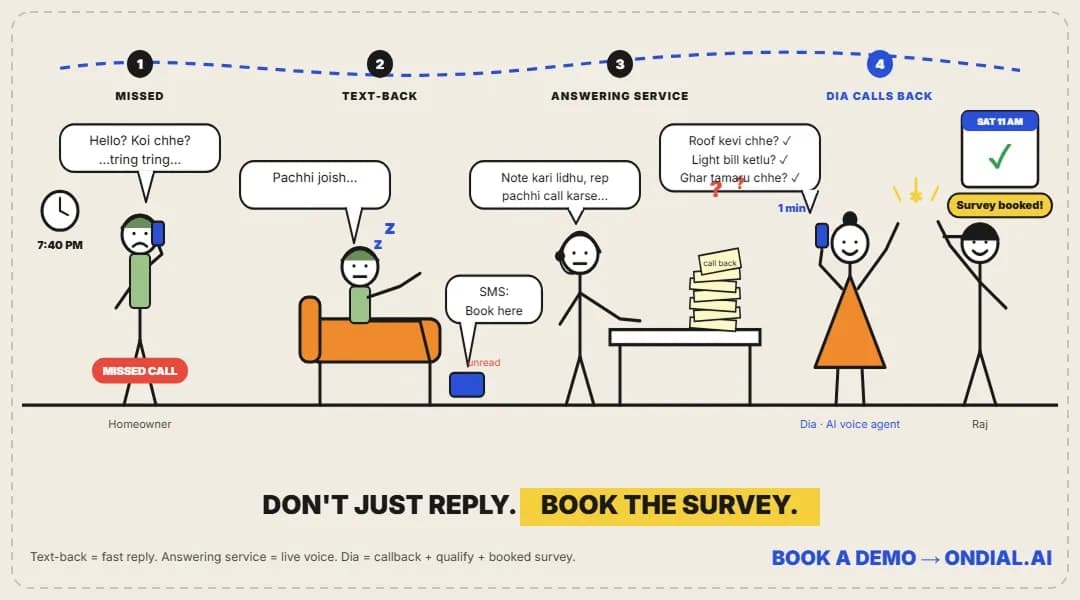
For a team like the installer's, the 130 unanswered calls can be handled in three main ways, and the right choice depends on whether you need a quick reply, a live pickup, or a booked appointment. Automated text-back sends an SMS within seconds of the hang-up and leaves the homeowner to do the rest. After-hours answering service setups pick the call up live instead of calling back, which suits businesses whose callers want a voice on the first ring.
What the installer is comparing across options | Automated text message sent after the hang-up | Answering service picking up after hours live | Voice AI agent calling the homeowner back |
Speed of first contact with the 7:40 pm caller | Within about 30 seconds, but only as a text message | On the first ring, if after-hours routing is configured | Within roughly a minute, as a live two-way voice call |
Qualifying the homeowner on roof, bill, and ownership | Only if the homeowner replies and answers by text | Depends on whether the service follows your qualification script | Asks all four questions during the callback itself |
Getting a site survey onto a consultant's calendar | Sends a booking link the homeowner may never open | Often passes a message to a rep, depending on the provider | Books an open slot on the territory consultant's calendar |
Best fit for the installer's kind of lead flow | Low volumes where homeowners happily book through a link | Teams that want every call answered live, day and night | Paid-lead teams losing bookings to hang-ups and voicemail |
Plenty of teams combine two of these, sending a text within seconds and placing the voice callback a minute later for anyone who does not reply. If your buyers already book comfortably through a web link, text-back alone may be enough, and adding voice callbacks would raise cost without adding many surveys. The installer's homeowners tend to have questions about roof condition and financing before they commit to a visit, which is why a spoken conversation fits this example better.
Designing the Handoff So Reps Inherit Booked Surveys, Not Transcripts
Lead response automation only pays off when the installer's consultants trust the surveys it books, so the handoff deserves as much design time as the callback script. Route each booking by zip code to the consultant who covers that territory, and use round-robin assignment where two consultants share an area so neither one feels shortchanged. The alert that lands before the 8:30 am standup should carry the monthly bill, the roof age, the preferred visit window, and any objection the homeowner raised, because those four details shape the first five minutes of the visit.
Decide in advance when the agent hands a live caller to a person. A sensible rule for the installer is a warm transfer whenever a homeowner asks for a human during staffed hours, and a booked callback slot with the territory rep when the request comes in after 5:30 pm. Without that rule, the agent either traps people who want a person or transfers so often that the after-hours coverage stops meaning anything.
One more rule prevents friction inside the team. Agree that a survey booked by the agent belongs to the consultant who runs it, for both pipeline reporting and commission, before the first booking lands. Teams that skip this step can end up with reps re-calling automated bookings to put their own name on them, which wastes the homeowner's time and muddies the attribution data.
Edge Cases That Quietly Break the Callback Flow
At a company like the installer, most missed call follow up failures trace back to a few untested edge cases rather than to the agent's voice or tone. Each one below is easy to miss in a demo and easy to catch in a one-afternoon test with a colleague's phone. Running through all five before launch costs far less than discovering them through an annoyed homeowner.
A homeowner who dials three times in ten minutes. Set a cooldown per number so that caller gets one callback, not three overlapping ones.
An existing customer calling about a monitoring app fault. Match the number against installed accounts first and send the call to service instead of qualification.
A call that came from a shared office switchboard line. Give the agent a polite way to ask the receptionist for the person who just called.
Renters and addresses outside the installer's service area. Thank them, log the reason in the CRM, and keep them off the survey calendar.
A rep who already returned the call manually five minutes later. The automation should detect that outbound call and cancel its own callback.
Consent, Disclosure, and the Rules Around AI Voice Callbacks
Calling back someone who just phoned the installer feels like ordinary courtesy, yet an automated voice on that callback can fall under consumer protection rules that vary by country. In the United States, the Federal Communications Commission adopted a Declaratory Ruling on February 8, 2024 confirming that AI-generated voices count as artificial voices under the Telephone Consumer Protection Act, which means the consent requirements for artificial or prerecorded voice calls apply to them. Whether a homeowner's own missed call counts as consent for an AI callback depends on the facts, including whether the conversation stays on their inquiry or drifts into marketing, so treat it as a question for legal counsel rather than for a vendor's sales team.
A few practical habits reduce risk wherever you operate. Have the agent say it is an automated assistant in its opening line, offer an easy way to stop further calls, and check every number against your internal do-not-call list before dialing. If you sell outside the US, local telemarketing, call-recording, and data protection rules apply as well, so confirm them market by market before switching on callbacks.
Where Voice AI Callbacks Fall Short
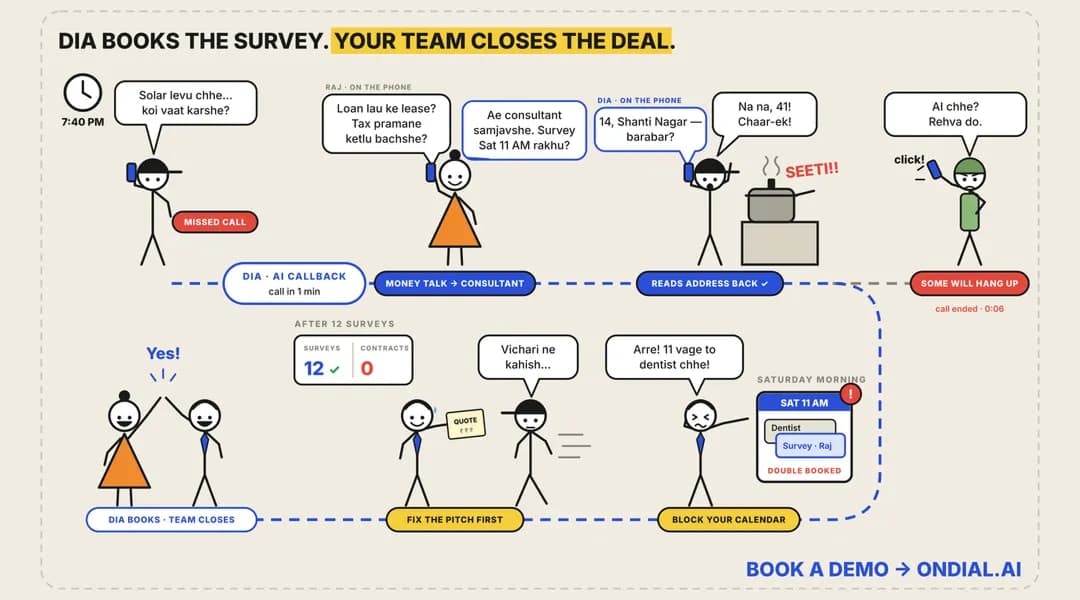
Voice AI callbacks handle the installer's routine survey bookings well, but they struggle in a handful of predictable situations that a sales leader should plan around. Detailed financing questions are the clearest example, since a homeowner comparing a solar loan against a lease wants numbers tailored to their tax situation, and the agent should book the visit and leave that conversation to a consultant. Poor connections and loud kitchens also cause transcription slips on street names and house numbers, so the agent needs to read the address back before confirming anything.
Some callers simply dislike speaking to software and hang up within seconds, and no script will win all of them over. The agent also depends on clean calendars, which means a consultant who forgets to block a dentist appointment will find a survey booked on top of it. Finally, automation speeds up the response but cannot rescue a weak offer, so if your surveys rarely turn into contracts, fix the pitch before you add more surveys to the calendar.
Running the Numbers Before You Commit
The installer's business case comes down to whether recovered surveys outweigh the platform cost, and the arithmetic fits on a single spreadsheet row. Imagine 60 percent of the 130 callbacks connect, giving 78 conversations, and 35 percent of those book a visit, which puts roughly 27 extra surveys on the calendar each month. At one close in four, that is six or seven additional installations from calls the team had already paid to generate.
Cost depends on how the provider prices, with per-minute and per-call models both common. If each callback averages four minutes, the installer would use about 520 minutes a month, and multiplying that by any quoted rate gives a monthly figure to set against those six or seven extra contracts. Ask whether calendar and CRM integrations, phone numbers, and call recording storage cost extra, since those line items change the comparison.
This setup is not the right fit for every sales team. If you miss fewer than ten calls a month, or your buyers are enterprise accounts who expect a named account executive to call them, the setup effort will likely outweigh the gain. In those cases, a tighter on-call rota for reps is the cheaper fix, and missed call automation can wait until volume justifies it.
A 30-Day Rollout for Your First Automated Callbacks
The safest way for the installer to start is with after-hours calls only, expanding to daytime overflow once the team trusts the bookings. A four-week plan keeps the scope small enough to review every recording in the first fortnight. It also gives the consultants time to see booked surveys arrive before anyone asks them to change how they work.
Week one: audit the call logs and draft the questions. Pull a month of call logs, count unanswered calls by hour, and write the four qualifying questions in plain language.
Week two: connect the phone system, CRM, and calendars. Wire up the integrations, set the territory rules, and test all five edge cases with a colleague's phone.
Week three: switch on callbacks after 5:30 pm only. Listen to every recording, note where homeowners hesitate, and adjust the script before widening coverage.
Week four: add daytime overflow and set the response target. Route calls that ring out during busy hours to the agent and start reporting minutes from hang-up to dial-out.
Other industries with an evening-call pattern follow the same plan with different questions. Real estate voice agents apply it to property inquiries, swapping roof age and electric bills for budget, preferred neighborhood, and a viewing slot. Clinics, home service firms, and education providers adjust the questions again, but the trigger, callback, qualify, and book sequence stays recognizable.
Turning Tonight's Missed Calls Into Tomorrow's Surveys
Every unanswered call this evening, like each of the installer's 130 a month, is a lead your marketing budget already paid for, and the only open question is whether someone calls it back while the homeowner still cares. Book a demo with a month of your own call logs in hand, and ask to watch one missed call travel from hang-up to booked appointment. Bring your four qualifying questions as well, because they shape the agent's script more than any feature list does.