Here is a number that should stop you cold. Leads contacted within five minutes are 21 times more likely to qualify than those reached just 30 minutes later, according to the MIT and InsideSales Lead Response Management Study. Yet the average business takes more than 40 hours to respond to a new inquiry. That gap is exactly where deals quietly die, and it is exactly where AI voice agents qualify leads automatically.
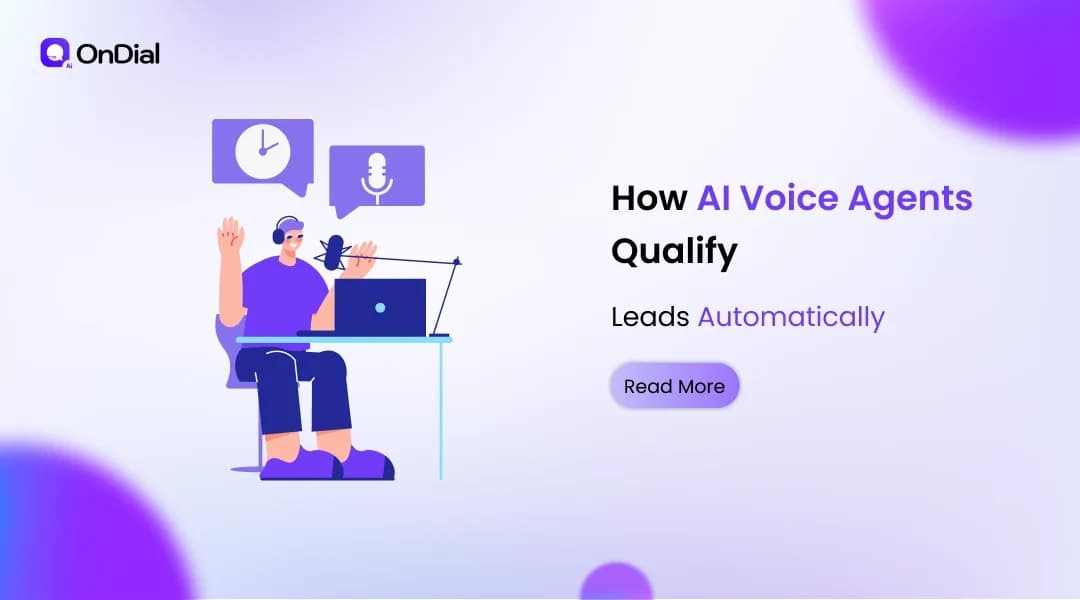
An AI voice agent is a conversational system that calls a prospect the moment they raise their hand, asks structured qualifying questions, scores their intent in real time, and routes only sales-ready leads to your team. No callback queue. No missed window. If you are drowning in leads you cannot reach fast enough, or you are skeptical that software can hold a real sales conversation, this guide is written for you. I will walk through how the qualification actually works, why speed decides who wins, where these systems still fall short, and how to judge whether one fits your team.
What It Really Means When AI Voice Agents Qualify Leads
AI voice agent lead qualification is the use of a real-time voice system to call, engage, and evaluate leads through natural conversation, instead of relying on forms, emails, or delayed callbacks. It is a first-touch layer that never sleeps. That single definition hides a real shift in how top-of-funnel sales gets done.
At OnDial, where we build voice AI systems for businesses across markets, the pattern I see most often is teams treating qualification as a staffing problem when it is really a timing problem. A lead does not care how many reps you have. A lead cares whether anyone picks up while their intent is still hot.
The Shift From Forms to Conversations
Traditional lead capture is thin by design. A contact form grabs a name, an email, and maybe a dropdown answer, then dumps a rep into a discovery call with almost no context. People also type very differently from how they speak, so a form flattens everything that actually signals intent.
A voice conversation does the opposite. In a few sentences, a caller reveals urgency, budget range, and readiness in ways a form field never captures. Conversational AI built on speech recognition, natural language understanding, and text-to-speech can pick up those signals, adapt its follow-up questions, and score fit before a human is ever involved.
Why Phone Still Wins for High-Intent Leads
For many businesses, the phone remains the highest-intent channel there is. When someone chooses to call rather than browse, they are usually closer to a decision. The problem is consistency: reps are busy, reception staff answer rather than filter, and important details slip through.
Consider what this costs in practice. Home service businesses see a large share of inbound calls go unanswered during peak hours, and each missed call is a missed job. A voice agent removes that leak by answering every call instantly and structuring the conversation from the first second, so the intent that drove the call does not evaporate on hold.
Why Speed to Lead Decides Who Wins
Most teams do not lose leads because their pitch is weak, as we've broken down in why lead response time is killing your conversions; they lose them because they answered too late. Speed to lead, the time between a prospect showing interest and your first real contact, is the single biggest lever most sales teams are ignoring.
The evidence here is not subtle, and it is worth taking seriously before you evaluate any tool.
Answer: Speed to lead is the time between a prospect raising their hand and your first genuine contact. Research shows that responding within five minutes makes you far more likely to qualify a lead, while delays of even an hour cause qualification odds to fall off a cliff.
The Five-Minute Window Most Teams Miss
The landmark study on this comes from James Oldroyd at MIT, in partnership with InsideSales, analyzing over 100,000 call attempts. The finding was blunt: contacting a lead within five minutes makes you 21 times more likely to qualify them than waiting 30 minutes. A follow-up analysis published by Harvard Business Review, titled The Short Life of Online Sales Leads, confirmed how fast the window closes.
There is a competitive edge buried in that data too. Research consistently shows that around 78% of customers buy from the first company that responds to them. So ask yourself honestly: how long does a fresh lead sit in your inbox before anyone actually calls?
How AI Closes the Response Gap
Here is the uncomfortable part. Studies repeatedly find that the average business takes well over 40 hours to respond, and a large share of online leads never get contacted at all. Human teams simply cannot guarantee a sub-minute first touch across every lead, every hour, every day.
An AI voice agent can, and that is its clearest advantage. The moment a lead comes in through a web form, ad, or missed call, the agent dials within seconds and starts qualifying. In the deployments I have worked on at OnDial, this is the change clients feel first, because the lead is engaged while their interest is still at its peak rather than two days later when they have already forgotten your name.
How the Qualification Actually Happens, Step by Step
This is the question buyers really want answered, so let me be concrete about the mechanics rather than the marketing.
Answer: AI voice agents qualify leads by calling the prospect, confirming they are the right person, then asking framework-based questions about budget, need, authority, and timeline. The agent scores each response in real time, captures context, and routes high-scoring leads to a human while filtering out poor-fit contacts.
The Frameworks Behind the Questions
An AI agent does not improvise its way through a call. It follows a qualification framework, and the questions map directly to that framework. The most common ones include:
BANT (Budget, Authority, Need, Timeline): the most widely used starting point, ideal for teams that need a fast, structured read on fit.
MEDDIC: a deeper enterprise framework for complex deals with multiple stakeholders and formal buying processes.
CHAMP: a needs-first variation that leads with the prospect's challenges before probing budget.
The framework you choose depends on your sales model, but the goal stays the same across all of them: gather actionable information while keeping the conversation natural. A practical build tip from experience is to lead with your highest-signal disqualifier. If geography or budget eliminates most leads, ask that first so the agent does not waste four questions on a call that was never going to fit.
Scoring and Intent Detection in Real Time
As the caller answers, the agent assigns a lead score against predefined criteria like budget range, urgency, and decision-making authority. This is the bridge between a marketing qualified lead (MQL) and a sales qualified lead (SQL), decided live on the call rather than hours later by a tired rep.
The scoring also factors in intent signals and firmographic fit, not just literal BANT answers. By the time the call ends, the lead is already categorized with meaningful context attached, so whoever picks up next inherits a warm, documented conversation instead of a cold name. That consistency is the real win, because a human rep might phrase questions differently on call one and call fifty, while the agent asks the same way every single time.
Where the Lead Goes Next: Routing and CRM Sync
Qualification is worthless if the outcome disappears into a spreadsheet nobody checks. The routing and CRM integration layer is what turns a good conversation into pipeline.
A well-built agent connects directly to your lead sources and your CRM, so every outcome is logged the moment the call ends. That closes the loop that manual follow-up so often breaks.
Live Transfers, Bookings, and Warm Handoffs
When a lead scores as high-intent, speed matters again, and the best systems act instantly. Depending on how you configure it, a hot lead can trigger a live transfer to an available rep with full context passed along, a calendar booking straight into Google Calendar or Outlook, or a priority flag in the CRM.
Low-fit calls get handled gracefully and closed out, which protects your reps' time. The point of the whole system is that only conversations worth a human's attention ever reach a human, so your team spends its energy on prospects who already show buying intent rather than on tire-kickers.
Keeping Your Pipeline Clean
The quieter benefit here is data hygiene. Because the agent writes qualification notes, scores, and call summaries automatically, your reps stop doing manual CRM entry and your records stop rotting. Native connectors into platforms like HubSpot and Salesforce mean the outcome of every call is reflected in your system of record without anyone touching a keyboard.
This matters more than it sounds. A clean, real-time pipeline is what lets you actually measure conversion by source, spot where leads drop off, and forecast honestly. In practice, teams that automate this layer stop losing the small details that quietly sink follow-up.
Inbound Versus Outbound: Two Different Games
People lump these together, but qualifying inbound and outbound leads are genuinely different challenges, and an agent has to be built differently for each. Getting this distinction wrong is where a lot of voice AI projects stumble.
The difference comes down to one thing: whether the prospect asked for the call.
Inbound: Catching Intent at Its Peak
Inbound is the easier and more forgiving game. The prospect already reached out, so intent is high, and the agent's job is to structure the conversation, confirm fit, and move fast toward a next step. The agent answers instantly, asks its qualifying questions, and books or transfers while the caller is still engaged.
This is where AI voice qualification consistently earns its keep. In verticals with high inbound volume and time-sensitive leads, such as real estate, home services, and insurance, the agent screens out poor-fit callers before they reach your calendar. One real estate breakdown I studied described voice agents filtering budget and timeline up front to spare agents the roughly 40% of their time that gets lost to unqualified leads.
Outbound: Earning Attention Before You Qualify
Outbound is harder, and honestly, it is where most builds fail first. The prospect did not ask for the call, so the agent has to earn attention before it can qualify anyone. The opener carries enormous weight here.
A strong outbound flow, much like the ones we cover for AI sales calling agents that automate outreach, introduces itself, confirms it is speaking to the right person, and asks permission before launching into questions, something like whether now is a good time for two quick questions. Outcomes all get logged: a hot lead gets a live transfer, no answer gets a voicemail plus an automatic SMS, and everything syncs back. This takes noticeably more prompt design work than inbound, and any vendor who tells you outbound is plug-and-play has not run enough campaigns.
Where AI Voice Qualification Still Falls Short

Now for the part the product pages skip. I believe in this technology, we build it, and I still think you should walk in with clear eyes about its limits. Overselling it is how you end up with a system your reps quietly resent.
An AI voice agent strengthens human judgment. It does not replace it.
The Compliance Layer You Cannot Skip
Before you evaluate a single feature, you have to evaluate compliance, especially for outbound calling. Regulations like the TCPA in the United States and DNC (Do Not Call) list requirements govern who you can call and how, and non-compliant setups expose you to per-call penalties that add up fast.
A responsible build treats this as foundational, not optional, which is why compliance sits at the core of our services: built-in DNC scrubbing, call-recording consent prompts where required, and a compliance-first architecture in regulated industries like financial services. If a platform cannot clearly explain how it handles this, that silence is your answer.
When a Human Still Has to Step In
AI voice agents are excellent at consistent, structured, high-volume qualification. They are not the right tool for closing complex deals, navigating emotional conversations, or handling the kind of nuanced objection that needs genuine human read. Some sharp prospects can also still tell they are talking to AI, particularly when latency is high (and yes, that gap is often audible in the first couple of seconds).
Latency is worth interrogating directly. True speech-to-speech systems respond far faster than older pipelines that chain speech-to-text, then a language model, then text-to-speech, and the difference shapes how human the call feels. The honest framing is this: use AI to qualify and route at scale, and keep your skilled humans for the conversations that already show intent. That division of labor is the whole point.
Conclusion
AI voice agents qualify leads automatically by doing the one thing most sales teams cannot do at scale: responding in seconds, every single time, without fatigue. Three things matter most as you weigh this. Speed wins deals, so first contact should happen in seconds, not hours. Structure beats improvisation, so a clear framework like BANT keeps every call consistent, and honesty about limits keeps you safe, so compliance and human handoff are features rather than afterthoughts.
You do not need a bigger team to stop losing leads. You need a faster first touch. At OnDial, we build voice AI agents tailored to your qualification logic, your CRM, and your market, so no high-intent lead ever waits for a callback again. If slow response time is quietly costing you pipeline, that is exactly the gap we help you close.