By the end of 2026, AI is projected to handle 95% of all customer interactions across both voice and text. That number sounds like a takeover. It isn't. AI in customer service works best as a support layer that answers routine questions instantly while routing the hard, emotional, and high-stakes cases to a person who can actually help. The businesses winning with it are not replacing their teams. They are removing wait times, cutting cost per contact, and freeing agents for the conversations that need a human.
If you have ever been trapped in a chatbot loop, you already understand the skepticism driving this whole topic. Nobody wants to inflict that experience on their own customers. (I don't blame you for being wary.) The gap between AI people resent and AI people thank you for comes down to a handful of design choices, not the technology itself. In this guide, I will walk through the genuine benefits, honest examples, the reasons customers get frustrated, and the best practices we have learned building voice AI at OnDial.
What AI in Customer Service Actually Means
AI in customer service is the use of technologies like natural language processing and machine learning to understand customer requests, answer them, and route the rest to human agents for a deeper breakdown. See how AI customer service works across use cases and costs. It is not one tool. It is a stack of them working together across chat, email, voice, and messaging.
How AI in Customer Service Works
Modern systems listen to what a customer says, figure out intent, pull the relevant account or order data, and respond in real time. Conversational AI handles the dialogue, sentiment analysis reads the emotional tone, and machine learning improves the responses with every interaction.
The mechanics matter less than the outcome. When AI can take an action, not just look up information, resolution rates climb sharply. Zendesk AI agents can automate up to 80 percent of customer interactions, but only because they connect to the systems where the actual work happens.
The Technologies Doing the Heavy Lifting
Underneath the friendly interface sits real engineering. Here is what powers a capable deployment:
Natural language processing (NLP): interprets messy, human phrasing rather than forcing customers through rigid menus.
Large language models (LLMs): generate context-aware answers that sound natural instead of scripted.
CRM and IVR integration: gives the AI the customer history it needs, replacing the old dead-end phone trees.
Sentiment analysis: flags frustration early so the system can escalate before a customer boils over.
Each piece is common now, yet the difference between platforms is integration depth. A chatbot wrapper with no backend access will disappoint. A system wired into your data will resolve.
The Real Benefits of AI in Customer Service
The benefits of AI in customer service are well documented, but they cluster around two things customers and finance teams both feel: speed and cost. Let me separate the marketing from the measurable.
Faster Resolutions and Round-the-Clock Availability
AI answers instantly, at 2 a.m., during a holiday rush, in any time zone, which is exactly why AI for retail and e-commerce support has become a priority as order volume spikes unpredictably. That availability is not a luxury anymore. Mature AI adopters reported a 17% higher customer satisfaction percentage, according to IBM, largely because customers stop waiting.
Speed also reshapes preference in surprising ways. While 79% of Americans prefer interacting with humans over AI, 51% prefer bots when they want immediate service. People will happily talk to a machine when it is faster than the alternative.
Lower Costs Without Cutting Corners
The economics are hard to argue with. Gartner benchmarks self-service at $1.84 per contact versus $13.50 for agent-assisted interactions, and McKinsey reports AI deployments reduce total interactions by 40 to 50 percent.
Those savings compound when AI handles volume so agents can focus on complexity. Crucially, 92% of businesses report improved CSAT after implementing AI, which tells you cost and quality are not a trade-off when the system is scoped well. The savings are real, but they follow good design, not the other way around.
AI in Customer Service Examples and Use Cases
The best AI customer service examples are not demos. They are deployments running in production with numbers attached. Here is what that looks like in practice.
Chatbots and Self-Service That Actually Resolve
The clearest wins come from high-volume, low-complexity tickets like order status, password resets, and billing questions. When Unity connected an AI agent to its knowledge base, it deflected 8,000 tickets and saved $1.3 million.
Some companies have gone further. Klarna and Trilogy have removed humans from parts of their support process, achieving dramatic cost reductions while redirecting talent to higher-value work. That path is not right for everyone, and I will be honest about why later, but it shows the ceiling.
Voice AI Agents on the Phone
Voice is where the biggest shift is happening, and where the hardest problems live. Industry data shows voice AI is the number-one CX investment priority for 2026, with 90% of retailers increasing their AI budgets and the phone remaining the top channel for complex or emotionally sensitive issues.
Voice is unforgiving in a way text is not, which is why comparing voice AI and chatbots for customer experience matters before deciding which channel handles your toughest calls. A chat interface has room to pause and compose a reply, while a caller expects natural, immediate conversation with no awkward gaps. In the voice deployments we build at OnDial, the systems that succeed recognize who is calling, pull their history, read the emotional tone, and hand off to a human without the customer noticing a seam. Get that right and phone support stops being the channel people dread.
Why Customers Get Frustrated (And What It Teaches Us)
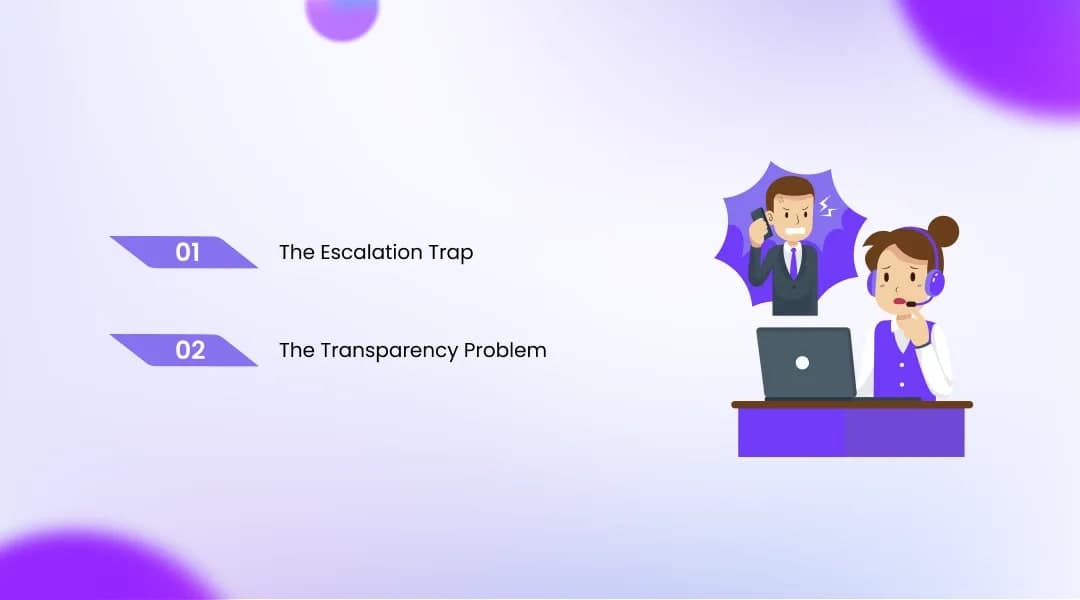
Here is the uncomfortable truth: most AI customer service failures have nothing to do with the AI. They have everything to do with how it was deployed.
Customers do not hate AI. They hate bad AI.
The Escalation Trap
The single fastest way to enrage a customer is to trap them. Customers are frustrated by a lack of empathy, having to repeatedly outline their problem, and being transferred between departments, and 85 per cent prefer support from a human when dealing with complex issues. When people cannot find the exit, resentment overshadows every benefit the system delivered.
The fix is not complicated, but it is often skipped. 81% of customers want the option to escalate to a human at any point in an AI conversation, and deployments that hide the escalation path see 3.4 times higher abandonment. Make the door to a human obvious, not buried.
The Transparency Problem
Have you ever hung up angrier than when you called? Usually it is because you felt handled, not helped, and often because you could not tell whether you were even talking to a person. Hiding the AI backfires: 52% of customers say transparency about whether they are talking to AI or a human improves their experience.
There is a real trust cost to getting this wrong. 63% of customers report being frustrated when using AI or ChatGPT technologies, and much of that frustration traces back to feeling deceived or stuck. Tell people what they are talking to, and give them a way out. Trust is the whole game.
AI in Customer Service Best Practices
These AI customer service best practices are the ones that separate deployments customers praise from the ones that go viral for the wrong reasons. They are less about the model and more about the plan around it.
Start Small and Solve One Clear Problem
The teams seeing the best results did not automate everything at once. They picked their highest-volume, lowest-complexity ticket category and proved value there first.
Define the operational goal: reduce first-response time, cover off-hours, or improve routing. Vague goals produce vague results.
Map the journey: find where your team repeats itself, then point AI at that gap before expanding.
Measure both sides: track efficiency metrics like handle time and experience metrics like CSAT together, so you never trade one for the other.
Scoping is the hidden variable. Poorly scoped AI can drop CSAT to painful lows even with a great model, while a narrowly scoped one earns trust quickly.
Design the Human Handoff First
Most teams treat escalation as an afterthought. Flip that. The handoff to a human is not a failure of the AI; it is a feature of a well-designed system.
Build it so the human agent inherits the full conversation and never asks the customer to repeat themselves. Then watch where the AI struggles and improve those gaps first. You should also account for governance early, since regulations like the EU AI Act and data rules such as GDPR increasingly shape how support AI can be deployed. Design for the exit, and the whole experience improves.
Conclusion
AI in customer service rewards businesses that design for the customer first and the algorithm second. The three things that matter most are simple: scope AI to the routine work it does brilliantly, make the path to a human obvious, and be transparent about when someone is talking to a machine. Do those three, and you get the speed and cost savings without the chatbot horror stories.
You do not need to gamble on this. Start with one clear problem and prove it. If that problem lives on the phone, where tone and immediacy are hardest to get right, OnDial builds human-centric voice AI agents designed around natural conversation and clean human handoffs. Book a walkthrough with our team, and we will map your highest-volume call type to a voice agent your customers will actually thank you for.