Running a salon means managing two conversations at once.
One happens inside the salon. Your team is serving customers, managing treatments, coordinating stylists, handling payments, and keeping appointments on schedule.
The other happens over the phone. Customers call to ask about services, prices, availability, timings, cancellations, packages, and appointments. When the team is busy, answering every call becomes difficult.
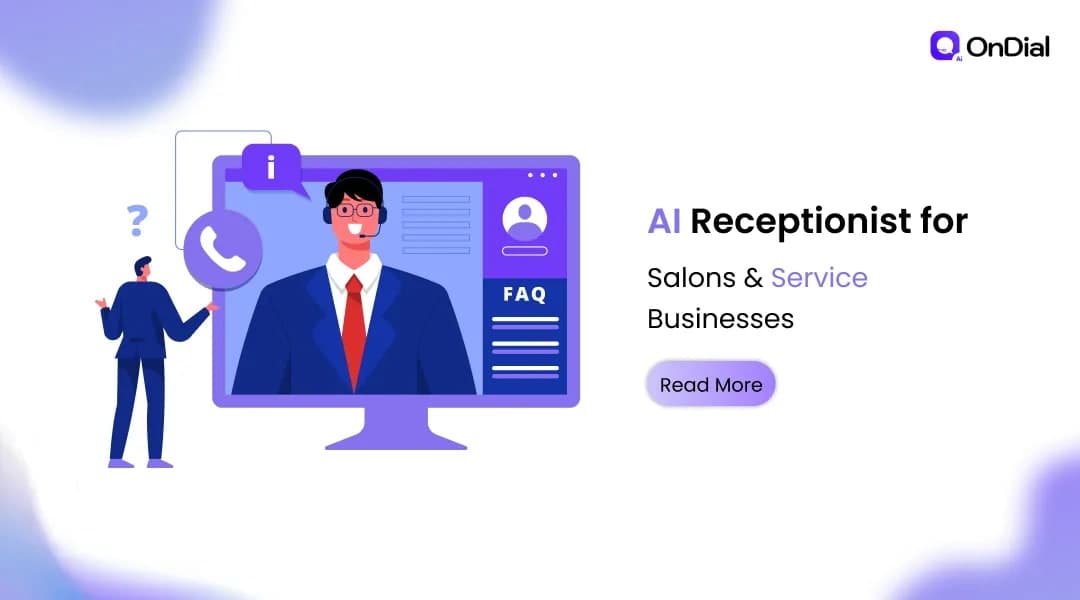
That is where an AI receptionist for salons can help.
Instead of sending callers to voicemail or asking them to call again, an AI receptionist can answer calls, understand what the customer needs, provide approved information, schedule appointments, handle rescheduling, capture enquiries, and transfer conversations to a staff member when human assistance is required.
For salons, spas, beauty clinics, wellness centres, and other appointment-driven businesses, the value is not simply answering the phone. The real value is connecting the phone conversation to the next business action.
What Is an AI Receptionist for a Salon?
An AI receptionist is a voice-based system designed to handle routine customer conversations over the phone.
A salon can configure the receptionist around its services, opening hours, booking rules, locations, staff availability, cancellation policies, and frequently asked questions.
A typical conversation might look like this:
A customer calls and asks whether a stylist is available on Saturday afternoon.
The AI receptionist identifies the requested service, checks the relevant availability, offers suitable time slots, confirms the customer's choice, and records the appointment.
If the customer instead asks about pricing, the AI can provide the approved information. If the caller has a request outside the configured workflow, the conversation can be transferred to a member of the salon team.
This makes an AI receptionist different from a traditional IVR.
A traditional IVR asks customers to navigate menus. A conversational AI receptionist can understand natural spoken requests and respond according to the context of the conversation.
Why Salons Miss Valuable Calls
Salon teams are often busiest precisely when customer demand is highest.
Weekends, evenings, holidays, promotional periods, and peak appointment windows can create a difficult situation. The staff inside the salon needs to focus on customers who are already there, while new customers may be calling at the same time.
When nobody answers, several things can happen.
The caller may try again later. They may send a message. They may wait for a callback. Or they may simply contact another salon.
The problem is not always that the business lacks leads. Sometimes the problem is that the business cannot respond quickly enough to the leads it already has.
A structured AI call answering workflow can help address that gap. OnDial's existing guidance on missed calls also highlights the relationship between unanswered calls, lost opportunities, and delayed customer response. (OnDial)
How an AI Receptionist Works for Salons
A useful salon receptionist should be connected to the actual workflow of the business rather than operating as a standalone chatbot.
1. The customer calls
The customer calls the salon's existing business number.
The AI receptionist answers and introduces itself according to the salon's preferred communication style.
2. The AI identifies the customer's intent
The caller may want to:
Book an appointment
Reschedule an appointment
Cancel an appointment
Ask about a service
Ask about salon timings
Check availability
Ask about packages
Request a callback
Speak with a team member
The receptionist identifies the purpose of the call before deciding what should happen next.
3. The AI collects relevant information
For an appointment, the system may need the customer's name, requested service, preferred date, preferred time, location, and other information required by the salon's workflow.
The important principle is to collect only what the workflow actually needs.
Long, unnecessary conversations create friction. A well-designed receptionist keeps the interaction focused.
4. The system checks availability
For booking workflows, the AI can connect with a calendar or scheduling system and check available slots.
This matters for salons because availability can depend on the service, stylist, branch, treatment room, or working hours.
The goal is not simply to tell a customer that appointments are available. The goal is to identify a real available slot and complete the booking correctly.
5. The appointment is confirmed
Once the customer selects a suitable time, the appointment can be recorded in the connected system.
The customer can then receive a confirmation through the configured communication channel.
OnDial's appointment scheduling service is designed around this call-to-calendar workflow, including live availability, booking, CRM updates, confirmations, rescheduling, and human escalation. (OnDial)
Salon Appointment Booking Is More Than Scheduling
Appointment booking is often treated as a simple calendar task.
In reality, it is a customer experience workflow.
Consider a customer calling for a hair appointment.
They may first ask which stylist is available. Then they may ask about the duration. They may want to know whether the stylist handles a specific treatment. They may change the preferred time. They may finally ask for confirmation.
A useful AI receptionist needs to maintain context throughout that conversation.
For example, if the customer changes the appointment from Saturday morning to Saturday evening, the system should understand that the customer is changing the existing request rather than creating an unrelated enquiry.
This is where conversational AI can be more useful than a basic menu-based phone system.
Rescheduling and Cancellation Without Unnecessary Staff Work
Not every customer call results in a new appointment.
Existing customers also call to change appointments.
A salon receptionist may spend a significant amount of time handling simple requests such as:
"Can I move my appointment to tomorrow?"
"Can I cancel my appointment?"
"Do you have anything available later today?"
An AI receptionist can handle these requests according to predefined rules.
It can identify the existing booking, check alternative availability, update the appointment where supported, and send the appropriate confirmation.
This also creates an opportunity to recover appointments that might otherwise become missed appointments.
If a customer cannot attend at the original time, giving them a simple way to move the appointment can be more useful than forcing them to call during another busy period.
Handling Salon Enquiries Beyond Appointments
A good salon receptionist should not treat every call as a booking request.
Customers often need information before they are ready to book.
They may ask:
What services does the salon offer?
How much does a particular treatment cost?
What are the salon's opening hours?
Which branch is closest?
Is a particular stylist available?
How long does a treatment take?
Do you offer a specific package?
Can I book for two people?
Do you accept walk-ins?
The AI should answer only from information approved by the business.
This is important because inaccurate answers can damage trust. A salon should regularly review its service information, pricing rules, policies, and availability logic so the AI reflects the actual business.
Lead Capture for Customers Who Are Not Ready to Book
Some callers are interested but not ready to make an appointment.
For example, someone may call to ask about bridal packages several weeks before an event.
Instead of treating that conversation as a dead end, the AI receptionist can capture the enquiry and the customer's preferred follow-up details.
Depending on the workflow, this information can be passed to the sales or salon team for follow-up.
That creates a more useful process:
Call → enquiry → customer information → follow-up → appointment
The receptionist becomes part of the lead management process rather than just a phone answering tool.
After-Hours Calls Can Become Opportunities
A salon may close for the day, but customers can still have questions.
Someone might search for a salon in the evening and immediately call. Another customer may remember that they need an appointment while travelling home from work.
If the phone only reaches staff during business hours, those enquiries wait.
An AI receptionist can provide a consistent response outside normal operating hours and handle tasks that have already been approved for automation.
For example, it can provide opening hours, answer common questions, capture an enquiry, or book an available appointment.
That gives customers another way to complete their journey without waiting for the next business day.
AI Receptionist for Multi-Branch Salons
Multi-location salons have another challenge: routing.
A customer may call a central number without knowing which branch is appropriate.
The AI can ask for the customer's preferred location and then continue the conversation using the correct branch information.
For example:
"Which location would you prefer?"
"Do you want the earliest appointment or a particular stylist?"
"Would you like the same service at another branch if your preferred location is full?"
This can reduce unnecessary transfers and help customers find an available option faster.
For businesses with multiple locations, the AI workflow should clearly separate branch-level information, staff availability, and booking rules.
Multilingual Salon Customer Service
Language can influence how comfortable a customer feels during a phone conversation.
This is especially relevant for Indian salons serving customers who may naturally switch between English, Hindi, Gujarati, Hinglish, or another regional language.
A multilingual voice workflow can allow customers to communicate in supported languages without forcing them through a rigid language menu.
OnDial supports multilingual voice interactions and positions language flexibility as part of its broader AI voice platform. (OnDial)
For salons, the practical objective is simple: customers should understand the booking process and receive clear answers without unnecessary communication barriers.
What Should an AI Receptionist Integrate With?
The AI receptionist becomes more useful when it can communicate with the systems the salon already uses.
Important integrations may include:
Calendar and booking systems
The AI needs access to current availability if it is expected to book or reschedule appointments.
CRM systems
Customer information and call outcomes can be recorded so the salon team has context for future conversations.
Messaging systems
Confirmation and reminder workflows can extend the interaction beyond the phone call.
Telephony
The AI should work with the salon's existing phone infrastructure or provide a practical migration path.
Human handoff
Some calls should always reach a person.
For example, complaints, unusual requests, sensitive situations, complex service questions, or requests outside the AI's configured authority may require staff involvement.
A strong implementation does not attempt to automate every conversation. It creates a clear boundary between automation and human service.
What to Look for When Choosing an AI Receptionist for a Salon
Not every AI receptionist is designed for appointment-driven businesses.
Before choosing a platform, evaluate the workflow rather than judging the system only by how natural the voice sounds.
Real appointment availability
The system should work with live availability rather than relying on a static list of appointment times.
Rescheduling and cancellation
Ask whether customers can modify existing bookings through the AI.
Human escalation
Check how the system transfers calls and whether the receiving employee gets useful context.
CRM and calendar integration
A receptionist that answers calls but leaves employees to manually enter every detail can create another administrative task.
Multilingual support
If your customers regularly use multiple languages, test the actual conversation instead of relying only on a language list.
Business-specific knowledge
The AI should be configured around your services, policies, locations, staff, and customer experience.
Conversation analytics
Call records and outcomes can help identify frequently asked questions, missed opportunities, and areas where the workflow needs improvement.
Clear automation boundaries
The system should know when to answer, when to ask for more information, and when to transfer the customer to a human.
AI Receptionist vs Traditional Salon Receptionist
An AI receptionist and a human receptionist serve different purposes.
A human brings judgment, empathy, flexibility, and the ability to handle situations that are difficult to standardise.
An AI receptionist brings consistency, availability, and the ability to handle repetitive conversations at scale.
The strongest approach for many salons is not to think in terms of replacing the front desk.
Instead, use AI for repetitive call handling while allowing staff to focus on customers who are physically present and conversations that require human judgment.
This creates a division of work.
AI can handle routine calls, appointment requests, confirmations, common questions, and structured follow-ups.
People can focus on customer relationships, complex requests, service quality, complaints, and in-person experiences.
How an AI Receptionist Can Support the Customer Journey
The real opportunity is bigger than answering calls.
A salon customer journey can look like this:
Discovery → Phone enquiry → Service questions → Appointment booking → Confirmation → Reminder → Visit → Follow-up
An AI receptionist can participate at several points in that journey.
It can answer the initial enquiry, help the customer choose a suitable appointment, confirm the booking, support rescheduling, and trigger configured follow-up workflows.
That makes voice automation part of the customer experience rather than an isolated phone feature.
For salons considering a broader voice automation strategy, OnDial's AI voice agents for hospitality page provides another example of how appointment, reservation, reminder, and customer communication workflows can be connected. (OnDial)
A Practical Implementation Plan for a Salon
The best way to introduce an AI receptionist is to start with the calls your staff handles repeatedly.
Step 1: Review your call types
Look at recent calls and categorise them.
How many are appointment requests? How many are rescheduling calls? How many are pricing questions? How many require a human?
Step 2: Define the AI's responsibilities
Decide which conversations the AI can complete independently and which should be transferred.
Step 3: Connect the required systems
Connect the phone, calendar, CRM, messaging tools, and other systems needed for the selected workflow.
Step 4: Build the conversation flow
Create clear greetings, questions, business rules, fallback responses, and escalation conditions.
Step 5: Test real scenarios
Test customers speaking quickly, changing their minds, asking multiple questions, switching languages, cancelling appointments, and requesting something outside the normal workflow.
Step 6: Launch gradually
Start with a controlled workflow and monitor conversations.
Step 7: Improve continuously
Use call outcomes and customer feedback to update the knowledge base, routing rules, scripts, and escalation logic.
For businesses researching the mechanics behind appointment automation, how AI appointment scheduling works provides a deeper explanation of the process from a phone call to a confirmed calendar slot. (OnDial)
Common Mistakes to Avoid
An AI receptionist can create problems when it is implemented without a clear workflow.
Automating everything
Some conversations should remain with people.
Using outdated business information
Incorrect prices, opening hours, policies, or service information can quickly damage customer trust.
Ignoring human handoff
Customers should have a clear path to a human when the AI reaches the edge of its capabilities.
Treating voice quality as the only priority
A natural voice is useful, but accurate actions matter more. The system needs to book the right service, at the right location, at the right time.
Measuring only call volume
A better measurement framework includes answered calls, completed bookings, reschedules, cancellations, qualified enquiries, transfers, and customer outcomes.
Forgetting the customer experience
Automation should make the process easier for the customer, not simply reduce work for the business.
Final Thoughts
An AI receptionist for salons is most valuable when it solves a specific operational problem.
It can answer routine calls when staff are busy, help customers book appointments, support rescheduling, capture enquiries, provide consistent information, and route conversations that need human attention.
The important question is not whether a salon should automate its phone.
The better question is which parts of the customer conversation should be automated and which should remain human.
When those boundaries are designed properly, voice AI can become a practical extension of the salon team.
For businesses evaluating the wider possibilities of AI voice automation, OnDial provides AI voice agents designed to handle inbound and outbound customer conversations, appointment scheduling, lead qualification, customer support, and connected business workflows.