A lead who fills out your form at 9:14 in the morning is a different person by 9:44. In those thirty minutes, their intent cools, they open two competitor tabs, and the urgency that pushed them to reach out quietly drains away. Widely cited research on lead response found that businesses contacting a fresh inquiry within five minutes are many times more likely to qualify that lead than those who wait even thirty minutes, and the odds collapse further after the first hour. This is where an AI voice agent for lead follow-up changes the economics of your entire funnel, because it removes the single biggest leak most sales teams never fully see.
The problem is not that your team is lazy or your product is weak. The problem is that human availability and lead behaviour are fundamentally mismatched. Leads arrive at all hours, in bursts, on weekends, and during lunch, while your reps can only dial one number at a time during working hours. Studies on buyer behaviour repeatedly show that a large share of prospects simply buy from whoever responds first, which means the winner is often decided by speed rather than by who has the better offer.
This blog breaks down exactly why slow lead follow-up quietly kills revenue, why traditional methods cannot solve it, and how an AI voice agent for lead follow-up responds in seconds, qualifies interest, and hands warm prospects to your team. We will cover the real cost of the problem, how the technology works in plain language, the measurable impact on your lead conversion rate, and what a real deployment looks like so you know what to expect before you commit.
The Hidden Cost of Slow Lead Follow-Up
Most businesses track how many leads they generate and how many deals they close, but very few measure what happens in the gap between those two numbers. That gap is where slow follow-up silently destroys pipeline value. Every minute a qualified lead waits for a callback is a minute in which a competitor can reach them first, or in which the buyer simply moves on to something else.
The financial damage is larger than most owners assume because it compounds across three separate layers. You lose the deal itself, you lose the marketing spend that generated the lead, and you lose the lifetime value of a customer who would have stayed for years. When you add these together, a slow response is not a minor operational hiccup; it is a direct subsidy to your competitors.
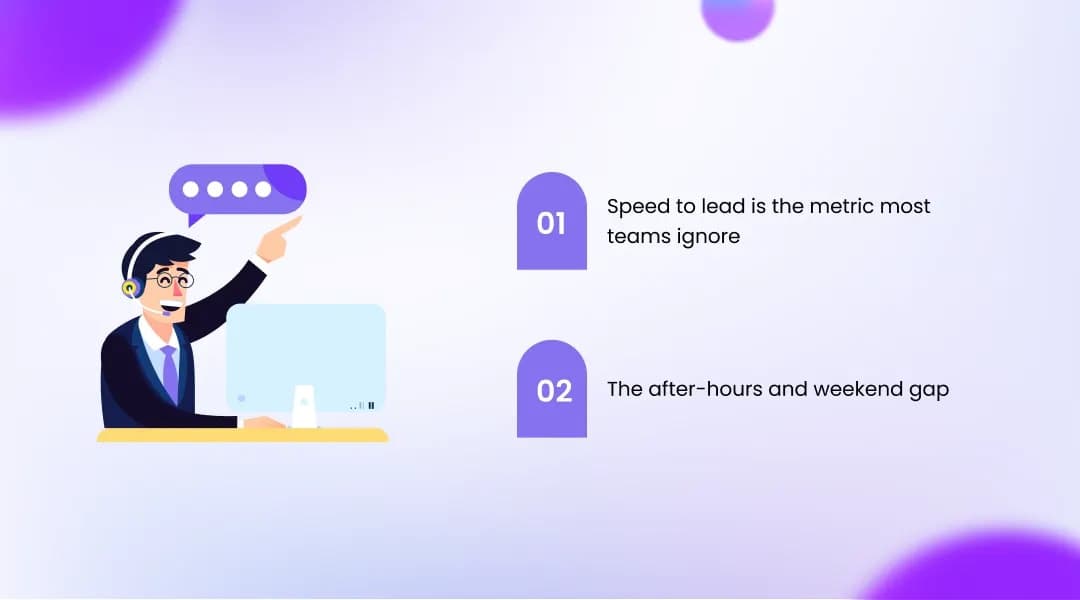
Speed to lead is the metric most teams ignore
Speed to lead is the elapsed time between a prospect expressing interest and your first meaningful contact with them, and it is the single most predictive number in modern sales. Research on lead response times consistently shows that the probability of qualifying a lead drops sharply once the first five minutes pass, yet the average business takes hours to respond, and many take more than a day. Teams that treat speed to lead as a core metric almost always outperform those that only measure total call volume or close rate.
The reason this metric gets ignored is that it is uncomfortable to look at. It exposes gaps in staffing, gaps in process, and gaps in accountability that are easier to leave unexamined. Once you start measuring speed to lead honestly, you usually discover that a large slice of your marketing budget is being wasted on inquiries nobody ever called back in time.
The after-hours and weekend gap
A significant portion of leads arrive outside the standard nine-to-five window, especially for consumer-facing industries like real estate, insurance, healthcare, and education. A prospect researching a home loan at 10 in the evening or an anxious patient looking for a clinic on a Sunday will not wait patiently for Monday morning. They will keep searching until someone answers, and that someone is rarely the business that closed at six the previous evening.
This after-hours gap is not a small edge case; it is often where your most motivated buyers live. People who research and inquire late at night or on weekends are frequently the ones with the strongest intent, because they are spending their personal time actively solving a problem. Leaving those leads to sit in a queue until the next business day hands your best prospects directly to whoever is available when you are not. Businesses solving this challenge with 24/7 lead follow-up consistently capture more high-intent prospects outside business hours.
Why Traditional Lead Follow-Up Fails
Before looking at the solution, it helps to understand why the conventional fixes rarely work. Businesses have tried to solve slow follow-up for decades, yet the problem persists across almost every industry. The reason is that the traditional tools were never designed for the speed and volume that modern lead generation produces.
Hiring more sales development representatives is the obvious answer, but it is expensive, and it scales poorly. Each new rep adds fixed salary cost, requires weeks of training, and still cannot work around the clock or handle sudden spikes in demand. When a marketing campaign performs unexpectedly well and generates triple the usual leads in a single afternoon, a human team simply cannot absorb that surge, and the overflow leads go cold.
The other common approach is automation through email and text, which is faster but far weaker than a real conversation. An automated email lands in a crowded inbox and competes with dozens of other messages, while a text is easy to ignore. Neither can ask a qualifying question, handle an objection, or read whether the person actually wants to move forward. A voice conversation does all three, which is why phone follow-up still converts better than any other channel despite being the hardest to scale manually.
There is also the human consistency problem, which quietly undermines even well-staffed teams. A rep who is tired, distracted, or having a bad day will follow up less rigorously, skip the second and third attempts, and let borderline leads slide. Since research on buyer behaviour indicates that most sales require several follow-up attempts before the prospect engages, this inconsistency means the majority of leads are abandoned long before they were ever going to convert.
How an AI Voice Agent for Lead Follow-Up Works
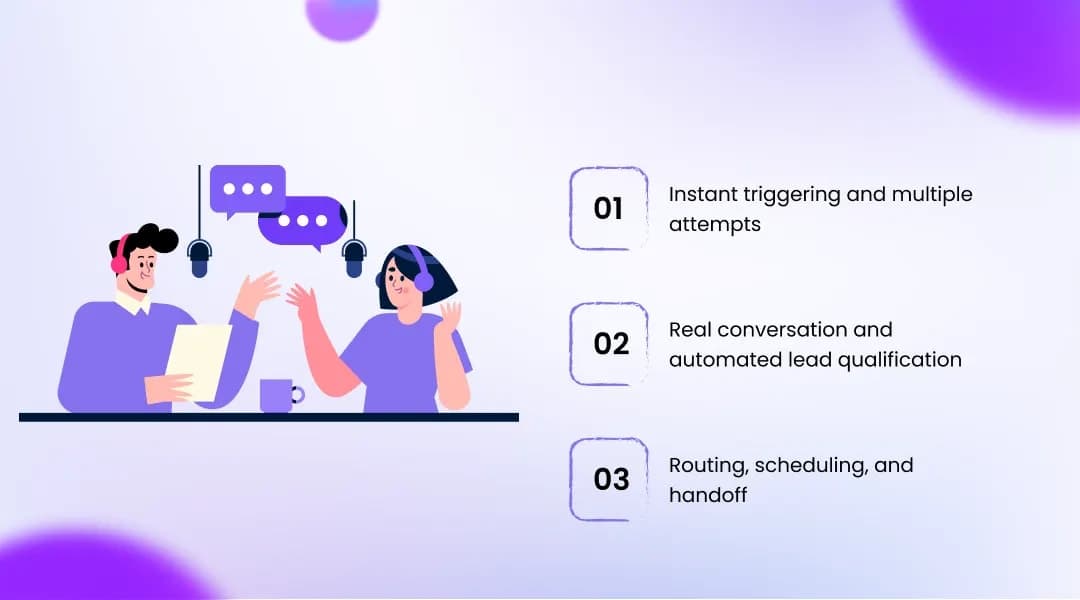
An AI voice agent for lead follow-up is an autonomous system that places or receives phone calls, holds a natural spoken conversation, qualifies the prospect, and routes the outcome to your team or your calendar without a human agent involved. It listens, understands intent, responds in a natural voice, and follows a conversation flow that you define. To the person on the other end, it feels like talking to a capable, patient, and well-informed representative who happens to be available instantly.
The core advantage is that the agent triggers the moment a lead arrives rather than waiting in a queue. When a form is submitted, a missed call comes in, or a lead lands in your system, the agent can call within seconds. This is the mechanism that finally makes a five-minute response time achievable at any volume, because the system does not care whether one lead or five hundred leads arrive at once.
Instant triggering and multiple attempts
The first job of the agent is to reach the lead before their intent fades. As soon as a new inquiry is captured, the AI voice agent initiates an outbound call, often within the same minute the lead was created. If the prospect does not answer, the agent can retry on a schedule you configure, spacing attempts across the day so that persistence never tips into harassment.
This automated persistence solves the follow-up consistency problem that human teams struggle with. The agent never forgets the second attempt, never gets discouraged after a voicemail, and never deprioritises a lead because it looked marginal. Every lead receives the same disciplined sequence of contact attempts, which is exactly what research on lead response says is required to convert a meaningful share of them.
Real conversation and automated lead qualification
Once the prospect answers, the agent conducts automated lead qualification through a genuine two-way conversation. It asks the questions that matter to your business, such as budget, timeline, location, or specific need, and it adapts based on the answers rather than reading a rigid script. A good AI voice agent understands accents, handles interruptions, and stays on track even when the caller goes off on a tangent.
The output of this conversation is a scored, qualified lead rather than a raw name and number. The agent can rate the lead based on the qualification criteria you set, flag high-intent prospects for immediate human attention, and politely disqualify people who are not a fit so your reps never waste time on them. This automated lead qualification is what turns a flood of raw inquiries into a clean, prioritised list your team can actually work.
Routing, scheduling, and handoff
The final step is doing something useful with the qualified lead. A capable agent can book the appointment directly into a connected calendar, transfer a hot prospect to a live rep in real time, or log the full conversation and outcome into your existing systems. This means a lead can go from form submission to booked meeting in a single unbroken flow, with no human involvement until the moment a real conversation with sales adds value.
This seamless handoff is what separates a genuine solution from a glorified answering machine. The reader who deploys outbound AI calling wants the agent to shorten the path to revenue, not to create another queue that a human still has to process. When routing and scheduling are built in, the sales team wakes up to a calendar full of pre-qualified meetings rather than a list of numbers to chase.
The Measurable Impact on Your Lead Conversion Rate
The reason speed to lead matters so much is that it moves the one number every business cares about, which is the lead conversion rate. When you respond in seconds instead of hours, you catch prospects while their intent is at its peak, and you catch them before a competitor does. The improvement is not marginal; it is often the difference between a campaign that pays for itself and one that quietly loses money.
Businesses that shift from multi-hour response times to near-instant response through outbound AI calling frequently report meaningful lifts across the funnel. The gains show up in several places at once, because faster contact improves every stage that follows.
Here are the specific outcomes a well-deployed AI voice agent tends to produce:
A dramatically faster first response, moving from an average of several hours to under one minute for the majority of new leads.
A higher connect rate, because the agent can attempt every lead multiple times at optimal moments without any additional staff cost.
A cleaner pipeline, because automated lead qualification filters out poor fit prospects before they consume any human selling time.
More booked meetings, because the agent schedules directly into the calendar at the moment of peak intent rather than after a delay.
A better lead conversion rate overall, because catching prospects first and qualifying them consistently compounds into more closed deals.
The economics are compelling once you compare the cost structure. A human sales development representative carries a fixed monthly salary, works a limited number of hours, and can only handle one conversation at a time. An AI voice agent handles thousands of simultaneous conversations, works every hour of every day, and costs a fraction of a single hire while covering the workload of an entire team during peak surges.
There is also a quality dividend that is easy to overlook. Because every call is recorded, transcribed, and analysed, you gain a complete data trail of what your leads actually say, which objections come up most, and which sources produce the best prospects. This intelligence feeds directly back into your marketing and sales strategy, so your lead conversion rate keeps improving over time rather than plateauing.
How OnDial Handles Lead Follow-Up at Scale
OnDial is a platform that deploys production-grade AI voice agents for real businesses, and lead follow-up is one of the clearest cases where it earns its place in the stack. Rather than acting as a simple auto-dialer, OnDial runs autonomous inbound and outbound voice agents that hold natural conversations, qualify prospects, and book meetings without human intervention. It is built for the exact scenario this blog describes, where speed and consistency decide whether a lead becomes revenue.
The technical foundation matters here because a slow or robotic agent will hurt conversion rather than help it. OnDial responds with a latency of under 500 milliseconds, which is fast enough that conversations feel natural and prospects do not experience the awkward pauses that make callers hang up. That responsiveness is what allows the agent to hold a real dialogue, handle interruptions, and qualify a lead the way a skilled human would.
Language coverage that matches your market
For businesses operating in India and other multilingual markets, language flexibility is not a nice-to-have; it is a requirement for connecting with leads. OnDial supports over 100 languages, including 9 Indian languages with more than 80 Indian voice variations, so the agent can speak to a prospect in Hindi, Tamil, Gujarati, or whatever language makes the conversation comfortable. A lead who is greeted in their own language stays on the call longer and trusts the interaction more.
This language depth directly improves the lead conversion rate in diverse markets. A prospect in a tier two city who receives a follow-up call in their regional language is far more likely to engage than one forced into a stilted English exchange. OnDial handles this natural code-switching and regional nuance, which is exactly what most global platforms built for English-speaking markets fail to do.
Round-the-clock coverage and built-in analytics
OnDial provides 24/7 inbound and outbound call handling, which is precisely what closes the after-hours and weekend gap discussed earlier. Every lead that arrives at midnight or on a public holiday gets an immediate call, so your most motivated prospects are never left waiting for the next business day. This continuous availability is impossible to replicate with a human team without enormous overtime costs.
Beyond raw availability, OnDial includes call sentiment analysis and smart analytics that turn every conversation into usable intelligence. The platform scores leads through automated lead qualification, tracks the sentiment of each call, and surfaces patterns across thousands of interactions. It handles GDPR and CCPA-compliant data handling, and it offers both API and no-code deployment, so a technical team can integrate it deeply while a non-technical operator can launch a working agent without writing code.
What Implementation Actually Looks Like
A common fear among business owners is that deploying an AI voice agent will be a long, technical, disruptive project. In practice, a focused lead follow-up deployment is one of the fastest AI systems to stand up, because the use case is narrow and the goals are clear. You are not rebuilding your entire operation; you are plugging a specific leak in a specific part of your funnel.
The first phase is defining what a good conversation looks like. You decide what questions the agent should ask, what qualifies a lead as hot, what disqualifies one, and what should happen at the end of each call. Most businesses already know this implicitly from how their best reps work, so the exercise is mostly about writing that knowledge down clearly.
The second phase is connecting the agent to your lead sources and your calendar or systems. This is where the trigger gets wired up, so that a new form submission or inbound inquiry launches a call automatically. With a no-code platform, this connection is often a matter of configuration rather than custom engineering, and with API access, a technical team can integrate it into a bespoke workflow.
Starting small and expanding
The smartest way to deploy an AI voice agent for lead follow-up is to start with a single, well-defined use case rather than trying to automate everything at once. Pick your highest volume or highest value lead source, point the agent at it, and measure the results against your current process for a few weeks. This gives you a clean before and after comparison and builds internal confidence before you expand.
Once the first use case proves its value, expanding is straightforward because the hard work of designing the conversation and connecting the systems is already done. Businesses typically move from one lead source to several, then from simple qualification to appointment scheduling and live transfer. This staged approach keeps risk low while letting the measurable wins fund and justify each expansion.
What to measure once you go live
The metrics that matter after launch are speed to lead, connect rate, qualification rate, meetings booked, and ultimately lead conversion rate. Watching these numbers side by side tells you quickly whether the agent is doing its job and where the conversation flow needs tuning. Because everything is logged and analysed, you can adjust the script, the timing of retries, and the qualification criteria based on real data rather than guesswork.
The goal in the first month is not perfection; it is proof. If your speed to lead drops from hours to under a minute and your booked meetings rise while your team spends less time chasing dead leads, the system is working. From there, ongoing refinement using the AI call analytics steadily improves performance, which is why teams that start with a narrow deployment usually end up expanding it across their whole funnel.
The Bottom Line on Faster Lead Follow-Up
The three points worth remembering are simple. First, speed to lead is the metric that quietly decides your revenue, because prospect intent decays within minutes and buyers overwhelmingly reward whoever responds first. Second, traditional follow-up through more staff, email, or text cannot solve this at scale, since none of them combine instant speed, tireless persistence, and a real qualifying conversation. Third, an AI voice agent for lead follow-up closes this gap by calling within seconds, qualifying consistently, and booking meetings around the clock.
This is exactly what OnDial is built to deliver for real businesses. OnDial deploys production-grade AI voice agents that respond in under 500 milliseconds, speak over 100 languages, including 9 Indian languages with more than 80 voice variations, handle inbound and outbound calls 24/7, and qualify and score every lead while staying GDPR and CCPA compliant. With both API and no-code deployment, it fits a small team launching its first agent just as well as an enterprise integrating voice into a complex sales stack.
If slow follow-up is quietly costing you deals you have already paid to generate, the fix is faster to deploy than you think. Schedule a demo with OnDial or start a free trial to see how an AI voice agent for lead follow-up can turn your missed opportunities into booked, qualified sales conversations.