Gartner predicts conversational AI will reduce contact centre labour costs by $80 billion in 2026. That is not a typo. And if you are a business leader staring at rising call centre expenses, that number probably makes you feel two things at once: excited and skeptical.
I get it. At OnDial, we work with companies every day who are caught between the promise of AI voice agents and the reality of managing human call centre teams. The confusion is real. Vendor pricing pages are deliberately vague. "Per-minute" rates hide infrastructure costs. And nobody tells you that your best human agents still outperform AI on the calls that actually matter.
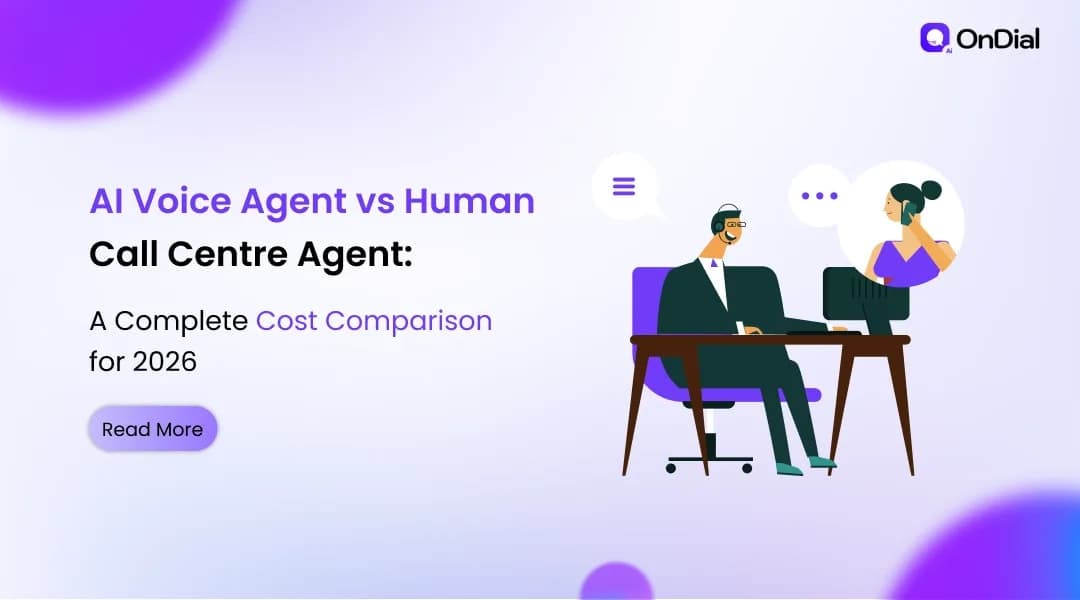
An AI voice agent is software that uses speech recognition and large language models to handle live phone conversations autonomously. A human call centre agent is a trained person who manages customer calls, bringing empathy and judgment to every interaction.
This article breaks down the true cost of each option, line by line. You will see exactly where AI saves money, where humans remain essential, and how the hybrid model delivers the strongest ROI. No inflated claims. No hidden math.
The Real Cost of a Human Call Centre Agent in 2026

Salary, Benefits, and Overhead
Most businesses dramatically undercount what a human agent costs. The salary is just the starting point. A customer service representative in the United States earns roughly $35,000 per year in base pay. Add health insurance, paid time off, management overhead, workspace, and software licences, and the fully loaded cost pushes closer to $50,000-$61,000 annually.
That breaks down to approximately $0.60 per minute of productive call time, according to Retell AI's benchmarking data. In India and the Philippines, offshore agents cost less on paper, but factor in quality management, time-zone coverage, and compliance oversight, and the gap narrows more than people expect.
Here is what most cost spreadsheets miss: labour accounts for 60-70% of total call centre expenditure. A modest four-person in-house team costs approximately $264,000 annually when you include agent compensation, management, and infrastructure, according to data published by ElevenLabs.
The Hidden Tax: Turnover and Training
This is the number that should keep call centre managers awake at night. Agent turnover runs between 30-45% annually. Every departing agent represents $10,000-$20,000 in lost investment when you account for recruitment ($1,500-$5,000 per hire), training ($5,000-$10,000 per agent), and the productivity ramp-up period.
I have personally seen companies burn through 40% of their frontline staff in a single year and then wonder why customer satisfaction scores keep sliding. It is not a people problem. It is a structural one.
(Here is the part nobody talks about: your top-performing agents are the ones most likely to leave, because they have options.)
Average agent tenure has dropped to just 10.5 months, according to CCW Digital's 2025 data. That means most contact centres are in a permanent state of hiring and training, never quite reaching peak operational efficiency.
What Does an AI Voice Agent Actually Cost?
Per-Minute Pricing Breakdown
AI voice agent pricing is not as simple as vendors make it sound. The headline rate, typically $0.07 to $0.25 per minute, covers the base orchestration cost. But a production AI voice call actually involves four billable components stacked together:
Speech-to-text (STT): Converting the caller's voice to text, roughly 100-300ms of processing per turn
LLM inference: The language model that generates the response, adding 200-800ms
Text-to-speech (TTS): Converting the AI's text response back to natural-sounding audio
Telephony fees: The actual phone line costs for inbound and outbound connections
When you add all four layers together, the total per-minute cost for a production AI voice agent lands between $0.08 and $0.40, depending on voice quality tier and LLM choice. For a typical 3-5 minute call, that translates to $0.20-$1.20 per interaction.
Setup, Integration, and Ongoing Fees
The per-minute rate is only part of the picture. I have watched companies get surprised by costs they did not plan for. Watch for these:
CRM integration fees vary widely. Basic webhook logging is often included. Two-way sync with Salesforce or HubSpot, where the AI pulls customer history and updates records in real time, can require custom API work and ongoing maintenance.
Compliance costs add up in regulated industries. HIPAA readiness, SOC 2 certification, PCI-DSS for payment handling, and GDPR data residency controls are not free. Platforms that include these certifications charge a premium, but for good reason.
Concurrency charges matter at scale. Most platforms include a limited number of simultaneous calls. Additional concurrent call capacity typically costs $8-$10 per slot per month.
Side-by-Side Cost Comparison: AI Voice Agent vs Human Agent
Cost Per Call
This is where the comparison gets concrete. For a standard 4-minute customer service call:
Cost Element | Human Agent | AI Voice Agent |
Cost per call | $3-$12 (domestic) | $0.20-$1.20 |
Cost per call (offshore) | $1-$4 | $0.20-$1.20 |
24/7 availability | Requires shift premiums | Included |
Scaling to 2x volume | Hire more staff | Automatic |
The cost reduction ranges from 70-95% per automated interaction, depending on call complexity and platform choice. But, and this matters, that reduction only applies to calls AI can actually resolve. We will get to that.
Monthly and Annual Cost at Scale
Let me make this tangible. A business handling 10,000 calls per month with an average call duration of 4 minutes:
Human-only model: 10,000 calls at $5 average = $50,000/month = $600,000/year
AI-only model: 10,000 calls at $0.50 average = $5,000/month = $60,000/year
Hybrid model (70% AI, 30% human): 7,000 AI calls + 3,000 human calls = $3,500 + $15,000 = $18,500/month = $222,000/year
That hybrid model delivers roughly 63% savings compared to the human-only approach. And it keeps your best agents focused on the calls where their skills actually matter.
Where AI Voice Agents Win (and Where They Don't)
Tasks AI Handles Better Than Humans
An AI voice agent is a tireless, consistent first responder for predictable interactions. AI excels at tasks with clear logic and API-connected workflows:
Order tracking and status updates. The caller asks where their package is. AI checks the system and responds in seconds. No hold time. No agent lookup.
Appointment scheduling and rescheduling. Calendar-connected AI agents handle booking flows faster and with fewer errors than human agents navigating multiple screens.
FAQ responses and account inquiries. Balance checks, policy questions, billing explanations. These high-volume, low-complexity calls are perfect for automation.
Post-call surveys. AI can run structured feedback collection with smart follow-up questions based on the caller's responses, capturing data that is more consistent than what a hurried human agent gathers.
Are you still paying $5-$12 per call for someone to read an order status off a screen?
Where Human Agents Still Matter
Let me be direct about this: AI voice agents are not a full replacement for human agents. Not today. Not in 2026. And any vendor who tells you otherwise is overselling.
Complex emotional situations require genuine empathy. A customer who just had a car accident and needs to file a claim. A patient calling about a frightening diagnosis. These interactions demand the kind of nuanced judgment that AI simply cannot replicate yet.
High-stakes sales conversations still convert better with human agents. Building trust, reading subtle verbal cues, and adapting a pitch in real time remain distinctly human strengths.
Dispute resolution and escalated complaints need a person who can make judgment calls outside of standard protocols. AI operates within defined boundaries. Angry customers need someone who can bend rules when the situation calls for it.
Research shows that 79% of customers still prefer human interaction for complex or sensitive problems, citing accuracy and emotional intelligence as the primary reasons.
The Hybrid Model: Why Most Businesses Need Both
How to Split the Workload
The honest answer for most companies is not "replace the call centre entirely" but "route the right calls to the right handler." AI voice agents can autonomously resolve up to 80% of routine issues. That leaves your human agents free to focus on the 20% that actually needs their expertise.
Here is a practical framework I use with OnDial clients:
AI handles: order status, appointment booking, FAQ, payment reminders, initial intake and discovery, after-hours coverage, and post-call surveys.
Humans handle: complex complaints, sales closing, sensitive conversations, high-value account management, and any interaction where the caller explicitly requests a person.
The critical piece is the handoff. When AI detects that a call has moved beyond its confidence threshold, it transfers the caller to a human agent with full conversation context. The human picks up exactly where the AI left off. No repetition. No frustration.
Real-World ROI of Hybrid Deployments
A Forrester Consulting study found that companies using voice AI report a 3-year ROI between 331% and 391%. That is not from replacing humans. It is from eliminating wasted human effort on calls that never needed a person in the first place.
A study of 130,175 calls across 45 businesses by NextPhone confirmed that hybrid models resolve 23% more inquiries on the first contact than AI-only systems. Better first-call resolution means fewer callbacks, lower total cost, and higher customer satisfaction.
The hybrid approach typically delivers 40-70% total cost savings compared to a fully human operation, according to data compiled by CallSphere.
How to Calculate Your Own Savings
The Simple Formula
You do not need a consultant or a fancy ROI calculator to estimate your potential savings. Start here:
Step 1: Count your monthly call volume. Separate calls into "routine" (order status, FAQ, scheduling) and "complex" (complaints, sales, emotional).
Step 2: Multiply routine calls by your current cost per call. That is your automation opportunity.
Step 3: Assume AI handles 60-80% of those routine calls at $0.30-$0.50 per call. The remaining 20-40% still go to humans.
Step 4: Subtract the AI cost from your current cost. That is your monthly saving.
For a company with 5,000 monthly calls where 70% are routine, shifting those 3,500 calls from $5 each ($17,500) to $0.40 each ($1,400) saves roughly $16,100 per month, or $193,200 per year.
Factors That Change the Math
Your actual savings will depend on several variables. Average call duration is the biggest: longer calls amplify AI savings because per-minute pricing works in your favour. Call complexity distribution matters too, because businesses with a higher percentage of routine calls see faster payback.
Industry compliance requirements can add cost to the AI side. Healthcare and financial services companies will pay more for HIPAA-compliant and PCI-DSS certified platforms. But even with those premiums, the cost advantage over human agents remains significant.
Integration depth affects both cost and value. A basic AI agent that answers and routes calls is cheaper than one that pulls CRM data, updates records, and triggers workflows. But the deeper integration generates substantially more value per call.
(Something I have learned from deploying these systems: the companies that get the best results are the ones who invest time in defining clear escalation rules. The technology is only as smart as the logic you build around it.)
Conclusion
The cost comparison between an AI voice agent and a human call centre agent is no longer theoretical. AI handles routine calls at 70-95% lower cost, scales instantly without hiring, and operates around the clock. Human agents remain essential for complex, emotional, and high-stakes conversations where judgment and empathy drive outcomes. The hybrid model, combining both, consistently delivers 40-70% total savings while improving first-call resolution.
If you are still running a fully human call centre for every inbound call, you are paying a premium for work that does not need a person. At OnDial, we help businesses design and deploy AI voice agents tailored to their specific call patterns, integrating with existing systems and building intelligent escalation paths so your human agents do what they do best. Start a conversation with us at ondial.ai to map out what a hybrid model looks like for your call volume.
AI voice technology is not about replacing people. It is about making sure the right voice, human or AI, answers every call.