Every year, the healthcare industry in the United States alone loses an estimated $150 billion to patient no-shows. That figure is not a projection or a worst case scenario. It is the cumulative cost of empty appointment slots, idle clinical staff, delayed treatments, and cascading scheduling inefficiencies that ripple through clinics, hospitals, and specialty practices every single day. For an individual physician practice, the average annual revenue loss from missed appointments falls between $150,000 and $200,000, a figure large enough to determine whether a small practice grows, stagnates, or closes its doors.
The problem is not new, and neither are the traditional attempts to solve it. Front desk staff make reminder calls when they have time. SMS reminders go out and get ignored. Patients forget, lose track of dates, feel anxious about procedures, or simply cannot navigate the rescheduling process quickly enough to notify the clinic. The result is a no-show rate that hovers between 15% and 30% across most outpatient settings, with some specialties and underserved populations experiencing rates well above 40%. These are not marginal losses. They represent a structural failure in how healthcare organizations communicate with the people they serve.
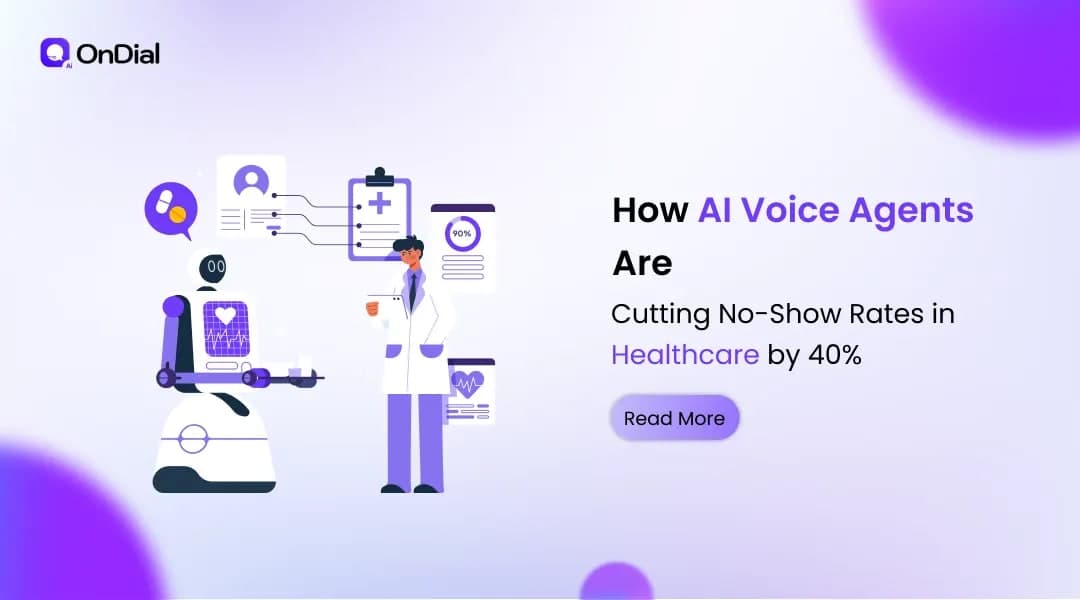
AI voice agents for healthcare are fundamentally changing this equation. Unlike static text reminders or overburdened front desk teams, autonomous voice agents can call every patient on the schedule, confirm or reschedule appointments in natural conversation, handle questions about preparation instructions or directions, and do all of this in the patient's preferred language at the time most likely to reach them. Practices deploying this technology are reporting no-show reductions of 25% to 40% within the first quarter of implementation, with corresponding revenue recovery that often pays for the entire system within weeks.
This blog examines the full scope of the patient no-show problem, why legacy reminder systems consistently underperform, how AI voice agents work in a clinical scheduling context, what measurable results healthcare organizations can realistically expect, and what the implementation process actually looks like from intake to live deployment. Whether you run a single specialty clinic, a multisite hospital network, or a diagnostic chain serving patients across multiple Indian states in nine or more regional languages, the operational logic and financial case are the same.
Understanding Why Patient No-Shows Persist Despite Existing Reminder Systems
The Real Reasons Patients Miss Appointments
Most healthcare administrators assume that patients miss appointments because they forget. Forgetfulness is certainly a factor, but research consistently shows it accounts for less than half of all no-shows. A 2021 study published in BMC Health Services Research found that the top reasons patients cited for missing appointments included transportation barriers, financial concerns about copays or uncovered services, anxiety about diagnoses or procedures, confusion about appointment details, difficulty reaching the clinic to reschedule, and simple scheduling conflicts that arose after booking.
What these reasons have in common is that they are not solved by a single SMS reminder sent 24 hours before the appointment. They require a conversation. A patient who is anxious about a procedure needs reassurance and information. A patient who has a scheduling conflict needs the ability to rebook on the spot without being placed on hold. A patient who is confused about whether they need to fast before a blood draw needs a clear, spoken answer in a language they fully understand. Text messages cannot provide any of this. A busy front desk team theoretically can, but in practice rarely does with the consistency and timeliness required.
Why Traditional Reminder Methods Hit a Ceiling
Most healthcare practices rely on one or more of these reminder approaches: manual phone calls from front desk or scheduling staff, automated SMS or text message reminders, email reminders, or patient portal notifications. Each of these methods has a hard ceiling on effectiveness. Manual calls are limited by staff availability and are the first task to be deprioritized when the front desk is busy with walk-ins, insurance queries, and inbound calls. Automated SMS reminders achieve open rates of roughly 90% but confirmation response rates that rarely exceed 30% to 40%, and they offer no ability to handle the patient's questions or reschedule on the spot. Email reminders perform even worse, with open rates below 25% in most patient demographics. Patient portal notifications require the patient to have registered, logged in, and enabled alerts, which excludes the majority of patients in most practice populations.
The fundamental limitation is that none of these methods are interactive at the moment of contact. They deliver information but do not have a conversation. When a patient receives a text reminder and realizes they need to reschedule, they must call the clinic, wait on hold, and speak to someone during business hours. Many patients simply do not complete that process, and the appointment becomes a no-show.
How AI Voice Agents Solve the Healthcare No-Show Problem

AI voice agents replace the static, one directional reminder with an interactive, intelligent phone conversation that happens automatically at scale. When a healthcare organization deploys an AI voice agent for appointment reminders, the system calls each patient at a configured time before their appointment, typically 48 hours and again 24 hours prior. The call is not a robotic recording. It is a natural language conversation powered by large language models that can understand the patient's responses, answer their questions, and take action in real time.
Confirmation, Rescheduling, and Cancellation in a Single Call
When the AI agent reaches a patient, it confirms the appointment details including date, time, provider name, and location. If the patient confirms, the system updates the scheduling record and the call ends in under 60 seconds. If the patient needs to reschedule, the agent accesses available time slots from the clinic's calendar system and offers alternatives. The patient selects a new time verbally, the agent confirms the change, and the original slot is immediately released back into the schedule for other patients. If the patient needs to cancel, the agent processes the cancellation and can offer to rebook at a future date.
This single interaction eliminates the three biggest friction points in appointment management: the patient does not need to call back, does not need to wait on hold, and does not need to navigate a phone tree or portal. The entire process happens in a natural spoken conversation that takes less than two minutes. Platforms like OnDial handle this with sub-500 millisecond response latency, meaning the conversation feels immediate and natural to the patient with no awkward pauses or delays that signal they are speaking to an automated system.
Multilingual Patient Outreach at Scale
One of the most significant advantages of AI voice agents in healthcare is the ability to communicate with patients in their preferred language. In diverse markets like India, the United States, the United Kingdom, and the Middle East, patient populations often speak dozens of languages and dialects. A front desk team that speaks English and one or two additional languages cannot serve a population that includes speakers of Tamil, Bengali, Marathi, Gujarati, Telugu, and Kannada, let alone patients who code-switch between Hindi and English mid-sentence.
OnDial supports over 100 languages including 9 Indian languages with more than 80 Indian voice variations, which means a hospital network in India can deploy appointment reminders that reach patients in their mother tongue across every state and demographic. This is not a minor operational detail. Studies have consistently shown that patient communication in the patient's preferred language increases appointment adherence by 15% to 25%, particularly among elderly patients and those in tier two and tier three cities who may not be comfortable with English language reminders.
Pre-Appointment Instructions and Preparation Reminders
Beyond simple confirmation, AI voice agents can deliver critical pre-appointment instructions during the reminder call. For a patient scheduled for a fasting blood test, the agent reminds them not to eat or drink after midnight. For a patient coming in for an MRI, the agent confirms they have no metallic implants and reminds them to wear comfortable clothing. For a patient seeing a specialist for the first time, the agent reminds them to bring their referral letter, insurance card, and any previous test results.
These instructions are often the difference between a productive appointment and one that must be rescheduled because the patient arrived unprepared. Delivering them in a spoken conversation rather than buried in a text message dramatically increases comprehension and compliance, especially among older patients and those with lower digital literacy.
Quantifying the Business Impact of AI Voice Agents on Healthcare Revenue
The financial case for AI voice agents in healthcare is unusually straightforward because the cost of no-shows is both large and precisely measurable.
Direct Revenue Recovery
Consider a mid-sized outpatient clinic with 20 providers, each seeing an average of 18 patients per day. With a 20% no-show rate, that clinic loses approximately 72 appointment slots per day. At an average revenue of $150 per visit, that translates to $10,800 in lost revenue every day, or roughly $2.8 million per year. If an AI voice agent reduces the no-show rate from 20% to 12%, a conservative 40% reduction, the clinic recovers approximately 29 appointments per day and $1.1 million in annual revenue.
The cost of deploying an AI voice agent platform across 20 providers is typically a small fraction of this recovered revenue. Most healthcare organizations achieve full return on investment within the first 30 to 60 days of deployment, making this one of the highest ROI technology investments available to clinical operations leaders.
Staff Time and Operational Efficiency
The revenue recovery is only part of the financial picture. Every no-show creates downstream operational waste. Clinical staff who were prepared for the appointment are idle. The room is empty but was cleaned and stocked. The provider's schedule has a gap that could have been filled. Administrative staff spend time logging the no-show, flagging the patient record, and attempting to fill the slot with a same day appointment.
When AI voice agents handle the outbound reminder and rescheduling process, front desk staff are freed from hundreds of manual calls per week. A clinic with 400 appointments per week that previously required manual reminder calls can redirect that staff time, typically 15 to 20 hours per week, toward higher-value activities like patient intake, insurance verification, and in-person service. OnDial's no-code deployment option means that this transition does not require IT staff or developers, which further reduces the implementation cost for smaller practices.
Downstream Clinical and Patient Outcomes
Beyond the direct financial impact, reducing no-shows improves clinical outcomes. Patients who miss appointments for chronic disease management, follow-up care, or diagnostic testing experience worse health outcomes and higher rates of emergency department utilization. Every appointment that an AI voice agent converts from a no-show to a completed visit is a patient who receives timely care, which reduces long-term healthcare costs for payers, providers, and patients alike.
What a Healthcare AI Voice Agent Deployment Actually Looks Like
One of the most common concerns among healthcare administrators considering AI voice agents is that implementation will be complex, disruptive, or require extensive IT resources. In practice, modern platforms have reduced the deployment process to a matter of days, not months.
Integration with Existing Scheduling Systems
The AI voice agent connects to the clinic's existing electronic health record (EHR) or practice management system through standard APIs or pre-built integrations. Patient appointment data, including names, phone numbers, appointment times, provider details, and preparation instructions, flows into the voice agent platform automatically. When the agent confirms, reschedules, or cancels an appointment during a call, the change is written back to the scheduling system in real time. There is no manual data entry and no duplicate record-keeping.
OnDial offers both API integration for organizations with in-house development teams and a no-code deployment option for practices that want to configure and launch their voice agent without writing a single line of code. This flexibility means that a five-provider dental clinic and a 200-bed hospital network can both deploy and manage their AI calling system using the approach that fits their technical resources.
Compliance, Privacy, and Patient Data Security
Healthcare data is among the most heavily regulated categories of personal information in every major market. Any system that handles patient names, phone numbers, appointment details, or health-related instructions must comply with applicable privacy regulations. OnDial's platform is built with GDPR and CCPA compliant data handling, and healthcare clients can configure data retention policies, consent workflows, and call recording settings to meet their specific regulatory requirements.
For organizations operating under HIPAA in the United States or similar frameworks in other countries, the AI voice agent can be configured to avoid transmitting protected health information in voicemail messages, to verify patient identity before sharing appointment details, and to log all interactions for audit purposes. These compliance features are not optional add-ons. They are foundational to any credible AI voice agent deployment in healthcare.
Configuration, Testing, and Go-Live Timeline
A typical deployment timeline for a healthcare AI voice agent follows a predictable sequence. During the first one to three days, the organization configures the voice agent's scripts, language preferences, calling schedule, and integration with their scheduling system. During days three to five, the system runs test calls to staff members and a small subset of patients to validate call quality, conversation flow, and data accuracy. By the end of the first week, the system goes live across the full patient schedule. Ongoing optimization, including adjusting call timing, refining language models based on patient interaction data, and tuning rescheduling logic, continues in the background as the system processes more calls.
Most healthcare organizations see measurable no-show reduction within the first two weeks of full deployment. OnDial's call sentiment analysis and smart analytics provide real-time visibility into confirmation rates, rescheduling volumes, patient satisfaction signals, and call completion metrics, allowing operations teams to optimize performance continuously.
Beyond Reminders: Expanding AI Voice Agent Use Cases Across Healthcare Operations

While appointment reminders and no-show reduction represent the highest immediate ROI use case, healthcare organizations that deploy AI voice agents quickly discover additional applications that compound the value of the platform.
Patient Intake and Pre-Registration
AI voice agents can call patients before their first visit to collect demographic information, insurance details, medication lists, and consent acknowledgments. This pre-registration process reduces check-in time at the clinic, improves data accuracy, and allows clinical staff to review patient information before the appointment begins. For large hospital systems processing hundreds of new patients per week, automated pre-registration calls save thousands of staff hours annually.
Post-Visit Follow-Up and Care Coordination
After a patient visit, AI voice agents can call to check on recovery, remind patients to fill prescriptions, confirm they understood discharge instructions, and schedule follow-up appointments. These calls improve patient adherence to care plans and reduce readmission rates, both of which directly impact revenue and quality metrics for healthcare organizations operating under value-based care models.
Billing and Payment Reminders
Outstanding patient balances are a persistent challenge for healthcare revenue cycle teams. AI voice agents can call patients with overdue balances, explain the amount owed, offer payment plan options, and even process payments over the phone. This approach is more effective than mailed statements and less adversarial than collection calls, resulting in higher collection rates and better patient relationships.
Health Campaign Outreach and Preventive Care
Healthcare organizations running vaccination campaigns, annual screening programs, or chronic disease management initiatives can use AI voice agents to conduct proactive outreach to eligible patient populations. A hospital network can call thousands of patients in a single day to schedule flu shots, mammograms, or diabetes check-ups, all without adding a single temporary staff member. With OnDial's support for over 100 languages, these campaigns can reach every patient in their preferred language, which is essential for public health initiatives targeting diverse or underserved communities.
Turning Empty Appointment Slots Into Revenue and Better Patient Care
The healthcare no-show problem is not a minor scheduling inconvenience. It is a structural revenue and care delivery challenge that costs the industry billions of dollars annually and delays treatment for millions of patients. Traditional reminder methods have proven insufficient because they lack the interactivity, personalization, and scalability required to meaningfully change patient behavior. AI voice agents solve this by transforming the appointment reminder from a one directional notification into a two-way conversation that confirms, reschedules, instructs, and re-engages patients at scale.
The three most important takeaways from this analysis are clear. First, no-show rates of 15% to 30% are not inevitable. They are the result of communication gaps that AI voice agents are purpose-built to close. Second, the financial return is immediate and measurable, with most healthcare organizations recovering their investment within 30 to 60 days through direct revenue recovery and staff efficiency gains. Third, the technology is ready for production deployment today, with compliance controls, multilingual support, and scheduling integrations that meet the requirements of real healthcare operations.
OnDial delivers exactly this capability with the reliability, language coverage, and deployment flexibility that healthcare organizations need. With sub-500 millisecond response latency, support for over 100 languages including 9 Indian languages with 80 plus voice variations, 24/7 call handling, GDPR and CCPA compliant data processing, and both API and no-code deployment options, OnDial provides healthcare practices of every size with a production-grade AI voice agent platform that reduces no-shows, recovers revenue, and improves patient engagement from the first week of deployment. Schedule a demo with OnDial today to see how autonomous voice agents can transform your appointment adherence rates and reclaim the revenue your practice is losing to empty slots.