Let me start with an uncomfortable truth.
Most patient communication in healthcare is broken. Not because hospitals don’t care—but because the system was never designed to handle scale, urgency, and human emotion at the same time.
I’ve watched clinics drown in missed calls. I’ve sat with product teams staring at dashboards full of abandoned Customer Calls. I’ve interviewed doctors who genuinely wanted to follow up with patients, but simply ran out of hours in the day.
And then someone suggests “automation.”
Cue the eye-rolls.
Because when healthcare leaders hear automation, they picture robotic IVRs. Cold menus. “Press 1 for disappointment.” That’s not what we’re talking about here.
AI voice agents - done right, are something else entirely.
Not replacements. Not shortcuts. But a way to restore something healthcare quietly lost: real-time, reliable patient communication.
What Are AI Voice Agents in Healthcare?
An AI voice agent is a conversational system that can talk to patients over the phone—listen, understand intent, respond naturally, and take action.
Not read scripts. Not follow rigid trees. Actually converse.
How they differ from IVRs & chatbots
Let’s clear the confusion fast:
IVR systems follow rules. They don’t understand people.
Chatbots are useful, but only if the patient is comfortable typing. Many aren’t.
AI voice agents use speech recognition, natural language understanding, and context memory to handle real conversations over AI Phone Calls.
Patients speak normally. The system understands. The task gets done.
No menus. No frustration spiral.
This is where modern AI Voice Assistants finally earn their place in healthcare.
How AI Voice Agents Enable Real-Time Patient Communication
Here’s where things get interesting.
Instant call handling
When patients call, they don’t want to wait. They’re anxious. They’re in pain. Or they’re just trying to confirm a damn appointment.
AI voice agents answer instantly. Every time.
No queues. No “please hold.”
Natural language conversations
Patients don’t speak in workflows.
They say things like: “I need to see Dr. Mehta sometime next week, preferably morning.”
A human understands that. A well-trained voice agent does too.
That’s the difference between automation that annoys, and automation that helps.
24/7 availability
Healthcare doesn’t clock out at 6 PM.
AI voice agents don’t either.
Appointment changes at midnight. Prescription queries on Sunday. Lab result follow-ups during lunch breaks.
Handled.
Key Use Cases of AI Voice Agents in Healthcare
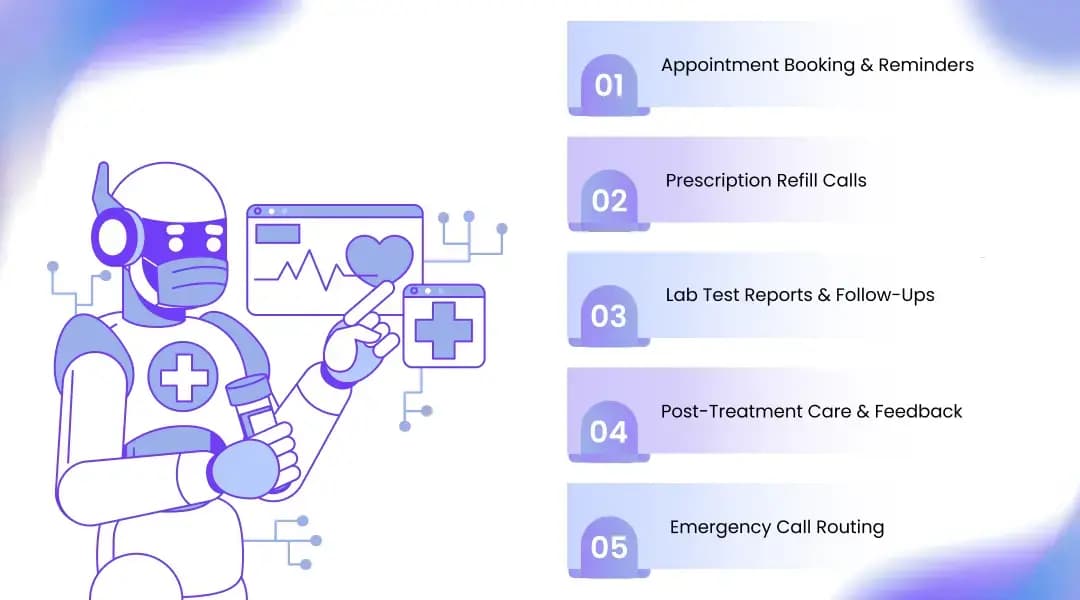
This is where theory meets reality.
Appointment Booking & Reminders
Missed appointments cost hospitals millions. Patients forget. Life happens.
AI voice agents:
Call patients proactively
Confirm, reschedule, or cancel appointments
Update the system automatically
Result? Fewer no-shows. Calmer front desks.
Prescription Refill Calls
A surprisingly common pain point.
Instead of tying up staff:
AI voice agents verify patient identity
Confirm refill eligibility
Notify pharmacies or flag exceptions
Efficient. Safe. Auditable.
Lab Test Reports & Follow-Ups
No, the AI doesn’t diagnose.
But it can:
Notify patients when reports are ready
Explain next steps
Schedule follow-up consultations
Patients feel informed - not abandoned.
Post-Treatment Care & Feedback
This one’s personal for me.
I’ve seen hospitals lose patients not because treatment failed, but because follow-up didn’t happen.
AI voice agents can:
Check recovery status
Capture feedback
Escalate red flags to human staff
That’s not automation. That’s care continuity.
Emergency Call Routing
When urgency is detected, AI steps aside.
Calls get routed instantly to humans, doctors, or emergency services.
The Role of AI Call Agents here isn’t replacement—it’s triage.
Benefits of AI Voice Agents for Hospitals & Clinics
Let’s talk about outcomes.
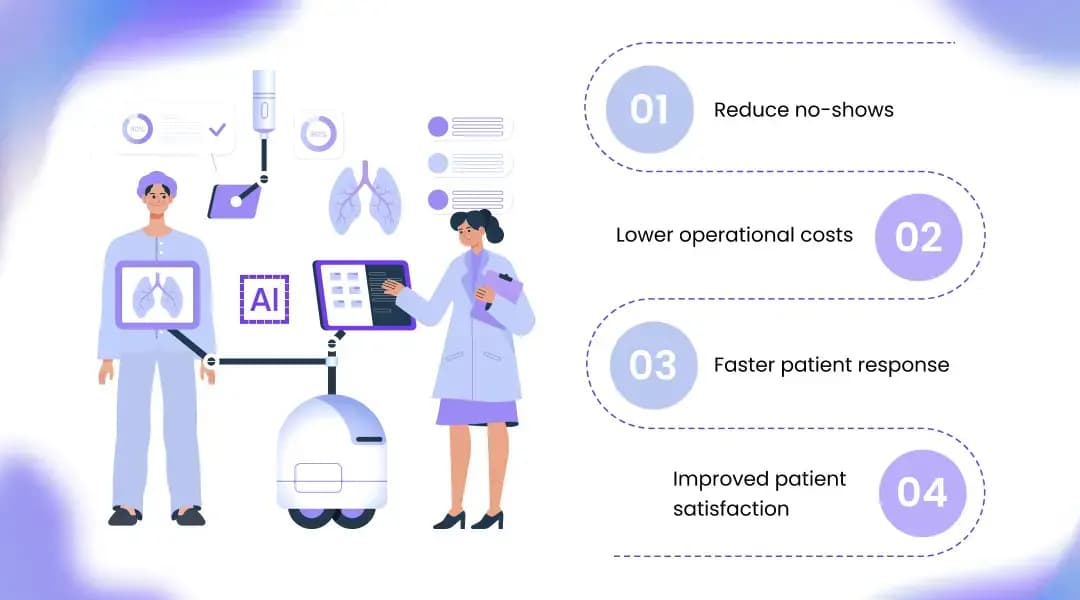
Reduce no-shows
Reminder calls. Easy rescheduling. Clear confirmations.
This alone often justifies the investment.
Lower operational costs
Fewer repetitive calls handled by humans. More focus on complex cases.
That’s how automation should work.
Faster patient response
Speed builds trust. Silence destroys it.
AI voice agents remove silence.
Improved patient satisfaction
Patients don’t care if it’s AI or human.
They care if it works.
AI Voice Agents vs Traditional Call Centers
Feature | AI Voice Agents | Human Call Centers |
Availability | 24/7 | Limited hours |
Cost | Low, predictable | High, variable |
Scalability | Instant | Slow |
Consistency | Always on-script | Depends on training |
This isn’t about eliminating humans.
It’s about letting humans do what humans do best.
Data Privacy, Security & Compliance in Healthcare AI
This is where skepticism is healthy.
Good AI voice platforms:
Encrypt voice data
Limit access strictly
Store nothing unnecessarily
Compliance matters. HIPAA matters. Local healthcare regulations matter.
A credible partner, like a Best AI Development Company, will show you how data flows, not dodge the question.
Transparency isn’t optional in healthcare AI. It’s the baseline.
Future of AI Voice Agents in Healthcare Communication
This is where things get quietly exciting.
Predictive patient engagement
AI that knows when a patient is likely to miss an appointment and calls before it happens.
Multilingual voice agents
Healthcare is local. Language matters.
Voice agents that speak regional languages aren’t a bonus. They’re essential.
Emotional intelligence in AI calls
Tone detection. Sentiment awareness. Escalation when distress is detected.
Not perfect. But improving fast.
Conclusion
AI voice agents won’t replace doctors. They won’t replace nurses. They won’t replace empathy.
What they replace is friction.
And in healthcare, friction costs trust. Time. Sometimes lives.
If you’re exploring Voice Assistant technology for healthcare, don’t ask: “Can AI do this?”
Ask: “Where are patients falling through the cracks and why?”
That’s where AI voice agents earn their keep.