Missed appointments cost the U.S. healthcare system over $150 billion every year, with each empty slot representing roughly $200 in lost revenue, according to data cited by SolutionReach and Dialog Health. If that number surprises you, you're not alone. Most practice managers I've spoken with underestimate their no-show losses by 40% or more, simply because nobody tracks the gap between scheduled and completed visits with any rigor. At OnDial, we've spent years building AI voice technology that solves exactly this problem: the silent, compounding revenue drain that happens every time a patient forgets, gets confused, or just can't be bothered to call and cancel.
AI voice agents for healthcare are intelligent conversational systems that call patients before appointments, confirm attendance in natural two-way dialogue, reschedule instantly when needed, and fill cancelled slots from waitlists. They work around the clock without adding a headcount. In this article, I'll walk you through exactly how this technology works, what the real-world numbers look like, and how your practice can stop losing revenue to no-shows starting this quarter.
The True Cost of Healthcare No-Shows in 2026
It Is More Than Just an Empty Chair
Every missed appointment triggers a chain reaction that extends far beyond one unfilled slot. The provider's time goes to waste. The support staff who prepped for that visit accomplished nothing productive. And the patient whose condition quietly worsens because they didn't show up? That's a downstream cost nobody puts on the balance sheet.
Outpatient no-show rates hover between 23% and 33% depending on the specialty, according to MGMA data. Behavioral health and chronic disease management clinics sit at the worst end of that range consistently. A mid-sized practice with 200 weekly appointments and an 18% no-show rate loses roughly 36 visits per week. At $200 per appointment, that's $7,200 weekly, or over $374,000 annually.
The Hidden Operational Drag
Here's what rarely gets discussed: no-shows don't just cost revenue. They cost morale. Front desk staff at organizations like El Rio Health in Tucson were spending 20 hours per week making manual reminder calls before switching to automation. That's half a full-time employee dedicated entirely to phone calls that patients often ignore. An MGMA poll from early 2025 found that 42% of medical group leaders now charge a no-show fee, yet only 25% of those practices reported meaningful improvement. Fees punish patients. They don't prevent the problem.
What Are AI Voice Agents for Healthcare?
Beyond the "Press 1 to Confirm" Era
An AI voice agent is a conversational AI system that interacts with patients through natural spoken language over the phone. It is not the robotic IVR menu your patients have learned to hate. Modern voice agents use natural language understanding (NLU) and large language models to interpret patient speech in real time, understand intent, and respond with human-like fluency.
When a patient says, "I can't make Thursday, can we do next week instead?" the agent doesn't freeze. It checks open slots, offers alternatives, and locks in a new time within the same call. No callback required. No front-desk involvement.
The Technology Stack Behind the Conversation
At OnDial, we build voice AI solutions on a stack that includes three core components. First, automatic speech recognition (ASR) converts patient speech into text using models trained on actual clinical language, not generic voice samples. Second, natural language understanding reads intent, not just words. Third, text-to-speech synthesis delivers responses in natural, empathetic tones that patients actually respond to.
The best platforms today deliver speech recognition accuracy above 95% for medical terminology, support 20+ languages, and respond with latency under 400 milliseconds. That's fast enough that the conversation feels genuinely human.
How AI Voice Agents Reduce No-Shows: The Mechanics
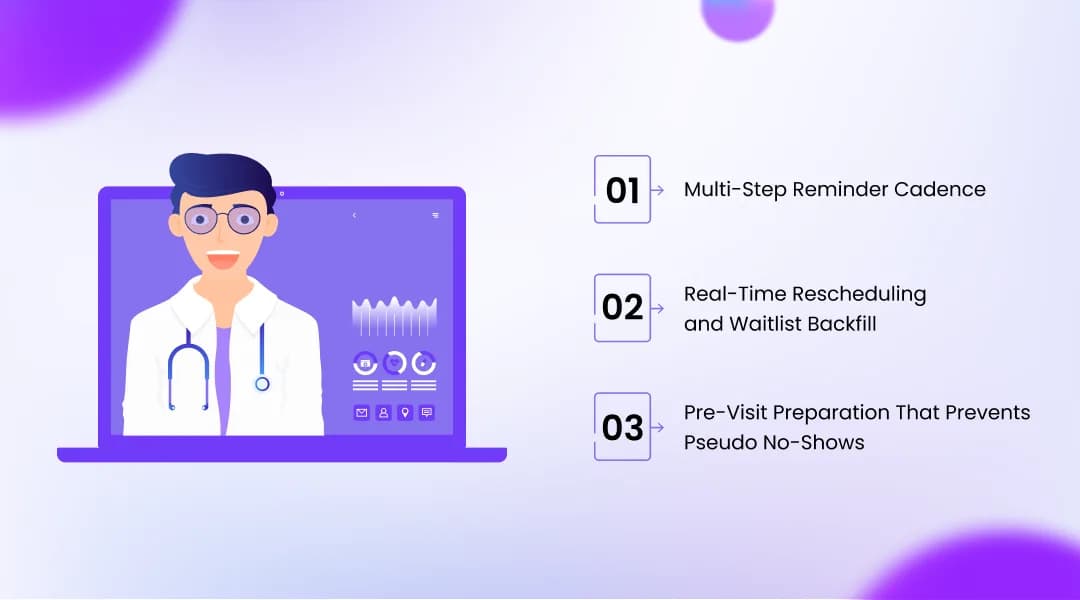
Multi-Step Reminder Cadence
The single biggest factor in no-show reduction isn't the technology itself. It's timing. AI voice agents reach out at strategic intervals: 72 hours, 24 hours, and 2 hours before the appointment. Each touchpoint serves a different purpose. The early call captures reschedules. The day-before call confirms commitment. The same-day call catches last-minute issues.
This multi-step cadence simply doesn't scale with human staff. A clinic with 200 weekly appointments would need to make 600 reminder calls per week across three intervals. That's a full-time job, and it's the kind of repetitive task where human performance degrades fast.
Real-Time Rescheduling and Waitlist Backfill
When a patient cancels during a reminder call, the voice agent doesn't just log the cancellation and move on. It immediately reaches out to waitlisted patients to fill the now-open slot. This is where the revenue recovery really compounds. A cancellation four hours before an appointment is only a problem if the slot stays empty. Automated waitlist outreach fills most of these gaps without any staff intervention.
Have you ever wondered how many of your cancellations could have been saved if someone had just called the waitlist in time?
Pre-Visit Preparation That Prevents Pseudo No-Shows
Some no-shows aren't really no-shows by choice. Patients arrive unprepared: fasting requirements missed, required documents forgotten, insurance cards left at home. The appointment gets cancelled or significantly shortened. The revenue impact is nearly identical to a true no-show.
Voice agents solve this by delivering pre-visit instructions during the reminder call, walking patients through everything they need in their preferred language. For practices in diverse metro areas with 15-25% non-native speakers, this capability alone can measurably reduce confusion-driven cancellations.
Real Revenue Recovery: What the Data Actually Shows
Case Studies Worth Paying Attention To
I'm cautious about throwing around case studies. Too many vendors cherry-pick their best outcomes and present them as typical. But the peer-reviewed evidence here is genuinely compelling.
A study published analyzing data from the UAE Primary Health Care Network across 135,393 appointments found that AI-driven reminder calls reduced the no-show rate from 20.82% to 10.25%, a 50.7% relative reduction. That's not a pilot. That's statistical significance across a massive dataset.
In the U.S., Memorial Hospital at Gulfport achieved nearly $804,000 in additional revenue in just seven months after reducing no-shows by 28%, translating to over $1 million annually, as reported by Health Catalyst. El Rio Health recovered $100,000 per month with a 32% no-show reduction while cutting staff time on manual outreach by 40%.
The ROI Math Is Hard to Argue With
Let me make this concrete. At a cost of roughly $0.05 per minute for AI voice calls, 1,000 reminder minutes runs about $50. If one recovered appointment is worth $200, that's a 20:1 return on investment on the conservative end. I've personally seen practices achieve ROI within their first billing cycle at OnDial, because the cost of the technology is so dramatically lower than the revenue it recovers.
The market reflects this confidence. Grand View Research valued the AI voice agents in healthcare market at $468 million in 2024, projecting it to reach $3.17 billion by 2030 at a 37.79% CAGR.
Why SMS Reminders Alone Are Not Enough
The Engagement Gap
If you're thinking, "We already send text reminders," I hear you. And I need to be direct: SMS reminders are better than nothing, but they're not solving the problem.
Text messages reach many recipients, but they operate in one direction. A patient who receives "Reminder: Appointment Thursday 2pm. Reply C to confirm" might glance at it and forget. Or they might want to reschedule but not want to deal with a phone menu during their workday. The friction of rescheduling feels higher than simply not showing up. Research shows that while 67.3% of patients prefer text reminders overall, voice reminders outperform SMS for complex scheduling situations where rescheduling is needed.
Voice Creates Commitment, Not Just Awareness
The difference between a text reminder and a voice conversation is the difference between awareness and commitment. When a patient verbally confirms "Yes, I'll be there" to a natural-sounding voice agent, something psychological shifts. They've made a spoken commitment. Classic IVR "press 1 to confirm" systems get response rates below 25%. A conversational voice agent that actually listens and reschedules on the spot combines the scalability of SMS with the commitment power of a personal call.
One sentence that should change how you think about this: the problem was never that patients didn't get the reminder; the problem was that the reminder couldn't respond when the patient said "actually, can we move it?"
HIPAA Compliance and Patient Trust
Non-Negotiable Security Standards
Any AI voice system handling patient information must meet HIPAA compliance requirements. This isn't optional, and it's not something you can bolt on after deployment. At OnDial, we believe in transparency and partnership, which means we walk every client through exactly how their data flows, where it's stored, and who has access.
Key compliance elements include encrypted communication channels, signed Business Associate Agreements (BAAs), role-based access controls, and comprehensive audit logs. Verify that your vendor holds current SOC 2 or HITRUST certifications and can provide recent third-party security audit documentation.
Building Patient Trust With Empathetic Design
Here's a limitation worth acknowledging openly: some patients will be skeptical. Prior experiences with spam calls, robocalls, and clunky chatbots have trained people to hang up on anything that sounds automated. The solution isn't to hide the fact that it's AI. It's to make the AI so conversationally competent, so respectful of the patient's time, that the experience feels like a genuine service rather than an interruption.
Modern voice agents can detect emotional cues from tone of voice and adjust their responses accordingly. If a patient sounds stressed, the agent shifts to a calmer cadence. If a patient asks a question outside its scope, it escalates to a human clinician with full conversation context so the patient doesn't have to repeat themselves.
How to Implement AI Voice Agents in Your Practice
Start With Your Biggest Revenue Leak
Don't try to automate everything on day one. Identify the appointment types with your highest no-show rates, typically behavioral health, follow-up visits, and specialty consultations, and start there. Measure your current baseline no-show rate, average appointment value, and staff hours spent on manual reminders. These numbers become your ROI scorecard.
At OnDial, I've seen the most successful implementations follow a three-phase approach. Phase one: deploy appointment reminders and confirmations for your highest-volume, highest-no-show service lines. Phase two: add real-time rescheduling and waitlist backfill. Phase three: expand to pre-visit preparation, post-visit follow-up, and billing support.
Integration Is Everything
A voice agent that can't read from or write to your electronic health record (EHR) is creating a data silo, not solving a workflow problem. Ensure your platform offers pre-built connectors or APIs for major healthcare systems like Epic, Cerner, and Athenahealth. The agent should update appointment status in your scheduling software in real time, without requiring staff to manually reconcile records afterward.
Train your front-desk team on the system. Not because they'll be operating it daily, but because they need to trust it. Show them the call transcripts. Let them hear the voice. When staff understand that the AI is handling the calls they didn't want to make anyway, adoption happens naturally.
Conclusion
AI voice agents for healthcare are not a future possibility. They're a present-tense operational tool that practices are using right now to recover hundreds of thousands of dollars in lost revenue annually. The three takeaways that matter most: no-shows are a solvable problem, not an inevitable cost of doing business; conversational voice AI outperforms every other reminder channel for confirmation and rescheduling; and the ROI is measurable within your first quarter of deployment.
You don't need to overhaul your entire tech stack to start. You need one high-no-show appointment type, a baseline measurement, and a voice AI partner who understands healthcare from the inside out. At OnDial, we build tailored, human-centric voice AI solutions designed specifically for challenges like this. If your practice is ready to stop losing revenue to empty chairs, talk to our team at ondial.ai and let's map your no-show recovery plan together.
Healthcare practices using AI voice agents recover lost revenue, reduce staff burden, and improve patient outcomes by turning missed appointments into confirmed visits through intelligent, two-way phone conversations.