Insurance operations depend heavily on conversations. Policyholders call to report incidents, check claim status, understand coverage, update personal information, confirm payments, and ask what happens next.
The challenge is that many of these conversations are repetitive but still require accurate information. A customer may need an immediate answer, while the insurer's team is simultaneously handling hundreds of other calls.
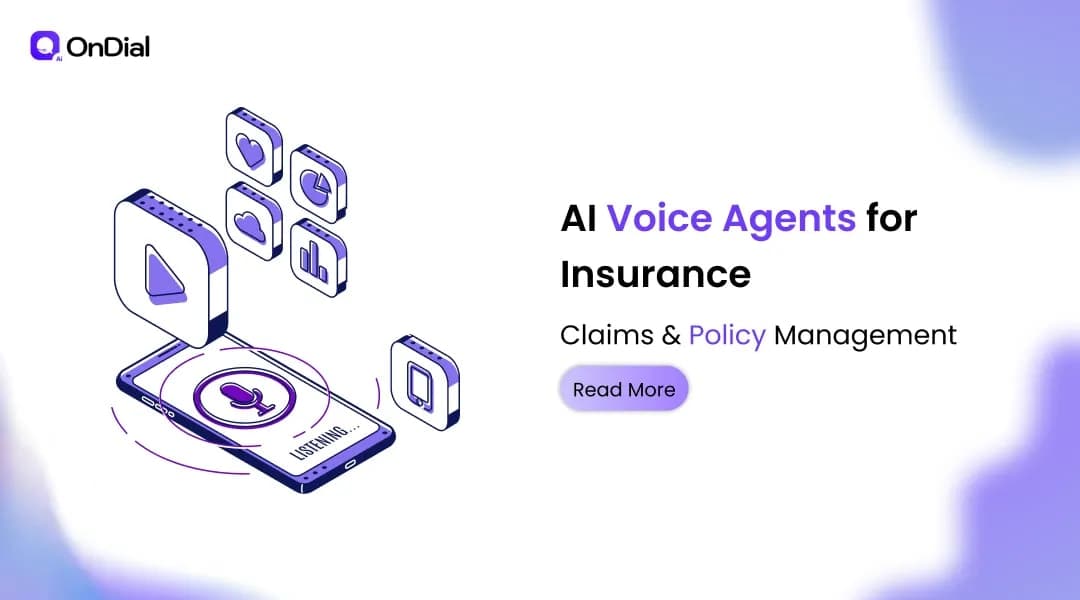
This is where AI voice agents for insurance can become part of the operational workflow. Instead of acting as a simple phone answering system, an AI voice agent can understand spoken requests, retrieve approved information, collect structured details, trigger workflows, update systems, and transfer complex situations to a human.
For insurers, brokers, TPAs, and insurance service teams, the objective should not be to automate every conversation. The better approach is to automate predictable interactions while preserving human involvement where judgment, empathy, investigation, or authorization is required.
What Are AI Voice Agents for Insurance?
An AI voice agent for insurance is a conversational system that handles inbound or outbound phone conversations using speech recognition, language understanding, workflow logic, and connections to business systems.
A traditional IVR generally asks callers to select numbered options. An AI voice agent can understand a request such as, "I submitted my motor insurance claim last week and want to know what is happening."
The system can identify the intent, verify the caller according to the configured process, retrieve relevant claim information, provide an approved response, and record the interaction.
For insurance organizations, that difference is important because many customer interactions follow recognizable workflows.
Common examples include:
First Notice of Loss intake
Claim status requests
Policy status questions
Coverage information
Premium and payment reminders
Renewal conversations
Document collection
Appointment or callback scheduling
Policy information updates
Customer feedback calls
Follow up after claim submission
The right use case is not simply the one with the highest call volume. It is the one where the conversation is sufficiently structured to automate safely.
How AI Voice Agents Improve Insurance Claims Processing
Claims are one of the strongest use cases for conversational voice automation because the process contains several structured communication steps.
A policyholder may need to report an incident, provide information, confirm documentation, ask about status, or understand the next step. Each interaction can create additional work when information is manually collected and transferred between systems.
Automating First Notice of Loss
First Notice of Loss, commonly called FNOL, is the initial report of an insured event.
An AI voice agent can guide a policyholder through the initial conversation by collecting information such as:
Type of incident
Date and approximate time
Location
Policy information
Description of the event
Vehicle or property details
Supporting document information
Police report details where applicable
Preferred follow up method
The important part is structured collection.
Instead of an agent listening to a conversation and later entering information into another system, the workflow can capture defined fields during the call and pass them to the appropriate system.
The AI should not independently make coverage or liability decisions unless the insurer has specifically designed and authorized that workflow. Those decisions can require policy interpretation, investigation, professional judgment, or regulatory oversight.
Automating Claim Status Calls
Claim status calls can consume significant contact center capacity because customers often want a simple update.
An AI voice agent can authenticate the caller, retrieve the approved claim status, explain the next step, and identify whether additional information is required.
If the request becomes complicated, the conversation can be transferred to an employee with the relevant context instead of forcing the customer to start again.
For a deeper look at claims automation, AI Voice Agent Insurance Claims: How 68% Got Resolved Without a Human provides a more detailed discussion of FNOL workflows, resolution boundaries, integrations, and human escalation.
Policy Management Through Conversational AI
Claims are only one part of insurance operations. Policy servicing generates a large volume of customer conversations throughout the policy lifecycle.
Policyholders may call about premiums, coverage, renewals, payment confirmation, changes to their information, or documentation.
An AI voice agent can handle approved policy servicing workflows by retrieving information from connected systems and following predefined business rules.
Policy Information and Coverage Questions
Customers often need straightforward explanations about their policy.
The AI can identify what the customer is asking and retrieve the relevant information from the connected policy system or approved knowledge source.
The response should remain within the information and permissions defined by the insurer. If the question requires interpretation or a decision outside those boundaries, the agent can escalate.
Premium and Payment Reminders
Insurance organizations can also use outbound AI voice agents for payment reminders and renewal communication.
The agent can explain the reason for the call, confirm the customer's identity, provide approved payment information, capture the customer's response, and trigger the appropriate next action.
This is especially useful when the same communication needs to reach a large number of policyholders within a defined period.
Renewal Conversations
Renewal is another workflow where voice automation can support insurance teams.
An AI agent can contact eligible policyholders, explain renewal information, answer approved questions, identify objections, and record whether the customer intends to renew, needs additional information, or wants human assistance.
For organizations focused specifically on renewal operations, How an Insurance Company Automated 85% of Policy Renewal Calls Using AI Voice Agents explores the workflow in greater detail.
Where Human Agents Still Matter
A strong insurance AI strategy should define what the AI should not handle.
Complex claims, disputed coverage, suspected fraud, vulnerable customers, emotionally difficult situations, complaints requiring management intervention, and decisions requiring professional authorization may need human involvement.
The AI should therefore be designed around escalation rather than forced automation.
A useful workflow looks like this:
AI identifies the customer's intent.
AI verifies the information required for the workflow.
AI completes the approved automated steps.
AI recognizes when the request exceeds its authority.
AI transfers the conversation with relevant context.
The human agent continues without making the customer repeat everything.
This hybrid model makes automation more practical because the objective is not to eliminate human involvement. The objective is to reserve human capacity for interactions where it creates the most value.
Connecting AI Voice Agents to Insurance Systems
Voice automation becomes significantly more useful when the agent can work with the systems already used by an insurance organization.
Without system integration, an AI voice agent may only answer questions or collect information. With integration, it can participate in actual workflows.
Typical connections can include:
Customer relationship management systems
Policy administration systems
Claims management platforms
Contact center software
Payment systems
Knowledge bases
Document management platforms
Scheduling systems
Analytics platforms
For example, a policyholder might call about an existing claim.
The AI identifies the caller, retrieves the appropriate record, checks the current status, explains the available information, records the conversation outcome, and triggers a follow up if necessary.
The conversation becomes part of the business process rather than an isolated phone interaction.
For organizations planning this architecture, AI CRM Integration That Writes Every Call Into Your CRM, Automatically explains how voice conversations can be connected with systems such as Salesforce, HubSpot, Zoho, and Microsoft Dynamics.
Compliance and Security Considerations
Insurance organizations handle sensitive customer and financial information, so voice automation should be introduced with clear security and governance controls.
Before deployment, teams should define:
Identity verification
The system should establish that the caller is authorized to access the information being requested before disclosing protected policy or claim details.
Access controls
The AI should only access the data and actions required for its assigned workflow.
Consent and disclosure
Calling and recording requirements can differ by jurisdiction. The organization should configure appropriate disclosures, consent handling, and contact rules before launching a voice workflow.
Auditability
Calls, actions, escalations, and system updates should be traceable so operational teams can review what happened during an interaction.
Human escalation
Customers should have a clear path to human assistance when the automated workflow cannot appropriately resolve the request.
These controls are particularly important for insurers operating across multiple regions because regulatory requirements and customer expectations can vary between markets.
AI Voice Agents for Insurance in India
India presents an additional consideration for insurance voice automation: language diversity.
Insurance providers may communicate with customers across metropolitan areas, smaller cities, and rural markets where customers have different language preferences.
A voice based experience can help insurers serve customers through natural spoken conversations rather than requiring every interaction to happen through English language digital interfaces.
AI voice agents can support multilingual workflows where configured appropriately, including conversations involving regional languages and code switching.
For Indian insurers, deployment should also consider local calling requirements, consent, data protection, customer disclosure, and the organization's existing compliance processes.
The goal is not simply to make the AI speak another language. The complete workflow should remain consistent across languages, including identity verification, policy information, escalation, and record keeping.
Measuring the Success of Insurance Voice Automation
Automation should be measured against business outcomes rather than the number of calls handled by AI.
Useful metrics include:
First call resolution
How many eligible customer requests are resolved during the first interaction without unnecessary escalation?
Automation rate
What percentage of eligible conversations are completed without human intervention?
Transfer rate
How frequently does the AI need to transfer customers to human agents?
A high transfer rate may indicate poor workflow selection, insufficient system access, or inadequate conversation design.
Average handling time
Measure whether automated workflows reduce the time required to complete routine interactions.
Data completeness
Check whether the information collected during calls is complete and usable by downstream teams.
Customer satisfaction
Automation should improve the customer experience, not simply reduce staffing requirements.
Escalation quality
When a human takes over, measure whether the receiving agent has enough context to continue the conversation without asking the customer to repeat the issue.
These metrics provide a more realistic picture of whether voice automation is improving the insurance operation.
A Practical Implementation Framework
Insurance organizations do not need to automate every phone workflow at once.
A better starting point is to select one high volume, structured process.
For example, an insurer could begin with claim status calls.
First, map the existing conversation and identify the information customers request most often. Then define the data the AI needs, the actions it is allowed to perform, the situations that require escalation, and the compliance requirements.
Next, connect the required systems and test the workflow using real conversation patterns.
After launch, review transcripts, transfer reasons, customer feedback, and failed interactions. Use those findings to improve the workflow before expanding into another use case.
This creates a controlled path from one automated process to a broader insurance voice automation strategy.
The Future of Insurance Customer Communication
Insurance will continue to depend on human judgment, but that does not mean every customer interaction needs to be handled manually.
AI voice agents can take responsibility for structured conversations while human teams focus on complex decisions, investigations, exceptions, complaints, and relationship driven interactions.
The strongest implementations will not treat voice AI as a replacement for the contact center. They will treat it as an additional operational layer connecting customers, employees, and insurance systems.
For insurers, the opportunity is straightforward: make routine communication faster, make information capture more consistent, and give human teams more time for work that actually requires human expertise.
OnDial provides AI voice automation for inbound and outbound business conversations, with workflows designed around customer communication, system integration, and human escalation.