I’ve walked into too many BPO floors that sound like controlled chaos.
Phones ringing. Agents apologizing. Supervisors firefighting. Dashboards glowing red.
And somewhere in the middle of all that noise sits a leadership team being told the same thing every quarter: reduce costs, improve service, scale faster.
That triangle doesn’t close easily.
For years, the answer was simple. Hire more people. Train harder. Optimize scripts. Repeat. But AI voice agents for BPO changed the equation in a way most executives still underestimate. Not because the technology is flashy. Because it quietly fixes structural problems humans were never meant to carry alone.
Here’s the part nobody says out loud: BPO isn’t failing because teams are bad. It’s failing because the system is overloaded.
Let me show you what changes when intelligent voice AI enters the room.
What Are Intelligent AI Voice Agents?
An intelligent AI voice agent isn’t a glorified IVR menu.
And it’s definitely not a chatbot with a microphone.
It’s software that understands speech, intent, context, and emotion well enough to hold a real conversation. Not a scripted loop. A conversation.
When I design conversational AI for BPO, the goal isn’t imitation. It’s performance. These AI voice assistants for business are trained on real customer calls, operational data, and workflows. They learn patterns. They execute tasks. They escalate intelligently.
Traditional IVR says: “Press 1. Press 2. Press 3.”
Voice AI for customer service says: “Tell me what you need.”
And then it actually understands.
That difference alone removes friction from millions of interactions. AI customer service automation doesn’t trap callers inside menus. It routes intent instantly. Which is why automated call center AI feels less like a machine and more like a competent operator.
Unexpected question for you: how much revenue disappears every year because customers hang up before reaching a human?
Most companies never calculate it. They should.
Challenges in Traditional BPO Operations
I don’t romanticize human call centers. I respect them. But I’ve also seen their limits.
High labor costs
BPO economics are brutally simple. Headcount equals expense. Scaling means hiring. Hiring means training. Training means attrition risk. The cycle never ends.
AI automation in BPO breaks that dependency. Not by eliminating people. By removing volume pressure.
Agent burnout
After your 200th angry call in a shift, empathy becomes a performance.
Burnout isn’t a character flaw. It’s math. Humans weren’t built for endless repetition under emotional stress. Speech AI for customer experience absorbs the repetitive, emotionally draining interactions first. That protects your best agents for complex cases.
Inconsistent service
Even great teams fluctuate. Fatigue, mood, experience level. All variables.
AI virtual agents for enterprises don’t fluctuate. They deliver consistent responses across every shift, every region, every spike.
Scalability issues
A product launch. A billing error. A viral complaint. Suddenly call volume triples.
Human scaling takes weeks. AI inbound call automation scales in seconds.
That gap is where customer trust gets lost.
How AI Voice Agents Transform BPO Workflows
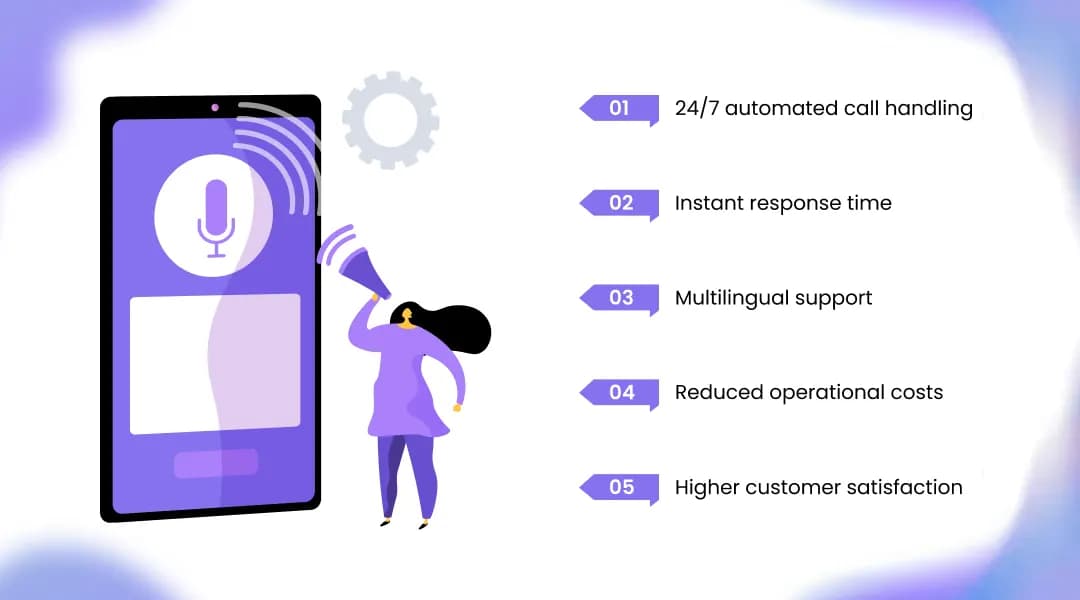
This is where theory becomes operational reality.
24/7 automated call handling
No night shifts. No skeleton crews. No overflow panic.
24/7 AI call handling absorbs volume continuously. Your queue stops being a bottleneck.
Instant response time
Customers don’t wait. AI answers immediately. Even during peak spikes. Call center productivity with AI isn’t about speed alone; it’s about removing waiting as a customer experience factor.
Waiting is friction. Friction is churn.
Multilingual support
Hiring native speakers for every region is expensive. Voice AI customer support software speaks dozens of languages instantly. Global expansion stops being a staffing nightmare.
Reduced operational costs
Let’s say it plainly: reduce BPO operational costs with AI isn’t marketing. It’s arithmetic.
Every automated resolution saves agent minutes. Minutes compound into hours. Hours compound into payroll shifts.
Higher customer satisfaction
People assume customers hate machines.
They don’t.
They hate slow service.
When conversational AI for BPO resolves issues in seconds, satisfaction scores climb. Not because customers love AI. Because it respects their time.
Real Business Benefits of AI Voice in Call Centers
I’ve seen organizations double capacity without doubling staff. That’s not fantasy. That’s architecture.
Cost savings
AI-powered BPO operations trim repetitive workload first. Billing inquiries. Appointment confirmations. Status checks. High-frequency interactions move to AI outbound call agents and inbound automation.
Humans stay focused on value.
Faster resolution
No transfers. No internal routing maze. AI call center solutions pull data instantly and act. The first contact resolution rate jumps.
Increased productivity
When agents aren’t drowning in basic requests, performance changes. They become specialists instead of operators.
(And morale improves. Quietly. Significantly.)
Scalable infrastructure
Scalable AI call center solutions expand without recruitment waves. Infrastructure grows digitally, not physically.
Data-driven insights
Every AI conversation produces structured data. Trends emerge. Complaints cluster. Opportunities reveal themselves. Most BPOs sit on gold mines of conversational data and never mine it.
AI does.
AI Voice Agents vs Human Agents: Collaboration, Not Replacement
Let me be blunt.
AI replacing human call agents is a lazy headline.
The real model is hybrid. AI handles predictable volume. Humans handle judgment-heavy interactions. The Role of AI Call Agents is support, not domination.
Think of AI Call Assistants as force multipliers.
Your best agents become elite problem solvers. AI becomes the front-line filter. Customers reach humans faster when complexity demands it.
That balance creates a workforce that’s smaller, sharper, and less exhausted.
And yes, companies that Hire AI Voice Agents early tend to outperform slower competitors. Not because they fire staff. Because they redeploy talent intelligently.
Industries Already Using AI Voice BPO Solutions
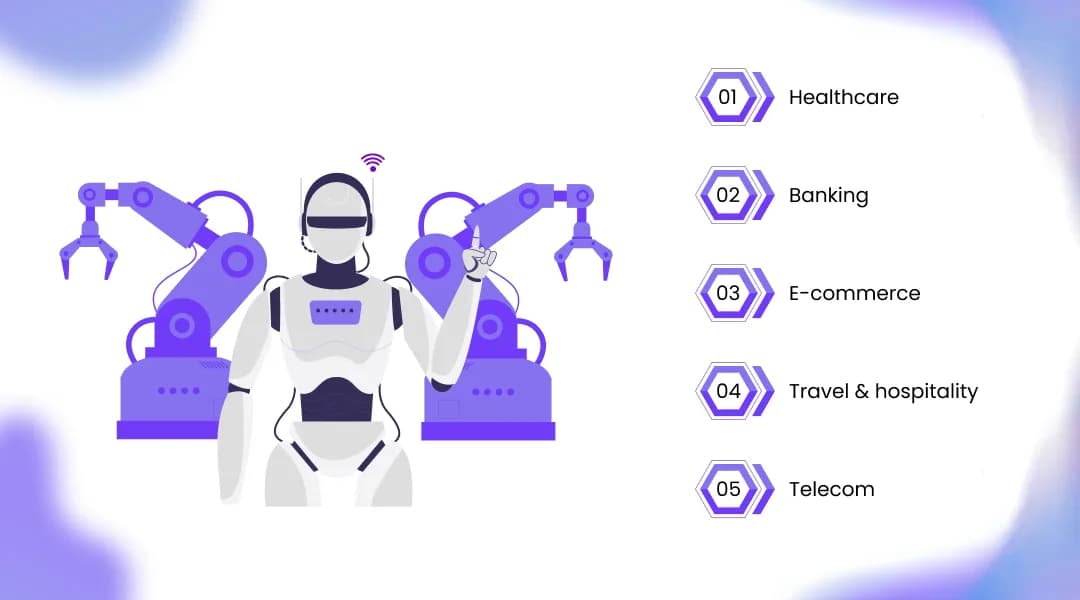
This isn’t experimental anymore.
Healthcare
Appointment scheduling. Insurance verification. Follow-ups. Voice AI removes administrative overload from medical staff.
Banking
Fraud alerts. Balance inquiries. Transaction confirmations. Security plus speed.
E-commerce
Order tracking. Returns. Delivery coordination. AI Phone Calls absorb seasonal surges effortlessly.
Travel & hospitality
Bookings. Changes. Cancellations. Multilingual Voice Assistant interactions improve global support.
Telecom
Billing issues. Plan upgrades. Service troubleshooting. High-volume industries feel the impact first.
The Best AI Voice Agent Platform isn’t defined by industry. It’s defined by adaptability.
Implementation Strategy for BPO Companies
Here’s where projects succeed or implode.
Step 1: Audit call data Identify high-frequency, low-complexity interactions. Start there.
Step 2: Define automation scope Don’t automate everything. Target precision.
Step 3: Pilot program Run a contained rollout. Measure resolution rates. Customer sentiment. Escalations.
Step 4: Human-AI workflow design Design handoffs. AI should escalate gracefully, not abruptly.
Step 5: Continuous learning AI improves through iteration. Static systems stagnate.
And choose your partner carefully. The Best AI Development Company isn’t the one promising magic. It’s the one asking uncomfortable operational questions.
Trust the team that wants to understand your mess.
Future of BPO: AI-Driven Intelligent Contact Centers
Five years from now, the future of BPO with AI won’t feel futuristic.
It’ll feel obvious.
Voice AI agents will handle the majority of Tier-1 interactions. Real-time sentiment detection will guide escalation before frustration peaks. AI outbound call agents will manage proactive service, not just reactive support.
The contact center becomes predictive instead of reactive.
That shift changes everything.
Personal moment here. I’ve watched executives resist automation for fear of losing “human touch.” Then I’ve watched customers praise systems that solved their problems in 12 seconds flat.
Speed is empathy.
We forget that.
Conclusion
BPO transformation isn’t about replacing people. It’s about redesigning pressure.
Intelligent voice AI for call centers redistributes workload, stabilizes service quality, and creates space for humans to do work that actually requires humanity.
If your operation still treats automation as optional, competitors are already rewriting the cost structure of customer support.
And customers notice the difference.
Quietly. Immediately. Permanently.