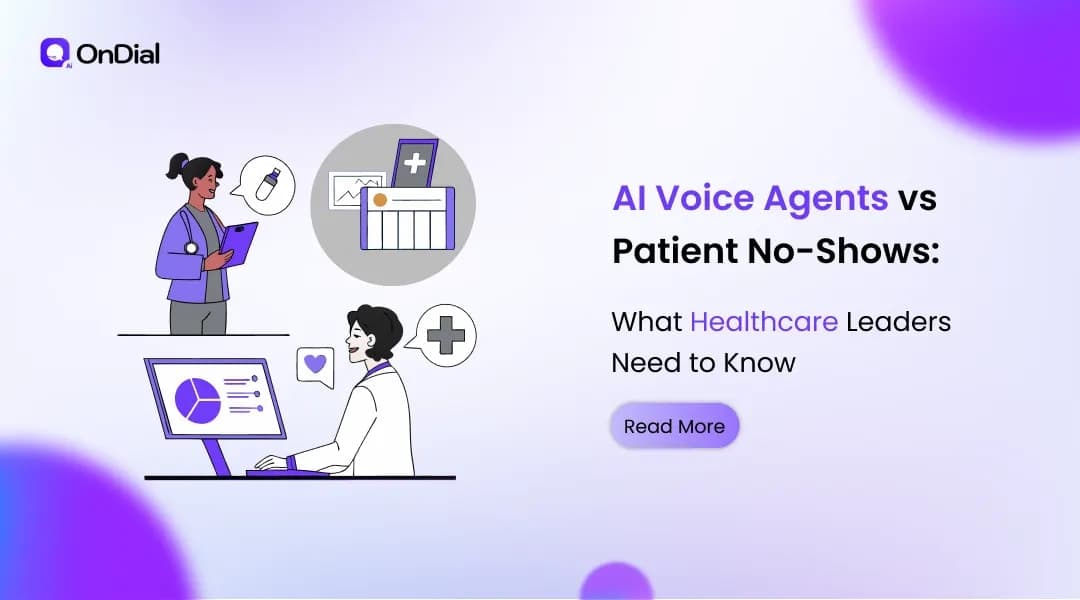
AI Voice Agents vs Patient No-Shows: What Healthcare Leaders Need to Know
Patient no-shows cost the U.S. healthcare system an estimated $150 billion every year. That number comes from aggregate industry data reported across multiple healthcare research organizations, and it has barely budged in a decade despite text reminders, patient portals, and email campaigns. If you run a healthcare practice, you already feel this. Every empty chair is lost revenue, wasted staff time, and a patient whose care just got delayed.
AI voice agents for patient no-shows represent a fundamentally different approach to this problem. An AI voice agent is a conversational AI system that calls patients, speaks naturally, understands responses, and takes action: confirming, rescheduling, or filling canceled slots in real time. Unlike static text blasts, these systems adapt to each patient. And for healthcare leaders weighing whether this technology is proven enough to invest in, the evidence is getting hard to ignore.
Here is what you will learn: why traditional reminder methods are failing, how AI voice agents work differently, what the data shows about their impact, and what you should evaluate before choosing a platform.
The Real Cost of Patient No-Shows in Healthcare
Why No-Show Rates Keep Climbing
The average patient no-show rate across U.S. healthcare falls between 5% and 30%, depending on specialty, geography, and patient population. Some behavioral health and pediatric clinics report rates as high as 50%. That is not a rounding error. That is half of scheduled patients not walking through the door.
Several structural factors drive this. Appointments booked more than a month out are more than twice as likely to result in a cancellation without rescheduling, according to a study analyzing 4.2 million appointments. Patients forget, their symptoms resolve, or life simply gets in the way. And here is something that often gets overlooked: 40% of medical appointments are booked outside business hours, which means the confirmation call your front desk makes at 2 PM may never reach the patient who booked at 9 PM.
More than 50% of medical groups have reported that their no-show rates increased over recent years. The problem is not shrinking. It is compounding.
The Hidden Costs Beyond Revenue
Most leaders think of no-shows as a revenue problem, and it is: individual physicians lose an estimated $200 per unused time slot. But the operational damage goes deeper. Staff still prep rooms, pull charts, and block provider time. Those resources do not snap back when a patient fails to appear.
Then there is the clinical cost. A patient who misses a single primary care appointment is 70% more likely to not return within 18 months. That is not just a scheduling gap. That is a care gap. For chronic disease management, where consistent follow-up drives outcomes, every no-show can cascade into emergency visits and hospitalizations that cost the system far more than the missed appointment ever would.
(Here is the part that rarely makes it into vendor brochures: no-show costs are not evenly distributed. Safety-net clinics, community health centers, and practices serving lower-income populations bear the heaviest burden. Any solution worth adopting needs to work for those settings too.)
How AI Voice Agents Actually Reduce No-Shows
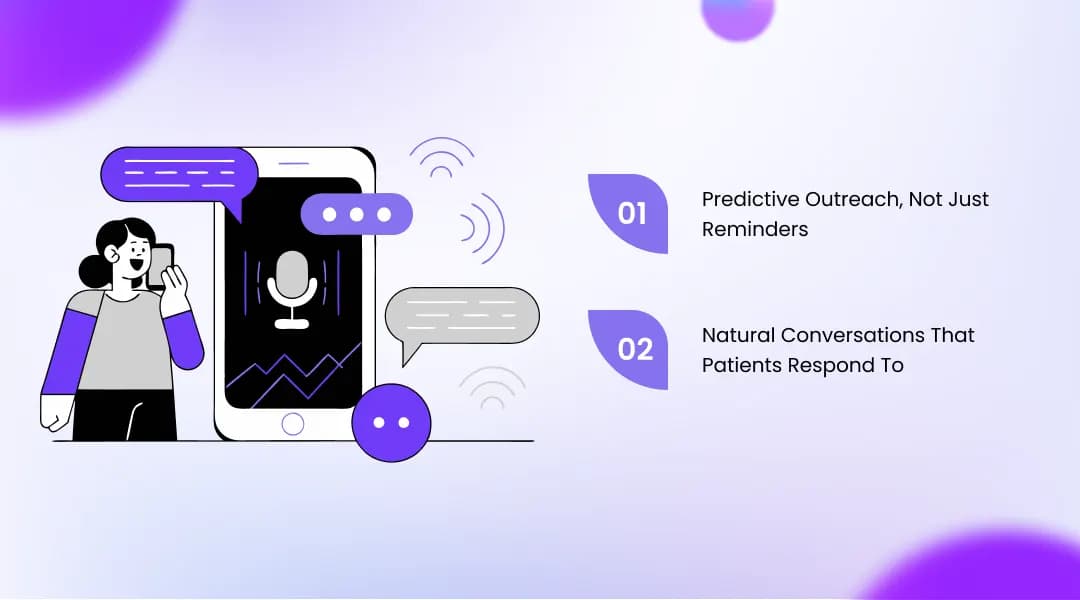
Predictive Outreach, Not Just Reminders
A standard text reminder says: "You have an appointment tomorrow at 3 PM. Reply C to confirm." That is a notification, not a conversation. It does not ask why a patient might be hesitant. It does not offer an alternative time. It does not fill the slot if someone cancels.
AI voice agents operate differently. These systems use Natural Language Processing and predictive analytics to identify which patients are most likely to miss their appointments based on historical patterns, appointment lead time, and demographic signals. High-risk patients receive enhanced engagement: multiple touchpoints at strategic intervals, delivered through the channel they actually respond to, whether that is a phone call, a text, or both.
An AI voice agent is a system that conducts natural spoken conversations with patients to confirm, reschedule, or cancel appointments without human intervention. That is a critical distinction from older IVR phone trees that route callers through rigid menus. Modern voice agents understand intent. "I need to move my Thursday appointment" and "Can I reschedule?" trigger the same workflow.
Natural Conversations That Patients Respond To
Have you ever ignored an automated text because it felt like spam? Your patients have too.
Voice AI systems trained on clinical vocabulary handle real patient conversations, not scripted prompts. They recognize drug names, procedure codes, and the natural way people describe their needs. When a patient says "I am not sure I can make it," the agent does not just log a cancellation. It asks about availability, offers the next open slot, and confirms the rescheduled visit before the call ends.
I have seen this shift firsthand at OnDial. When we build voice AI solutions for healthcare clients, the difference between a system that talks at patients and one that talks with them shows up immediately in engagement rates. The technology matters, but the conversational design matters more. A voice agent that sounds robotic will get the same response as a robotic text message: silence.
AI Appointment Reminders vs. Traditional Methods: What the Data Says
Where Manual Reminders Fall Short
Traditional reminder methods each carry specific limitations. Phone calls from staff are expensive and time-consuming: a front desk team making confirmation calls spends hours daily on a task that pulls them away from patients who are physically present. Text messages are cheaper but passive; they rely on the patient to act. Emails sit unread. Patient portals require logins that many patients, especially older adults, never complete.
The core problem? These methods are one-directional. They push information and hope for a response. They cannot adapt mid-conversation, offer alternatives, or act on what the patient says.
The Measurable Difference AI Makes
The data points are becoming consistent across multiple platforms and studies. Automated AI reminders have been shown to reduce no-show rates by up to 40%, with some healthcare systems reporting even higher reductions when predictive targeting is layered in. Health systems using voice AI agents have reported reductions of over 70% in staff time spent on phone-based workflows.
Let me be direct about what this means financially. If a practice with a 15% no-show rate and $200 average visit value sees 100 patients daily, that is roughly $3,000 lost per day, or over $780,000 annually. Cut the no-show rate by even a third and you recover more than $250,000 per year. That is not a projection. That is arithmetic.
Gartner projects that 80% of healthcare providers will invest in conversational AI technologies by 2026. The AI voice agent market in healthcare is growing at approximately 37.9% annually, according to Grand View Research. This is not experimental technology anymore. It is infrastructure.
What Healthcare Leaders Should Evaluate Before Adopting Voice AI
HIPAA Compliance and EHR Integration
This is non-negotiable, and it is where many evaluations should start rather than end. Any voice AI platform handling patient data must maintain HIPAA-compliant data handling: encrypted call recordings, access-controlled transcripts, audit trails for every interaction, and the ability to sign a Business Associate Agreement. If a vendor cannot produce a BAA immediately, remove them from your list.
HIPAA-compliant voice agents are AI systems that meet federal data privacy standards for handling protected health information during patient interactions. Beyond compliance, the system needs to integrate with your existing EHR. A voice agent that confirms an appointment but does not update the patient record creates more work, not less. Look for platforms that read and write directly to your scheduling system in real time.
At OnDial, we approach this with full transparency. We work with healthcare clients to map their existing EHR workflows before building anything. The AI should fit your process. You should not have to rebuild your process around the AI.
ROI Metrics That Matter
Do not get distracted by vanity metrics like "calls handled." The numbers that actually tell you whether voice AI is working include: no-show rate reduction (percentage change pre- and post-implementation), slot fill rate (how many canceled appointments get rebooked automatically), staff time recovered (hours per week redirected from phone work to patient care), and patient satisfaction scores (are patients rating the experience positively or complaining about robots?).
Should you build or buy? That depends on your scale. A single-location practice with 50 daily appointments has different needs than a multi-specialty group with 20 providers. But in both cases, the cost of doing nothing is measurable. Track your current no-show rate for 90 days, multiply by your average visit revenue, and you will have the number you need to justify a pilot.
One honest caveat: AI voice agents are not perfect. They struggle with heavy accents in some languages, edge cases no script anticipated, and patients who simply prefer talking to a human. The best implementations always include a clear escalation path to live staff. The goal is not to eliminate human contact. It is to make sure human attention goes where it is needed most.
Conclusion
AI voice agents and patient no-shows are no longer a theoretical match. The data is clear: practices that adopt conversational voice AI reduce missed appointments, recover revenue, and free their staff to focus on the patients who show up. Three takeaways matter most. First, the cost of inaction is measurable, and it compounds every month you wait. Second, the technology is now proven, HIPAA-compliant, and integrated with major EHR systems. Third, the difference between success and failure in implementation comes down to conversational quality and proper workflow integration, not just the technology itself.
At OnDial, we build AI voice solutions that are designed around how patients actually communicate, not how systems wish they would. If you are a healthcare leader evaluating whether voice AI can close your no-show gap, we would welcome the conversation. Visit ondial.ai to explore how our team approaches this problem with the transparency and partnership your practice deserves.
The practices that act on this data now will not just reduce no-shows. They will build a patient communication model that scales with them, without adding headcount, without burning out staff, and without leaving revenue on the table.