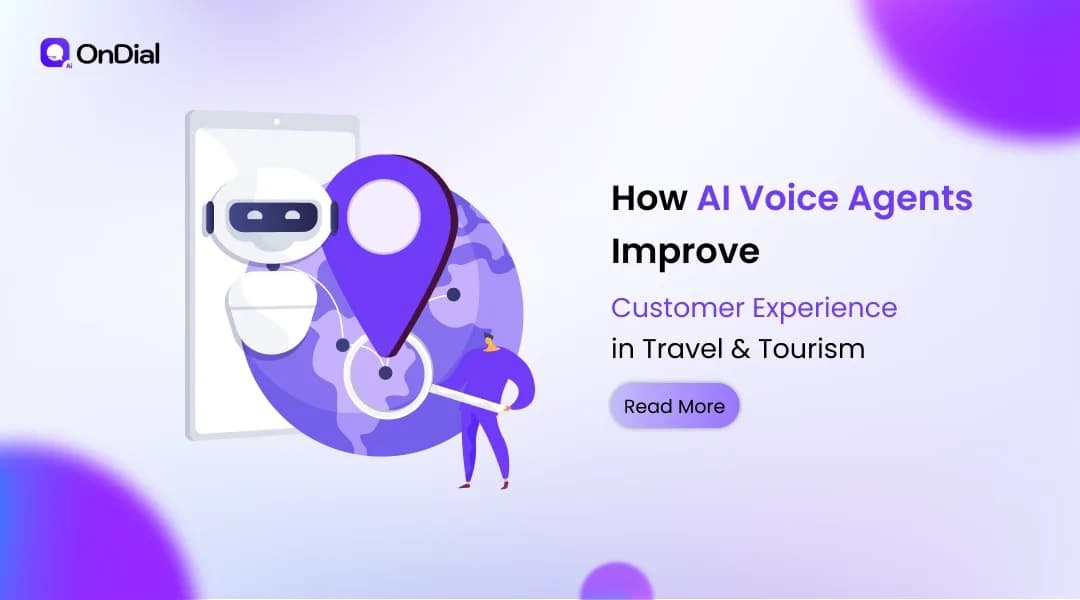
Voice AI now handles 19% of inbound contact center volume in 2026, up from 6% in 2024, according to Forrester Wave research, and travel is specifically named as one of the sectors lagging behind that curve because emotional handling and edge-case complexity remain hard. That gap is the opportunity. AI voice agents in travel improve customer experience by answering every inbound call instantly, resolving routine booking and status requests without hold time, detecting and speaking the traveler's language automatically, and calling travelers proactively when their plans break.
If you run a travel business, you have probably sat through several voice AI demos already, especially if you've looked into AI voice agents for travel and tourism built specifically for this industry. The polished ones all sound the same, and you are right to be sceptical, because a smooth demo call tells you almost nothing about how a system behaves at 2 am when a traveler is stranded and angry. I have built and deployed voice agents at OnDial for exactly those conditions, and the difference between a pleasant demo and a deployment that raises satisfaction scores is not the voice quality.
It is the design decisions nobody puts in the sales deck.
Here is what this article covers: where travel customer experience actually breaks, the four use cases that produce measurable improvement, the escalation architecture that determines whether travelers trust you, and a realistic first 90 days.
Why Travel Customer Experience Breaks at Exactly the Wrong Moment
Travel is unusual among service industries because demand for support is inversely correlated with your ability to supply it. Nothing goes wrong on a quiet Tuesday afternoon when your team is fully staffed, and the queue is empty. Everything goes wrong during a storm system, a schedule change, or a peak holiday weekend, and that is precisely when your phone lines collapse.
The Disruption Spike Nobody Staffs For
A disruption spike is a sudden surge in inbound call volume caused by cancellations, delays, or weather events affecting many travelers at once. No human staffing model can flex fast enough to absorb it, because the surge arrives in minutes and hiring takes weeks. Most operators respond by accepting long hold times and hoping the wave passes quickly.
The cost of that acceptance is measurable. Roughly 28% of customers placed on hold abandon the call within five minutes or less, and in travel, an abandoned call rarely means a resolved problem. It usually means a traveler rebooking through a competitor, filing a chargeback, or writing a review that thousands of future customers will read before they book.
What Travelers Actually Say When They Are Stuck
Read through forum threads about AI in travel and a consistent complaint surfaces: automated systems do not think alongside the customer. One travel agency put it bluntly in a public statement, arguing that booking platforms will not ask whether you booked the wrong airport or notice that your cruise departs from a different port than your hotel. That criticism is fair, and it is aimed at systems built to deflect rather than resolve.
The second recurring frustration is credibility. A widely mocked incident involving a Microsoft AI-generated travel guide that listed the Ottawa Food Bank as a top attraction did lasting damage to traveler confidence in automated recommendations. Travelers remember failures like that far longer than they remember a smooth interaction. Any voice deployment in this sector inherits that scepticism on day one.
How an AI Voice Agent for Travel Customer Service Changes the First Sixty Seconds
The most underrated improvement an AI voice agent for travel customer service delivers is not intelligence. It is arrival. The call gets picked up on the first ring, every time, at any hour, from any time zone, with no queue position announcement and no hold music.
Answering Calls You Never Knew You Were Missing
Most travel operators have no reliable picture of their true missed call volume. Abandoned calls, after-hours voicemails that nobody returns, and busy signals during peak periods do not show up cleanly in most reporting stacks. When we instrument call flows before deployment, the missed-contact number is almost always higher than the client expected.
So ask yourself directly: what percentage of the calls that hit your line after 8 pm ever get a human response?
For hotels and tour operators, those unanswered calls have an identifiable revenue cost, the same surge-season gap covered in how travel agencies use AI calling to handle seasonal booking surges. A guest who cannot reach the property directly returns to an online travel agency and completes the booking there, and the property pays commission on a reservation it could have taken itself.
Resolution Instead of Deflection
Deflection means pushing a customer away from a human channel. Resolution means completing the task the customer called about. The distinction matters enormously in travel because the routine requests are genuinely completable: booking status, baggage policy, check-in times, cancellation windows, itinerary confirmation, and payment links.
Doing this properly requires system access, not conversational skill. A voice agent that cannot read live inventory from Amadeus, Sabre, or Travelport, or write back to a property management system, is a well-spoken IVR. At least 61% of consumers say they would use conversational AI to assist with travel plans, according to National Research Group data, which tells you willingness is not the constraint. Capability is.
24/7 Multilingual Travel Support Without Hiring a Second Shift
Travel is the most linguistically diverse service category there is. A single boutique property in a tourist region may take calls in six languages during peak season, and hiring for that coverage across three shifts is economically impossible for most operators.
Language Detection Before the Guest Has to Ask
Modern voice agents detect the caller's language within the first few seconds and switch automatically, with no menu tree and no press-two-for-English step. This removes a small humiliation that international travelers experience constantly, which is having to navigate a system in a language they are still translating in their head. The experience improvement is disproportionate to the engineering effort.
The commercial case follows the experience case. Zendesk's 2026 CX Trends research found that 74% of consumers expect customer service to be available 24 hours a day and 88% expect faster response times than they did a year ago. Multilingual coverage at 3 am is not a premium feature in travel anymore. It is the expectation, which is exactly why so many operators are turning to the best AI voice agents for travel industry customer support to close that gap.
Where Multilingual Voice Still Struggles
I want to be honest about the limits here, because overselling this is how trust gets destroyed. Speech recognition performance degrades meaningfully with heavy regional dialects, code-switching mid-sentence, and background noise, and airport terminals are among the worst acoustic environments a voice agent will encounter. (I have watched a polished demo come apart on a single strong Glaswegian accent, so I treat accent claims carefully.)
The practical mitigation is not a better model claim from a vendor. It is a confidence threshold that triggers a human transfer when recognition quality drops below a set level, plus targeted testing against recordings of your actual caller base before launch. Any partner who will not run that test with you is selling you a demo.
Voice AI Flight Disruption Management and the Front Desk Phone
Two use cases produce the clearest experience gains in this sector. One is inbound and outbound handling during irregular operations. The other is the ordinary, unglamorous hotel front desk phone.
Proactive Outbound During Irregular Operations
Voice AI flight disruption management means using automated outbound calls to notify affected travelers of schedule changes and offer rebooking options before they call you. This inverts the entire experience. Instead of a stranded traveler fighting through a queue, the traveler receives a call that already knows their booking reference, their onward connection, and their options.
The operational effect is a flattened call spike. Every traveler reached proactively is a call that never enters your inbound queue, which shortens waits for the complex cases that genuinely need a human. In deployments I have worked on, this sequencing matters more than raw automation rate.
The Hotel Front Desk Problem
Hotel front desk staff are asked to do two incompatible jobs simultaneously: serve the guest standing in front of them and answer a ringing phone. Someone always loses. The phone usually loses during check-in rush, and the guest at the desk loses when the phone is prioritised.
An AI concierge for hotels and tour operators resolves this by taking the overflow rather than replacing the desk. It handles wake-up requests, WiFi questions, late checkout enquiries, restaurant hours, and reservation confirmations. Survey data from HotelTechReport indicates 58% of hospitality guests feel AI improves their booking and stay experiences, and the improvement travelers report is usually about speed rather than novelty.
The Escalation Design That Decides Whether Travelers Trust You
The most important thing a travel voice agent does is stop talking. Every top-ranking article on this topic sells conversational capability, and almost none of them discuss the handoff, which is strange, because the handoff is where customer experience is actually won or lost.
Why the Handoff Is the Whole Experience
Consumer research from 2026 shows that 82% of people expect a clear and immediate path to a human when they request one, and 74% still prefer a human for complaints, billing disputes, and emotionally weighted contacts. Those two numbers should shape your entire deployment scope. They tell you that automating complaints is a mistake and that trapping a caller who asks for a person is an unforced error.
A warm transfer passes the full conversation context to the human agent so the traveler never repeats themselves, a capability built into our voice agent feature set for handling escalations smoothly. This single detail separates deployments that raise satisfaction scores from deployments that generate complaints, and it is a configuration decision rather than a model capability. Ask any vendor to demonstrate the transfer, not the conversation.
Disclosure, Consent, and Rules You Cannot Skip
Travel operators handle payment data and personal information across jurisdictions, so voice deployments sit inside a real compliance perimeter. Card data captured in a call falls under PCI DSS obligations, and recorded voice interactions carry data retention duties under regional privacy law. These are solvable, but they need addressing before launch, not after.
Disclosure is the other requirement worth naming. In EU markets, obligations under the EU AI Act mean a caller should be told at the start that they are speaking with an automated assistant. In my experience, disclosure also helps rather than hurts, because travelers calibrate their expectations and stop testing the system.
Voice AI Implementation for Travel Businesses: A Realistic First 90 Days
Most failed deployments fail for the same reason: scope. Teams try to automate the whole phone line at once, quality varies across twenty call types, and the pilot gets cancelled before anything proves out.
Start With One Call Type, Not the Whole Phone Line
Pick the highest-volume, lowest-emotional-stakes call you receive. For hotels, that is usually availability and booking confirmation. For tour operators, it is departure times and inclusions. For agencies, it is booking status. Automate that one flow completely, including the transfer path, before touching anything else.
Here is what a sensible sequence looks like:
Weeks 1 to 3: Instrument current call volume, capture real recordings, and identify your top three call reasons by frequency
Weeks 4 to 8: Build and test a single flow against those real recordings, including accent and noise conditions
Weeks 9 to 12: Run live on after-hours and overflow traffic only, where the alternative is an unanswered call rather than a human agent
That last point matters. Launching on overflow means your downside is bounded, because you are competing against voicemail rather than against your best agent.
Measure What Signals Experience, Not Just Cost
Containment rate and cost per call are the metrics vendors report because they are flattering. They tell you very little about whether travelers had a better experience. Track transfer rate with reason codes, repeat contact within 48 hours, and CSAT split between AI-handled and human-handled contacts.
Repeat contact rate is the honest one. If a traveler calls back within two days about the same issue, the first interaction did not resolve anything regardless of what the containment dashboard says. Industry data showing that 88% of contact centres use some form of AI while only 25% have fully integrated it into daily operations suggests most organisations stall precisely because they never measured the right thing.
Conclusion
AI voice agents in travel improve customer experience through three things that compound: instant answering that eliminates hold abandonment, automatic multilingual handling that removes friction for international travelers, and proactive outbound contact during disruptions that flattens the call spikes your team cannot staff for. The technology is ready. The differentiator is design discipline, particularly around when the agent hands off to a person.
You do not need a full transformation programme to find out whether this works for your operation. You need one call type, real recordings from your actual callers, and a transfer path that works.
At OnDial, we build tailored voice agents for travel operators and start by auditing your existing call data to identify which single flow will produce measurable improvement first. If you want to see what your missed-call volume actually looks like before committing to anything, that audit is where we would start.