Why Seasonal Booking Surges Break Traditional Travel Agency Operations
Here is a number that should make every travel agency owner pause: companies using AI voice agents have reported a 70 to 90 percent reduction in call-related manual costs, according to DerbySoft's pilot programs. Yet most agencies still scramble to hire temps every time summer or holiday season hits, throwing money at a problem that compounds year after year.
If you run a travel agency, you already know the feeling. June arrives, call volumes triple, and suddenly your team of five is drowning in inquiries about family vacation packages, last-minute flight changes, and group bookings. AI calling for travel agencies is the practice of deploying voice-based artificial intelligence to answer, route, and resolve customer phone calls without adding headcount. And it is not a future concept. It is already reshaping how the smartest agencies operate during their busiest months.
In this article, I will walk you through exactly how AI calling works for travel agencies, what kind of results real companies are seeing, and how to evaluate whether it is right for your business. No hype. Just practical insight drawn from projects I have worked on at OnDial.
The Real Cost of Missed Calls During Peak Season
RateGain reports that 40 percent of voice reservations at travel and hospitality companies go unanswered. Think about that: nearly half the people calling to spend money never get through. During peak season, that percentage climbs even higher.
Every unanswered call is not just a lost booking. It is a lost relationship. A family that could not reach you on a Saturday morning in December will book with someone who picked up. And they will not call back in January.
The financial impact goes beyond the single transaction. Poor customer service threatens up to $4.7 trillion in annual revenue globally, a figure that underscores just how expensive it is to leave phones ringing. For a mid-size travel agency handling 200 calls per day during peak, even a 20 percent abandonment rate translates to 40 potential bookings lost daily.
Why Hiring Temporary Staff No Longer Works
Training a new customer service agent takes six to eight weeks for basic competency. That timeline alone makes seasonal hiring impractical: by the time your temps are ready, the surge is half over. Add in the costs of onboarding, the inconsistency in service quality, and the inevitable turnover, and the math simply does not add up anymore.
I have personally seen agencies spend more on recruiting and training seasonal staff than they ultimately recover in bookings those staff members generate. It is a leaky bucket, and throwing more people at it does not fix the holes.
(Here is the uncomfortable truth most agency owners avoid: your peak season staffing problem is not a staffing problem at all. It is a scalability problem.)
What AI Calling Actually Means for a Travel Agency
AI calling is a system where a voice-powered artificial intelligence answers phone calls, understands what the caller needs through natural language processing, and either resolves the inquiry or routes it to a human agent. It is not an IVR menu. It is not a recorded message telling your customers to "press 1 for bookings."
Modern AI voice assistants can hold genuine two-way conversations, understand accents, process complex multi-part requests, and respond with sub-second latency. At OnDial, we build these systems to sound and feel like your best agent on their best day, except they never call in sick and they never put a customer on hold.
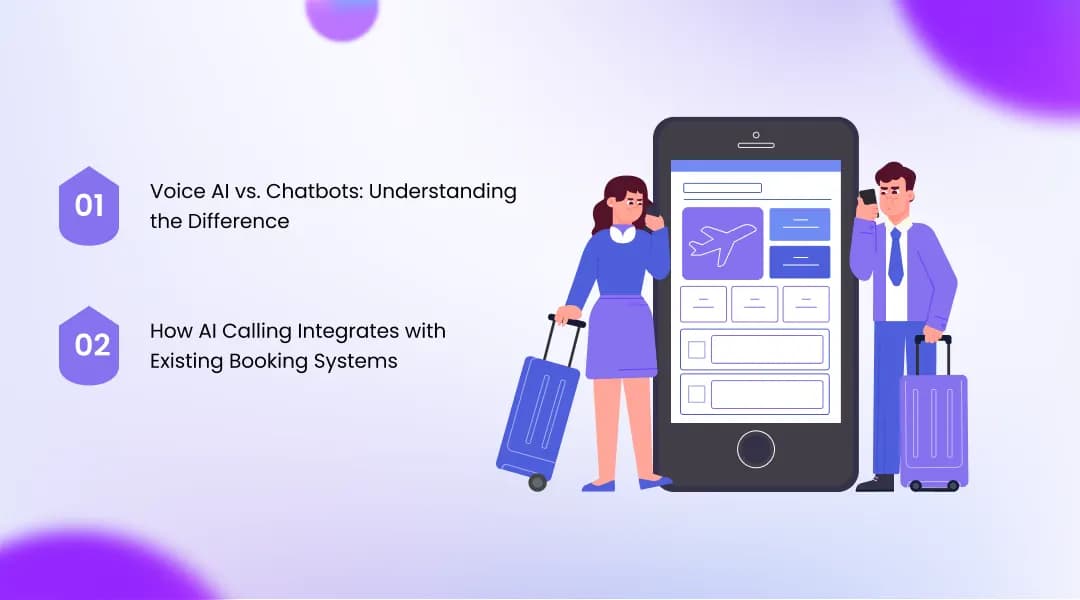
Voice AI vs. Chatbots: Understanding the Difference
A chatbot is a text-based assistant that lives on your website or messaging app. An AI voice assistant operates on the phone, where most high-intent travel bookings still happen. The distinction matters because the phone remains the preferred channel for complex, high-value transactions like multi-city itineraries, group tours, and urgent rebookings.
Chatbots handle roughly 80 percent of routine text-based inquiries effectively. But when a traveler's flight has just been cancelled and they are standing in an airport with two kids, they are not going to type a message. They are going to call. That is where AI calling fills a gap that chatbots cannot.
How AI Calling Integrates with Existing Booking Systems
A voice AI system worth investing in connects directly to your GDS (Amadeus, Sabre, Travelport), your CRM, and your booking engine. This means the AI does not just answer questions. It pulls live availability, confirms pricing, captures passenger details, and processes changes in real time.
Should you worry about ripping out your current tech stack? Not at all. The best AI calling solutions are designed as an overlay, not a replacement. They plug into what you already use, which is exactly how we approach it at OnDial: we work with your systems, not against them.
How AI Voice Assistants Handle Peak Season Call Volumes
The single biggest advantage of AI calling during seasonal surges is instant, unlimited scalability. A human team that handles 200 calls a day cannot handle 800 without quadrupling headcount. An AI voice assistant handles 800 calls the same way it handles 200: without breaking a sweat, without hold times, and without a single dropped call.
HotelPlanner offers a compelling example. Before deploying AI voice agents, they could handle fewer than 25,000 calls daily. After implementation, that capacity jumped to 45,000, and in the first month alone, their AI agents handled 40,000 inquiries and generated approximately £150,000 in revenue.
Automating Routine Booking Inquiries
The bulk of calls during peak season are predictable: "What packages do you have for Bali in August?" "Is the resort all-inclusive?" "Can I add a child to my existing booking?" These are structured, repeatable interactions that an AI voice assistant handles with precision.
By automating 60 to 80 percent of these routine questions, your human agents get freed up for what they are actually good at: closing complex, high-value bookings that require judgment, empathy, and creative problem-solving. It is not about replacing people. It is about finally letting them do meaningful work.
Managing Cancellations, Changes, and Rebookings
This is where AI calling earns its keep. During irregular operations like weather disruptions, airline cancellations, or sudden travel advisories, rebooking requests surge. An AI voice assistant can instantly retrieve a caller's booking, present alternative options, process the change, and send a confirmation, all within a single conversation.
Have you ever watched your team handle a cancellation wave during a monsoon season flight disruption? I have. It is chaos. Phones ring nonstop, hold times climb past 30 minutes, and customers who were already stressed become furious. AI calling does not eliminate the disruption, but it eliminates the bottleneck.
Real Results: What Travel Agencies Gain from AI Calling
Let me be specific about what agencies are actually experiencing, because vague promises help nobody.
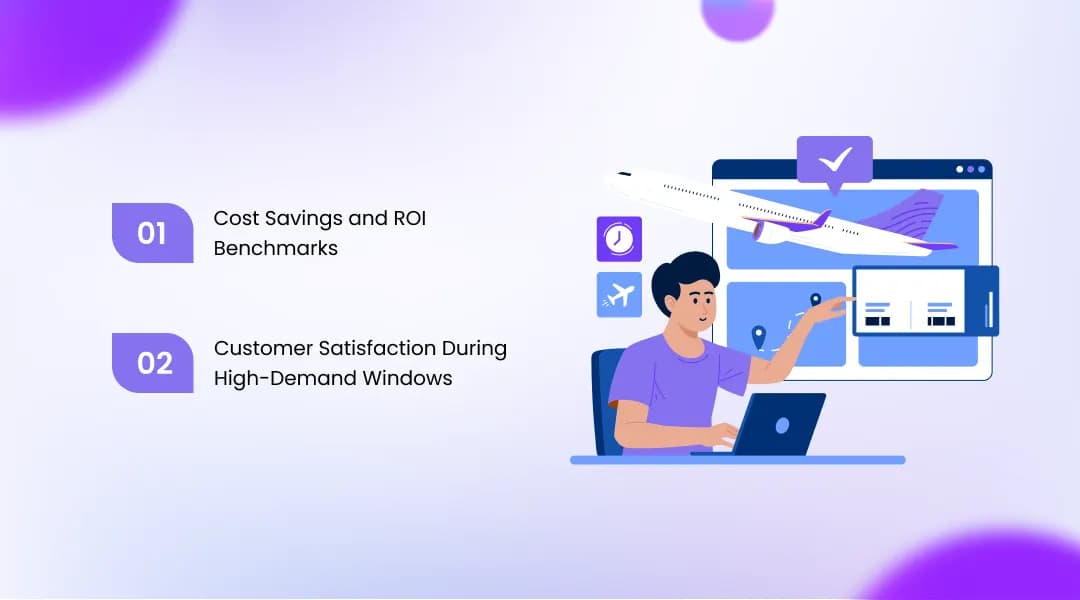
Cost Savings and ROI Benchmarks
Travel agencies implementing AI calling solutions report 30 to 50 percent reductions in customer service operating costs. The savings come from multiple angles: reduced need for seasonal hires, elimination of overtime during peak windows, lower training costs, and fewer lost bookings from abandoned calls.
AI chatbots and voice assistants can bring per-interaction costs down from $5 to $12 to roughly $1.55 per interaction. For an agency fielding 500 calls a day during peak season, that cost reduction adds up to thousands saved per week. And unlike temporary staff, AI calling delivers a positive ROI within three to six months for most implementations.
Customer Satisfaction During High-Demand Windows
Here is a pattern I have noticed in projects at OnDial: agencies often worry that AI will feel impersonal. What actually happens is the opposite. Wait times drop to near zero. Callers get immediate, accurate answers. And when the system does hand off to a human, that human is not exhausted from answering the same question for the 90th time.
The result? Agencies using AI voice tools report up to 35 percent increases in customer satisfaction scores. One factor that surprises people: consistency. An AI voice assistant gives the same quality of response at 2 AM as it does at 2 PM. It speaks 15 to 30 languages without accent fatigue. It never has a bad day.
What to Look for in an AI Calling Solution for Travel
Not all AI voice solutions are built for the travel industry. Generic call center AI often lacks integration with booking systems, cannot handle multi-leg itinerary conversations, and stumbles on the specialized vocabulary of travel (PNRs, fare classes, codeshares, travel advisories). Choosing the wrong platform can actually make your peak season worse, not better.
Key Features That Matter for Seasonal Scalability
When evaluating AI calling solutions, prioritize these capabilities:
GDS and booking engine integration: The AI must access live availability and pricing, not cached data from yesterday.
Multilingual support: If you serve international travelers, language coverage is not a nice-to-have. It is essential.
Sub-second response latency: Anything above 800 milliseconds starts feeling unnatural. Aim for under 600ms for human-like conversation flow.
Contextual handoff to human agents: When a call exceeds the AI's scope, the transition should be warm, with full context passed along so the customer never has to repeat themselves.
Elastic scaling: The whole point is handling surges. If the system requires manual capacity adjustments, it defeats the purpose.
Red Flags When Evaluating Vendors
Watch out for vendors who cannot demonstrate a live integration with at least one major GDS. Be cautious of platforms that require you to rewrite your booking workflows around their system. And always ask about uptime guarantees during peak load: if a vendor cannot commit to 99.9 percent uptime during your busiest season, walk away.
I will be honest about a limitation: AI calling is not perfect for every scenario. Extremely emotional interactions, complaints that require human empathy and judgment, and VIP clients who expect a personal relationship are still best served by your team. The right AI calling solution knows when to step back and let a human take over. That self-awareness is what separates a great implementation from a frustrating one.
Conclusion
AI calling for travel agencies is no longer an experiment. It is a proven approach to managing seasonal booking surges without the expense, delays, and inconsistency of temporary hiring. The agencies seeing the strongest results are the ones using AI to handle routine calls at scale, freeing their best people for the work that truly requires a human touch. The cost savings are measurable, the customer experience improves, and the system scales instantly when you need it most.
At OnDial, we build voice AI solutions specifically for businesses facing exactly this kind of challenge: high call volumes, seasonal unpredictability, and the need to deliver excellent service without ballooning headcount. If you are preparing for your next peak season and want to explore what AI calling could look like for your agency, visit OnDial to start a conversation with our team. No scripts. No pressure. Just a practical discussion about what is possible.
Travel agencies that adopt AI calling do not just survive seasonal surges. They turn peak season into their most profitable, most efficient, and most customer-friendly window of the year.