Hotels operate around the clock, but hotel teams cannot give every phone call their full attention at every moment.
A front desk employee may be checking in a guest when the phone rings. A manager may be handling a complaint while another caller asks about room availability. During peak periods, even simple questions can create a queue of calls that staff cannot answer quickly.
The challenge becomes greater when guests speak different languages.
A hotel serving domestic and international travelers may receive calls in English, Hindi, Spanish, Arabic, French, or other languages. Hiring multilingual staff for every shift is difficult, especially for independent hotels, resorts, and properties operating with lean teams.
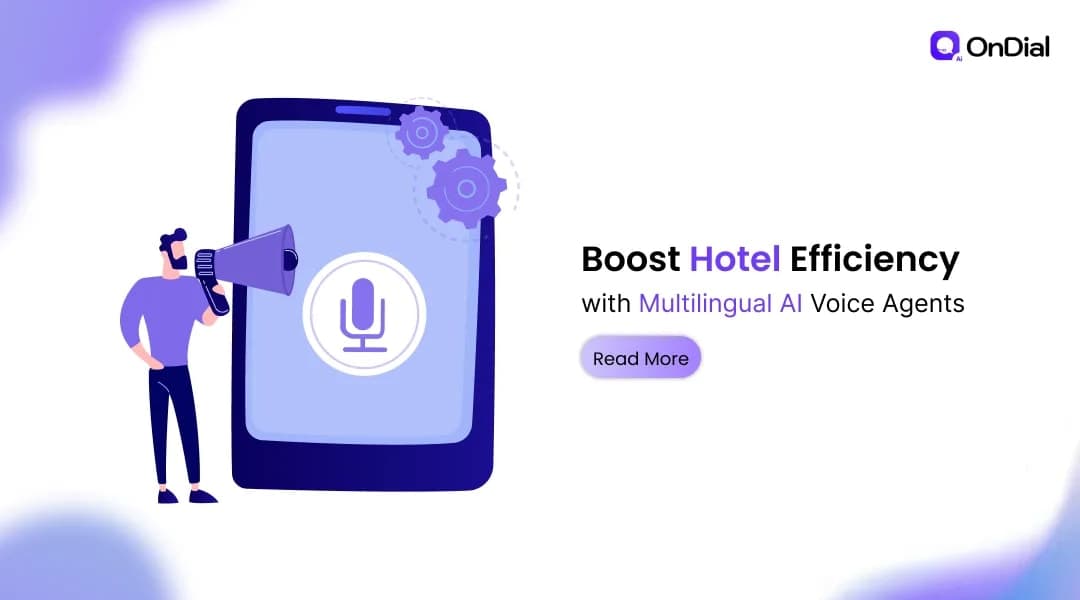
Multilingual AI voice agents provide another approach. They can answer calls, understand natural speech, respond in the caller's language, handle routine hotel requests, and transfer conversations to human staff when a situation requires personal attention.
The goal is not to remove hospitality from the guest experience. It is to remove unnecessary friction from the communication layer so hotel employees can spend more time with guests who need them.
What Is a Multilingual AI Voice Agent for Hotels?
A multilingual AI voice agent is a conversational phone system that can understand and respond to guests in multiple languages.
Unlike a traditional IVR, where callers select options such as "Press 1 for reservations" or "Press 2 for the front desk," a voice agent allows guests to explain what they need naturally.
For example, a guest might say:
"I am arriving tomorrow evening. Can I check in late, and do you have airport pickup?"
The system can identify multiple intents from that request, retrieve relevant hotel information, answer the guest, and route the conversation to the appropriate workflow when an action is required.
For hotels, this means the phone becomes more than a communication channel. It becomes an operational interface that can connect guests with reservations, policies, availability, reminders, requests, and other hotel workflows.
For properties evaluating where voice automation fits into their operations, AI voice agents for hospitality provide a useful starting point for mapping these use cases.
Why Hotel Efficiency Often Breaks Down at the Phone
Hotel teams are responsible for both physical and digital guest interactions.
A front desk employee may need to welcome a guest, process a check-in, answer a question from someone in the lobby, coordinate with housekeeping, and respond to a phone call within the same few minutes.
The problem is not necessarily that the team lacks training. The problem is that human attention is limited.
Peak hour call pressure
Call volume often increases around booking periods, check-in times, check-out periods, holidays, weekends, and local events.
When several guests call simultaneously, staff members must prioritize the guest physically standing in front of them. Phone callers may experience ringing, waiting, voicemail, or a delayed callback.
Every missed interaction creates another task for the team to recover later.
Repetitive guest questions
Hotels receive many recurring questions:
What time is check-in?
What time is check-out?
Is breakfast included?
Do you provide airport transfers?
Is parking available?
Is Wi-Fi available?
Can I request early check-in?
Can I cancel or modify my reservation?
Are pets allowed?
What facilities are available?
These questions are important to guests, but they do not always require a human employee.
Language limitations
A multilingual hotel needs to communicate clearly with guests before and during their stay.
A guest who is uncomfortable communicating in English may struggle with a conventional IVR or an English-only front desk. The result can be unnecessary clarification, longer calls, or an escalation that could have been avoided.
A multilingual AI voice agent can make language selection part of the conversation rather than forcing the caller through a rigid menu.
How Multilingual AI Voice Agents Improve Hotel Efficiency
The strongest hotel use cases are not limited to answering calls. The real operational benefit comes when the voice agent connects conversation with action.
1. Answer calls around the clock
A voice agent can provide continuous phone coverage for routine inquiries and booking requests.
This is particularly useful for properties that receive calls outside normal office hours or serve travelers across different time zones.
A guest planning a trip late at night does not have to wait until morning to ask about availability or hotel policies.
2. Automate reservation inquiries
Reservations are one of the most valuable hotel phone interactions.
Instead of simply collecting a guest's phone number for a callback, an appropriately integrated AI voice agent can gather travel dates, number of guests, room preferences, and other required information.
Where the necessary systems and permissions are available, the workflow can then check current availability and move toward confirmation.
OnDial's hospitality solution specifically describes reservation handling, reservation modifications, and PMS integration as hotel use cases.
3. Handle multilingual conversations naturally
Multilingual support becomes more useful when it goes beyond translating a fixed script.
Guests may change languages during a conversation. They may mix English with Hindi or another regional language. They may use local expressions, accents, or informal phrasing.
A modern voice agent should therefore be evaluated on whether it can preserve the meaning and context of a conversation when the language changes.
OnDial currently states that its platform supports more than 100 languages and can switch languages during a conversation while preserving intent and context.
4. Reduce repetitive front desk calls
When routine calls are handled automatically, front desk employees can focus on work that requires physical presence and human judgment.
That includes welcoming guests, resolving unusual complaints, coordinating special requests, supporting VIP guests, and managing situations where empathy matters.
This creates a practical human and AI operating model rather than treating automation as a replacement for hospitality staff.
5. Provide consistent answers
A hotel should not give different answers about check-in policies, cancellation rules, amenities, or breakfast hours depending on which employee answers the phone.
A properly configured AI agent can use an approved knowledge base and business rules to provide consistent information.
This is especially useful for hotel groups where multiple properties need to maintain consistent communication while still using property-specific information.
Hotel Use Cases Beyond Reservations
Reservations are only one part of the guest communication journey.
Pre-arrival calls
Hotels can use outbound voice automation to confirm reservations, remind guests about arrival information, collect preferences, or provide instructions before check-in.
This can reduce the number of routine questions reaching the front desk later.
Check-in and arrival assistance
Guests may call while traveling to ask about directions, parking, check-in times, luggage arrangements, or airport transportation.
An AI voice agent can provide approved information and route requests that require staff intervention.
In-stay guest requests
Guests may call for room service information, housekeeping requests, Wi-Fi assistance, late checkout questions, or facility information.
Routine requests can be captured and routed into the appropriate workflow rather than depending on handwritten notes or repeated phone calls.
Feedback collection
Voice agents can conduct post-stay surveys and collect structured feedback.
This gives hotel management another source of information about guest satisfaction, recurring complaints, and service opportunities.
Upselling and additional services
During appropriate conversations, an AI agent can present relevant options such as room upgrades, dining reservations, transportation, or additional hotel services.
The important principle is relevance. The system should use guest context and hotel rules rather than repeatedly presenting generic sales messages.
Multilingual Voice AI vs Traditional Hotel IVR
Traditional IVR systems remain useful for basic routing, but they can create friction when guests have complex requests.
An IVR typically follows a predefined decision tree.
A conversational voice agent can understand a request such as:
"I have a reservation for tomorrow, but my flight arrives late. Can you tell me if late check-in is possible?"
The guest does not need to determine which menu option matches the request.
The agent can understand the intent, retrieve the relevant policy, ask a clarification question if necessary, and escalate the conversation when human involvement is required.
That distinction matters because hotel conversations rarely follow perfectly predictable paths.
What Hotel Systems Should Connect to AI Voice Agents?
Voice automation becomes significantly more useful when it can access the systems that already run hotel operations.
Property management systems
PMS integration can allow the agent to work with reservation information, availability, guest details, and other approved property data.
Customer relationship systems
CRM connectivity can help maintain customer context and ensure that important interactions are recorded for future follow-up.
Booking and scheduling systems
Reservations, appointments, transportation requests, and other scheduled services can be connected to voice workflows where supported.
Messaging and confirmation systems
After a call, the workflow can trigger an SMS, WhatsApp message, or email confirmation when the required integration is available.
OnDial's AI voice platform currently documents CRM, calendar, telephony, communication, automation, and enterprise API integrations.
How Hotels Should Measure AI Voice Efficiency
Implementing an AI voice agent without measuring its operational impact makes it difficult to determine whether the deployment is working.
Hotels should establish baseline metrics before launch and compare them after deployment.
Call answer rate
Track how many inbound calls are answered and how many reach voicemail or remain unanswered.
Reservation conversion
Measure how many booking-related calls result in completed reservations or qualified booking opportunities.
First call resolution
Track how many guest requests are resolved during the initial interaction without requiring a callback.
Human escalation rate
Not every call should be automated.
A useful system should identify which conversations require a human and measure how often escalation occurs.
Average handling time
Compare the time required for routine interactions before and after automation.
Guest satisfaction
Monitor feedback associated with AI-handled conversations and compare it with other service channels.
Operational workload
Measure how much repetitive phone work is removed from front desk teams.
The objective is not to maximize automation. The objective is to improve the balance between automated routine work and human hospitality.
How to Implement Multilingual AI Voice Automation in a Hotel
A successful deployment should start with the hotel's actual call patterns rather than a generic AI script.
Step 1: Audit existing calls
Identify the most common inbound and outbound call types.
Group them into categories such as reservations, FAQs, cancellations, transportation, check-in information, guest requests, and complaints.
Step 2: Identify automation candidates
Start with predictable, high-volume workflows.
Reservation inquiries, common FAQs, reminders, confirmations, and simple requests are usually easier to structure than highly emotional complaints or complex exceptions.
Step 3: Map languages and guest segments
Review which languages guests actually use.
Do not select languages simply because they are available from a vendor. Prioritize languages based on the hotel's guest profile, locations, booking sources, and call data.
Step 4: Connect operational systems
Determine which workflows need access to the PMS, CRM, booking engine, calendar, messaging platform, or internal APIs.
The AI should only access the information and actions required for the specific workflow.
Step 5: Design human escalation
Define clear escalation conditions.
Examples include complaints involving compensation, security concerns, unusual billing situations, emotionally sensitive conversations, or requests outside the agent's authority.
A good handoff should provide the human employee with the conversation context instead of forcing the guest to repeat everything.
Step 6: Test real conversations
Testing should include accents, interruptions, background noise, language switching, ambiguous requests, cancellations, corrections, and unexpected questions.
A system that performs well on a scripted demo may still fail when a real guest changes direction halfway through a call.
What to Look for in a Multilingual AI Voice Platform
Hotels should evaluate vendors based on operational fit rather than the number of AI features shown in a product demo.
Look for:
Multilingual speech recognition
Language detection and language switching
Natural conversation handling
PMS and CRM integration
Booking workflow support
Human escalation
Call analytics and transcripts
Configurable business rules
Data security and access controls
Scalable call capacity
Property-specific knowledge
Clear deployment and support processes
OnDial's AI voice platform provides capabilities including multilingual conversations, context-aware human handoff, CRM synchronization, live API execution, call summaries, analytics, and configurable workflows.
For hotels, the most important question is simple: can the platform reliably complete the workflows your guests actually need?
The Future of Hotel Voice Automation
Hotel voice automation is moving beyond basic call answering.
Future systems will increasingly connect guest conversations with operational data, allowing voice interactions to become part of a larger guest journey.
A guest may ask for a late checkout, receive an availability response, have the request recorded, and receive confirmation without several separate interactions.
Another guest may switch from English to Hindi during a call and continue without restarting the conversation.
The direction is clear: voice AI is becoming less about answering questions and more about understanding intent, accessing business systems, completing actions, and knowing when a human should take over.
That makes integration, context, and workflow design more important than simply having a natural sounding voice.
Final Takeaway
Multilingual AI voice agents can improve hotel efficiency by addressing one of the most overlooked operational bottlenecks: phone communication.
They can answer routine calls, support multiple languages, assist with reservations, handle common guest questions, automate reminders and feedback, and reduce repetitive work for front desk teams.
The strongest deployments do not attempt to automate every guest interaction.
They automate predictable work while keeping humans involved where judgment, empathy, and personal hospitality matter most.
For hotel operators, the right starting point is not "How much can AI replace?"
It is "Which guest conversations consume the most staff time, create the most missed opportunities, and can be handled reliably through a conversational voice workflow?"
That question leads to a much more practical AI strategy.