Here is a number that should make every support leader sit up: 91% of customer service and support leaders are now under executive pressure to implement AI, according to a 2026 Gartner survey cited by Orvera. The pressure is real, but so is the confusion. Most teams record every call for "quality and compliance," then never listen to a single one.
AI call analysis is the technology that finally closes that gap. It automatically transcribes, reads, and scores your customer calls at scale, so you learn what happened across hundreds of conversations without replaying a single recording. It detects sentiment, flags objections, tracks keywords, and surfaces patterns a human sampling ten calls a week would never catch.
I get the skepticism. You have probably been sold "AI magic" before and watched it underdeliver. Fair. So this guide skips the hype. I will walk you through exactly how the pipeline works, what it can genuinely extract, where its accuracy quietly breaks, and how to decide if it is worth it for your team.
What AI Call Analysis Actually Is
AI call analysis is the automatic processing of phone conversations to extract insights, replacing the manual work of listening to recordings one by one. That single sentence is the whole idea, and it is worth sitting with before we go deeper.
The Problem It Solves
Think about your last full week of calls. Every one of them carried intent, frustration, a buying signal, or a complaint. Almost none of that got captured.
The traditional fix was quality assurance by sampling: a supervisor listens to a handful of calls and hopes they are representative. They rarely are. Conversation intelligence flips this by reviewing 100% of interactions instead of a thin slice, which is exactly why vendor research repeatedly cites AI-driven quality monitoring as delivering full-call coverage rather than spot checks.
Why It Matters Now
The shift is not academic. According to CallBotics, citing Salesforce, 30% of service cases were resolved by AI in 2025, with that figure expected to reach 50% by 2027. As more of the conversation happens between customers and machines, understanding what is said on every call becomes a competitive necessity, not a nice-to-have.
At OnDial, where we build voice AI systems for a living, I have seen this firsthand with voice ai for sales. The teams that win are not the ones with the fanciest dashboard. They are the ones who finally stopped guessing what customers were saying.
How Does AI Analyze Phone Calls?
The magic word here is automatic speech recognition, and understanding the pipeline demystifies the whole thing. This is the H2 covering our primary zero-click keyword, so here is the direct answer.
AI analyzes phone calls in three stages: it transcribes the audio into text using speech recognition, interprets that text with natural language processing to detect sentiment and intent, and then surfaces patterns across many calls in a searchable dashboard. That is the entire process, start to finish.
Step One: Transcription
First, ASR converts spoken audio into text. Modern systems handle accents, interruptions, and crosstalk far better than the clunky voice-to-text of a few years ago.
A critical piece here is speaker diarization, which splits the audio to identify who said what with voice AI beyond static call scripts. Without it, you cannot separate the agent's words from the customer's, and half your analysis falls apart. Good platforms nail this; weak ones blur the two speakers into one messy transcript.
Step Two: Interpretation
Once the call is text, natural language processing goes to work. NLP scans for meaning: recurring keywords, objections, buying signals, compliance phrases, and emotional cues.
This is where a call like "I have already spoken to three different reps" gets flagged as dissatisfaction, even though the customer never said the word "unhappy." The system reads intent, not just vocabulary. Tools like Gong and CallMiner built entire businesses on doing this well at enterprise scale.
Can AI Detect Customer Sentiment on Calls?
Yes, and this is the feature everyone asks about first. Sentiment analysis uses AI to classify a conversation as positive, negative, or neutral by reading emotional cues in the language and, in stronger systems, the voice itself.
How Sentiment Detection Works
Most tools work primarily off the transcript. They detect emotion through word choice and phrasing; clipped sentences might flag frustration, while "I love this" signals a happy customer.
The more advanced platforms go further and analyze the audio directly. As INO CX notes, acoustic analysis evaluates pitch, pace, volume, and pauses, because vocal cues often carry emotional signals that the words alone do not reveal. That distinction matters more than most buyers realize (more on that in the accuracy section, because it is the single biggest gotcha in this whole category).
A Real Example
One pattern I keep seeing: a customer stays polite the entire call, so a human reviewer marks it "fine," but their tone was flat and clipped the whole time. A text-only tool misses it. An acoustic-aware tool catches the frustration underneath the politeness. That gap is worth real money in churn.
Real-Time vs Post-Call Analysis: Which One Do You Need?
This is the decision that trips up most first-time buyers, so let me make the real-time vs post-call analysis choice simple.
Post-Call Analysis
Post-call processing runs after the conversation ends. It generates summaries, QA scores, trend reports, and coaching insights.
This is the mature, high-ROI category. It is where teams spot patterns across dozens of calls, not just moments in one, and it is where most businesses should start with AI call analytics and conversation insights. You walk before you run.
Real-Time Analysis
Real-time analysis processes the call as it happens, delivering live transcription, sentiment alerts, and on-screen agent prompts like objection-handling tips or compliance warnings. It is powerful for training new reps and rescuing calls in progress.
But it demands more computing power and tighter telephony integration. Here is my honest take: skip real-time until your post-call process is dialed in. Nail the fundamentals first.
What Businesses Actually Do With the Insights
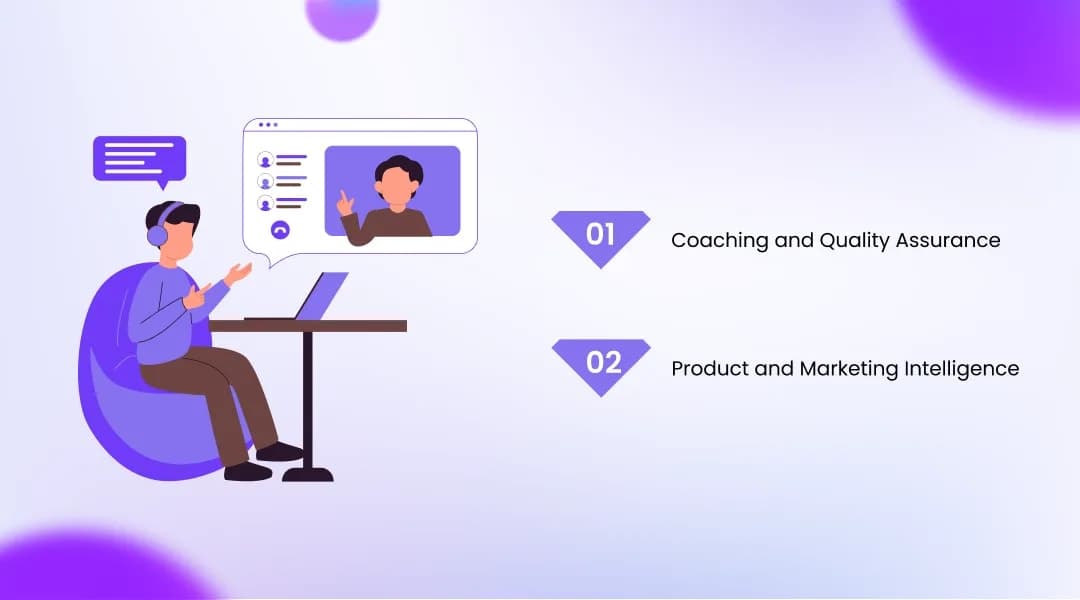
Analysis without action is just a prettier dashboard. So what do teams genuinely do once AI is reading every call?
Coaching and Quality Assurance
Managers stop reviewing full recordings and start reviewing AI-summarized calls, which is why some deployments report compressing new-rep ramp time significantly. Instead of one supervisor sampling ten calls, the system scores all of them against a rubric and flags the ones that need a human eye.
Any call dipping into negative sentiment or missing a compliance script triggers an alert. Coaching happens in hours, not weeks.
Product and Marketing Intelligence
Your calls are a listening post. AI aggregates the exact language customers use, "too slow," "missing integration," a specific competitor's name, and feeds it straight to your product and marketing teams.
Product roadmap: Recurring complaints become prioritized fixes instead of anecdotes.
Marketing copy: The precise phrases customers use to praise you become your ad headlines.
Churn prevention: Filtering for negative sentiment surfaces at-risk accounts before they cancel.
Is AI Call Analysis Accurate? The Honest Answer
Now for the part the other guides skip. AI call analysis is accurate enough to be genuinely useful, but it is not flawless, and knowing where it breaks is the difference between a smart buyer and a disappointed one.
The Accuracy Ceiling
Under good conditions, transcription is highly reliable. But per BuildBetter's 2026 review, accuracy can drop to 85–92% for calls with heavy accents, background noise, poor audio, or specialized industry jargon with multilingual customer call automation. That is not a rounding error when you are making coaching decisions on the output.
The fix is real: most serious platforms let you train custom vocabulary for your domain. Test any tool on your own messy, real-world audio, not a polished vendor demo.
The Text-vs-Audio Limitation
Here is the nuance almost nobody tells you. Many tools, including transcript-based analyzers, strip away tone before analysis, so a lot of human emotion is lost the moment audio becomes text.
Should you care? If sentiment is core to your use case, yes, prioritize a tool that does acoustic analysis. And remember compliance: reputable systems automatically redact PII and honor GDPR and PCI standards, so sensitive data like card numbers never sits unprotected in a transcript.
Conclusion
AI call analysis turns a pile of ignored recordings into your most honest source of customer truth. If you remember three things, make them these: the pipeline is transcription, then interpretation, then pattern-spotting; post-call analysis is where you should start, and accuracy has real limits worth testing before you buy.
You came in skeptical, and rightly so. But you now know exactly how this technology works and where it does not, which means you can evaluate any vendor without falling for the hype.
That clarity is the whole point. At OnDial, we build human-centric voice AI systems, so if you want call analysis that is honest about tone, accents, and audio quality rather than one that pretends those problems do not exist, start a conversation with our team about what your specific call data actually needs.