In many small charity offices, the phone rings over lunch, after 5 p.m., and through late December. To Scale call volume without hiring, many teams now use AI voice agents for nonprofit organizations.
Used with care, they pick up routine calls that slip through. People then keep the grief, the complaints, and the five-figure conversations.
The deciding test is short. Would a wrong answer on this call be cheap to fix, and does a fast answer change the outcome? If both answers are yes, a voice agent can probably take it.
To keep things concrete, picture Northgate Reading Trust, an illustrative adult literacy charity. It has five office staff, about 3,800 monthly donors, and a learner helpline taking roughly 650 calls a month. Its numbers return throughout this guide.
What a Voice Agent Actually Does on a Charity's Phone Line
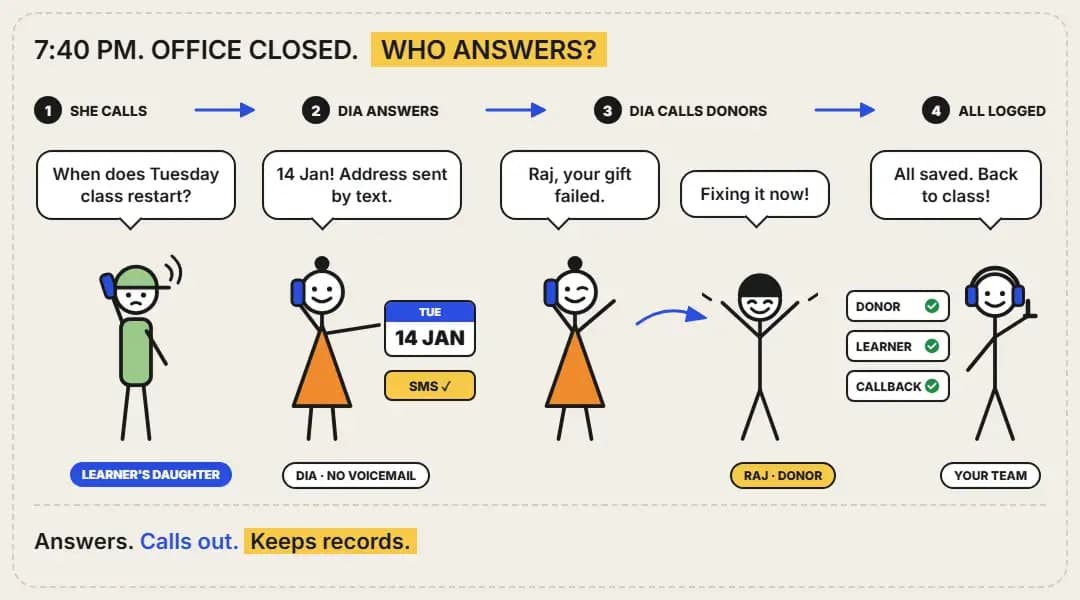
At 7:40 p.m., a learner's daughter calls Northgate to ask when the Tuesday evening class restarts. Instead of voicemail, a synthetic voice answers, checks the term calendar, gives the date, and texts her the address. Vendors call software that holds this whole exchange by voice an AI voice agent.
Unlike a traditional IVR menu, it never asks the daughter to press 3 for classes. She simply says what she needs in her own words, and the agent works out the intent. Also, it can dial out, which matters a great deal for fundraising.
Among AI voice agents for nonprofit organizations, the work usually splits into three directions:
Inbound support, answering callers about class dates, tax receipts, and the spring open day while staff teach.
Outbound calling campaigns, phoning donors about failed payments, gala pledges, and the December appeal on your schedule.
Record keeping, logging each call outcome and callback request into the right donor or learner file.
Inside One Call: How an NGO Voice Agent Works From Ring to Record
Follow one Northgate donor, Priya, as she rings to raise her monthly gift from $15 to $20. Her two-minute call passes through six stages, and knowing them sharpens the questions you ask vendors.
Telephony connects Priya's call. Northgate's existing number forwards to the agent, so donors dial nothing new.
Speech recognition turns her words into text. Priya's request to give $20 becomes a transcript in well under a second.
A language model reads the intent. It spots an upgrade rather than a cancellation, using rules Northgate's team wrote.
The agent checks your systems. Through a donor CRM integration, it finds her record and confirms the current $15 amount.
Text-to-speech replies to her. A synthetic voice confirms $20 and asks whether the 1st of the month still suits her.
The record updates and a summary appears. The CRM saves the $20 gift, and staff see a two-line call note.
Stage four is where many projects stall. If the agent cannot read and write your donor database, it can only take messages. So ask each vendor to demo that step live with a test donor record.
Stage three also sets the limits. There, your team decides which topics the agent refuses and which words trigger a warm human handoff. It also lists what the agent must never promise.
Which Calls AI Voice Agents for Nonprofit Organizations Should Answer First
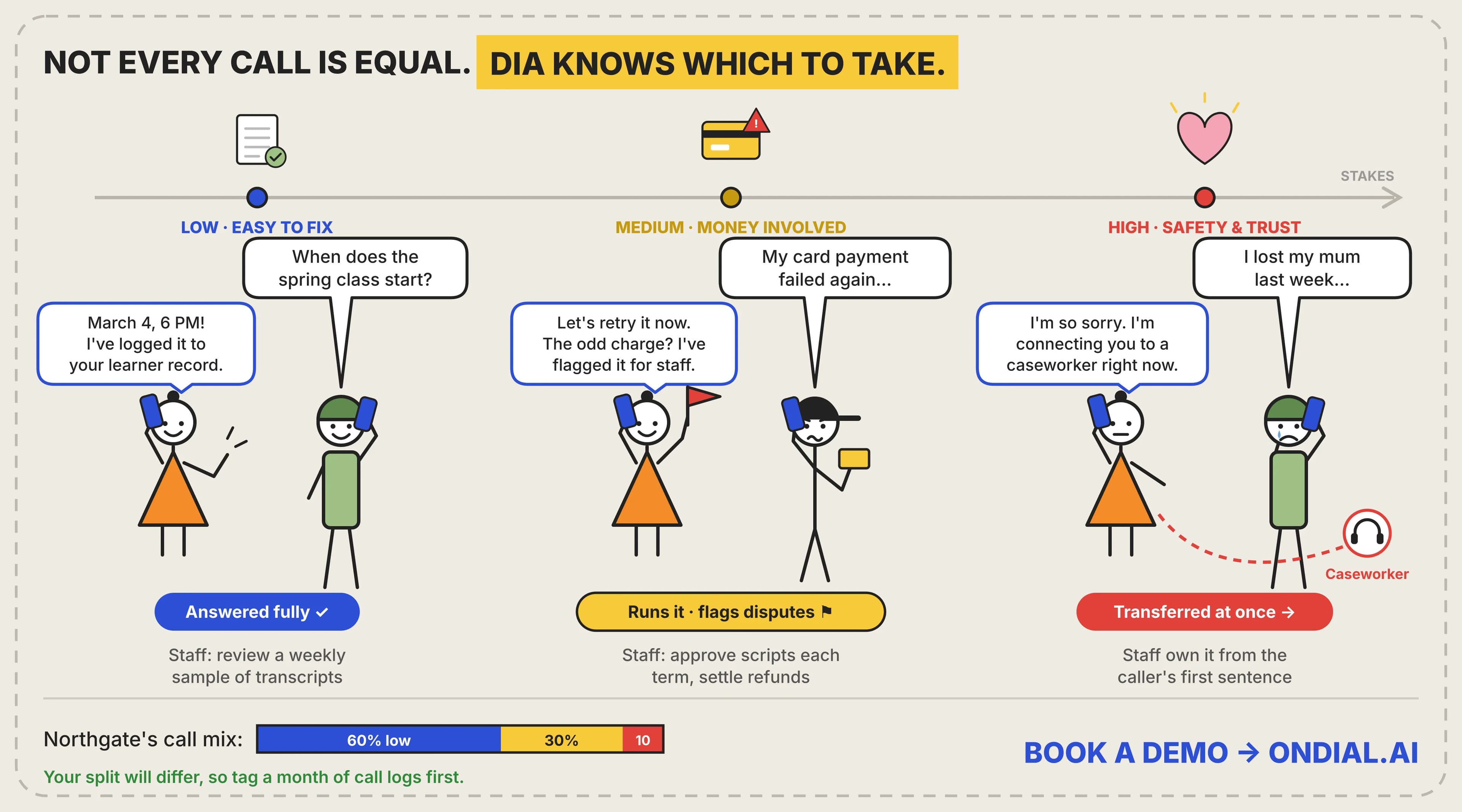
Start with the calls where a slow answer costs Northgate money or goodwill, but a wrong answer costs little. That rule sorts most nonprofit calls into three tiers, shown here with Northgate's examples.
Stakes tier | Typical calls at Northgate | What the agent does | What staff do |
Low, since a wrong answer is easy to correct | Class start dates, tax receipt copies, open day parking, and donor address changes | Answers the caller fully and logs the outcome against the donor or learner record | Review a weekly sample of Northgate transcripts for accuracy |
Medium, since a donor's money is involved | Failed card payments, gala pledge reminders, and $15 to $20 gift upgrades | Runs the conversation, then flags a disputed charge or odd request for staff | Approve call scripts each term and settle disputes or refund requests |
High, since safety or deep trust is at stake | Distress, safeguarding worries, bereavement calls, and five-figure gift conversations | Transfers the caller at once or books a same-day caseworker callback | Own the conversation from the caller's very first sentence |
In this example, Northgate's mix is roughly 60% low, 30% medium, and 10% high. Most nonprofit organizations testing AI voice agents will see a different split, so tag a month of logs first.
Wondering how these tiers look inside a ready-built setup for charities? A dedicated page on AI voice agents for nonprofits groups the call types a nonprofit deployment usually starts with.
Donor Outreach AI Beyond the Thank-You Call
Thank-you calls look like the obvious first job for donor outreach AI, yet a 500,000-donor trial points elsewhere. In that randomized study of new donors, thank-you calls had no measurable effect on retention. Researchers Anya Samek and Chuck Longfield published that result in 2023, although experts had predicted large gains.
Gratitude still matters for donor stewardship. However, if a person's thank-you call made no difference, a synthetic voice saying it probably won't either.
Retention is the better target. More than half of a typical charity's donors skip giving the following year. The Fundraising Effectiveness Project put overall US retention at 43.3% for 2025.
Individual supporters also carry most of the load. They gave about $394.2 billion of 2025's $617.2 billion total, Giving USA reported.
Failed Payments and Lapsed Recurring Gifts
Many of Northgate's lapsed monthly gifts end without any decision by the donor. A card expires, the bank declines the charge, and nobody follows up.
In this example, about 140 Northgate monthly gifts fail each month. Staff reach only about a third before the next appeal.
Instead, an agent can call all 140 donors within two days and confirm they still want to give. It then texts a secure link to the existing donation page, which keeps card details off the call. For many nonprofit organizations using AI voice agents, that recurring gift recovery step is a sensible place to start.
Other outbound calls fit the same medium tier:
Pledge fulfillment calls after a gala, while the evening is still fresh for guests.
Upgrade asks to $15 monthly donors who have given that same amount for two years.
Seat confirmations before the spring fundraising dinner, so paid tables do not sit empty.
Lapsed donor reactivation calls to supporters who stopped giving 13 to 24 months ago.
The December Surge
December brought 37% of nonprofits' online revenue in 2025, according to M+R Benchmarks. That pressure lands on Northgate's same five-person office, which runs everything else too.
For nonprofit organizations, AI voice agents need no holiday cover during a year-end appeal or Giving Tuesday campaign. They can answer receipt questions and confirm gifts on many lines at once, depending on your plan. Meanwhile, staff spend those weeks on major donors and the calls that need real warmth.
Helpline Automation That Protects People in Distress
Helpline automation is safe for logistics and risky for crisis, so design Northgate's learner line around that split. Demand keeps climbing in the US, too. A 2026 GAO review counted roughly 19.1 million 988 Lifeline contacts from July 2022 through September 2025.
General support lines are busy as well. United Way reported that 211 lines handled 16.8 million requests in 2024. Most charity helplines are not crisis services.
Still, any line can receive a crisis call. So nonprofit organizations deploying AI voice agents need clear rules for it.
On Northgate's beneficiary support line, the agent takes on three practical jobs:
After-hours answers about class times, eligibility, and how a new learner registers.
Callback booking, so a caseworker phones back at an hour the learner picks.
Routing to the right person, such as the tutor coordinator or the family learning lead.
The other half of the design matters more. Write a short list of signals that end the AI's part of the call immediately:
Any mention of self-harm, suicide, abuse, or danger, even mid-sentence during a class-times question.
A learner who is crying, confused, or repeating one request after two attempts.
Questions about a child's safety at a family learning session, or a medical emergency.
Any request for a person, at any point, with no reason required from the caller.
Test these triggers with staff role-playing hard calls before launch. And if your helpline is a crisis service, keep the first answer human. Limit AI to overflow messages and callback logging.
Volunteers, Events, and Program Feedback by Phone
Coordinating Northgate's 60 volunteer tutors creates a steady stream of reminder and swap calls. Nationally, AmeriCorps counted about 75.7 million Americans volunteering formally in 2023. Each of those people needs shift details from someone.
At Northgate, every tutor gets an automatic volunteer shift reminder the day before a session. If a tutor can't come, the agent offers open slots and alerts the coordinator. Likewise, event registration calls confirm numbers for the spring open day without anyone dialing by hand.
Program feedback is another strong fit for AI voice agents at nonprofit organizations like this one. Adult learners often struggle with emailed forms, so a spoken survey is simply easier for them. For structured campaigns like this, AI survey and feedback calls turn spoken answers into sortable data.
Reaching Donors and Families in Their Own Language
A language gap quietly shrinks who Northgate can serve by phone. Northgate's helpline hears from Spanish- and Polish-speaking parents enrolling relatives, yet only one staff member speaks Spanish. Many agents can detect a caller's language and switch, depending on the provider and the languages it supports.
Accuracy varies across AI voice agents built for nonprofit organizations, though. Before launch, have native speakers test names, street addresses, and local program terms in each language.
Charities can borrow this approach from commercial service lines. A guide to the Multilingual customer support agent explains how language switching works in more depth.
Consent Rules to Settle Before Nonprofit Call Automation Goes Live
Inbound calls carry few legal hurdles in the US, but outbound AI calls need consent planning first. In February 2024, the US Federal Communications Commission ruled on AI-generated voices. It found they count as artificial voices under the Telephone Consumer Protection Act.
In practice, an AI call to a donor's mobile phone needs that donor's prior consent. Nonprofits do get some relief under the FCC rules in 47 CFR 64.1200:
Tax-exempt charities sit outside the telephone solicitation definition, so the National Do Not Call Registry doesn't bind them.
The rules allow up to three prerecorded or artificial-voice calls per 30 days to a residential landline without consent.
Each of those three landline calls must include an opt-out, and the charity maintains an internal do-not-call list.
You must honor an opt-out within 10 business days and keep the record for five years.
These rules apply to AI voice agents for nonprofit organizations just as they apply to ordinary robocalls. Rules outside the US differ, so check local law before any campaign.
Also, disclose early in each call that the caller is an AI, since that builds trust. This section is general information, not legal advice.
Where a Nonprofit Voice Agent Falls Short
A voice agent is weakest at the relationships Northgate's development director has built over a decade. That limit, and several others, should shape where you use one:
Reading a longtime major donor's mood is beyond it, unlike your development director.
Strong accents, weak mobile signals, or a noisy shelter can make it mishear callers.
Stale class dates in its knowledge base produce confident wrong answers to learners.
Some older Northgate supporters will hang up on any automated voice, however lifelike.
Refund requests, complaints, and fee exceptions still need a staff member's sign-off.
These limits don't rule out AI voice agents for nonprofit organizations. However, they do mean someone on staff must review transcripts weekly and update the knowledge base.
It also isn't for everyone. As a rough rule of thumb, an office taking under 100 calls a month may not need one. Shared voicemail and a firm callback habit could serve it better.
Running the Numbers on a Voice Agent for a Small Fundraising Team
Price an agent against the staff hours it frees at Northgate, not against a full salary. Staffing pressure makes those hours valuable. In a 2023 National Council of Nonprofits survey, 74.6% of responding nonprofits reported job vacancies.
Take Northgate's 140 failed payments a month as an illustration. Say each one costs a staff member 15 minutes, counting retries, voicemails, and notes. That adds up to 35 hours a month on one task.
If the agent resolves 70% alone, staff handle only 42 donors. As a result, the work drops to about 10.5 hours, freeing roughly 24 hours monthly. Many providers charge per connected minute, and rates vary by country, voice quality, and volume.
So multiply your expected minutes by a quoted rate, and set that beside 24 freed hours. Then compare AI voice agents with the other ways nonprofit organizations cover phones:
Option | Where it works well | Where it struggles |
Staff calling from the office | Major donors, complaints, and calls needing judgment | Coverage ends at closing time and during staff holidays |
A volunteer phone bank evening | Warm, personal appeals on a single busy evening | Hard to schedule, train, and keep consistent each month |
An outsourced call center contract | Very large campaigns that follow a fixed script | Costly per call, with little knowledge of your mission |
An AI voice agent on your number | Routine, repeatable calls at any hour or volume | Judgment, distress, and long donor relationships |
A Four-Week Pilot Plan for Your First Voice Agent
A four-week pilot is the cheapest test of whether your calls suit this kind of software. Run it on one call type, in four steps:
Tag a month of call logs by stakes tier in week one, then pick one low-tier call type.
During week two, write the knowledge base, transfer triggers, and AI disclosure line with staff.
Spend week three testing with staff and board members posing as callers, including difficult ones.
Go live on that single call type in week four, and read every transcript daily.
Measure before and after: answer rate, callbacks completed, payments recovered, and transfer rate. Also hold back a small group of donors who keep your usual process. Given the thank-you call research, that holdout group is the only honest way to see what changed.
Picking Your First Call Type
A careful rollout of AI voice agents at nonprofit organizations starts small, with one low-stakes call type.
Failed payment follow-ups or after-hours class questions make good first tests against a holdout group. When you're ready to scope that pilot, compare the OnDial services with the call type you tagged first.