Here is a number that reframes this entire conversation. Leads contacted within five minutes are 21 times more likely to qualify than those reached after thirty, according to the MIT and InsideSales Lead Response Management study led by Dr. James Oldroyd. Most sales teams cannot hit that window consistently, and that gap is exactly where AI voice agents qualify leads over the phone: by calling the second an inquiry lands, asking structured questions in a natural conversation, scoring the answers, and routing only sales-ready prospects to a human rep. If you are skeptical that software can separate a serious buyer from a tire-kicker without sounding like a robocall, that doubt is fair and worth examining honestly. I have spent years at OnDial building voice AI for this exact problem, and the real answer is more nuanced than most vendor pages admit. This guide walks through the actual mechanics: what the agent asks, how it reads intent, how it scores and hands off leads, and where the technology still falls short.
The Speed Problem AI Voice Agents Were Built to Solve
Speed to lead is the single variable that quietly decides who wins the deal.
Why does response time decide who wins the lead
The math is brutal once you look at it directly. Harvard Business Review's "The Short Life of Online Sales Leads" found that lead quality drops by roughly 80 percent after the first five minutes, and separate MIT data shows the odds of even making contact fall 100 times when you wait thirty minutes instead of five. Yet the average B2B company takes 42 to 47 hours to respond, per InsideSales benchmarks tracked across thousands of teams.
That delay is not a small inefficiency. It is the difference between reaching a prospect while their intent is hot and reaching them after two competitors have already called. Speed to lead is simply how fast you engage a new inquiry, and it correlates more tightly with conversion than almost any other sales metric.
What speed to lead actually looks like in practice
Picture a prospect who fills out a form at 9:47 PM. A human team sees it the next morning, calls at 10:15 AM, and finds a lukewarm lead already in conversations elsewhere. That scenario plays out millions of times a year, and it is pure lost revenue.
An AI voice agent closes that gap in a specific, measurable way:
Instant outbound trigger: The moment a form submission, ad click, or missed call registers, the agent dials, often within seconds rather than hours.
Always-on coverage: Nights, weekends, and holidays are handled the same as a Tuesday afternoon, so no inquiry sits in a queue overnight.
Consistent first touch: Every caller gets the same qualifying questions in the same order, which removes the variability that plagues manual calling.
Salesforce's State of Sales research reports that 64 percent of consumers now expect real-time responses when they reach out. AI voice agents exist because human staffing simply cannot meet that expectation at scale.
How AI Voice Agents Qualify Leads on Calls

Now to the core question, because this is where most explanations stay frustratingly vague.
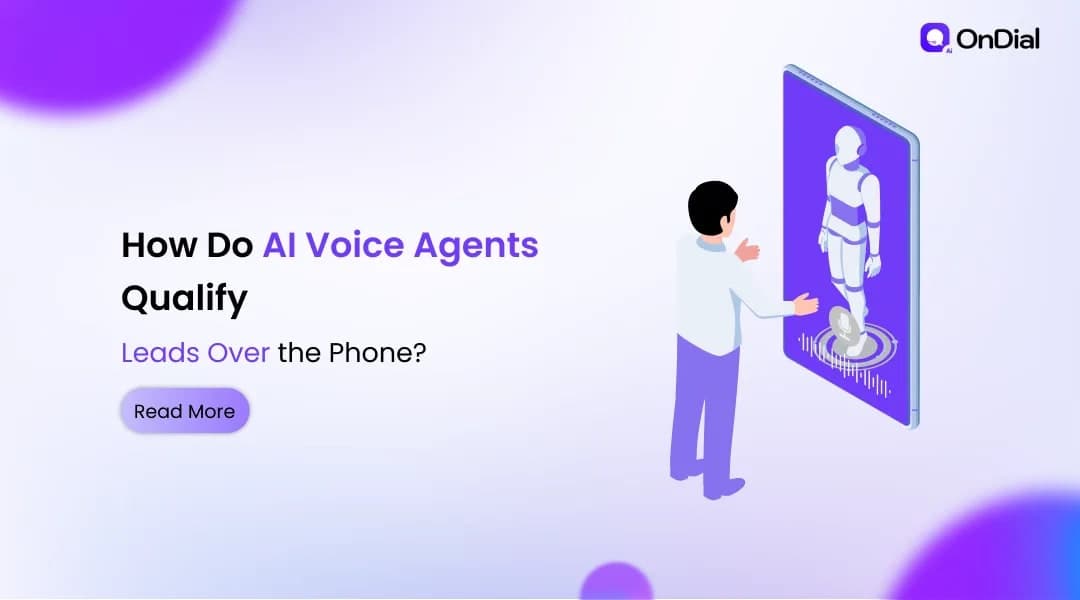
AI voice agents qualify leads over the phone by calling within seconds of an inquiry, asking scripted questions about budget, authority, need, and timeline, then interpreting the spoken answers with natural language processing. The system scores each response, updates the CRM, and transfers only high-intent prospects to a human sales rep with Sales AI voice agents. That is the whole loop in one breath.
The four qualification signals every call captures
Most well-built agents run on a version of the BANT framework, which stands for Budget, Authority, Need, and Timeline. The agent's job is to surface those four signals through conversation rather than an obvious interrogation. A good script hides the framework inside questions that feel like a normal chat.
Here is how each signal usually gets captured:
Budget: A soft probe like "what range were you hoping to stay within" tells the agent whether the deal size fits your business.
Authority: A question about who else is involved in the decision reveals whether you are speaking to a buyer or a researcher.
Need: Open-ended prompts let the caller describe their actual problem in their own words, which is where real intent hides.
Timeline: Asking when they want to solve this separates an active buyer from someone six months out.
Lead qualification is the process of judging whether a prospect is worth a salesperson's time. Doing it on a live call, with tone and hesitation as extra signals, gives you data no web form can match.
From spoken answer to structured data
The technical part happens in milliseconds. Speech-to-text converts the caller's words into text, natural language processing extracts meaning and intent from that text, and the agent maps the answer to a qualification field with AI lead qualification with voice agents. Response latency of about 800 milliseconds is what keeps the exchange feeling like a conversation rather than a laggy machine.
In projects we have deployed at OnDial, the detail that surprises clients most is how much signal lives in how something is said, not just what. A prospect who answers budget questions quickly and specifically behaves very differently from one who deflects, and a well-tuned agent flags that difference.
What Questions Do AI Voice Agents Ask to Qualify Leads?
The questions are where a good agent earns its keep, and where a lazy one gets caught.
Building the qualification script
A strong script leads with your highest-signal disqualifier. If geography or budget eliminates most of your inbound, you ask that in the first thirty seconds rather than spending five minutes on rapport with a lead that was never a fit. Every question after that should either move the lead forward or route them out.
Typical qualifying questions map cleanly to your sales criteria:
Fit questions confirm the caller matches your target profile, such as company size, industry, or property type.
Intent questions gauge whether they are actively buying or casually browsing.
Logistics questions capture the contact details, preferred callback time, or service address you need to act.
The best systems use conditional logic, so the next question adapts to the last answer instead of marching through a rigid list. That is the line that separates a modern agent from an old phone tree.
Reading intent beyond the words
Can AI really tell a hot lead from a tire-kicker? Mostly, yes, and here is the honest mechanism behind it.
The agent tracks intent signals across the whole call: specificity of answers, urgency in the language, questions the caller asks unprompted, and whether they volunteer details or hold back. A caller asking about pricing and availability is signaling very differently from one asking only general questions. Modern research supports this in aggregate: Landbase's 2026 analysis found AI-driven lead scoring improves qualification accuracy by around 40 percent, with top systems reaching 85 to 95 percent accuracy on straightforward cases with automated lead qualification with voice AI. That is comparable to a solid junior sales rep, without the off days.
Lead Scoring and CRM Routing: What Happens After the Call

Qualification is worthless if the data dies on the call. Lead scoring and CRM routing are what turn a conversation into a pipeline.
How the agent scores and prioritizes leads
Once the call ends, the agent assigns a lead score based on the criteria you defined: budget fit, timeline, authority, and expressed need. Lead scoring is the practice of ranking prospects by how likely they are to convert. A prospect who cleared every BANT threshold lands near the top; a curious browser with no timeline drops to nurture.
That scoring does two useful things at once. It prioritizes your team's attention on prospects most likely to close, and it filters out low-intent contacts before a human ever spends a minute on them. The result is a cleaner pipeline built from consistent, comparable data on every lead.
The handoff to your human team
The agent then writes everything back to your CRM, whether that is Salesforce, HubSpot, or another platform, with the full transcript, score, and captured fields attached. High-intent leads can be transferred live to a rep or booked straight into a calendar, while lower-fit contacts are logged with notes for later follow-up.
This is the part that protects your sales team's time and sanity with OnDial. A rep picks up a warm, context-rich lead instead of dialing cold, which is why higher-velocity teams in benchmark studies also report higher rep satisfaction and larger average deal size, not burnout. The systems do the triage so people can do the selling.
AI Voice Agents vs Human Reps and Old IVR Systems
Let me be direct about where this technology wins and where it does not, because the vendor pages rarely are.
Where AI clearly wins
Against a legacy IVR phone tree, there is no contest. IVR forces callers through rigid "press 1 for sales" menus, while an AI voice agent holds a real two-way conversation, handles interruptions, and adapts to open-ended answers. Against human reps, the AI advantage is speed, consistency, and volume: it answers in seconds, asks the same qualified questions every time, and handles hundreds of simultaneous calls without fatigue.
The economic case is straightforward too. HubSpot found that businesses excelling at lead qualification see a 20 percent lift in sales productivity, and AI makes that consistency achievable without adding headcount. When the first conversation is fast, structured, and logged automatically, the whole funnel improves.
Where humans still win
Here is the nuance the industry glosses over. Complex, consultative, or emotionally charged conversations remain genuinely hard for AI, with qualification accuracy on those cases sitting closer to 60 to 80 percent, according to 2026 industry analysis. A high-value enterprise deal with a hesitant, multi-stakeholder buyer is not where you want an agent flying solo.
The honest best practice is a hybrid model. Use the AI voice agent for instant first-touch screening and clear-cut qualification, then design explicit escalation triggers that route ambiguous or high-stakes conversations to a person. You also need to build in compliance awareness, including consent handling and call recording aligned with regulations like the TCPA. At OnDial, we treat that human handoff as a feature to design carefully, not a failure to hide with ai voice agents.
Conclusion
AI voice agents qualify leads over the phone by doing three things humans struggle to do at scale: responding in seconds, asking consistent questions, and scoring every answer into your CRM without dropping context. The takeaways worth keeping are simple. Speed to lead decides who wins; structured BANT questions plus intent-reading do the actual qualifying, and a hybrid human handoff covers the cases AI still gets wrong.
You should walk away from this clearer, not sold. If you now understand the mechanics well enough to spot where a voice agent fits your pipeline and where it does not, that is exactly the point. When you are ready to design that first-touch qualification flow and the human escalation logic around it, that is the specific problem OnDial builds for, with the transparency to tell you honestly where the technology helps and where it should stay out of the way.