Fifty-five percent of people say the thing they hate most about voice agents is having to repeat themselves, according to a 2026 analysis from Bluejay. That number points to something specific. It is not that the AI sounds robotic or answers slowly. It is that the caller said what they needed, and the system only heard part of it.
The multi-intent problem in AI voice conversations is exactly this failure: a caller packs two or three requests into a single breath, or changes direction halfway through, and the agent locks onto one intent while the rest fall away. If you run support or sales operations, you have felt the cost of this without having a name for it. Calls that should take ninety seconds stretch to four minutes. Customers escalate not because the problem was hard, but because the agent could not hold more than one thing at a time.
This article breaks down why multi-intent breaks voice AI, why the phone makes it worse than chat, and how modern systems finally handle it. You will leave knowing what to test before you trust an agent with a real conversation.
What Is the Multi-Intent Problem in AI Voice Conversations?
The multi-intent problem is what happens when a caller expresses more than one goal in a single voice interaction, either bundled into one utterance or introduced as the conversation shifts. Systems built to detect a single intent per turn miss the extra requests, forcing repetition, misrouting, or dropped tasks. That gap is where satisfaction quietly leaks.
The Two Faces of Multi-Intent
In practice, multi-intent shows up in two distinct forms, and conflating them is where most teams go wrong. The first is the compound request: a caller says, I want to check my order status and also update my delivery address. A single-intent classifier picks the stronger signal and ignores the other.
Two intents, one breath, and only one survives.
The second form is the intent switch. The caller starts with a billing question, then pivots: actually, forget that, I need to cancel my subscription. The original goal is abandoned, a new one takes over, and the agent has to notice the pivot rather than finish its old script. Google's early multiple-query feature only worked when you joined requests with the word and, and each request had to be answerable on its own, which shows how narrow the first attempts at this really were with AI voice agent platform features.
Why Voice Makes It Harder Than Chat
Here is the uncomfortable part. In chat, a missed intent is recoverable because the user can scroll up, see the half-answer, and retype the rest. On voice, that safety net is gone. The caller has no transcript in front of them, no way to see what the agent heard, and every dropped request has to be rebuilt out loud, one detail at a time.
There is also a technical penalty unique to speech. According to Hamming AI, which analyzed more than four million voice agent interactions, voice agents carry three to ten times higher error rates than text because of the ASR cascade: speech recognition errors feed into intent classification, and small mishearings compound into wrong actions. When two intents share one noisy utterance, the odds of losing at least one climb fast.
Why Voice AI Agents Struggle With Multiple Requests at Once
The reason voice AI agents struggle with multiple requests at once is architectural, not accidental. The design assumptions underneath most systems were never built for it. Understanding those assumptions tells you exactly where to look when an agent underperforms.
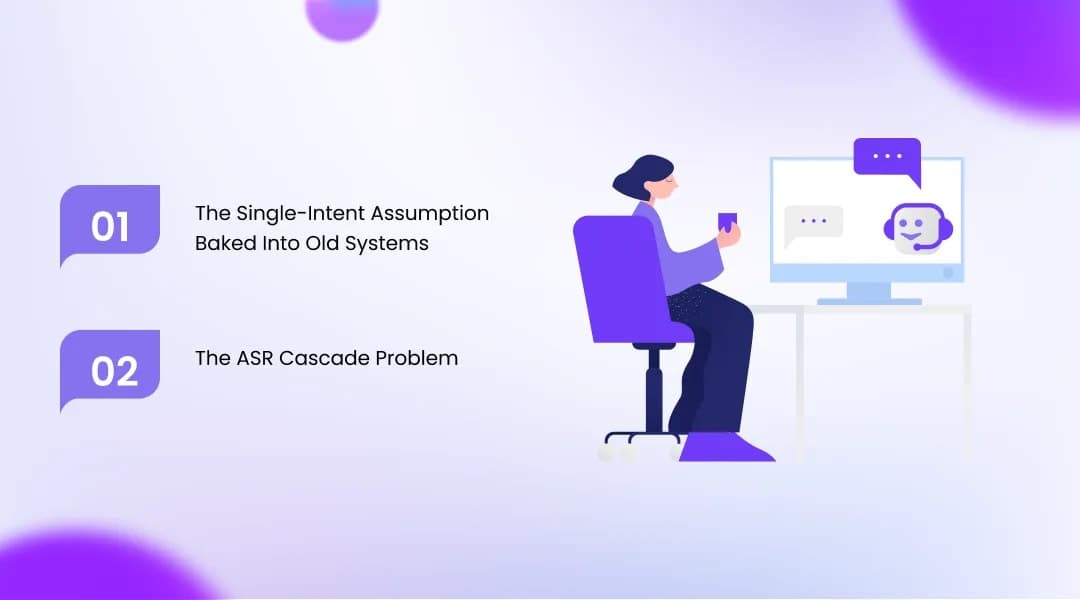
The Single-Intent Assumption Baked Into Old Systems
Most first-generation voice systems, and plenty still shipping today, were built on one quiet assumption: one turn, one intent with voice AI that syncs with your CRM. The NLU layer runs a classifier, returns the single highest-confidence label, and the dialogue manager acts on it. Anything else in the utterance is treated as noise.
Worse, in these systems intent is detected once at the top of the call and then effectively frozen. When the caller shifts, the agent keeps steering toward the original goal, because nothing in its design tells it to re-evaluate. This is why so many agents feel like they are arguing with you: they committed to an intent you have already moved past.
The ASR Cascade Problem
Text systems read clean words. Voice systems read whatever the speech recognizer produced, which, on a noisy line, with an accent, or over a cheap headset, is rarely perfect. Every downstream decision inherits those errors.
Even in good conditions, the numbers set a ceiling. Caller intent detection accuracy sits around 87 percent across industries, rising to 94 percent in domains with strong knowledge bases, per a Nuance and Microsoft benchmark cited in AInora's 2026 data. That looks high until you remember a compound request needs every intent caught. Two intents at 87 percent each mean a meaningful share of calls lose something before the agent even starts working.
Handling Intent Switching Mid-Conversation
Dynamic intent handling is the discipline of noticing when a caller changes their mind and adjusting in real time. It is the difference between an agent that adapts and one that talks over you. So what should actually happen the moment a caller changes direction?
Detecting the Shift in Real Time
Dynamic intent handling means the system re-runs intent detection on every turn, not just the first, with OnDial. When the caller says actually, or wait, or no, forget that, the agent should treat it as a signal that the active goal may have changed, pause its current plan, and re-anchor on the new request. Interruption handling and intent switching are close cousins: both require the agent to abandon its script gracefully.
In projects I have worked on at OnDial, the switch we see most often is the buried second ask. A caller books an appointment, then adds, Can you text me the address? The booking succeeds, but the follow-up request vanishes unless the agent is explicitly designed to capture trailing intents after the primary task closes (the kind of miss that looks fine in a demo and quietly bleeds you in production).
Holding the Thread: Dialogue State Tracking
Catching the shift is only half the job. The agent also has to remember what came before, so later can you send that to my email refers to the right that. This is dialogue state tracking, and it leans on coreference resolution, mapping pronouns and shorthand back to the entities established earlier in the call.
When the state is dropped, callers pay for it directly. Salesforce's State of the Connected Customer report found that 56 percent of customers report having to repeat information, a clear symptom of agents who lose the thread. Strong state tracking is what lets a multi-intent call feel like one conversation instead of three disconnected ones.
How Modern Voice Agents Actually Solve Multi-Intent
The fix is not a bigger model. It is a better decomposition of the problem before the model ever answers. The teams getting this right treat multi-intent as a structured pipeline, not a prompt to be optimized with AI voice agents for sales.
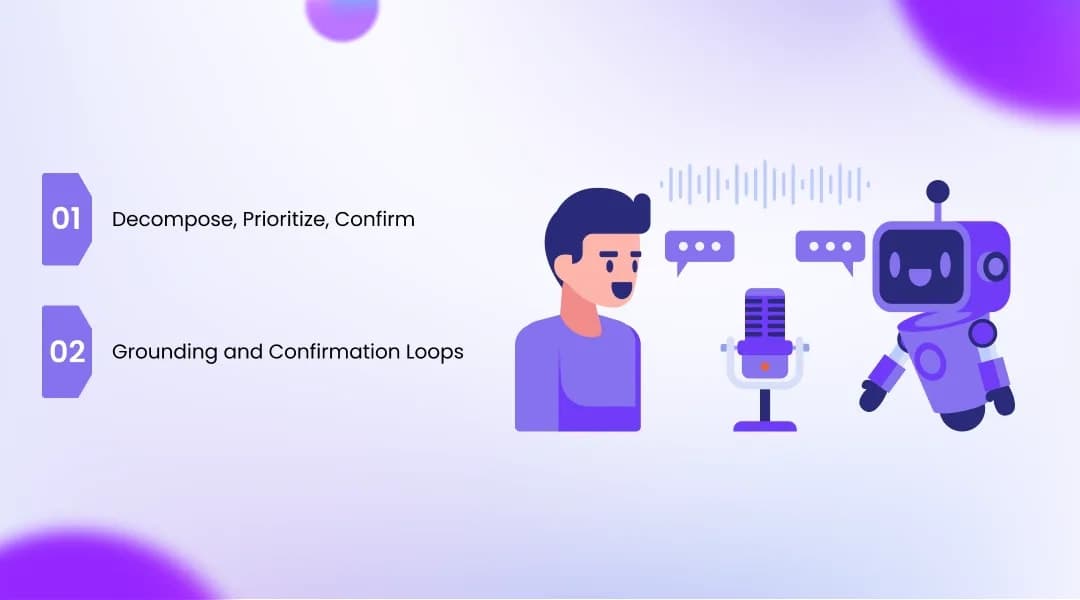
Decompose, Prioritize, Confirm
The most reliable pattern I have seen for multi-intent handling breaks into three moves:
Decompose: split the utterance into separate intents before acting, so I want to pay my bill and change my plan becomes two tracked tasks, not one blurred guess.
Prioritize: decide which intent to handle first based on dependency and urgency, then tell the caller the plan so they are not left wondering whether the second request landed.
Confirm: close each intent explicitly, and surface any request that could not be completed rather than letting it disappear silently.
This ordering matters because a misclassified intent corrupts everything downstream, as Famulor's 2026 KPI analysis puts it. Get the split wrong, and no amount of fluent speech saves the call.
Grounding and Confirmation Loops
Here is where I will be honest about the limits. A voice agent can decompose intents perfectly and still be wrong, because unlike an old IVR phone tree, it can state a confident answer that is simply false. That is the real trade: an IVR never invents a policy, but it also punishes anyone whose problem spans two menu branches.
This is why grounding matters more in voice than anywhere else. Every resolved intent should be checked against real data, your CRM, your policy base, and your order system before the agent speaks. At OnDial, we treat confirmation loops and human handoff with full context as required design elements, not optional extras, precisely because the phone gives the caller no way to catch a confident mistake on their own.
Conclusion
The multi-intent problem in AI voice conversations comes down to three things worth remembering in AI conversations that replace rigid call scripts. First, multi-intent has two shapes: the compound request and the mid-call switch, and a capable system has to handle both. Second, voice raises the stakes because the caller cannot see what was missed, and the ASR cascade multiplies small errors into wrong actions.
Third, the agents that win decompose, prioritize, and confirm, then ground every answer in real data before speaking. You do not need a perfect model. You need an agent designed to expect more than one intent and honest enough to admit when it cannot finish one.
If you are evaluating voice AI and want an agent that treats compound and shifting requests as the norm rather than the exception, that is exactly the problem we build for at OnDial. Bring us your messiest real call flow and test it against ours.