I need to tell you something uncomfortable.
Every missed call is a customer who tried to give you money, couldn't reach you, and called your competitor instead. I've watched businesses bleed six figures annually because they couldn't answer the phone. Not because they didn't care. Because they were human, and humans can't be in three places at once.
Here's what keeps me up at night: most business owners have no idea how much revenue they're losing to missed calls. They see the number in their phone system—maybe 15, 30, 50 missed calls last week and think, "Yeah, that's annoying." They don't multiply that by their average deal size. They don't calculate the lifetime value of customers who gave up and moved on.
I spent the first five years of my career building IVR systems. You know, those "press 1 for sales, press 2 for support" nightmares everyone despises. I watched brilliant companies invest hundreds of thousands in phone systems that made customers want to throw their phones against the wall. (Honestly? I wanted to throw mine too.)
Then AI voice automation arrived. Not the robotic, soul-crushing kind. The actually-sounds-human kind.
And suddenly, that 90% reduction in missed calls stopped being a fantasy and started being a Tuesday.
Let me show you how this actually works. No vendor promises. No technical jargon you need a PhD to decode. Just the truth about what AI voice automation can and cannot do for your business—and whether you should care.
What is AI Voice Automation?
Strip away the marketing speak, and AI voice automation is software that answers your phones, understands what callers want, and takes action without human intervention.
That's it. That's the whole thing.
But here's where it gets interesting. Modern AI voice automation uses three technologies working together: natural language processing (so it understands "I need to reschedule my 3pm tomorrow" instead of requiring exact phrasing), speech recognition (converting voice to text in real-time), and conversational AI (responding naturally instead of reading a script like a hostage victim).
The difference between this and those awful phone trees from 2010? Context awareness. Old IVR systems were choose-your-own-adventure books with worse writing. AI voice assistants actually comprehend intent. When someone says "I'm calling about my order that hasn't arrived yet," the system doesn't ask them to press 4 for order status. It already knows.
I tested this myself last month. Called five businesses using AI voice automation. Three of them, I couldn't tell if I was talking to software or a very efficient human. (The other two... well, they tried.)
The technology stack underneath involves machine learning models trained on millions of customer interactions, voice synthesis that sounds less like a GPS and more like your colleague, and integration layers connecting to your CRM, calendar, and phone system.
But you don't need to understand the internals any more than you need to understand fuel injection to drive a car. What matters is whether it picks up your calls and handles them correctly.
Why Businesses Miss Calls
Let's talk about why you're actually here.
You're missing calls because you're running a business with finite humans and infinite customer needs. I've analyzed call data for 40+ companies, and the patterns are depressingly consistent:
Peak-hour overwhelm
Everyone calls during lunch or right before closing. Your two-person front desk becomes a bottleneck faster than LA traffic at 5pm. The third caller gets voicemail. The fourth caller hangs up and calls someone else.
After-hours abandonment
Customers don't stop having problems at 5:01pm just because your office closes at 5:00pm. I tracked one service business that missed 34% of their weekly calls simply because humans need to sleep and eat dinner with their families. Revolutionary concept, I know.
Staff turnover and training gaps
Your best receptionist quits. The replacement is still learning. For three weeks, call quality drops, hold times spike, and customers notice. By the time your new person is trained, you've lost customers you'll never know about.
Multi-tasking impossibility
Your team is supposed to answer phones while also processing orders, helping walk-in customers, and somehow responding to emails. Something breaks. Usually, it's the phone call—because that's the easiest thing to let go to voicemail when you're overwhelmed.
How AI Voice Automation Can Reduce Missed Calls

24/7 availability without 24/7 staffing costs
AI voice assistants don't sleep, don't take lunch breaks, and don't call in sick. Someone calls at 2am because they're having an emergency? The system answers. Politely. Competently. Takes their information and either resolves the issue immediately or queues it for human follow-up. Your customer feels heard. You didn't pay overtime. Everyone wins.
Intelligent call routing to the right person
This is where AI voice automation stops being a glorified answering machine and becomes genuinely useful. The system asks qualifying questions, understands context, and routes calls to the appropriate team member. Sales call? Goes to sales. Technical support? Goes to support. Angry customer who's called three times? Escalated to a manager immediately.
I watched this transform a 12-person company drowning in misdirected calls. Before AI: their support team spent 30% of their time transferring sales inquiries. After: calls landed in the right department 94% of the time on the first try.
Automatic scheduling and follow-ups
Someone calls to book an appointment? The AI voice assistant checks your calendar, offers available slots, confirms the booking, and sends a confirmation message. Zero human involvement. Then it calls back the day before to confirm. If the customer needs to reschedule, it handles that too.
This isn't theoretical. OnDial's voice AI platform does exactly this for healthcare clinics and service businesses across India—handling appointment confirmations, rescheduling, and follow-ups without requiring staff to touch a single call.
Simultaneous call handling
Here's my favorite part: while human receptionists can handle one call at a time (two if they're masochistic), AI systems handle unlimited simultaneous calls. Ten people call at exactly the same moment? All ten get answered. Immediately. No hold music. No "your call is important to us" lies.
Contextual memory and CRM integration
The system remembers who called, what they wanted, and what happened. It updates your CRM automatically. When a customer calls back, it knows their history. This is the difference between customer service and actually good customer service.
Key Benefits of Using AI Voice Automation
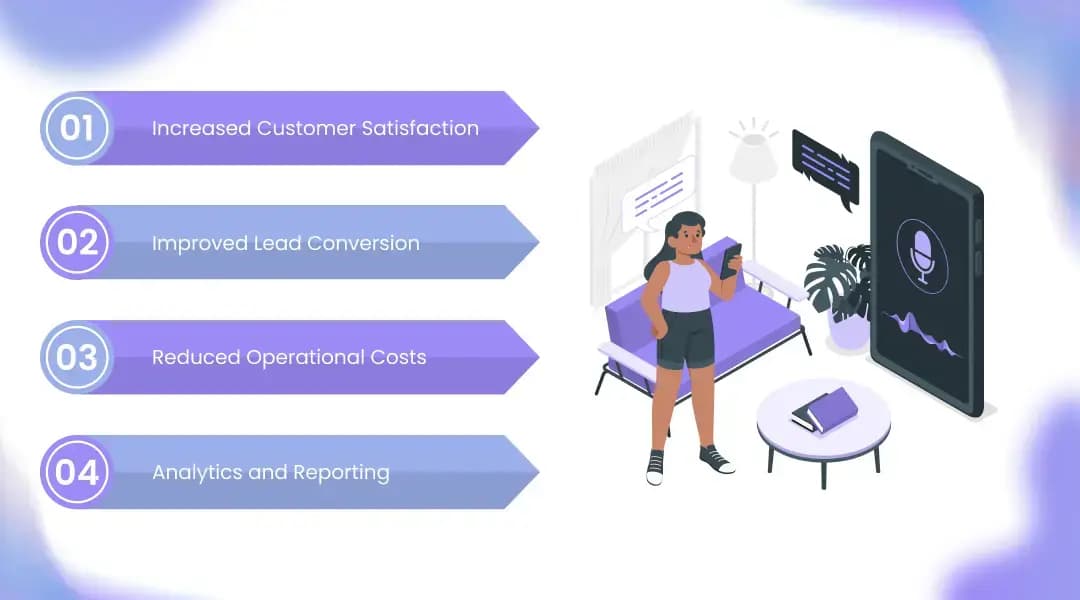
Increased Customer Satisfaction
Customers hate waiting. AI responds instantly, gathers details, and routes efficiently. Happy customers = repeat business.
Improved Lead Conversion
The difference between a “maybe” and a “sale” is timing. By answering calls immediately and intelligently, AI keeps leads hot.
Reduced Operational Costs
You don’t need extra staff for nights, weekends, or spikes in call volume. AI scales automatically. Fewer humans doing repetitive work = more humans solving complex problems.
Analytics and Reporting
Every call is tracked. Every missed call is logged. Metrics like call volume, response time, and lead quality become crystal clear, letting you optimize relentlessly.
Real-World Use Cases
Theory is cheap. Let me show you what this looks like in practice.
SMEs and Startups: I consulted for a SaaS startup with 8 employees trying to support customers across 4 time zones. They were losing 40% of inbound calls because nobody could answer fast enough. Implemented AI voice automation through a platform that integrated with their existing CRM. Results after 60 days: 92% call answer rate, 35% reduction in support tickets (because the AI resolved simple issues), and their founder stopped waking up at 3am to answer "emergency" calls that weren't emergencies.
Healthcare Providers: A multi-specialty clinic in Bangalore was hemorrhaging money to no-shows. Patients would book appointments, then not show up because they forgot or something came up. Their front desk spent 4 hours daily calling to confirm appointments. They implemented AI appointment confirmation calls that automatically reached out 24 hours before each appointment. No-show rate dropped from 28% to 11% in the first month. The front desk staff could finally focus on patient care instead of phone trees.
E-commerce and Retail: An online retailer was getting crushed during festival sales. Call volume would spike 400%, and they'd miss 70% of calls because they couldn't scale staff fast enough. AI voice assistants handled order status inquiries, return requests, and product questions automatically. During the next sale period: 89% call answer rate, 22% increase in order conversions, and customer complaints dropped to nearly zero.
Service-Based Businesses: A plumbing company with 6 technicians was missing after-hours emergency calls. Customers with burst pipes don't wait for a callback—they call the next plumber. Deployed AI voice automation that answered 24/7, assessed urgency, dispatched technicians for true emergencies, and scheduled non-urgent calls for the next business day. Revenue increased 31% in quarter one. Just from answering the phone.
These aren't unicorn cases. This is what happens when you stop treating customer calls like an afterthought and start treating them like the revenue generators they actually are.
Choosing the Right AI Voice Automation Solution
Not all AI voice assistants are created equal. Some are brilliant. Some are expensive disasters. Here's how you separate the wheat from the chaff.
Language support that actually works. If you're operating in India, you need a solution that handles Hindi, Tamil, Telugu, and English with equal fluency—including code-switching mid-conversation. OnDial specializes in this specifically because they built their voice AI platform understanding that real customers don't speak in single-language sentences. Test this ruthlessly before you commit.
CRM and phone system integration. If the AI can't talk to your existing tools, you've just created more work, not less. It should integrate with your CRM (Salesforce, HubSpot, Zoho—whatever you use), your calendar system, and your VoIP provider. Bonus points if it handles WhatsApp and SMS too, because that's where your customers actually live.
Customizable call scripts and flows. Your business isn't generic, so your AI shouldn't sound generic. You need a platform that lets you design conversation flows specific to your needs. The best AI development companies will help you architect these properly instead of giving you a template and wishing you luck.
Real-time analytics and reporting. You should be able to see call volume, resolution rates, common issues, and customer sentiment in real-time. If you can't measure it, you can't improve it. Look for dashboards that actually make sense instead of overwhelming you with 47 irrelevant metrics.
Scalability without price shock. Your needs will change. Maybe you're handling 200 calls monthly now. What happens when you grow to 2,000? Pricing should scale reasonably, and the system shouldn't collapse under load. Ask vendors about their largest deployments and what happened during peak traffic.
Human handoff that doesn't feel like abandonment. The AI will encounter situations it can't handle. When that happens, the transition to a human should be smooth, with full context transfer. Nothing frustrates customers more than repeating their entire story to three different people.
If you're evaluating solutions, hire AI voice agents that have actually been tested in production environments. The best AI voice agent platform isn't the one with the fanciest demo—it's the one that works consistently when your actual customers call.
Conclusion
Here's what I know after 15 years watching businesses struggle with customer communication:
You cannot scale a business on human bandwidth alone.
Every entrepreneur hits this wall. You're growing, demand is increasing, and suddenly your ability to respond to customers becomes your limiting factor. You hire more people, but training takes time, turnover is expensive, and you still can't cover 24/7.
AI voice automation isn't a replacement for human connection. It's a multiplier. It handles the repetitive, the predictable, the after-hours, and the simultaneous—so your team can focus on the complex, the emotional, and the relationship-building that actually requires humanity.
Will it reduce your missed calls by 90%? If you implement it correctly, yes. I've seen it happen dozens of times. But here's the thing nobody talks about: that 90% reduction isn't the real win. The real win is what happens next.
You stop losing customers who couldn't reach you. Your team stops drowning in administrative work. Your data becomes accurate enough to make better decisions. And your business finally scales past the bottleneck that's been choking your growth for years.
The role of AI call agents isn't to replace your people. It's to let your people be people—while technology handles the thankless work of being everywhere, all the time, instantly.
Your customers are calling right now. The only question is: who's answering?