Gartner projects that conversational AI will reduce contact center labor costs by $80 billion in 2026. That is not a far-off prediction. It is happening right now, across industries, in businesses of every size.
If you're a business leader asking whether you should replace call center agents with AI, I understand the hesitation. The vendor noise is deafening. Every platform promises full automation, and every headline swings between "AI will take all the jobs" and "AI can't do anything useful." Neither is true.
Here is what I've seen firsthand at OnDial, building voice AI solutions for businesses across India and beyond: AI can replace the repetitive, structured tasks that burn out your agents and frustrate your customers, but it cannot replace the human judgment, empathy, and creative problem-solving that define great customer service. The businesses winning right now are not choosing between AI and humans. They're building systems where both work together.
In this guide, you'll get real data on what AI can and cannot do in call centers today, a phased implementation roadmap, honest cost benchmarks, and practical advice on where to start. No hype. No jargon. Just what works.
The Real State of AI Call Center Automation in 2026
What the Data Actually Shows
AI in call centers is no longer experimental. It is operational infrastructure. The call center AI market reached approximately $4.89 billion in 2026, according to Precedence Research, and it is growing at a 27.5% compound annual growth rate.
But here is the number that matters more than market size: 88% of contact centers now report using some form of AI, according to IBM research. Yet only 25% have fully integrated it into daily operations. That gap between "we bought AI" and "AI is actually working" defines the biggest challenge businesses face today.
What does this mean for you? It means the technology is ready. The bottleneck is implementation, not capability.
Why Most "AI Replacement" Headlines Are Wrong
Let me be direct about something most articles in this space avoid saying.
AI will not fully replace call center agents. Not in 2026, not in 2028. Gartner projects that even by 2027, only about 14% of customer interactions will be handled entirely by AI without any human involvement. The other 86% will still involve human agents, either directly or with AI providing support.
(That 14% number is worth sitting with for a moment. It is both smaller than the hype suggests and larger than most businesses have prepared for.)
The real shift is not replacement. It is role transformation. AI is an automation layer for predictable, repeatable work. It is a support tool for everything else. Forrester predicts that 30% of enterprises will create entirely new AI-related roles in their contact centers by end of 2026: AI operations specialists, conversation designers, escalation specialists.
The call center agent's job is not disappearing. It is evolving into something more skilled, more interesting, and better paid.
Which Call Center Tasks AI Can Handle Today
Tier-1 Tasks Ready for Full Automation
AI voice agents and conversational AI are a strong fit for structured, predictable interactions. These are the calls that follow the same pattern hundreds of times a day and drain your agents' energy without requiring real problem-solving.
Password resets and account verifications follow rigid authentication flows. An AI voice agent handles these in under two minutes with zero hold time and identical quality at 3 AM or 3 PM.
Order status checks and tracking updates require pulling data from a system and reading it back. AI does this faster and more accurately than any human.
Appointment scheduling, rescheduling, and cancellations involve calendar logic and confirmation steps. Voice AI handles this across healthcare, real estate, and professional services right now.
Basic FAQ responses about pricing, hours, return policies, and service areas are fully automatable. AI can pull from a knowledge base and deliver consistent answers every time.
Call routing and initial triage is where sentiment analysis and natural language processing (NLP) shine. AI classifies caller intent, assesses urgency, and routes to the right department or agent without the old "press 1 for billing" frustration of legacy IVR systems.
At OnDial, these are the exact use cases where we see businesses get their fastest return on investment.
Tasks That Still Need Human Agents
Have you ever called a company while genuinely upset, only to be met with a bot that couldn't understand why you were frustrated?
That is the boundary. AI can detect negative sentiment in a caller's voice. It can flag keywords associated with frustration. But it cannot match the judgment of an experienced agent who knows when to bend a policy, when to simply listen, and when to escalate with urgency.
Complex billing disputes with multiple line items, partial refunds, and policy exceptions need human decision-making. Emotionally charged complaints require genuine empathy. Regulatory and compliance-sensitive conversations in healthcare, finance, and legal demand nuanced understanding of context.
AI is a tool for speed, scale, and consistency. Humans are essential for judgment, trust, and connection.
The Hybrid AI-Human Model That Actually Works
How Hybrid Models Outperform Pure AI
This is the part most businesses get wrong. They see AI as a binary choice: either automate everything or don't bother.
The data tells a different story. Research from Hashmeta found that hybrid AI-human models achieve an 87% resolution rate with an 8.7 out of 10 customer satisfaction score. That outperforms both pure-AI and human-only models by a significant margin.
In 2026, 76% of contact center leaders are formalizing a hybrid operating model, according to CMSWire's benchmarks. AI handles routing, availability, and tier-1 volume. Humans handle complex, emotional, and high-stakes interactions.
This is not a compromise. It is the optimal design.
Designing the Handoff Between AI and Humans
The quality of the AI-to-human handoff is the single most important factor separating good implementations from bad ones.
A well-built system passes full conversation context to the human agent: what the caller said, what the AI attempted, what the likely resolution path is. The agent picks up exactly where the AI left off. The customer never repeats themselves.
A poorly built system drops the caller into a generic queue with no context. The customer explains their issue again. Satisfaction tanks.
When I work with businesses at OnDial, I tell them this: the handoff is your product. Get it right and customers won't care whether they spoke to AI or a person. Get it wrong and it doesn't matter how sophisticated your voice technology is.
How to Replace Call Center Agents with AI: A Phased Roadmap
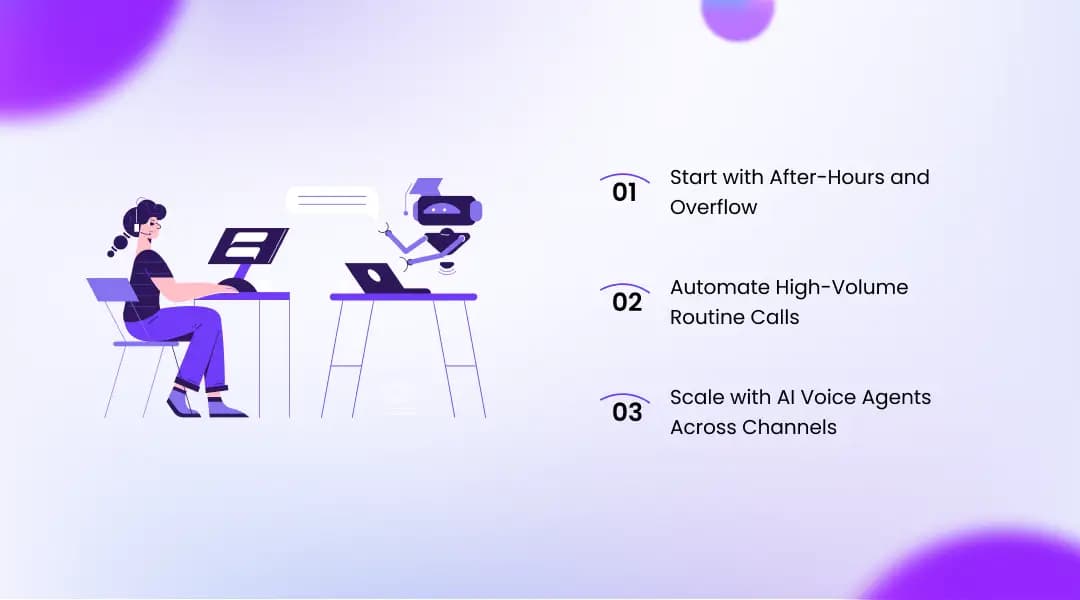
Phase 1: Start with After-Hours and Overflow
Don't try to automate everything at once. The lowest-risk, highest-impact starting point is after-hours coverage and overflow handling.
Your business probably loses calls after 6 PM or during peak spikes. An AI voice agent answers those calls, handles routine requests, captures details for callback, and qualifies leads while your team is offline.
This phase builds organizational confidence in the technology without disrupting existing workflows. It also generates measurable data: how many calls AI resolved, how many needed human follow-up, and what the caller experience looked like.
Most businesses see results within the first two weeks.
Phase 2: Automate High-Volume Routine Calls
Once you have confidence from Phase 1, expand AI to handle your highest-volume, most repetitive call types during business hours. This typically includes appointment booking, order status inquiries, and basic account questions.
Run AI alongside your human agents. Compare first-call resolution rates, average handle time, customer satisfaction scores, and cost per interaction. In my experience, AI consistently matches or exceeds human performance on these structured interactions.
This is also where you begin retraining your best tier-1 agents for higher-value work. Your top performers know your customers, your products, and your culture. Move them into escalation handling, AI supervision, or quality analysis roles.
Phase 3: Scale with AI Voice Agents Across Channels
Phase 3 is about expanding AI across voice, chat, email, and messaging platforms using a unified conversational AI platform. At this stage, you are building an omnichannel system where AI handles first contact across every channel and humans step in for complexity and relationship-building.
This is also where you invest in AI-driven quality assurance. Traditional QA teams review 2-5% of interactions. AI evaluates 100% of them, checking every conversation for tone, compliance, and resolution quality.
The contact center at this stage is no longer a cost center. It is a strategic growth engine.
AI Call Center Cost Savings: What to Expect
Cost Comparison: AI vs Human Agents
The cost differential is significant, and it is why the conversation around replacing call center agents with AI keeps accelerating.
AI voice agents operate at approximately $0.07 to $0.15 per minute. A U.S.-based human agent costs $29 to $42 per hour. Even with offshore agents in India or the Philippines, the per-interaction cost with AI is a fraction of human staffing.
The average cost per call in a traditional contact center is about $6.47, according to industry benchmarks. With AI handling routine calls, that drops to under a dollar per interaction. For businesses processing thousands of calls daily, the savings compound fast.
Where ROI Shows Up First
The fastest ROI comes from three areas. Reduced staffing for night and weekend shifts eliminates overtime and the difficulty of hiring for unpopular hours. Lower agent turnover costs matter because annual turnover in call centers runs at 30-45%, and each replacement costs thousands in hiring and training. Faster resolution times improve customer satisfaction, which directly impacts retention and revenue.
But here is an honest caveat: AI implementation is not free. There are platform costs, integration work, conversation design, and ongoing optimization. A realistic payback period for most businesses is 3 to 6 months when you start with high-volume, structured call types.
Conclusion
Replacing call center agents with AI is not an all-or-nothing decision. The businesses getting real results in 2026 are automating structured, repetitive tasks with AI voice agents while investing in their human teams for complex, high-value conversations. The data supports the hybrid model. The ROI is measurable. And the technology is ready today.
If you're considering this shift, start small. Pick one high-volume, low-complexity call type. Deploy AI for after-hours or overflow. Measure everything. Then scale what works.
At OnDial, we help businesses build tailored AI voice solutions that fit their specific workflows and customer expectations. If you want to see what voice AI can do for your call center, without the hype, let's talk. We'll walk you through a real demo, map your use cases, and give you an honest assessment of where AI fits and where it doesn't.
The call center of 2026 is not AI or humans. It is AI and humans, each doing what they do best, together.