Here is a number that should change how you think about your sales funnel: leads contacted within one minute of showing interest convert at 391% higher rates, yet the average human SDR takes 47 hours to make first contact, according to Landbase's 2026 research. That gap is not a process problem. It is a structural one - and no amount of hiring solves it at scale.
If you have been using a voice bot for lead qualification - or seriously considering it - you are probably not worried about the efficiency upside. You already see that. What keeps you up is a different question: will this actually annoy the prospects I am trying to win?
That concern is legitimate. I have seen it play out firsthand in projects where companies deployed voice AI and watched their contact rates improve while prospect sentiment quietly tanked. The bot called too often. Asked blunt questions. Felt like a corporate interrogation with a pleasant voice. The technology worked. The experience did not.
This guide is written from that hard-won perspective. You will learn exactly how to design and deploy a voice bot that qualifies leads faster and more consistently - without your prospects feeling like they have been processed by a machine. There is a meaningful difference between an AI that respects a prospect's time and one that wastes it. By the end, you will know how to build the former.
What a Voice Bot for Lead Qualification Actually Does
A voice bot for lead qualification is an AI-powered voice agent that engages prospects in real-time spoken conversation to assess whether they match your ideal customer profile - before a human sales rep is ever involved.
It is not a phone tree. It is not a recording. It is a conversational system built on natural language processing that listens, responds, adapts, and routes - all within a single call.
How Voice Bots Qualify Leads in Real Time
The mechanics are straightforward, but the quality of execution varies enormously. When a prospect fills out a form, calls your number, or triggers a CRM event, the voice bot initiates contact - typically within seconds. It introduces itself, gathers context, and begins asking targeted questions aligned with your sales team's criteria.
What happens next depends entirely on how the system is designed. A well-built voice bot does three things simultaneously: it collects structured qualification data, it scores the lead against predefined criteria, and it adapts its conversational path based on what the prospect is actually saying. A poorly built one reads from a script regardless of what it hears.
The difference between those two outcomes is not the technology. It is the conversation design.
According to research cited across multiple 2026 industry analyses, companies implementing conversational AI for qualification have reported 40-60% reductions in cost per qualified lead and significant improvements in speed-to-contact. Those numbers are real - but they only materialize when the prospect experience is right.
The BANT Framework Inside Conversational AI
Most effective voice bots for lead qualification are built around a BANT structure: Budget, Authority, Need, and Timeline. This framework - originally a human sales methodology - maps cleanly onto AI conversation logic because it is sequential and branching.
A prospect who reveals a budget mismatch early does not need to answer timeline questions. A prospect who is a decision-maker gets a different path than someone who is "just researching." The BANT framework gives the voice bot a logical structure to follow without making the conversation feel like a checklist.
In practice, the best implementations use BANT as a skeleton, not a script. The questions are conversational: "Are you looking at solving this in the next quarter, or is this more of a future-state plan?" rather than "What is your timeline?" The data captured is identical. The experience is completely different.
You can also build around MEDDIC for complex B2B deals - Metrics, Economic Buyer, Decision Criteria, Decision Process, Identify Pain, Champion. The framework is more detailed, but the principle is the same: give the AI a consistent, logical path to follow while allowing enough flexibility for the conversation to breathe.
How to Design a Voice Bot Prospects Actually Want to Talk To
(Here is where most implementation guides get it wrong. They write about what the bot should capture. Almost none of them write about how the bot should feel to the person on the other end of the call.)
Prospects are not case studies. They are people who picked up a phone expecting something useful. The design decisions you make before a single line of conversation is written will determine whether they stay on the call or hang up in frustration.
Lead With Transparency, Not Trickery
The single biggest mistake I see in voice bot deployments is the attempt to pass the AI off as human. Some companies think this increases engagement. In practice, it destroys trust the moment the prospect senses something is off - and they always do.
The better approach is radical transparency delivered with warmth. Something like: "Hi, this is an automated assistant from [Company Name] calling because you requested a demo earlier. I have just a few quick questions to connect you with the right person - should take under two minutes. Is this a good time?"
That approach does three things: it discloses the AI nature, gives the prospect control, and sets a time expectation. Research supports this. Transparency about AI involvement tends to improve prospect acceptance when the AI itself performs well, according to Leadgen Economy's 2026 qualification guide. Prospects do not actually resent AI. They resent being deceived by it.
California's Bot Disclosure Law already requires disclosure when AI is used in sales conversations. Best practice is simply to be clear upfront regardless of jurisdiction - and frame it as a service to the prospect, not a confession.
Ask Fewer, Smarter Questions
The number-one complaint from prospects about voice qualification - pulled directly from Reddit threads and Quora discussions on this exact topic - is not "it felt robotic." It is "it asked me too many questions."
A prospect who filled out a form with their name, company, and role does not need to answer those questions again on the phone. A voice bot integrated with your CRM should already have that data and use it contextually: "I can see you are the Head of Sales at [Company] - are you looking at this for your team specifically, or across departments?"
That single personalization signal changes the entire feel of the call. It signals that the bot knows who it is talking to. It removes one interrogation step. And it demonstrates that your company actually read what the prospect submitted.
Keep qualification calls to a maximum of five questions. Lead with your highest-signal disqualifier first. If geography eliminates 70% of your inbound, confirm that in the first 30 seconds. Do not invest five minutes building rapport with a lead that was never going to convert.
The 5 Steps to Deploy a Voice Bot Without Burning Prospect Trust
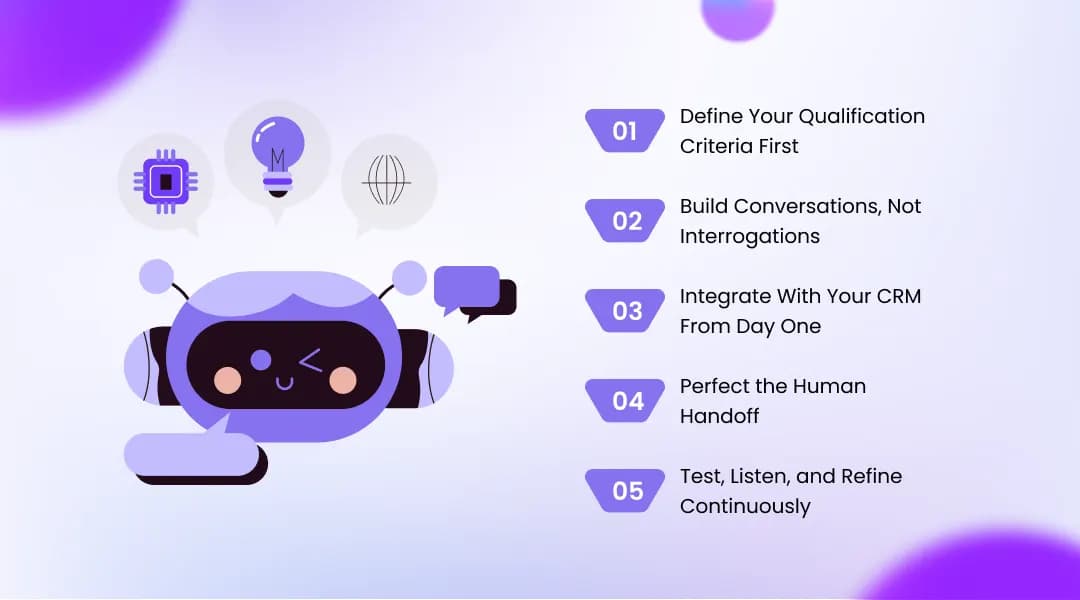
Step 1: Define Your Qualification Criteria First
Before you write a single line of conversation, document exactly what "qualified" means for your business. Budget range, authority level, geographic fit, timeline, specific pain points that match your solution. The AI needs clear, explicit criteria to apply consistently.
This step sounds obvious. It is almost universally skipped. Without it, you end up with a voice bot that asks questions but cannot make consistent decisions - and your sales team receives a mix of genuinely qualified leads and warm bodies who happened to stay on the call long enough.
Write out your ideal customer profile in detail. Pull characteristics from your top 20 closed deals. Build the scoring logic from that reality, not from what you assume the ideal looks like.
Step 2: Build Conversations, Not Interrogations
Script your questions, then rewrite every single one to sound like something a thoughtful salesperson would actually say. Compare these two approaches:
Standard: "What is your annual budget for this solution?" Conversational: "To make sure we show you the right options - are you working with a specific budget range, or is that still being scoped out?"
The second version does the same qualification job. It also gives the prospect an out if they do not have a firm number yet, which reduces drop-off and captures more honest data.
Use pauses and acknowledgments. When a prospect gives an answer, the bot should confirm it before moving to the next question: "Got it, that helps a lot." These micro-signals of listening dramatically change how the conversation feels - even when the listener is an AI.
Step 3: Integrate With Your CRM From Day One
A voice bot that does not talk to your CRM is a dead end. Every qualified conversation should automatically push transcript data, lead scores, and next-action triggers into your existing system - whether that is HubSpot, Salesforce, or another platform.
This integration matters for two reasons. First, it eliminates manual data entry and the accuracy problems that come with it. Second, it gives the next person who touches that lead full context. When your human sales rep picks up after the voice bot has qualified a lead, they should already know the prospect's budget range, timeline, and specific pain point. The conversation starts at discovery, not from zero.
Step 4: Perfect the Human Handoff
The handoff moment - when the voice bot transitions a qualified prospect to a human - is where deals are won or lost. I have seen it executed brilliantly and catastrophically in equal measure.
A well-designed handoff sounds like: "Perfect, you qualify for a personalized demo. I am going to connect you with [Name] from our team right now - they specialize in exactly what you described. Just a moment." Then the transfer happens with a brief hold, not silence and confusion.
A badly designed handoff drops the call, routes to a generic queue, or triggers a callback 48 hours later. Everything the voice bot built is destroyed in that moment.
If live transfer is not possible, the minimum acceptable alternative is an immediate calendar booking within the same call. The prospect should hang up knowing exactly when they will speak to a human - and that information should already be in their inbox before the call ends.
Step 5: Test, Listen, and Refine Continuously
Your first conversation script will not be your best one. The best deployments I have seen treat the first 90 days as a calibration phase, not a launch phase.
Listen to call recordings regularly. Identify exactly where prospects hesitate, drop off, or push back. If the budget question causes consistent friction, move it later in the sequence. If prospects frequently ask a question the bot cannot answer, add that to the knowledge base. Conversation design is never static.
Track the metrics that matter: qualification accuracy (what percentage of AI-qualified leads actually convert?), automation rate, time-to-qualification, and prospect sentiment from post-call surveys. The numbers will show you where to improve faster than any assumption will.
Common Mistakes That Make Voice Bots Feel Intrusive
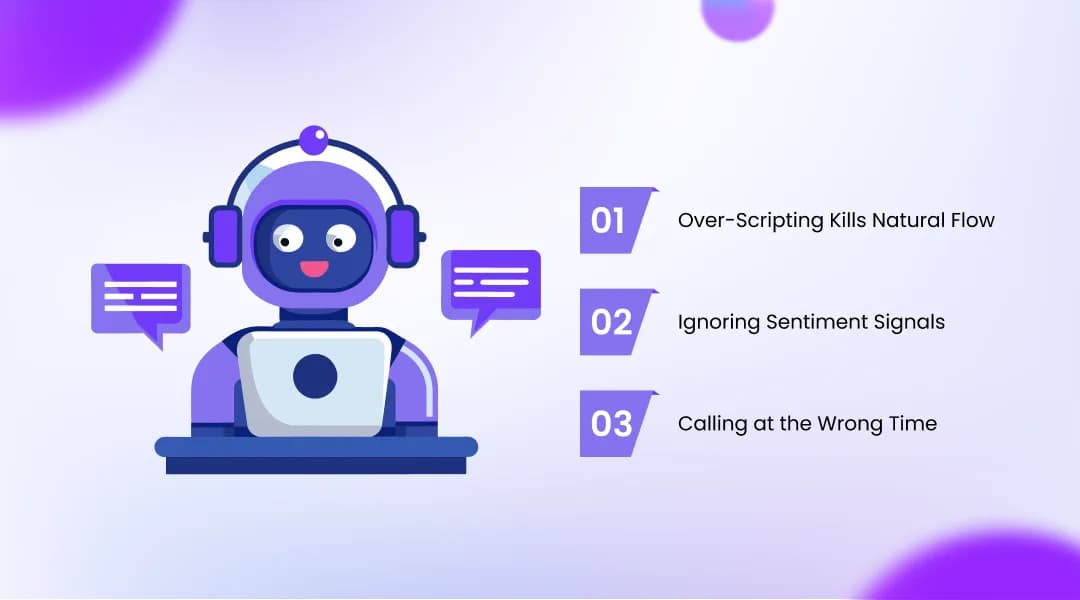
Over-Scripting Kills Natural Flow
The most common technical mistake is also the most damaging to prospect experience: writing rigid, linear scripts that cannot adapt when a prospect goes off-path.
Real conversations are not linear. A prospect might answer your second question before you ask it, or raise an objection mid-flow, or simply say "actually, I have a quick question first." A rigid system hears those signals and ignores them, plowing ahead with the next scripted prompt. The prospect immediately knows they are dealing with a machine that is not listening.
The solution is to design around objectives, not exact phrasings. Give the AI a goal for each turn - "confirm budget range" - and allow multiple conversational paths to achieve it. The flexibility makes a fundamental difference to how the interaction feels.
Ignoring Sentiment Signals
A voice bot that detects frustration and keeps asking questions anyway is not just annoying - it is actively destroying your brand reputation with that prospect.
Modern NLP systems can detect hesitation, irritation, and disengagement through tone and phrasing. Build explicit escalation triggers into your design: if a prospect sounds frustrated or uses specific phrases like "I just want to talk to someone," the bot should immediately offer a human transfer. No additional questions. No delay.
(This is actually what good human SDRs do intuitively. The voice bot needs to be explicitly programmed to do what a skilled rep does naturally.)
Calling at the Wrong Time
Timing matters more than most teams realize. Calls between 4-5 PM tend to be significantly more successful than morning calls, according to CallHippo data cited in Leaping AI's 2026 outbound guide. B2B prospects are typically most reachable Tuesday through Thursday.
Respect time zones. Never call prospects outside business hours unless they have explicitly opted in to that contact window. And if a prospect says "this is a bad time," that data should update their contact schedule in the CRM automatically - not get ignored until the next campaign cycle.
Is a Voice Bot Really Worth It for Qualifying Leads?
Honestly? Yes - but only when it is built to serve the prospect, not just the pipeline.
Consider the alternative. According to Landbase's 2026 research, 67% of lost sales stem from inadequate lead qualification. The problem is not that teams do not care about qualification. It is that human SDRs physically cannot contact every inbound lead fast enough, consistently enough, at the right time of day, without bias or fatigue.
A voice bot does not get tired at 4 PM on a Friday. It does not skip the budget question because the prospect seemed enthusiastic. It does not deliver a different experience to the fifth lead of the day than to the first.
At OnDial, we have worked with businesses across industries where the moment of contact is the moment of decision. In those contexts, a well-built AI voice assistant is not a cost-cutting tool - it is a trust-building one. The prospect who submits a form and hears from a helpful, clear, respectful AI within 60 seconds has a better first experience than the prospect who waits two days for a human callback.
The key word in that sentence is "respectful." That is the design principle that separates voice bots that convert from voice bots that annoy. Build with the prospect's experience as your primary constraint, and the efficiency gains follow naturally.
Conclusion
Using a voice bot for lead qualification the right way comes down to three principles: design for the prospect's experience first, integrate deeply with your CRM from day one, and never let the AI replace the human relationship - only prepare for it.
The businesses winning with voice AI right now are not the ones with the most sophisticated technology. They are the ones who figured out that a prospect who feels respected by an AI is already a warmer lead when the human rep picks up.
At OnDial, we build conversational AI voice assistants specifically designed to solve this balance - fast qualification that does not feel clinical, transparent automation that does not sacrifice trust, and CRM-connected systems that make every human handoff count. If you are ready to see what a voice AI solution built around your prospects' experience actually looks and sounds like, let us build you a demo conversation tailored to your exact sales funnel.