Every year, patient no-shows cost the U.S. healthcare system an estimated $150 billion. That number comes from Health Catalyst's research, and it should stop every hospital administrator in their tracks. But the financial damage is only one part of the story. Behind every empty appointment slot sits a patient whose chronic condition goes unmonitored, a surgeon whose operating room sits idle, and a front-desk team stretched so thin they can barely keep up with the patients who do show.
I've spent years working with healthcare organizations on their communication challenges at OnDial, and the pattern repeats everywhere. No-show rates across outpatient settings range from 5.5% to as high as 50%, with the global average hovering near 23.5%, according to the National Library of Medicine. Specialty clinics often fare worse, averaging around 23% per missed visit.
So why are hospitals now turning to AI voice agents as the answer? Because the traditional playbook of reminder postcards, one-way text blasts, and overburdened front-desk staff making manual calls has hit a ceiling. And the technology to break through that ceiling finally exists.
Here's what you'll learn: how AI voice agents actually work in healthcare, why they outperform legacy reminders, what measurable results early adopters are seeing, and how to evaluate a solution for your own facility.
What Are AI Voice Agents in Healthcare?
Beyond the "Press 1" Era
An AI voice agent is a conversational AI system that interacts with patients through natural spoken language over the phone. It is not an IVR menu. It doesn't tell patients to "press 1 for scheduling" or loop them through robotic prompts. Instead, it understands intent, holds context across a conversation, and completes tasks like booking, rescheduling, or confirming appointments in real time.
These systems are built on natural language processing (NLP) and natural language understanding (NLU), trained specifically on medical terminology, drug names, procedure codes, and diverse patient accents. When a patient says "I need to move my Thursday visit," the agent recognizes that as a rescheduling request and acts on it immediately.
How They Integrate with Hospital Systems
The real value kicks in when a voice agent connects directly with a hospital's Electronic Health Record (EHR) system. This two-way integration means any appointment booked by the AI appears instantly in the clinical calendar, and any staff-side change is visible to the agent. No double bookings. No manual data entry. No gaps between what the patient said and what the chart reflects.
At OnDial, we've seen firsthand how this kind of deep system integration separates a useful tool from a genuinely impactful one. Without it, you're just adding another disconnected layer to an already fragmented workflow.
Why Traditional Reminder Systems Fall Short
The Bandwidth Problem
Here's a question worth sitting with: if simple reminders worked, why do no-show rates remain stubbornly high?
A 2026 MGMA Stat poll found that 60% of medical practices reported no-show rates staying flat year over year, despite widespread adoption of text and email reminders. Only 13% saw improvement. The remaining 27% said no-shows actually increased. Traditional systems treat every patient the same: one generic message, one channel, one timing window. A 25-year-old who lives on their phone gets the same outreach as a 70-year-old who prefers a voice call. That's not a communication strategy. That's a broadcast.
The Friction Patients Won't Tell You About
The reasons patients miss appointments are more nuanced than forgetfulness. MGMA's research identified a mix of factors: scheduling conflicts where calling to cancel felt like too much hassle, transportation barriers, anxiety about procedures, and a general lack of friction-free options. The front-desk team, meanwhile, handles insurance verifications, walk-ins, and billing questions simultaneously. Outbound patient calls simply fall to the bottom of the priority list.
(Here's the part most vendors won't admit: the problem isn't that patients don't care. It's that the system makes caring inconvenient.)
How AI Voice Agents Reduce Hospital No-Show Rates
Predictive Outreach and Personalized Timing
Not every patient carries the same risk of missing an appointment. AI voice agents can analyze appointment type, patient history, demographics, and even contextual factors to determine who needs a reminder, when they should receive it, and through which channel. A first-time surgical consult patient booked three weeks out needs a different cadence than a regular follow-up patient.
Deep Medical, a U.K.-based healthtech company working with NHS hospitals, uses roughly 200 predictive factors, including weather forecasts and public transport access, to identify likely no-shows. Their system then intervenes with personalized responses: extra reminders, reworded messages, or even free transportation through a partnership with Uber Health. That's not a reminder. That's a rescue mission for every at-risk appointment.
Real-Time Rebooking Within the Same Call
This is where AI voice agents genuinely change the dynamic. When a patient says they can't make their Thursday appointment, the agent checks open slots, offers alternatives, and confirms a new time within the same conversation. No callback needed. No waiting for the front desk to find a gap. The friction disappears, and the patient stays in the care continuum instead of drifting away.
24/7 Availability That Matches Patient Behavior
A remarkable 40% of medical appointments are booked outside standard business hours. Patients don't stop needing care at 5 p.m. An AI voice agent answers every call in under a second, triages needs, and completes scheduling around the clock. Clinics offering this 24/7 automated booking have reported a 15% to 25% increase in appointment volume simply by capturing demand that previously went to voicemail.
Think about that for a moment. These aren't new patients being marketed to. They're existing patients who wanted care and couldn't reach anyone.
Real-World Results: Hospitals Already Winning with Voice AI
Case Studies and Measurable Outcomes
The evidence is building fast, and it's not theoretical.
Memorial Hospital at Gulfport implemented a data-driven initiative combining automated reminders, efficient rescheduling, and proactive outreach. The result: a 28% relative reduction in their no-show rate and roughly $804,000 in additional revenue in just seven months, translating to over $1 million annually. That case study, documented by Health Catalyst, remains one of the clearest ROI examples in the space.
Deep Medical's NHS pilots brought hospital no-show rates down from 8% to under 6%, with their backup booking feature recovering an additional 45% of remaining no-shows through an AI-informed overbooking approach.
Chesapeake Health Care, after deploying AI voice agents across 150+ providers and six specialties, cut hold times by 89% and captured over $1 million in new revenue from after-hours bookings alone. Patient satisfaction scores jumped from 2.6 to 4.4 out of 5.
The ROI Math for a Mid-Sized Practice
For a practice with six providers and around 120 daily appointments at a 10% no-show rate, the numbers are straightforward. Voice AI costs roughly $3,500 to $7,000 annually. Dropping the no-show rate to 5% recovers approximately $312,000 in annual revenue and saves around $14,500 in labor. Even at half those projections, the return is overwhelming.
In my experience at OnDial, the organizations that hesitate longest on voice AI aren't uncertain about the technology. They're uncertain about change. But the cost of standing still is now clearly higher than the cost of moving forward.
What to Look for in a Healthcare Voice AI Solution
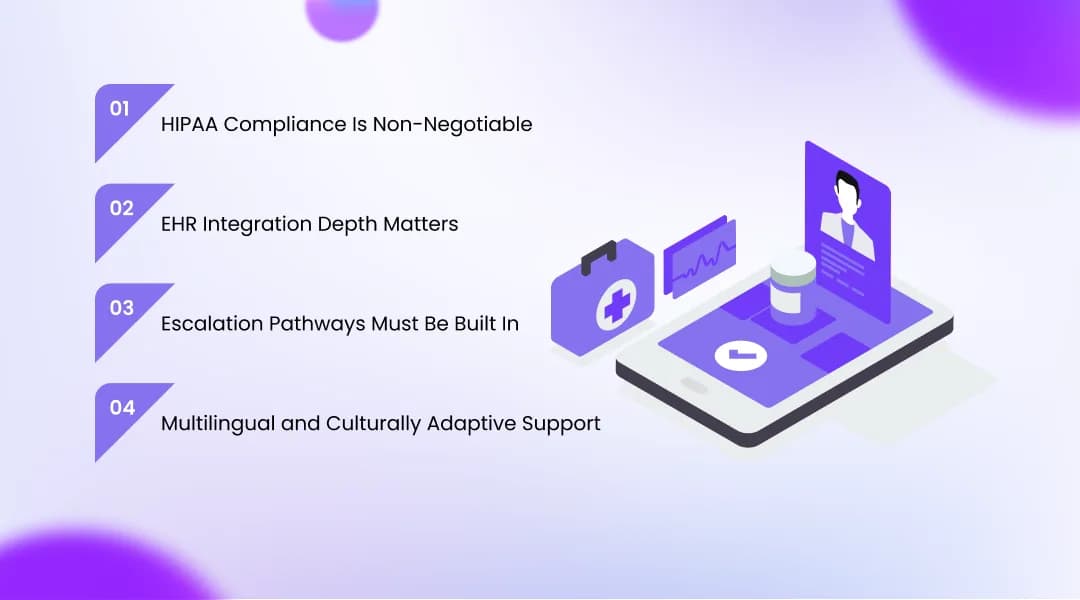
HIPAA Compliance Is Non-Negotiable
Any voice AI handling patient data must be fully HIPAA-compliant, with end-to-end encryption, signed Business Associate Agreements (BAAs), and secure data handling protocols. This isn't a feature to evaluate. It's a prerequisite. If a vendor can't clearly document their compliance posture, walk away.
EHR Integration Depth Matters
A voice agent that can't read from and write to your EHR creates more work, not less. Look for bidirectional integration with your specific system, whether that's Epic, athenahealth, Oracle Health, or another platform. The agent should update records in real time without manual staff intervention.
Escalation Pathways Must Be Built In
No AI should handle clinical conversations, emotionally complex situations, or insurance disputes. The best systems recognize these boundaries and escalate to a human clinician immediately, passing the full conversation context so the patient doesn't repeat themselves. I've worked on enough implementations at OnDial to know that the escalation protocol is where good solutions separate from risky ones.
A trustworthy voice AI partner will tell you what their system can't do. That honesty is more valuable than any feature list.
Multilingual and Culturally Adaptive Support
Gartner projects that 80% of healthcare providers will invest in conversational AI technologies by 2026. As adoption scales, multilingual support becomes essential for equitable care access. Modern platforms can operate in 20 to 30+ languages, adjusting tone and communication style to match diverse patient populations.
Conclusion
Hospitals are switching to AI voice agents to fight no-shows because the math, the technology, and the patient expectations have all converged. The three takeaways that matter most: no-shows are a communication and friction problem, not a patient compliance problem; AI voice agents solve both by delivering personalized, two-way conversations at scale; and the ROI is measurable within months, not years.
You don't have to accept a 20%+ no-show rate as the cost of doing business. The hospitals acting now are recovering revenue, improving patient outcomes, and freeing their staff to do what they trained for: providing care.
At OnDial, we build tailored voice AI solutions designed for exactly this kind of challenge. If your facility is ready to turn missed appointments into kept ones, start a conversation with our team and let's map the path forward together.
AI voice agents represent a practical, proven response to one of healthcare's most persistent operational problems, reducing no-shows, recovering revenue, and improving patient access without replacing the human touch that medicine demands.