Every year, missed appointments cost the U.S. healthcare system an estimated $150 billion, according to figures widely cited by the Medical Group Management Association (MGMA). That number alone should stop every clinic administrator mid-scroll. But the no-show problem in healthcare goes far deeper than lost revenue. It is a systemic failure that quietly erodes patient health, staff morale, and operational efficiency all at once.
A patient no-show is a scheduled appointment where the patient neither appears nor provides prior notice to the clinic. The global average no-show rate hovers around 23.5%, according to the National Library of Medicine, with some specialties and regions reporting rates as high as 50% or more. If you manage a healthcare practice, you already know this frustration intimately. And if you have been searching for a real solution, not just another reminder tool, this article breaks down exactly why patients miss appointments and how AI-powered voice calling is changing the equation.
Here is what you will learn: the true cost and causes of no-shows, why traditional methods keep failing, how conversational AI calling works in practice, and what measurable results real clinics are reporting.
The Financial Drain No One Talks About
A single missed appointment costs a practice between $150 and $200 in lost revenue. Scale that across a mid-sized clinic with 200 patients per week and a 15% no-show rate, and the numbers become staggering. That is roughly 30 empty slots per week, or over $200,000 in annual lost revenue for just one practice.
But direct revenue loss is only part of the picture. Staff still prepare exam rooms, pull charts, and allocate provider time for patients who never arrive. Rent, utilities, and salaries remain fixed. The operational cost of a no-show is not zero: it is often higher than the appointment fee itself because resources were consumed with no return.
(Here is what most practice managers miss: no-shows do not just waste today's slot. Research from the healthcare consulting firm MGMA shows that patients who no-show once are 70% more likely not to return within 18 months. That is not a scheduling problem. That is patient attrition.)
The Ripple Effect on Patient Outcomes
Beyond the balance sheet, missed appointments create clinical risk. For chronic care patients managing diabetes, hypertension, or mental health conditions, one skipped visit can cascade into worsening symptoms, emergency department visits, and more expensive interventions down the line.
There is also the hidden cost to other patients. When an appointment slot sits empty, another patient who needed that time cannot access it. No-shows do not free up a provider's day. They create administrative work, disrupt scheduling flow, and prevent other patients from receiving timely care.
In my work at OnDial, I have personally seen how a single missed follow-up for a post-surgical patient led to a readmission that cost the health system thousands. The patient did not skip the appointment out of carelessness. They simply could not reach the clinic to reschedule when a conflict arose.
What Really Causes Patients to Miss Appointments?
Understanding the root causes is essential before any solution can work. The reasons patients miss appointments are more nuanced than "they forgot," though forgetfulness is certainly a factor.
A 2023 Tebra survey of over 1,000 patients found that 59% reported canceling or not showing up to appointments in the prior 12 months. The reasons ranged from scheduling conflicts and transportation barriers to financial anxiety and simple communication failures.
Friction in Rescheduling Is the Silent Killer
Here is something counterintuitive: most no-shows are not patients who do not care about their health. They are patients who could not easily reschedule.
Think about it from the patient's perspective. They realize on a Tuesday evening that they cannot make Thursday's appointment. The clinic is closed. They could call Wednesday morning, but that means navigating a phone tree, waiting on hold, and hoping to reach someone before the day gets away from them. For many patients, not showing up feels easier than fighting the system to change a time.
MGMA data confirms that most patients discover scheduling conflicts during evening hours and weekends, precisely when clinic phone lines are closed. This creates a structural gap where good intentions collide with inaccessible systems.
Have you ever tried calling your own clinic during peak hours? The experience is often the best argument for change.
The Communication Gap Between Clinics and Patients
Research published in the National Library of Medicine suggests that up to 31.5% of missed appointments are linked to inadequate outreach from the provider side. That is nearly one-third of no-shows caused not by patient behavior, but by the clinic's own communication failures.
There is also a striking disconnect in how providers and patients view solutions. According to the same Tebra survey, 79% of providers rely on appointment reminders as their primary no-show prevention strategy. But when patients were asked what would actually help them keep appointments, 71% said same-day or next-day scheduling availability was the best solution.
Providers are solving for reminders. Patients are asking for access.
Why Traditional Reminder Systems Fall Short
If reminders alone solved the no-show problem in healthcare, we would have fixed it decades ago. Phone calls, postcards, text messages: these have been standard practice for years. And while they help at the margins, they do not address the structural reasons patients miss appointments.
The Limits of Robocalls and One-Way Texts
A robocall that asks a patient to "press 1 to confirm" does not help a patient who needs to reschedule. It does not offer alternative times. It does not follow up if the call goes unanswered. It generates a record that outreach was attempted, but it does not solve the problem behind the empty slot.
Text reminders perform somewhat better. Published healthcare research shows that SMS reminders reduce no-shows by approximately 14%. That is meaningful, but it still leaves the majority of no-show causes unaddressed: transportation, financial concerns, scheduling conflicts, and the sheer difficulty of reaching a human to make changes.
The result is a system that produces the appearance of engagement without meaningfully reducing no-show rates. Reminder metrics look fine. Schedule gaps keep appearing.
Staff Burnout From Manual Outreach
Many clinics still rely on staff members working through daily call lists, leaving voicemails for most patients and reaching a fraction in real time. This is time-consuming, inconsistent, and emotionally draining for front desk teams already stretched thin.
I have talked with clinic managers who describe their staff spending two to three hours every morning making confirmation calls. That is two to three hours not spent on patient check-in, insurance verification, or the dozens of other tasks competing for attention. And the return on that effort? Often, fewer than half the patients answer the phone.
The honest truth is that manual calling does not scale. It worked when patient panels were smaller and schedules were simpler. In a modern multi-provider practice handling hundreds of appointments weekly, it is a strategy built for a different era.
How AI Calling Actually Works for Healthcare
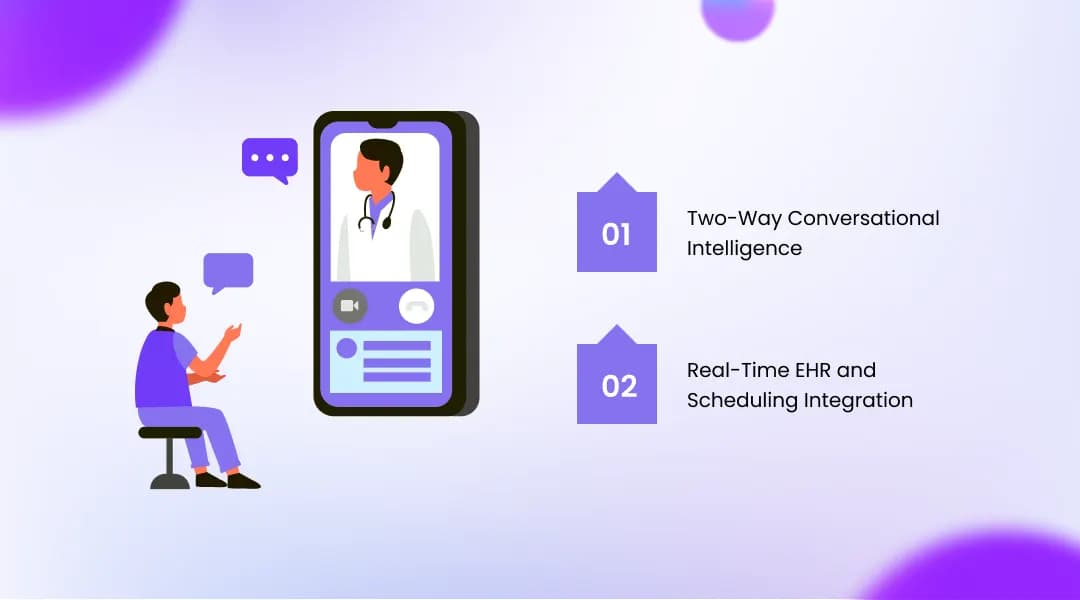
AI calling for healthcare is not a fancier robocall. It is a fundamentally different approach to patient communication. A conversational AI voice agent uses natural language understanding to conduct real, two-way phone conversations with patients, understanding spoken responses, answering questions, and completing actions like confirming, canceling, or rescheduling appointments.
Two-Way Conversational Intelligence
When an AI voice agent calls a patient, the conversation sounds natural. The patient can say, "I need to move my Thursday appointment to next week," and the system understands the intent, checks real-time provider availability, offers options, and confirms the new time, all within a single call that typically lasts two to four minutes.
This is the critical difference from traditional automated systems. An AI voice agent does not just push information out. It listens, interprets, and acts. If a patient asks a question mid-call, such as "What should I bring to the appointment?" or "Do you accept my insurance?", the agent can respond with accurate, pre-configured answers.
At OnDial, we build these voice AI systems with a specific philosophy: the technology should feel like talking to a knowledgeable, patient receptionist, not like navigating a machine. Our conversational AI is designed to handle the natural unpredictability of human speech, including interruptions, topic changes, and accented English.
Real-Time EHR and Scheduling Integration
An AI calling system that cannot see live appointment availability is just a sophisticated answering machine. The real value comes from deep integration with electronic health records (EHR) and practice management systems like Epic, Cerner, and Athenahealth.
When connected to these systems, the AI agent can verify patient identity, check which providers have open slots, apply scheduling rules specific to each appointment type, and write confirmed changes directly back to the system. No manual entry required. No staff follow-up needed.
This integration is what makes AI calling a workflow, not a broadcast. The agent runs the engagement from outreach through resolution, autonomously and at scale. A single AI system can handle hundreds of simultaneous calls during peak periods like Monday mornings, something no front desk team could match.
Does AI Calling Really Reduce No-Shows?
This is the question that matters. And the data says yes.
AI calling reduces no-shows by addressing the two most common drivers: patients who forgot the appointment and patients who needed to reschedule but could not easily reach the clinic. By providing 24/7 conversational access and removing the friction of phone trees and hold times, AI voice agents convert what would have been no-shows into confirmed or rescheduled appointments.
Measurable Results From Real Implementations
The evidence is building across multiple health systems. El Rio Health, an Arizona-based federally qualified health center, reported a 32% reduction in no-show rates after implementing AI-powered appointment outreach, along with a $100,000 increase in monthly revenue. Cleveland Clinic used automated patient messaging to cut its no-show rate by 20% while also improving patient satisfaction scores.
Practices using AI calling for appointment reminders are reporting no-show reductions of 30% to 50%, according to data compiled by healthcare technology analysts. And studies show that 65% to 75% of patients are comfortable with AI for appointment reminders and routine communication, especially when the system is polite, efficient, and respects their time.
One sentence changed my perspective on this topic entirely. A clinic director told me: "We stopped trying to remind patients and started trying to make it easy for them."
What Makes AI Voice Different From Automated Reminders
The distinction is worth repeating because it is often misunderstood. Automated reminders inform. AI voice agents resolve.
A reminder tells a patient their appointment is tomorrow. An AI voice agent calls two days before, confirms whether the patient can attend, offers to reschedule if they cannot, checks the waitlist for the newly opened slot, and fills it with another patient, all within the same call. The outcome is not just fewer no-shows. It is fuller schedules.
AI voice agents also enable intelligent outbound call strategies. Instead of blasting every patient with the same reminder timing, the system can prioritize outreach to patients flagged as high-risk for no-shows based on past attendance patterns, appointment type, and other behavioral signals. Machine learning models analyzing appointment data can predict no-show probability with accuracy rates exceeding 80%, according to a comprehensive review published by ScienceDirect covering 52 studies.
How to Implement AI Calling Without Disrupting Your Practice
Adopting AI calling does not require replacing your existing systems or retraining your entire staff. The best implementations are additive, working alongside your current workflows and handling the high-volume routine calls that consume the most staff time.
Choosing the Right AI Voice Partner
Not every AI solution is built for healthcare. When evaluating vendors, several criteria separate systems that meaningfully reduce no-show rates from tools that only partially address the problem.
Real-time scheduling integration is non-negotiable. The AI must connect directly to your EHR and scheduling system to see live availability and complete rescheduling workflows. Without this, the agent cannot close the loop.
Genuine two-way communication matters equally. A system that sends outbound messages but cannot intelligently handle patient responses creates frustration, not resolution. Look for natural language understanding that can handle conversational turns, follow-up questions, and unexpected requests.
At OnDial, we approach every healthcare implementation as a partnership. We do not believe in one-size-fits-all deployments. Every clinic has unique scheduling rules, patient demographics, and integration requirements. Our team works directly with practice administrators to configure AI voice agents that reflect the specific workflows and communication style of each practice. We believe that transparency about what AI can and cannot do builds the trust that makes adoption successful.
HIPAA Compliance and Patient Trust
Any AI calling system handling patient health information must be HIPAA compliant. This means encryption of all data in transit and at rest, role-based access controls, audit trails for every interaction, and a signed Business Associate Agreement (BAA) with the vendor.
Beyond compliance checkboxes, patient trust is earned through experience. The system should identify itself as an AI assistant (transparency is not optional), provide opt-out options on every call, and never leave voicemails containing specific health information.
I will be honest about a limitation here: AI calling is not appropriate for every patient interaction. Complex clinical questions, sensitive diagnoses, and emotionally charged conversations still require a human touch. The best AI systems know their boundaries and transfer seamlessly to staff when a call exceeds their scope. Any vendor who promises their AI handles everything is promising too much.
Conclusion
The no-show problem in healthcare is not a patient behavior issue. It is a systems design issue. Patients miss appointments because rescheduling is hard, communication is one-directional, and clinics are unreachable when conflicts arise. AI calling solves this by replacing static reminders with real, two-way conversations that meet patients on their terms, any time of day.
The three most important takeaways: no-shows are driven more by access friction than patient apathy, traditional reminders address only a fraction of the problem, and AI voice agents deliver measurable reductions of 30% to 50% by completing the full scheduling workflow.
If you are ready to move beyond reminders and give your patients a genuinely better way to manage their appointments, OnDial builds tailored AI voice solutions designed for exactly this challenge.
Missed appointments are a solvable problem. The clinics filling their schedules in 2026 are the ones that made it easy for patients to stay connected, not the ones that reminded them louder.