When a business phone starts ringing continuously, the problem is rarely the phone itself. The real problem is what happens after the call arrives.
A customer may need an order update, an appointment, a product answer, a policy detail, or help with an existing issue. If every call has to wait for a human agent, growing call volume quickly creates queues, missed calls, repetitive work, and inconsistent customer experiences.
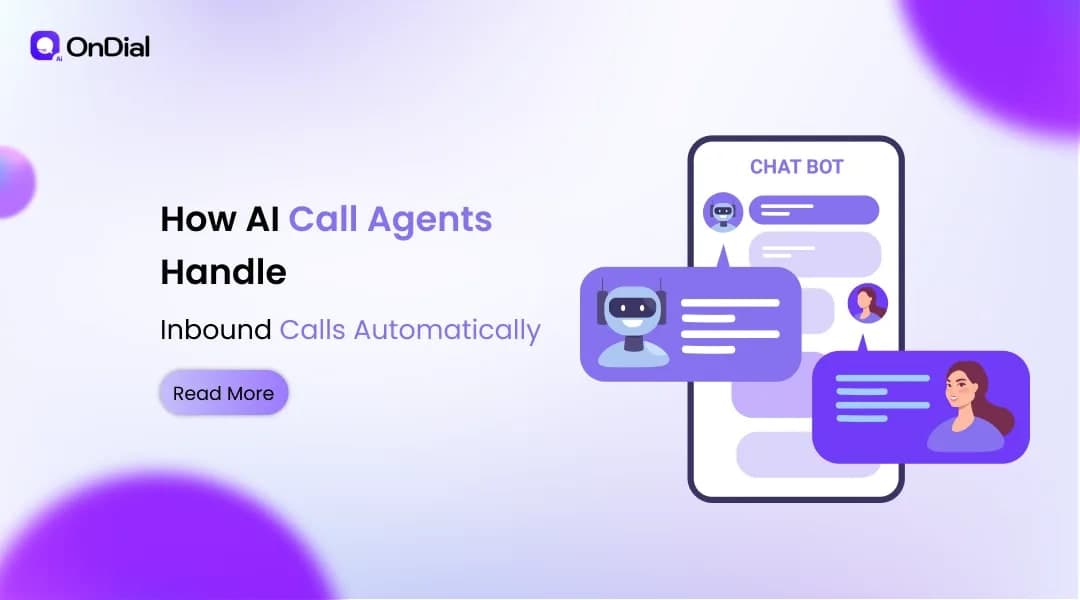
AI call agents change that model by turning an incoming phone call into an automated conversation. They can answer the caller, understand what the person needs, retrieve relevant information, complete defined actions, and transfer the conversation when human judgment is required.
I have seen businesses approach this technology with both excitement and skepticism. Both reactions are reasonable. The important question is not whether AI can answer a phone call. It is whether the AI can handle the entire inbound workflow accurately, safely, and naturally.
This guide explains how that process works, where AI call agents provide the most value, where human agents remain essential, and what businesses should consider before deploying inbound call automation.
What Is an AI Call Agent?
An AI call agent is a software system that conducts spoken conversations over the telephone using artificial intelligence. Unlike a traditional IVR that relies mainly on predefined menu selections, an AI call agent can interpret natural language and respond based on the caller's intent.
For example, a caller might say:
"I ordered a product last week and want to know when it will arrive."
The system can identify the request as an order status inquiry, retrieve the relevant information from a connected business system, and provide the answer without requiring a human representative.
The important distinction is that an AI call agent is not simply answering questions. A well designed system can also take actions within defined business rules.
It can collect information, schedule appointments, qualify leads, update records, create tickets, provide status information, route calls, and escalate issues.
How AI Call Agents Handle an Inbound Call
The process can be understood as a sequence of connected steps. Each step determines whether the conversation becomes useful automation or simply another frustrating phone experience.
1. The AI Answers the Call
The process starts when a customer calls the business number.
Instead of placing the caller into a long queue or sending the call to voicemail, the AI agent can answer automatically and introduce itself.
The opening should be clear and appropriate for the business. A healthcare provider, financial services company, retailer, and logistics company may all require different conversation styles.
The objective is simple: acknowledge the caller quickly and establish what they need.
2. Speech Recognition Converts the Caller’s Voice
The caller does not need to follow a fixed script.
The AI uses automatic speech recognition to process spoken language and convert the audio into information that the conversational system can interpret.
This becomes particularly important when callers use accents, regional languages, informal expressions, interruptions, or a mixture of languages.
For businesses serving India, multilingual and code switching capabilities can be particularly useful because customers may naturally move between English and a regional language during the same conversation.
3. The AI Identifies Intent
Understanding individual words is not enough.
The system needs to determine what the caller is actually trying to accomplish.
Consider these examples:
"Where is my shipment?"
"My order hasn't arrived yet."
"Can you tell me when my package will reach me?"
Although the wording is different, all three may represent the same underlying intent: shipment status.
An effective AI call agent uses conversational context to classify the request and determine the next appropriate step.
4. The AI Collects Missing Information
Some requests cannot be completed immediately.
A caller asking to schedule an appointment may need to provide a preferred date. Someone requesting account information may need identity verification. A sales inquiry may require information about budget, location, product requirements, or purchase timeline.
Instead of transferring every incomplete request to a human, the AI can ask relevant follow up questions.
This is one of the biggest differences between basic call automation and conversational AI. The system can keep the conversation moving rather than forcing the caller through a rigid sequence.
5. The AI Retrieves Business Information
An AI call agent becomes significantly more useful when it can connect to the systems a business already uses.
Depending on the use case, the agent may need access to a CRM, order management system, appointment calendar, ticketing platform, knowledge base, or other business database.
For example, an e commerce customer asking about an order should receive information from the current order record rather than a generic answer.
The same principle applies to appointment scheduling, account inquiries, lead qualification, and customer support.
AI should not guess when accurate business data is available.
6. The AI Takes the Required Action
The next step is where inbound call automation becomes more than automated answering.
Depending on the permissions and workflow, the agent can perform a defined business action.
Examples include:
Booking or rescheduling an appointment
Creating a support ticket
Capturing a sales lead
Updating customer information
Providing order status
Recording a complaint
Scheduling a callback
Sending a confirmation
Routing the caller to the correct department
The exact capabilities depend on the systems connected to the AI and the workflows configured for the business.
7. The AI Resolves or Escalates the Call
Not every conversation should end with AI.
A good inbound call strategy includes clear escalation rules.
The AI may resolve a routine question independently. If the request is sensitive, complex, outside the agent's authority, or emotionally difficult, it can transfer the conversation to a human representative.
The key is context preservation.
A useful handoff should provide the human agent with information about the caller, the reason for the call, relevant conversation details, and any actions already completed.
That prevents the customer from explaining the same problem again.
What Can AI Call Agents Handle?
The strongest use cases tend to involve high call volume, repeatable workflows, and clearly defined business rules.
Customer Support
AI call agents can handle frequently asked questions, order status requests, account inquiries, basic troubleshooting, and other routine support conversations.
Human agents can then focus on cases requiring investigation, negotiation, empathy, or judgment.
Appointment Scheduling
Appointment driven businesses can use AI to answer calls, identify the service required, check availability, book a suitable slot, and confirm the appointment.
This can be especially useful for healthcare, real estate, automotive, professional services, and other businesses where phone calls frequently lead to scheduled appointments.
For a deeper look at the workflow, see How AI Appointment Scheduling Works From Call to Calendar.
Lead Qualification
Inbound calls often contain valuable sales intent.
Instead of simply forwarding every prospect to a sales representative, an AI agent can ask qualification questions and capture structured information.
The sales team receives a more useful lead record and can prioritize conversations based on predefined criteria.
Order and Delivery Inquiries
E commerce and logistics businesses often receive repetitive calls about shipment status, delivery timing, returns, and order information.
When connected to the appropriate systems, AI can answer these questions without requiring an agent to manually search for every record.
Call Routing
Some calls still need a specialist.
AI can identify the reason for the call and route it to the appropriate department or representative.
For call centers and BPOs, this creates an additional layer between incoming call volume and human capacity. Businesses can use AI Voice Agents for Call Centers & BPOs to explore how inbound handling, routing, complaint management, and routine support can fit into a broader call center workflow.
AI Call Agents vs Traditional IVR
Traditional IVR systems are useful for basic routing, but they usually require customers to adapt to the system.
The caller hears a menu and selects an option.
"Press 1 for sales."
"Press 2 for support."
"Press 3 for billing."
AI call agents approach the interaction differently. The caller can explain the request in natural language, and the system can determine what the person needs.
That does not mean IVR has become completely irrelevant. Businesses may still use menus for certain routing or compliance requirements.
The important shift is that conversational AI can make the interaction less dependent on rigid menu structures.
Why Human Handoff Still Matters
The goal of inbound AI automation should not be to remove humans from every conversation.
Some situations require judgment.
A customer may be angry about a billing problem. A patient may have a sensitive concern. A financial services customer may need assistance with an unusual case. A business customer may have a request that falls outside the AI's configured authority.
These are situations where escalation can protect both the customer experience and the business.
The best model is often a hybrid workflow.
AI handles predictable volume.
Humans handle complexity.
The AI should also know when it cannot confidently answer a question. A transparent escalation is usually better than an inaccurate answer delivered with confidence.
How AI Call Automation Improves Operations
Inbound call automation can affect more than the customer conversation.
Faster Response
Customers receive an immediate response instead of waiting for an available representative.
24/7 Availability
Businesses can continue handling routine inbound calls outside normal working hours without requiring a full human support shift.
More Consistent Conversations
An AI agent follows defined business rules consistently across conversations.
Reduced Repetitive Work
Human representatives spend less time answering the same basic questions repeatedly.
Better Call Data
Each interaction can produce structured information such as intent, outcome, summary, and next action.
This data can help managers identify recurring customer problems and operational bottlenecks.
Where AI Call Agents Can Fail
AI automation should not be treated as a plug and play replacement for business processes.
Poor data can produce poor answers.
Weak escalation rules can frustrate customers.
Overly complicated conversation flows can make simple requests harder.
And automating a process that was already poorly designed can simply make the problem happen faster.
Businesses should therefore start with clearly defined use cases.
Identify the most repetitive inbound calls. Document the desired outcome. Connect the required business systems. Define escalation rules. Then monitor real conversations and improve the workflow continuously.
For teams exploring the broader operational role of voice AI, AI Call Assistant Automating Customer Support Calls in Real Time provides another perspective on real time call handling, context, sentiment, and escalation.
How to Measure an AI Inbound Calling System
The success of an AI call agent should not be measured only by the number of calls it answers.
Businesses should monitor metrics that connect automation to customer and operational outcomes.
Useful measurements include:
Call answer rate
AI resolution rate
Human transfer rate
Average handling time
First call resolution
Appointment completion rate
Lead qualification rate
Customer satisfaction
Escalation reasons
Repeat call rate
These metrics help identify whether the AI is actually solving customer problems or simply moving them further through the support process.
A high automation rate is not necessarily a success if customers repeatedly call back because the original issue was not resolved.
What Businesses Should Consider Before Deployment
Before implementing an AI call agent, answer five questions.
What Calls Should AI Handle?
Start with repetitive, well defined call types rather than attempting to automate everything immediately.
What Information Does the AI Need?
Identify the CRM, calendar, knowledge base, order system, ticketing platform, or other data source required to answer accurately.
What Actions Can the AI Take?
Define which actions are allowed and which require human approval.
When Should a Human Take Over?
Create explicit escalation conditions based on complexity, sensitivity, uncertainty, customer request, or business policy.
How Will Performance Be Reviewed?
Monitor transcripts, outcomes, transfers, customer feedback, and recurring failure points so the system can improve over time.
The Role of AI Call Agents in Modern Customer Service
Inbound calls remain an important customer communication channel for businesses across India and global markets.
The challenge is not simply handling more calls. It is handling those calls in a way that combines speed, accuracy, context, automation, and human support.
AI call agents can answer routine questions, understand customer intent, retrieve information, complete defined tasks, and escalate conversations when necessary.
That makes them particularly valuable for businesses where call volume is growing faster than human teams can comfortably handle.
The strongest implementation is not the one that removes humans from the most conversations.
It is the one that gives customers an immediate answer when automation is appropriate and a knowledgeable human when it is not.
That is the practical future of inbound call automation.
Businesses looking to build this kind of workflow can explore OnDial AI Voice Agents for inbound and outbound voice automation across customer support, sales, appointment scheduling, lead qualification, and other business workflows.