Patient no-shows cost the U.S. healthcare system an estimated $150 billion every year, according to data from Curogram and Dialog Health. That number isn't abstract. For a mid-sized clinic seeing 30 patients a day with a 20% no-show rate, it translates to roughly six empty slots daily, each one worth $150 to $200 in lost revenue.
I've worked with clinic teams who describe the same cycle: staff members spend hours each week calling patients to confirm appointments, half those calls go to voicemail, and the no-show rate barely moves. The frustration is real. You've probably felt it too.
AI voice agents reduce patient no-shows by automating outbound and inbound patient communication with natural, human-sounding phone conversations. These systems use natural language processing to confirm appointments, offer rescheduling in real time, and reach patients at the exact window when confirmation rates are highest. Clinics deploying this technology are reporting no-show reductions of 25% to 40%.
Here's what this article covers: the specific mechanics of how voice AI works in a clinical setting, why it outperforms SMS and email reminders, real results from practices already using it, and a practical path to implementation, even for smaller clinics with limited IT resources.
What Are AI Voice Agents and How Do They Work in Healthcare?
The Core Technology Behind Voice AI
An AI voice agent is a system that conducts real phone conversations with patients using natural language processing and speech recognition. It is not an interactive voice response (IVR) menu. There are no "press 1 for appointments" prompts. The patient speaks naturally, and the agent understands intent, responds conversationally, and completes actions like booking, rescheduling, or canceling in real time.
These agents integrate directly with electronic health record (EHR) systems such as Epic, Cerner, and Athenahealth. When a patient confirms or reschedules during a voice call, the change updates automatically in the clinic's scheduling system. No staff intervention required. No sticky notes. No callbacks.
How It Differs from Chatbots and IVR
Here's a distinction that matters more than most people realize. A chatbot handles text. An IVR handles button presses. A voice AI agent handles spoken conversation. The difference isn't just the channel; it's the completion rate. Patients are significantly more likely to respond to and complete a phone interaction with a voice agent than to click a link in a text message or navigate a clunky phone tree.
Why? Because it feels like someone actually called to check on them. That emotional dynamic, the sense of being cared for rather than processed, is what drives the behavioral shift from "I'll deal with it later" to "Yes, I'll be there."
Why Traditional Reminder Systems Fall Short
The SMS and Email Ceiling
Most clinics already send appointment reminders. Text messages, emails, maybe an automated robocall with a flat recorded message. And yet, according to MGMA data, no-show rates still hover between 5% and 30% depending on specialty. Behavioral health and primary care sit at the worst end of that range consistently.
The problem isn't that reminders don't work at all. They do, modestly. A U.S. pediatric clinic study found that automated appointment reminders reduced no-show rates from 38.1% to 23.5%. That's meaningful. But it's also a ceiling. Text reminders are one-directional. They tell the patient about the appointment. They don't solve the patient's problem.
The Real Reasons Patients Don't Show Up
What if the patient can't make Thursday but could come Friday? What if they need to ask about parking, fasting requirements, or whether their insurance is still active? What if they simply forgot and now feel embarrassed about calling back?
(Here's something most clinic managers don't talk about openly: a significant portion of no-shows aren't about forgetfulness at all. They're about friction.)
A text reminder can't negotiate a new time slot. It can't answer a question about pre-visit instructions. It can't detect hesitation in someone's voice and offer reassurance. A voice AI agent can do all of those things, in a single two-minute conversation.
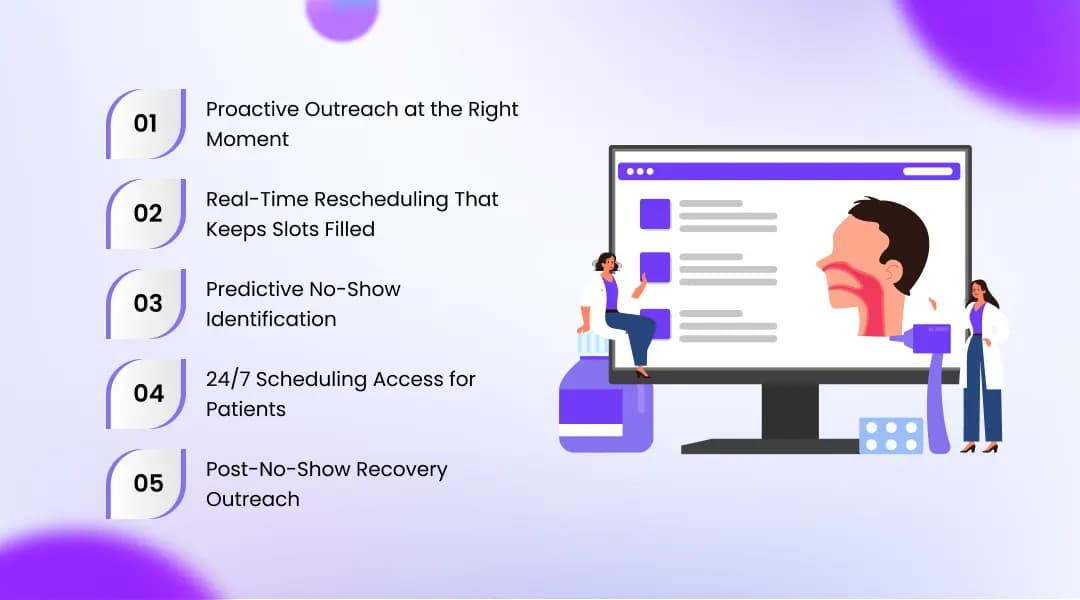
Five Ways AI Voice Agents Reduce Patient No-Shows
1. Proactive Outreach at the Right Moment
Timing is everything in appointment confirmation. The 48-to-72-hour window before an appointment consistently shows the highest confirmation rates across patient engagement data. AI voice agents execute outreach across hundreds of patients within this window without adding a single task to your front desk staff's plate.
The agent calls, confirms availability, and if the patient can't make it, checks open slots and locks in a new time within the same conversation. No callback required. No hold music. No transferred line.
2. Real-Time Rescheduling That Keeps Slots Filled
This is where the revenue recovery happens. When a patient says "I can't come Thursday," a traditional system logs a cancellation. An AI voice agent says, "I have openings on Friday at 10 a.m. or Monday at 2 p.m. Would either work for you?"
That slot doesn't go empty. It gets filled. The difference between a cancellation and a reschedule is the difference between lost revenue and recovered revenue. Over a month, those saved slots add up to thousands of dollars for even a modest-sized practice.
3. Predictive No-Show Identification
Here's where things get genuinely interesting. AI-powered prediction models can identify 60-70% of potential no-shows before they happen, according to Mentera. These systems analyze patterns across patient data: appointment history, visit frequency, time-of-day preferences, distance from the clinic, and even weather patterns.
When a patient is flagged as high-risk, the voice agent can trigger an additional outreach, a personal check-in call, or a schedule adjustment. Your staff doesn't manually track who tends to cancel. The system does it and prompts the right action.
4. 24/7 Scheduling Access for Patients
A remarkable 40% of all medical appointments are booked outside of standard business hours, according to Prosper AI. When your office is closed and a patient remembers they need to reschedule, what happens? Voicemail. And voicemails turn into no-shows.
AI voice agents provide round-the-clock access. A patient calling at 10 p.m. can book, reschedule, or cancel with the same conversational experience they'd get during office hours. Clinics offering 24/7 automated booking have reported a 15-25% increase in appointment volume simply by capturing previously lost demand.
5. Post-No-Show Recovery Outreach
Most clinics treat a no-show as a dead end. The appointment is missed, the slot is wasted, and nobody follows up systematically because the front desk simply doesn't have time.
Voice AI agents trigger follow-up outreach after a no-show, checking in with the patient, asking if they'd like to reschedule, and sometimes surfacing a concern the practice didn't know existed. This kind of post-no-show engagement almost never happens in manual workflows. It should.
The Multilingual Advantage Most Clinics Overlook
Language Barriers as a Hidden No-Show Driver
A significant portion of no-shows in urban practices, federally qualified health centers, and community clinics trace back to language barriers. Patients who aren't comfortable communicating in English often struggle with text-based reminders, automated phone trees, and even live front-desk interactions.
Voice AI agents can be configured to communicate in dozens of languages. When a pediatric health system launched AI agents in multiple languages, families who previously struggled with English-only systems showed measurably better engagement and treatment compliance. This isn't a nice-to-have feature. For clinics serving diverse populations, it's a direct lever against no-show rates.
Personalization Beyond Language
The same technology that handles multilingual support also enables personalization at scale. The agent can reference the patient's specific provider, their appointment type, and even their preferred communication style. A patient with chronic diabetes hears a different message than a first-time visitor scheduling a routine checkup. That specificity builds trust, and trust drives attendance.
Real-World Results: What Clinics Are Actually Seeing
Case Study Evidence
The results aren't theoretical. A family practice in the Midwest replaced manual reminder calls with voice AI and saw 40% less staff time spent on scheduling alongside improved patient satisfaction scores. A multi-location hospital system reduced no-shows by 25% in six months after deploying voice AI reminders and confirmations.
An AI-driven study published in PMC involving over 135,000 appointments showed a 50.7% reduction in no-show rates after implementing AI-powered prediction and outreach systems. The odds of a no-show dropped by 57%. Those numbers are from a controlled before-and-after comparison, not a vendor pitch deck.
The ROI Math
Let me put this plainly. A healthcare system with 2,000 weekly appointments and a 15% no-show rate loses roughly $180,000 weekly in appointment revenue, assuming an average appointment value of $600. Automated outbound reminders with interactive confirmation have reduced no-show rates to 5-8% in documented deployments, recovering $70,000 to $90,000 weekly.
Even at more conservative numbers, a clinic with 200 weekly appointments and a $200 average value recovers $4,000 to $6,000 per week by cutting no-shows from 20% to 10%. That's over $200,000 annually, from a single operational change.
How to Implement Voice AI Without Disrupting Your Practice
Start With One High-Impact Use Case
At OnDial, I've seen clinics try to automate everything at once and stall. The better approach: pick your single biggest pain point. For most practices, that's outbound appointment confirmation calls. Start there. Measure the impact over 90 days. Then expand.
Your voice AI platform needs to integrate with your existing EHR. If you're on Epic, Cerner, or Athenahealth, most established voice AI providers offer pre-built connectors. If you're on a smaller system, look for providers that offer custom API development and are transparent about setup timelines.
Compliance Is Non-Negotiable
Any AI voice agent handling patient information must be HIPAA-compliant. That means encrypted data in transit and at rest, signed Business Associate Agreements (BAAs), proper access controls, and audit logs. This is not optional and not negotiable. Ask your vendor for recent third-party security audits and current HIPAA or HITRUST certifications before signing anything.
Pilot, Measure, Scale
Launch the agent in a limited capacity first: a single department or after-hours calls only. Track these metrics from day one: no-show rate change, call completion rate, first-call resolution, patient satisfaction scores, and staff time recovered. Once the pilot shows consistent results, scale across departments and locations.
I'll be honest about a limitation here. Voice AI is not perfect. Some patients, particularly older demographics or those with hearing difficulties, may prefer human interaction. The best implementations always include a clear escalation path: if the patient says something the agent can't handle, the call transfers to a human with full conversation context. No one has to repeat themselves. That handoff design is what separates a good deployment from a frustrating one.
Conclusion
AI voice agents reduce patient no-shows by addressing the root causes that text reminders and manual calls simply can't reach: friction, timing, language barriers, and the inability to reschedule on the spot. The three takeaways that matter most are that voice AI works because it's conversational (not transactional), that predictive identification catches potential no-shows before they happen, and that the ROI pays for itself within months, not years.
If your clinic is losing revenue to empty appointment slots and your front desk team is stretched thin, this is the specific, practical step worth taking next. At OnDial, we build AI voice solutions designed for exactly this problem: tailored, human-centric voice agents that integrate with your existing systems and start delivering results in weeks. Visit ondial.ai to explore how a voice AI pilot could work for your practice.
Healthcare clinics using AI voice agents recover lost revenue, reduce staff burden, and keep more patients connected to the care they need, making voice AI one of the highest-ROI operational investments available to practices today.